

(How many of us learned the word “monolith”—the opening scene of 2001: A Space Odyssey.)
I was perplexed by Steven Pinker’s unwillingness to defend Nathan Cofnas in today’s Journal:
“I think he’s dangerously tactless in a radioactive topic” and “should exercise more caution,” Steven Pinker, author and Harvard University evolutionary psychologist, said of Cofnas’s rhetoric on genetics’ role in intelligence. Pinker said examining potential racial discrepancies in intelligence “could cause harm to African Americans” and lead to discrimination against them. “There’s times in science where the best policy is don’t go there,” he said.
Pinker is one of the founders of Heterodox Academy and previously a strong defender of “viewpoint diversity.” But now when Cofnas has just been suspended by Ghent University, Pinker seems to distance himself. (It’s possible the Journal’s story was being prepared before Cofnas’s suspension, yesterday—but that suspension was imminent.)
Earlier Pinker was apparently a flagship signatory for this open letter:
Two separate statements have recently been issued by members of Ghent University, in Belgium, calling on the university to rescind the appointment of Nathan Cofnas as a postdoctoral researcher. One claims that his views “violate the university’s code of ethics and are morally beneath contempt”.
We oppose this attack on academic freedom. While we are not endorsing any specific claims Cofnas has made, we believe that academics must be able to put forward controversial or provocative claims without fear of losing their employment. Of course, other academics should be free to criticise or repudiate those claims.
The statements mentioned above do not even attempt to engage with Cofnas’s empirical claims. Disagreements, whether about empirical claims, ethical principles, or the interpretation of the ethical code of a university, should be settled through free inquiry and open, civil discussion.
We commend Petra De Sutter, Rector of Ghent University, for her statement to the Belgian newspaper De Morgen, that "As a university, we have a responsibility to create space for debate, but also to ensure an environment where people feel heard and respected." We agree that creating space for debate is an essential element of a university, and that space for debate should not be closed unless this is a last resort to prevent a clear threat of lasting substantial harm.
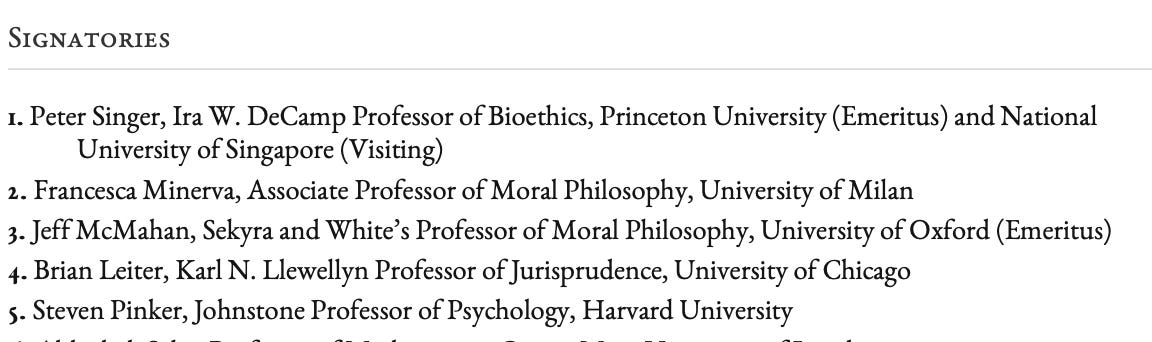
Cofnas is a proponent of “hereditarianism” in intelligence, the view that intelligence is mainly inherited not formed by the environment. His substack post on the late Jason Arday went viral—when other attempted exposés had gone bust—and now he is being blamed for Arday’s lamentable death, presumably by suicide.
Pinker should have said something like this to the Journal and left it at that:
“I have supported Nathan Cofnas’s right to pursue his research and I continue to do so. He published documented evidence of academic fraud through responsible means. He is not responsible for the behavior of those who harassed Arday online, and it is wrong to hold him so. The tragedy of Arday’s death does not alter the fact that the evidence Cofnas presented was real, that two journals issued corrections, and that Cambridge itself conducted an inquiry. If we hold researchers responsible for the deaths of those whose misconduct they expose, we have made honest scholarship impossible.”
Three thoughts about Cofnas and Arday.
First, about Arday—every serious person I know says things like “90% of what is published in academia is garbage. 90% of academic books are garbage.” That’s just the nature of human life, and that’s how things look if you have high standards.
Thousands of journals play the role of a publication-certifier for a relatively small circle of scholars who approve one another’s work so that they can all qualify for tenure.
Something similar will be true even for professors at Cambridge and Harvard and their works. Whole departments and disciplines have been created, for a variety of reasons, some legitimate and some not, as effectively soft-landing places for people who couldn’t possibly be successful in, say, quantum physics or pure mathematics.
Professors who take themselves to be on the 5% or 10% side of things in my experience just don’t care about that other stuff. They don’t have time to police it. They think that that’s the job of administrators, if it’s anyone’s job (academics are not strong communitarians) and their main concern is to get their own work done at a high standard.
That is why it can easily look like it was a (racist?) witch hunt to focus on Arday and insist that he get punished and drummed out. “Just leave the guy alone and let serious people decide whether they think he is serious or not.”
Second, I just don’t understand why Arday did it—the unattributed taking of long passages from the work of others. Because there was nothing creative, interesting, or novel in these passages. It’s not like he cribbed lines from a proof of Fermat’s last theorem.
Consider one of the most egregious cases presented in Cofnas’s original substack post:
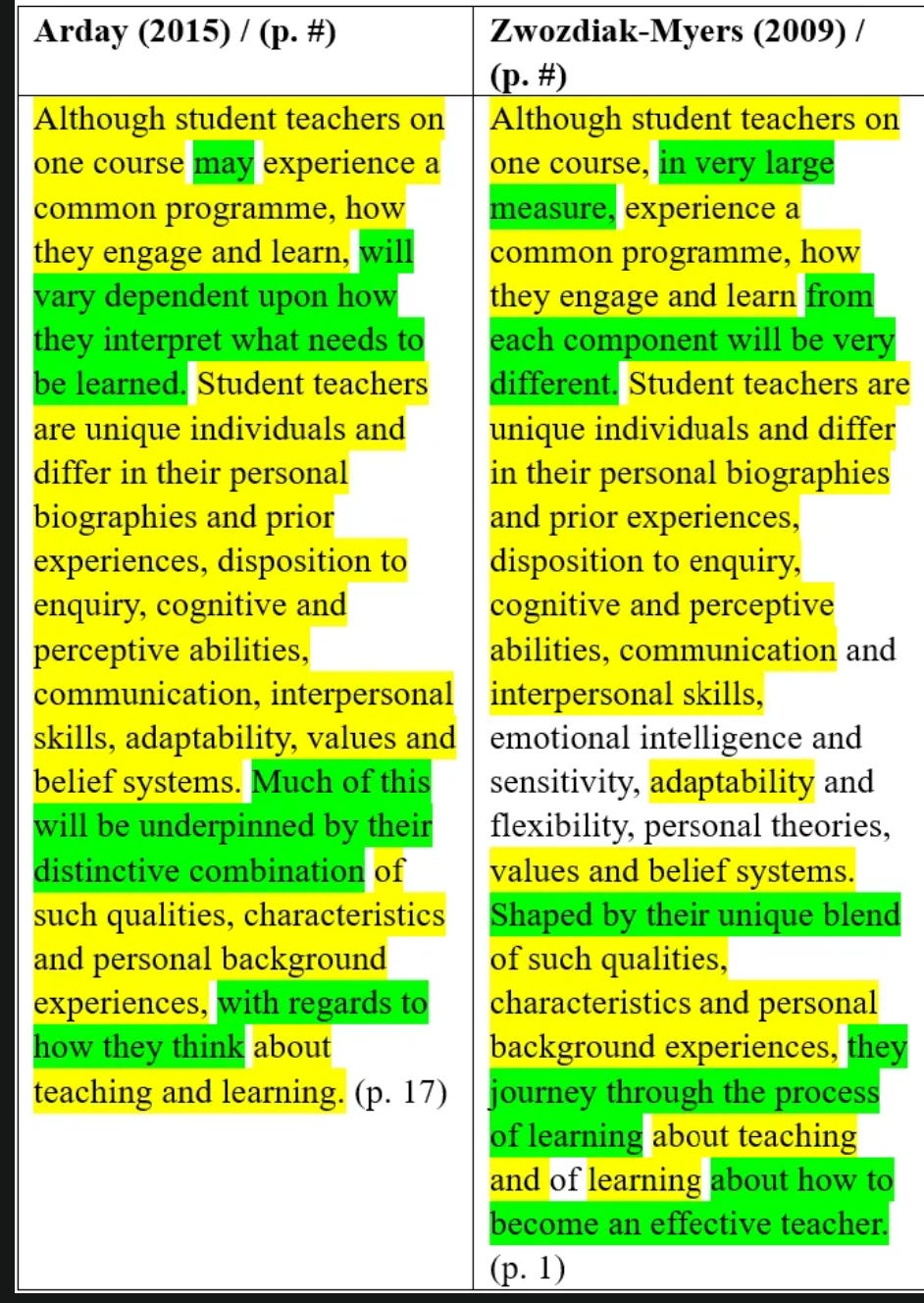
Anyone could have written something like this without needing to copy it. I’m sure that’s why many people apparently were not bothered by the “plagiarism.” They figured, surely this must have been mere sloppiness in citing.
Certainly, that in another instance “he copies and paraphrases from an obscure article by Muhammad Athar Hussain et al. published in the Turkish Online Journal of Distance Education in 2011,” as Cofnas reports, isn’t going to look good for the work of a Wunderkind professor at Cambridge. I’ll grant you that.
My third thought, about reactions to Cofnas: suppose it’s true that, say, white persons have a lower IQ in general than Asian persons, and that this difference is inherited and determinative, so that differences in education will not close the gap.
This is the old Bell Curve claim. I’m supposing Cofnas is just this generation’s advocate of that view. If Cofnas does not believe it, then suppose that some Hereditarian Biologist does believe it.
From the point of view of human dignity, it makes not a whit of difference if this is true. Our dignity is not based on our intelligence, and it does not increase, the more intelligence we have.
Rather, our dignity is based on our capacity of intelligence and our capacity of rational desire or will (both of which are shared as potentials even by an unborn child or a comatose patient). And our “worth”—that is, what we should ask to be judged on—is to be found in “the content of a man’s character,” and no more in his intelligence than in the color of his skin.
There is an “intellectualist” error on both sides of the dispute. (By the way, the pro-life movement strongly underlines the truth here.)
Over the last couple of days, I had to proofread the copy edits of my typescript for Walk in the Good Way, my collected papers on natural law and civic friendship.
It has ten papers. Since these span political philosophy, philosophy of law, moral philosophy, and—classical philosophy—drawing on Plato, Aristotle, Cicero, St. Thomas, among others, the last few papers do not shy from quoting amply from Greek and Latin texts. (I always give translations, of course.)
I looked at those passages in Greek and Latin carefully in preparing the final typescript for the press. That is painstaking work. But I wanted to double-check them all, and for this Claude was a remarkable help.
Claude was invaluable, especially, for discovering when the wrong unicode character had been used for a Greek breathing mark or elision, or for a diacritical mark. These characters are tiny and hard to see, for me now, even on my big screen.
But I was pleased that Claude found only a couple of typos in the Greek and Latin (e.g. De Lebigus). It saved me many hours.
Ciao!
No posts
Comments
Nothing yet. Say the first thing.
Sign in to join the conversation.