
Yesterday in “The Ethicist” column of the New York Times, the question was posed,
My husband was diagnosed with Alzheimer’s disease four years ago, and in the past year his decline has rapidly accelerated. Two of his physicians issued letters of incapacity last year. I have not only been a caregiver to him but also a single mother to our daughter, who is a minor. I have been operating a family life without a partner, and as the breadwinner.
Lately I’ve been wondering if and when it’s ethically permissible for me to start dating other people. My husband is not getting any better. I have a lot of working years and child-rearing years ahead of me — there is a large age gap between us — and I find myself desiring physical and emotional intimacy with a partner.
“The Ethicist” responds that despite her husband’s failing health:
[You] owe him continued stewardship as his spouse. But given that his condition has evidently left him unable to sustain a reciprocal emotional and marital relationship, these obligations don’t mean you have to give up emotional and physical intimacy for the rest of his life. Fidelity, in a situation like yours, involves a duty of care, but with the effective loss of a companion, you’re entitled to care for yourself as well.
Exactly how far does this “entitlement” to care for oneself go? It would help, The Ethicist says, if the woman had had conversations with her husband before he lost his capacity to reason and give meaningful consent. And yet, even if she had, still, she would not be bound by any prior agreement, which would not have been made in view of “the marriage as it now exists.”
If she does become involved with someone else (i.e. commit adultery), her only obligation is to let this person know that she is married and has “continued stewardship” for a debilitated husband:
You should also consider the effect of a new relationship on your daughter and, depending on his level of awareness, on your husband. Those considerations, though, bear on how you pursue a new relationship, not on whether you may have one.
(Where does the husband get parked, I wonder, when she is enjoying newfound “emotional and physical intimacy”?)
Who is this great Ethicist dispensing such wisdom? Former Professor of African-American Studies at Princeton University and current Silver Professor of Philosophy and Law at New York University, Kwame Anthony Appiah. He enjoys absolutely all the appointments and honors which a professor can enjoy. From the NYU website:
Kwame Anthony Appiah, Silver Professor of Philosophy and Law at NYU, grew up in Ghana, and was educated at Cambridge University, where he received both a BA and a PhD in philosophy. He taught previously at the University of Ghana, Cambridge, Yale, Cornell, Duke, Harvard, and Princeton.
His books include Assertion and Conditionals, For Truth in Semantics, In My Father’s House: Africa in the Philosophy of Culture, The Ethics of Identity, Cosmopolitanism: Ethics in a World of Strangers, The Honor Code: How Moral Revolutions Happen, and The Lies that Bind: Rethinking Identity and two textbook introductions to philosophy. He is also the author of three mystery novels.
Professor Appiah is President of the American Academy of Arts and Letters, a Fellow of the Royal Society, the Royal Society of Literature, and the British Academy, and a member of the American Academy of Arts and Sciences and the American Philosophical Society.
He has served as President of the Eastern Division of the American Philosophical Association and as Chair of its Board.
He began writing the Ethicist column for the New York Times Sunday magazine in 2015 and has written frequently in the New York Review of Books.
President Obama presented him with a National Humanities Medal in 2012. In 2024, he was awarded the Kluge Prize for Achievement in the Study of Humanity by the Library of Congress.
Appiah is not an outlier but a representative of ethical thinking in the academy. (By the way, on what authority does he teach what he does?)
I don’t ask you to do anything about this except ponder it deeply and call it to mind when a Catholic father or mother boasts in your presence, “My son (or daughter) just got into Princeton (or Cambridge, Yale, Cornell, Duke, Harvard, or NYU).”
To avoid l’esprit d’escalier, you might contrive in advance various bon mots, which, as the occasion warrants, you can speak aloud, mutter under your breath, or simply think silently, such as:
“I thought the soul mattered more than the mind, and virtue more than cleverness.”
“Did you place your child in a high school which taught a similar ethic, or do you think ethical growth ends in high school?”
“Would St. John Henry Newman approve of that university?”
“Did St. Pope John Paul II write Ex corde ecclesiae in vain?”
Or think of your own. You’ll come up with better ones I suppose.
I am praying today for Daniel Lendman, Dean of Students at Ave Maria University, and his family. Dozens of husbands and wives there could with proper pride post a picture such as this of him and his family:
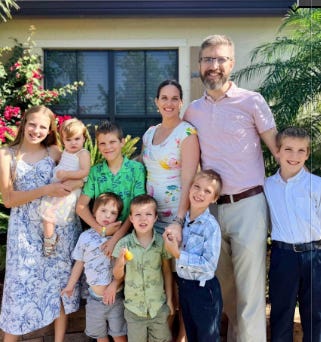
Last Sunday their littlest daughter, Beata, almost two years old, wandered into the small lake behind their backyard and drowned. The funeral Mass is today.
Just about everyone’s home abuts a body of water there, and just about everyone owns a pool. It could happen to anyone. All of us know this who have lived there. “There but for the grace of God…” Tremendous caution is necessary, and yet who never slips in necessary caution?
May the good God bring down great blessings on this family in view of their loss, and may they find especial comfort in the consolation of the Virgin Mary, whose queenship we and they celebrate today.
Mary a queen? my Protestant brethren may ask. Yes, in Jewish culture, the mother of the king was made a queen (the “Queen Mother”). Unless you deny the kingship of Christ, “Son of David,” you must acknowledge the queenship of Mary.
From the serious to the light: My favorite Churchill saying is when he saw a particularly pompous and self-important man walk by and remarked, “There but for the grace of God goes God.”
That’s all for now. Ciao!
No posts
Comments
Nothing yet. Say the first thing.
Sign in to join the conversation.