
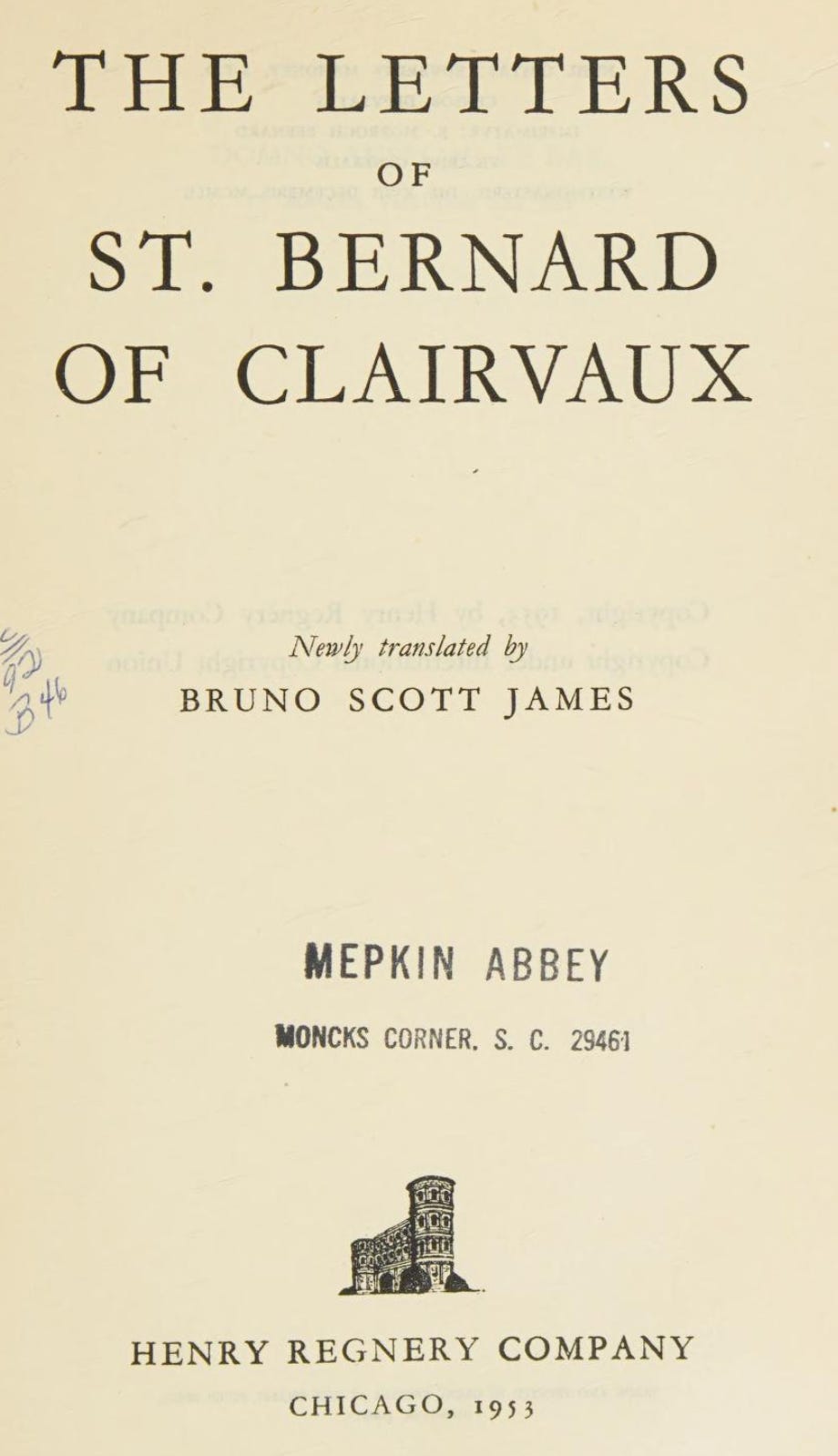
Today is the feast day of St. Bernard of Clairvaux. If you’d like to see his famous critique of the Canons of the Church of Lyons for their institution of a Feast of the Immaculate Conception, you may find it as letter 215, in the 1953 translation by Bruno Scott James of St. Bernard’s letters, published by Regnery (my publisher!).
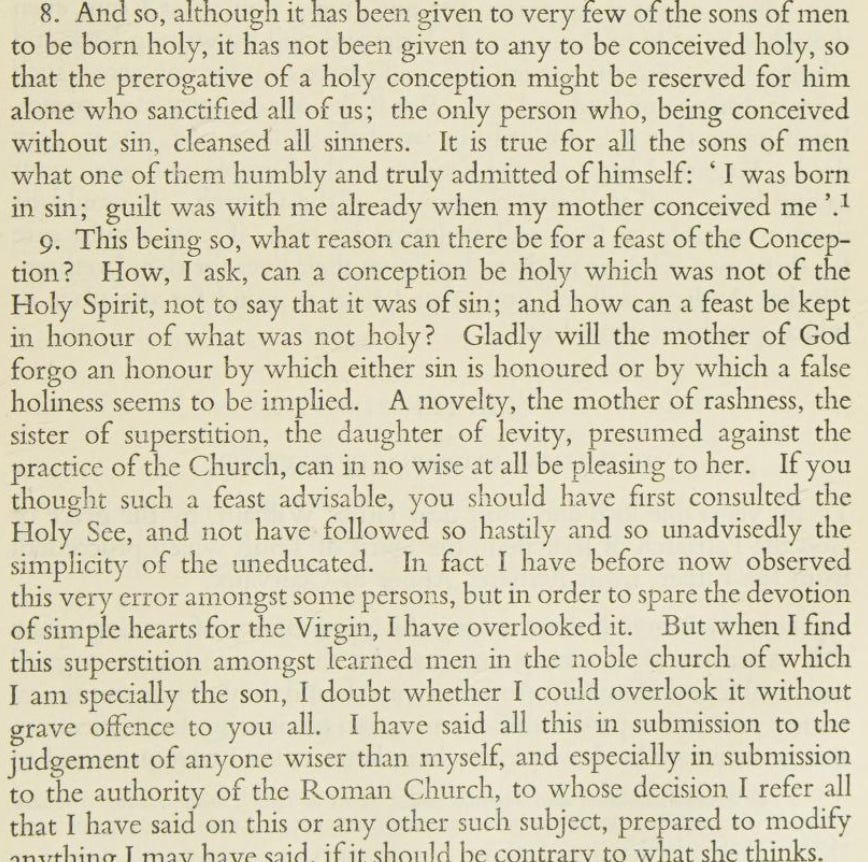
You can see how he rails against any superstition in connection with the Virgin Mary:
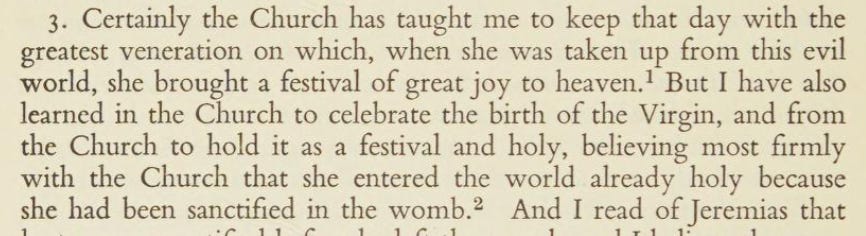
At the same time he says that, of course, the Feast of the Assumption must be observed:
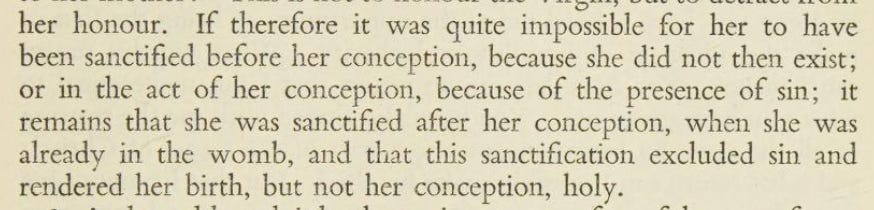
But it is clear that by Mary’s conception he means the biological process by which she came to be and which may be attributed to her mother, Anne. He takes Lyons to be celebrating the sinlessness of Anne’s conception of Mary. But, he says, Anne suffered the effects of original sin, and so her act of intercourse leading to her conception of Mary would have been vitiated by sin, and it’s wrong to institute a Feast to celebrate sin:
You will find it fascinating to read the whole letter, here. But to read it you’ll need to make an Archive.org account, because this is a book under limited copyright protection still, which therefore cannot be downloaded but only “borrowed” and read as if at a library.
One of the best analyses I’ve seen so far of soaring yields in the long-term bond market is by James Mackintosh in his column today in the Journal, “Why Scott Bessent is Playing with the Treasury Market.” Many analyses hold that the markets are spooked by inflation risk and Trump’s instability. The Journal’s Editorial Board reasonably argues that soaring yields are nothing to be concerned about, because they represent a return to historic values. Mackintosh attributes the trend to capital need:
The simple explanation for all this is that the world is going into a new era of capital need, for data centers, the military and reshoring. That means a higher reward for suppliers of capital, in the form of higher yields.
I am fond of Mackintosh’s writing and follow him closely, not simply because he is astute, and I always learn from him, but also because he studied philosophy for six years at Oxford before turning to a career in financial journalism.
You may find an interview with him on the Press Profiles podcast (Spotify, here:)
An excerpt:
I thought being an Oxford don would be a great life. You can research whatever you like. You don’t have to teach very much. You have smart people to teach. What could be bad about that?
But like others who have found the undergraduate study of philosophy a great path of general education, he lost his enthusiasm as a grad student:
So I did two years of postgraduate study and realized that the last thing I wanted to do with my life was write footnotes to Plato.
I suppose. If only I could write footnotes like Aristotle’s!
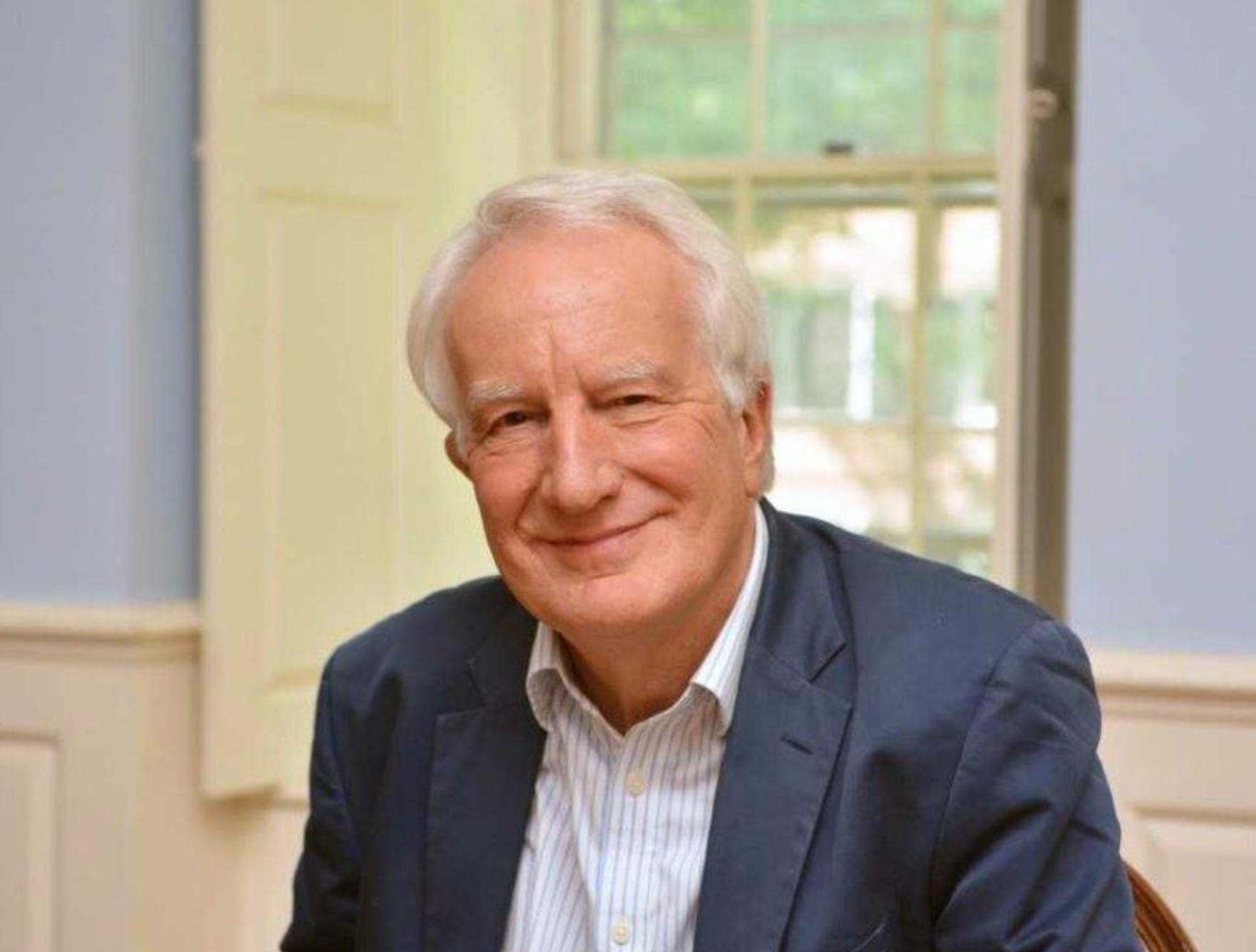
In memoriam: David Charles
I was deeply saddened to learn of the passing on Aug 12 of David Charles, a scholar of ancient philosophy who, it seemed to me, was a friendly and unassuming man, and who cultivated really excellent anti-Cartesian intuitions in moral psychology.
He contributed a paper along those lines to an anthology I edited (with Giles Pearson) on Aristotle’s moral psychology and philosophy of action (Oxford University Press).
When we were at a conference together once in Patras, Greece, he told me what a big fan he was of my (now defunct) blog, Dissoi Bloggoi—which pleased me immensely. The picture below is a good likeness of how I remember him then. (Who knows on what disc or computer my pictures of him from that time perdure, if anywhere.)
Requiescat in pace. It remains for us to emulate him, as best we can.
Yesterday I gave seven rules for parents, for fostering a culture of reading in the home, and, as much as I like the number seven, because I like numerology, and seven is a perfect number, I really ought to have added an eighth, (and I’ll add more, if I think of any), which is this:
(8) Forbid the watching of TV shows or movies in the evening when the next day is a school day.
I say, “when the next day is a school day,” to allow for Family Movie Night, which is Friday night for a lot of families; and for weekend nights; and for watching sports over the weekend; and for a relaxation of the rule during the summer. Also, we allow exceptions to the rule for major sports championships, like the World Cup, the NBA playoffs, the World Series, and the Olympics.
For the record, here are my first seven rules again:
(1) Set a good example as a parent by staying off your phone in your home and, in your free time, reading books in the common spaces of your home.
(2) Read aloud to your children in the evenings. Work through a long book over time.
(3) Similarly, listen to audible books on long car rides (pick the book wisely, so that it is enjoyable) and allow your children, especially before they can read, to listen widely to audible books. Print is simply the capturing of speech. Books aloud are prior to books in print.
(4) Do not allow young children to have smart phones. Introduce smart phones as instruments of work and of responsibility—at about the age when a child can drive. Insist that it is not acceptable to waste time — on devices (or playing video games), or any other mode of wasting time. Time is a treasure and a gift from God, for which we will be accountable.
(5) When your child is reading a book or has a book to read as an assignment or summer reading, exercise helpful oversight by regularly checking up on progress. Help the child divide up the reading in order to set a schedule and have intermediate goals.
(6) Discuss books with your child.
(7) Encourage reading of the daily newspaper. We regard only the WSJ as trustworthy enough. It’s on our breakfast table each morning.
Ciao!
No posts
Comments
Nothing yet. Say the first thing.
Sign in to join the conversation.