
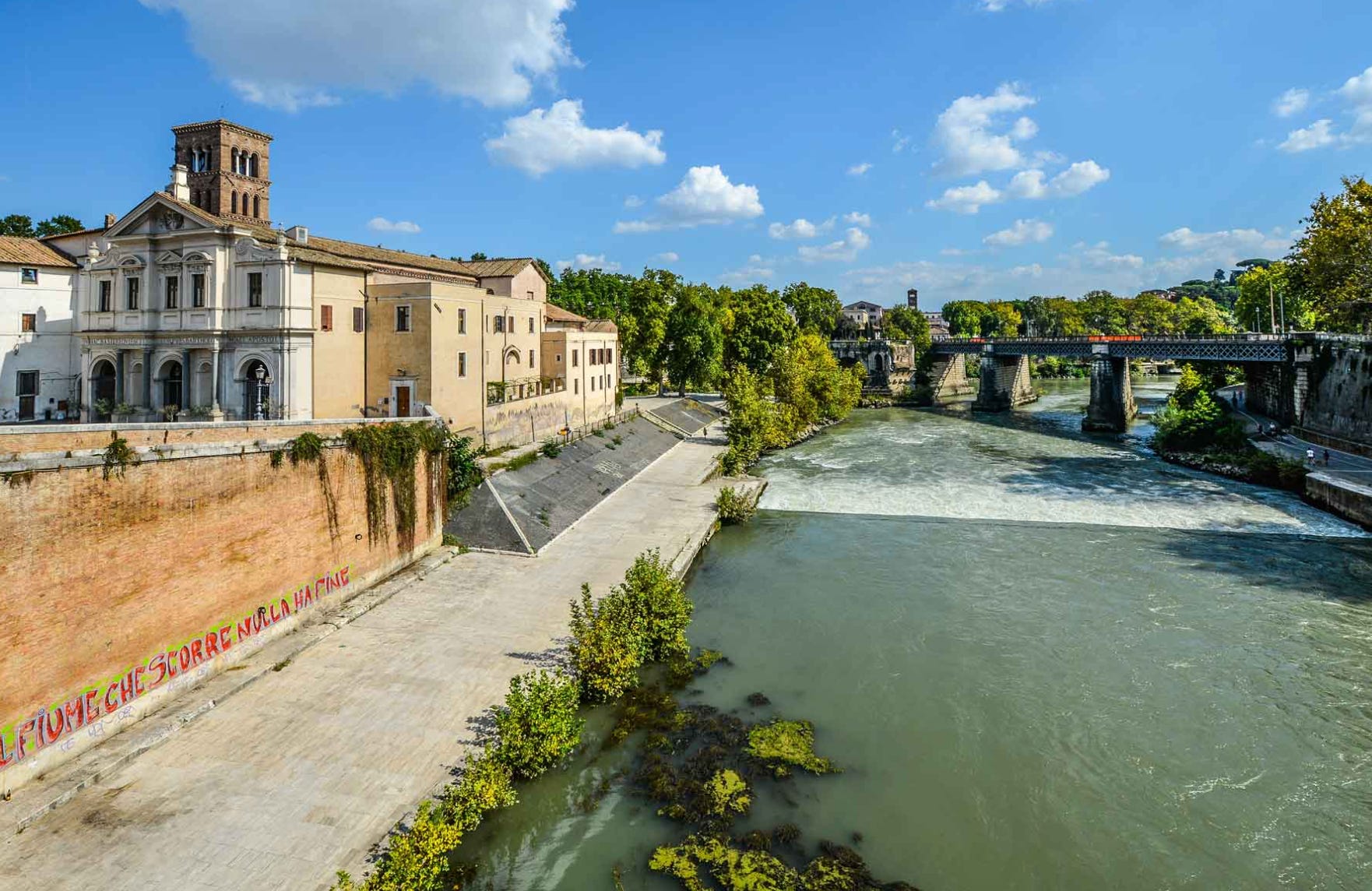
(One of my favorite places in Rome: the Basilica of St. Bartholomew on the Tiber Island. Yesterday was the feast day of St. Bartholomew.)
I was visiting friends, and they invited over a young man who was about to leave for Cambridge, Mass., to begin studies at Harvard College. They asked me in the presence of this young man what advice I would give to him. My friends are Catholic and this young man is a Catholic.
I asked the young man why he wanted to go to Harvard. He said because he liked their basketball program. He had visited Yale, Princeton, and U Penn, and didn’t like the basketball programs there as much. I thought to myself, If your reason is that superficial, then you ought to decline admission even now and attend a real university (I mean, a real university, in Newman’s sense) such as my own. But with age comes either a reticence in saying what one thinks or a complete unguardedness, and I have gone the way of the former. Vanity of vanities, saith the Preacher.
I remembered something I read in a book about golf written by a professional golfer. When he walks along the driving range, he wrote, often someone will say to him, “Look at my swing! What am I doing wrong?” He looks and sees twenty things that are wrong. Where would he even begin?
I said to the young man, “My advice is that every day you find time to read the New Testament and pray.” This would be like saying to the mixed-up golfer, “Get a good coach.”
To someone a little more mature I might have added: “You will need to provide for yourself the education which you will not receive there. Are you prepared to read in addition to your classes Newman on faith and reason, Plato’s dialogues, the works of Aristotle, St. Augustine’s City of God and Confessions, the Summa, the main works of the Fathers, the great spiritual classics such as Story of a Soul and Interior Castle, reliable histories of the Church, lives of saints, good books in apologetics? Because given your talents and your other areas of attention, you are even more obliged to educate yourself in the really important matters.”
But it would be hopeless to say this. When I attended Harvard, I read in addition to my classwork two books every three days. No one today can do this, and therefore no one can complete his education in the way that is required.
My wife and I, going for a walk in our neighborhood, passed by an elementary school and saw in the field there young girls playing cricket. In the background gathered under a pavilion were spectators, parents and siblings, maybe a hundred in number. “I’ve never seen anyone in the U.S. playing cricket,” I said. They seemed to be immigrants from India.
Is there a cricket league among these immigrants—unlikely—or do they just get together informally for cricket matches the way American boys (when there were enough of them around) used to gather to play pick-up baseball games?
These immigrants are doing what we used to do. The future belongs to people like that.
I make a similar judgment when my wife and I walk to the Church in the evenings for a visit and, it seems without exception, there is some event in the parish hall among the Salvadoran immigrants there —mainly dancing or a social event—while on the parish’s lighted soccer pitch boys or men are inevitably there playing soccer until late at night. The future belongs to them!
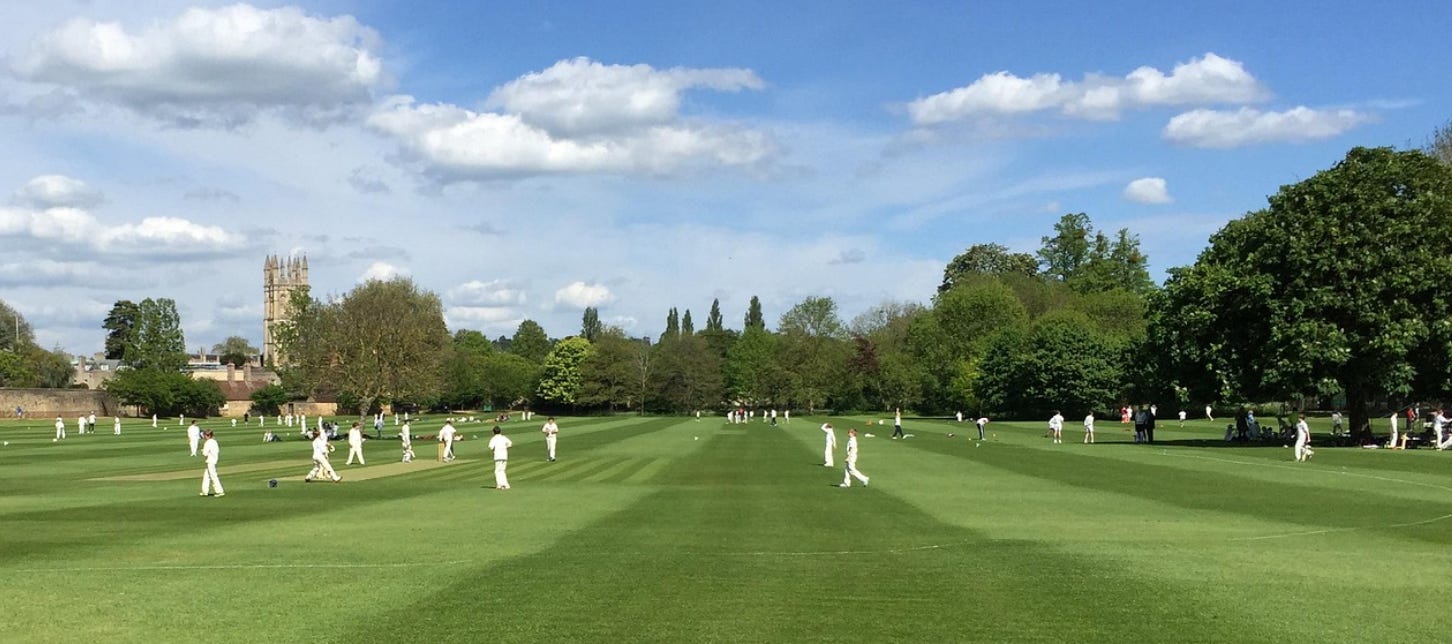
(I’ve seen lots of cricket in Oxford.)
There is a difference between anniversaries and remembrances. Yesterday, I celebrated the anniversary of Ukrainian independence, 35 years ago.
But these days my wife and I have been practicing the “remembrance” of our anniversary trip to Santa Fe. Here is how that goes. During the day, say, Sunday, we say to each other “at this time last week, 2pm, we were having lunch at La Boca restaurant; we had just arrived and we had great cocktails and tapas.” And so on. “At this time last week we began our hike from the parking lot at St. John’s College.” Or, “At this time last week we were at Chimayó for Mass and had our marriage blessed after Mass by that great Korean priest there.”
You know what I mean, and you have probably done the same yourself. Why do we practice “remembrance” in this way? The easy answer is that we wish to relive the occasion. But we don’t relive it, do we? I mean, we don’t sit down outside under an umbrella and set places and try to mix the same cocktails and prepare the same tapas. We just think of what it was like to be there and feel gratitude and a kind of solidarity.
And it seems to me that the essence of the Christian life is to practice remembrance of the life of Christ. It is called “contemplation.” Curiously, we were not there. But the fact that the Apostles were there, and passed it down to us (through the agency of the Holy Spirit, one must add) makes it so that we can claim to have been there with them. One might even say that the whole office of an Apostle is to transmit the possibility of remembrance—not celebrating anniversaries, not “thinking about,” but rather remembering.
My brief life as an Evangelical Christian did not have this character. It was doctrinal, and moralistic in a good way, but it was not the cultivation of a life of remembrance.
The Holy Rosary must be understood in this way. It is an instrument of remembering the life of Christ.
The Sacrifice of the Mass is like this too. “Do this in remembrance of me.” But he isn’t crucified again, a bloody sacrifice, any more than my wife and I set a tapas table to remember our lunch. But the Sacrifice is not simply a work of imagination, because it is a participation in the God-man’s own remembrance. If the Apostles transmit to us remembrance of the life of Christ, God himself gives us this remembrance of his sacrifice.
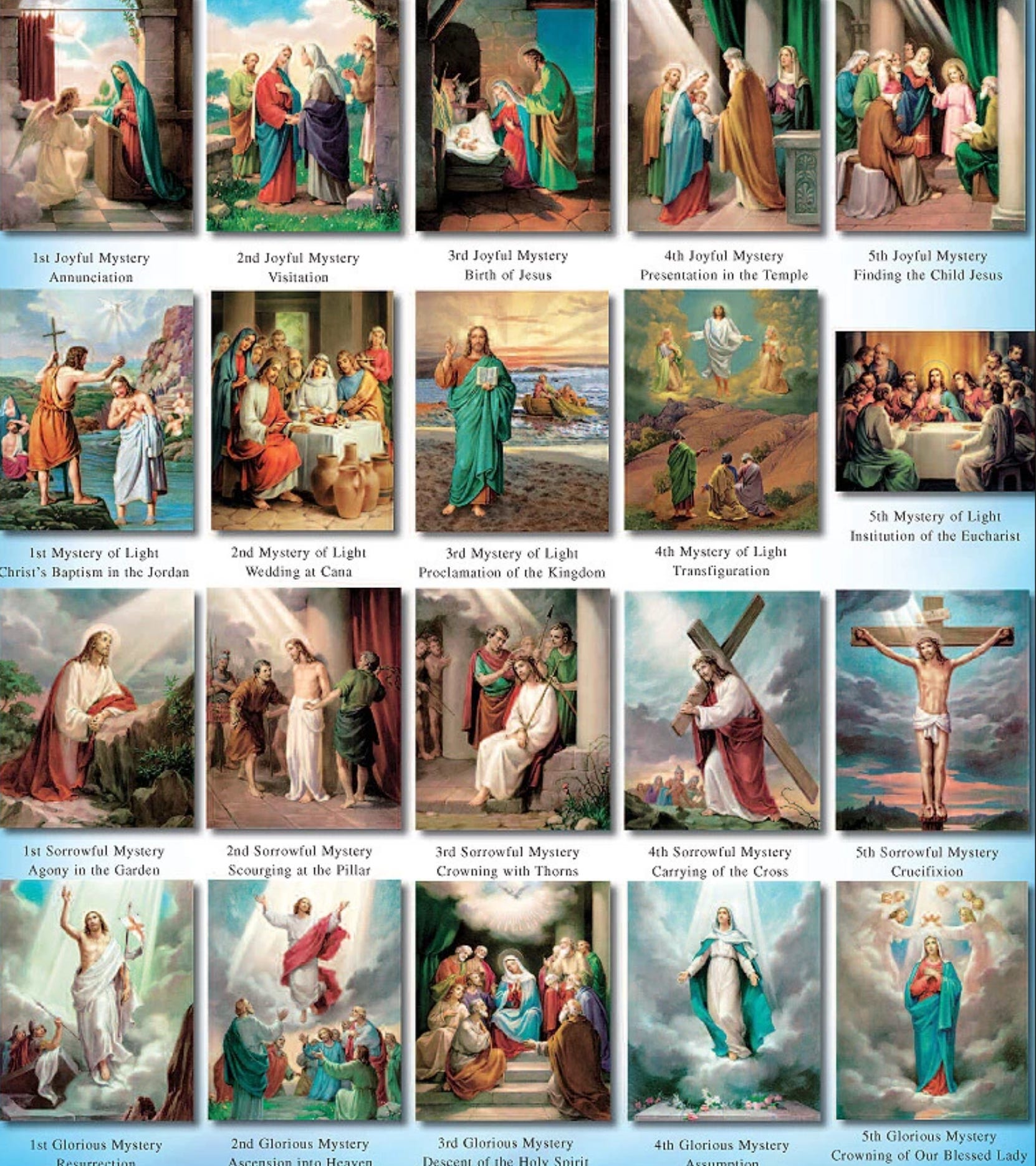
(A child’s chart of the mysteries of the Rosary.)
Ciao!
No posts
Comments
Nothing yet. Say the first thing.
Sign in to join the conversation.