
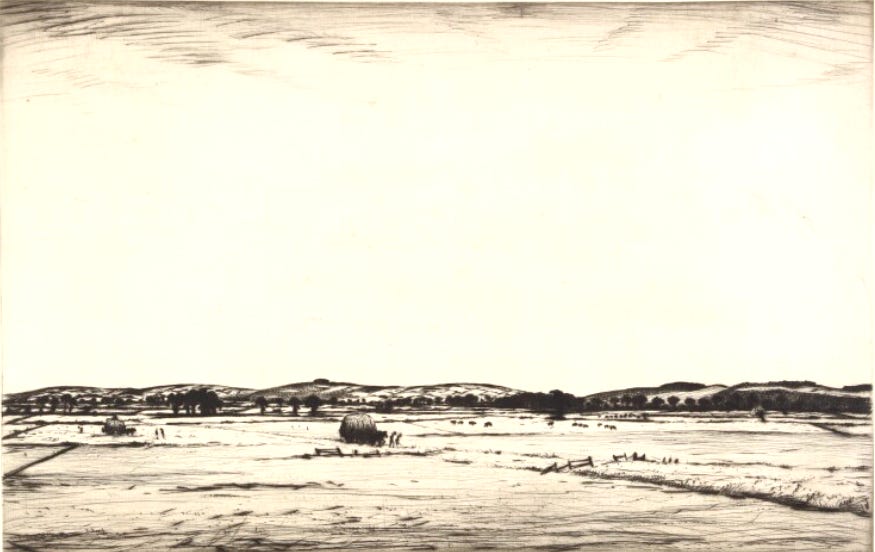
It’s not the picture at the exhibition that first draws the eye. It’s small and, from mid distance, seems to depict ants crawling across the canvas.
It’s unprepossessing.
Certainly the bolder paintings of the artist’s contemporaries, the bright slabs of Cubist colour and the stunningly stark woodcuts have more immediate claims for attention.
But I kept being drawn back to this image for, beneath its quiet simplicity, it is almost shouting a story.
This landscape speaks to me of escape, of unseen trauma, of scenes of unimaginable death recently seared onto the retinas. Of the need to exorcise oneself of all that.
It is by a little remembered artist called C R W Nevinson and is entitled Sussex Downs.
What you see if you peer in is the view from Nevinson’s motor caravan, an etching of agricultural labourers with horse-drawn carts gathering hay in fields laced with irrigation ditches and broken fences.
In the distance a few cattle graze and beyond that the chalk escarpments of the Downs rise above the flattened foreground. Trees are scarce.
This should be bucolic, I think Nevinson hoped so, and yet he, almost unwittingly, produced something quite bleak, drained of life.
Instead of hay makers the figures in this scene could easily have been soldiers trudging across the muddy killing fields of northern France a few short years before.
This was not what was in Nevinson’s mind. Nor indeed many of his artist friends who returned from World War One determined to forget what they had seen with a retreat to more innocent times, to lionise the British agricultural labourer at work perhaps or to sketch the green and pleasant land of home.
For many it was a remarkable turnaround. War artists like Paul Nash, Graham Sutherland, Eric Ravillious together with Nevinson had produced searing images of conflict and all had been lastingly altered by what they had seen.
Nevinson, a pacifist, served in the Quaker-founded Friends Ambulance Unit (FAU) during the war to avoid fighting.
That didn’t protect him from the maelstrom. In fact the bravery of FAU members on the frontline was remarkable and the flood of injured and dying flowing through the medical tents unremitting.
His mental state never recovered and depression dogged him for the rest of his life, was probably responsible for a personality that many found difficult to like.
But before that young Nevinson was a bold artist, a proponent of Italian Futurism, a dabbler in Cubism and member of the Vorticists with their warm embrace of the machine age.
After being invalided out of his service with FAU he was later appointed a war artist. Here his boldness of vision is striking, his art, foregrounding pain and destruction, as good as anything produced by his more illustrious colleagues.
One work, the ironically titled, Paths of Glory, of two dead British servicemen surrounded by mud and barbed wire was banned by the War Propaganda Bureau, deemed to be damaging for morale.
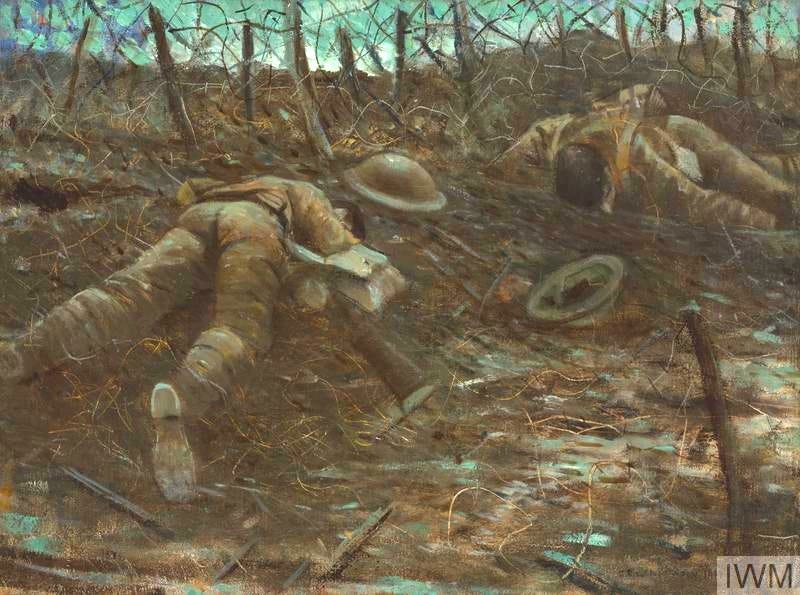
Nevinson hung it nevertheless covered with brown paper on which he daubed the word Censored.
The drift of Futurism into the muscular plaything of Mussolini fascism and the experience of war stripped Nevinson of his artistic core.
Equally celebration of the machine age, responsible for industrial scale killing, seemed grotesque.
Like many artists he turned to the British landscape and increasingly began to favour etching.
In 1922 he had a motor caravan built to his own design which gave him privacy from the world and a new freedom.
Containing a mobile studio he embarked on sketching expeditions across Dorset, Cornwall, Kent and Sussex. He was attempting to place the conflict in his rear view mirror.
It was from the back step of this curious vehicle that he etched the scene above, contemplative and sombre like much of his work at the time.
I’d never heard of Nevinson until I went to Pallant House Gallery’s excellent exhibition British Landscape: A Sense of Place last week.
Its main focus is pre and post world wars and how the landscape changed through the prism of artistic experience.
What is clear is that the fields, meadows, rivers and woodlands of this country have always been symbolic, with meaning projected upon, to be defended, idealised.
Artists like Nevinson, Nash and Clare Leighton, whose wonderful woodcuts of rural labourers are an exhibition standout, saw the land and those who worked as part of a simple but noble tradition, an innocence that turned its back on violence and war and harked back to a (very mythical) Golden Age.
It was a way of life to be defended from external enemies like the Germans
Later the exhibition shows that some thought the danger to this Land of Milk and Honey was internal.
The growth of the suburbs, ironically built under Homes Fit For Heroes programmes for returning servicemen, seemed to threaten this rural bliss.
So the cover art for Clough Williams-Ellis’s 1928 polemical book against urban sprawl, England and the Octopus, drawn by illustrator Richard Ellis, shows the sea creature, representing suburbia, wrapping its tentacles around a picturesque quaint village.
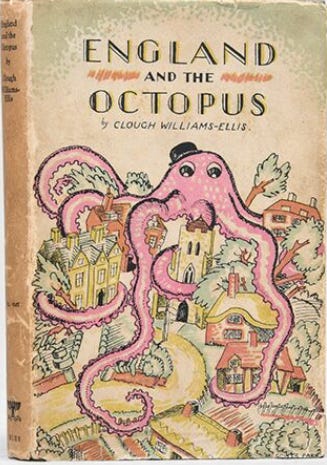
This is included in the exhibition.
Leaving aside Williams-Ellis’s astonishing snobbery about this improvement in living standards for millions, many did fear the days of warm beer and cricket on the village green were under threat.
Later British art moved away from the figurative and the response of artists after the next war was very different.
Included in the exhibition, Ivon Hitchen’s abstract Sussex River near Midhurst from 1965 is all blocks of colour wash. The scene is just a few miles from that painted by Nevinson 40 years before.
It was the latter image that stayed with me long after my visit.
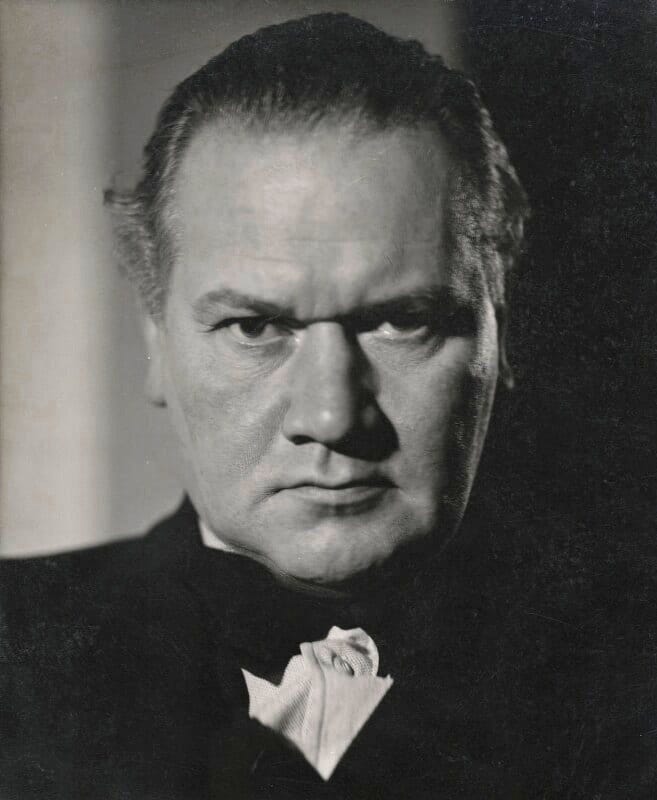
I can picture Nevison steering his motorised contraption though the countryside looking for salvation in his landscapes.
Staring across the Sussex Downs at the pastel-hued panorama in front of him, his etching needle scratching across copper plate, creation coming deep from within, never quite escaping what he had seen somewhere else.
British Landscapes: A Sense of Place is at the Pallant House Gallery until November 1.
Comments
Nothing yet. Say the first thing.
Sign in to join the conversation.