
Before us is a wide valley
The sun shines with glittering rays
The road is a gray band
White stripes, green edges
We are driving, driving, driving on the Autobahn
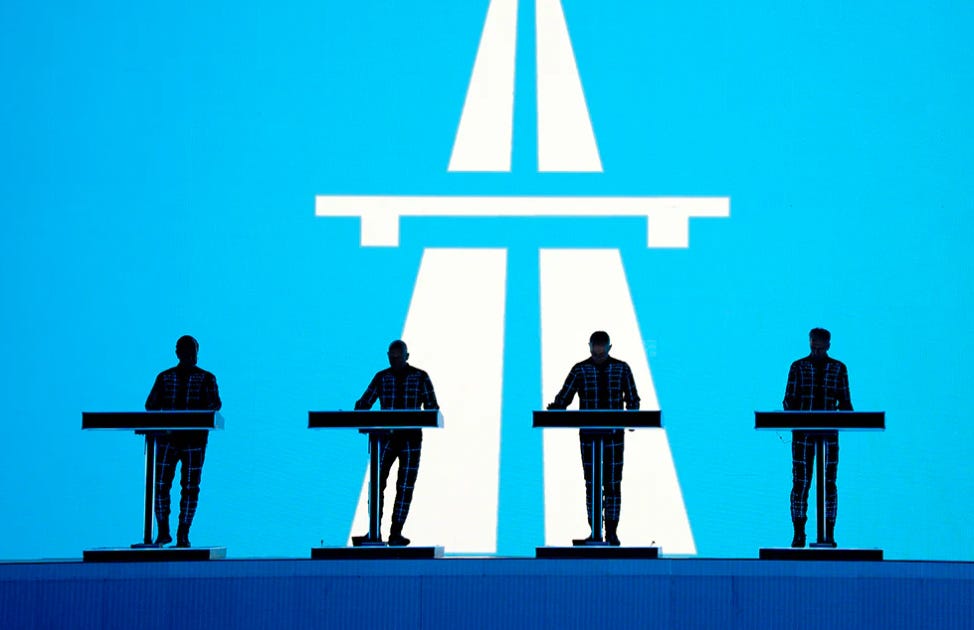
The four men in neon-striped constantly shade-shifting onesies are on stage sending out from their synthesisers some of the greatest pioneering modern music ever recorded.
Beneath our feet the floor of the Royal Albert Hall throbs to their intense rhythms, above us delicate melodies float in the air.
The men stand still, save the odd bending knee, for two hours of blissful sound as behind them primary coloured images and retro graphics dance to the music.
My sons and I are lucky witnesses, along with 5,000 others, to the work of Kraftwerk and their remaining founder member and chief creator, the 79-year old Ralf Hutter.
Who would have thought a band of expressionless, first generation post World War Two Germans fiddling with early computers and assembling prototype synths would have so much influence on music?
Would inspire Detroit rap and hip hop and spawn a thousand imitators?
The boys of Kraftwerk were some of the many who grew up wondering what it was their parents did, or didn’t do, in the war.
Understanding that the country of their birth hid war criminals in every town.
The response of Ralf and co-founder Florian Schneider (who died in 2020) was to create music that looked forward. Formed in 1970, Kraftwerk were the future 50 years ago and, incredibly, still are.
Complex muscular techno rhythms rocked your core while their early casio-simple tunes aimed straight for the heart.
On first hearing their banal lyrics, deadpan sung (or vocodered), seemed squeezed of emotion but were in fact enthused with love, yearning and a light/dark relationship with new technology. It was also, magically, futuristic and nostalgic at the same time.
The theme running through Kraftwerk’s work was of a new Europe arising from the ashes of war, a borderless, frictionless place where you could jump on a train (Trans Europe Express) for a ‘rendezvous on Champs-Elysees’ followed by a ‘late-night cafe’ in Vienna.
And so, on the same ground, here we are, midway through the set last Friday night, listening to the song whose English lyrics sit at the top of this piece.
Their breakout 1974 hit Autobahn and its misinterpreted lyric We Have Fun Fun Fun on the Autobahn.
The German for drive, ‘Fahren’, often sounded like ‘Fun’ to English ears leading some to suggest the band were attempting a droll parody of the Beach Boys, replacing surf with grey tarmac.
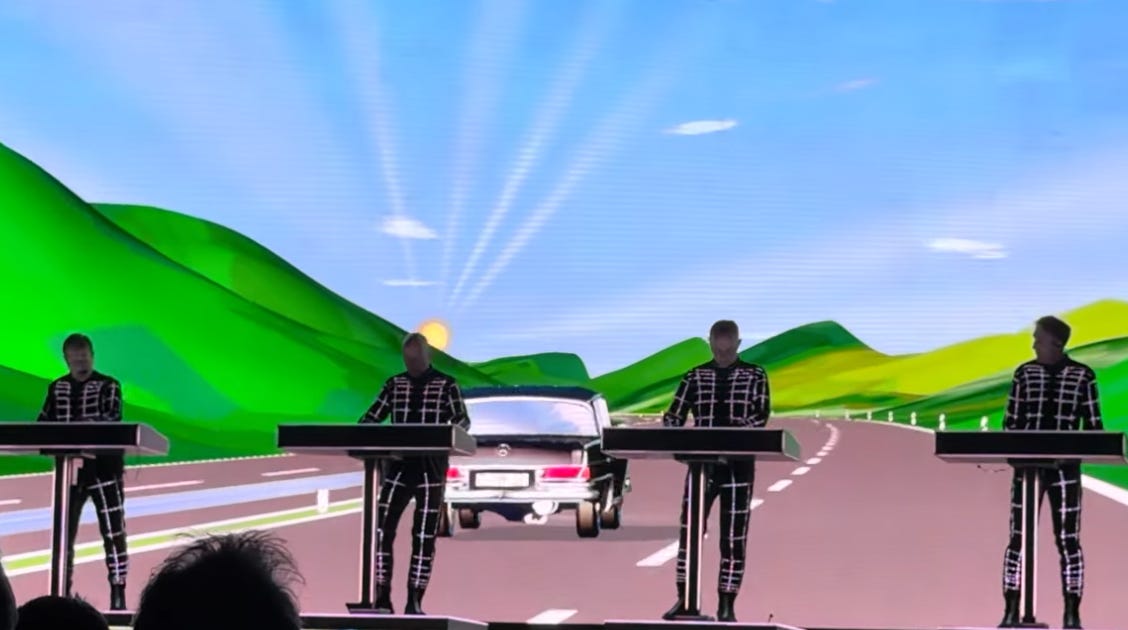
The road in the song is thought to have been Germany’s first autobahn, the A555 that links Bonn to Cologne.
It doesn’t really matter for all the new autobahns were dramatic symbols of a reborn country, reconnected to its neighbours, beautifully designed with landscape architects central to the projects.
Out of the wreckage came a determination of next generation Germans to be at the heart of Europe, to build not destroy.
The autobahns criss crossing the country, giving easy access to and from the nation, removing barriers, aiding mutual understanding, were almost a reparation. We are all Europeans again.
Beneath the nursery rhyme lyrics that was what Kraftwerk were celebrating in Autobahn.
Meanwhile, across the Channel, the nation that had been on the winning side of the conflict was preparing to go backwards.
As Germany was being reimagined Britain went on an infrastructure free-for-all in which landscape and beauty appeared to matter little.
In July 1956 two men, Richard Sudell (the hero of my book) and Geoffrey Jellicoe, both members of the recently-formed Institute of Landscape Architects (ILA) embarked on a forlorn mission to the Ministry of Transport in Whitehall.
They wanted landscape to be a central consideration for a project to create the country’s first motorway. The M1 would connect London to Yorkshire.
Casting envious eyes across the Channel, they thought motorways in Britain should follow the example being adopted by the Germans.
The ILA called for comprehensive design on these new roads, recognising the dominance they would have on the countryside but insisting they exist in harmony with the contours and features of the landscape as was happening with the autobahns.
Drivers should be presented with a new interesting vista as they travelled.
As ILA member Brenda Colvin put it. Travelling at anything over 30 miles per hour, the details of the flower and leaf count for very little, form and mass, light and shadow are the materials we must make use of, and these are also the requirements from the point of view of the more distant observer to the countryside
Sudell and Jellicoe came away empty handed. Landscape architects would be unnecessary and expensive, said the mandarins.
To add insult to injury, the construction company building the motorway employed two foresters instead.
In the winter of 1959 more than 72,000 trees, mainly alder, ash, common oak, Scots pine and Spanish chestnut, were plonked along the road’s periphery.
The M1 simply bulldozed its way north without acknowledging the surrounding countryside.
Almost as soon as it opened angry letters flooded in to the government and the newspapers from the Royal Fine Art Commission and the Royal Institute of British Architects as well as the ILA.
Many of the protestors pointed out there was a clear contrast to be found between a country which had lost the war and a supposedly triumphant nation.
Germany’s post war reconstruction had begun to be compared favourably with that of Britain’s on a number of other fronts too, leading to the oft-repeated jibe wondering who the actual victors of the conflict had been.
The autobahns were marvelled at by many British architects and landscape architects, with leading proponent and practitioner Slyvia Crowe quick to compare the M1 unfavourably with the Ulm to Baden-Baden road.
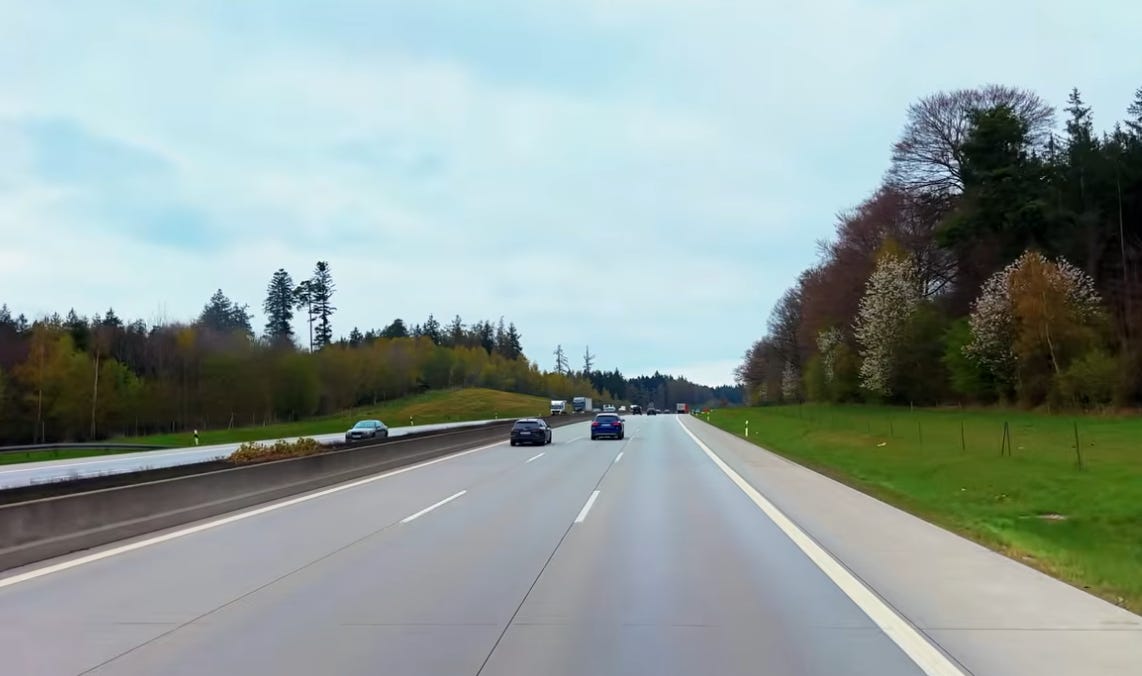
For Crowe the autobahns revealed ‘a fluid plasticity’ with ‘smooth transition between road and countryside with the route shaping itself to the contours of the existing landscape’, while the M1 was bedevilled with harsh, angular lines and constructions that ‘act as a jarring element divorcing road from landscape’.
It was all ‘negative interruptions and disruptions’. Crowe was joined by a host of other eminent architects, critics and designers, many who alighted on the brutalist reinforced concrete bridges of the M1 compared to those of the autobahns.
John Betjeman, writing in the Daily Telegraph, described the landscaping and bridges as ‘matters of lasting regret.’
It would not be the the last time that a peculiarly Anglo-Saxon, market force driven, laissez faire approach to design and planning, architecture and landscape would be cause for anguish.
For this inhabitant of Britain, last Friday night at the Albert Hall was both uplifting and a cause for reflection.
For Kraftwerk’s idealised vision of Europe, born out of the horror of conflict, is at a point of utmost stress again, with this country on the outside looking in.
No wonder then that, for two hours last Friday night, we lost ourselves in the simple yet beautiful pleasures of having fun, fun fun on the autobahn.
Comments
Nothing yet. Say the first thing.
Sign in to join the conversation.