
This settles the divine right of government beyond exception, and that for two ends: first, to terrify evil doers: secondly, to cherish those that do well; which gives government a life beyond corruption, and makes it as durable in the world, as good men shall be.
I imagine I hear his quill pen scratching on the parchment as he writes these words. It is very likely that he is looking out at this magnificent view as he does so. Just like me right now,
He’s creating one of the most famous texts, a foundational rock, of a ‘new’ nation, a country that will be based on democracy, justice, fairness and religious freedom.
As he writes, beyond corruption. Things have changed since 1682.
One thing for sure is this place would have given him the inspiration to claim his place in history. He was close to heaven here.
The view would have confirmed his belief that Man, Nature and God could live as one.
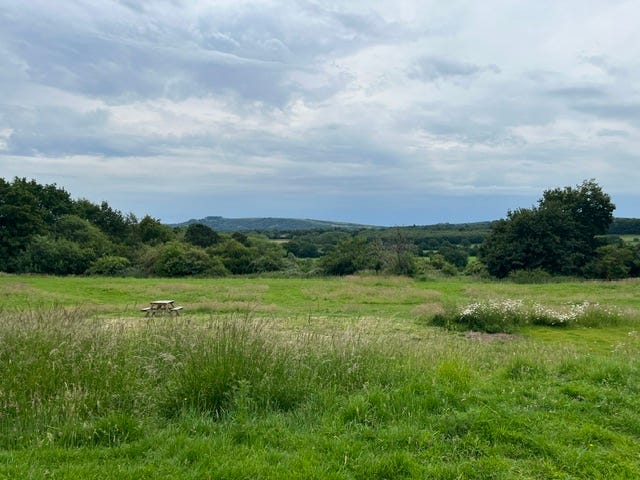
As I sit outside my campervan, a solitary visitor on a beautiful summer’s evening, the South Downs of England is set out before me.
Despite the parched season, lush shades of green field, meadow, line of trees, and, on the horizon, the darkening outline of the Iron Age hill fort of Chanctonbury Ring, seem to slide into the view as if part of a toy theatre.
At my feet an incredible number of butterflies, undoubtedly encouraged by the organic farming and rewilding all around, dance in the slight breeze.
The rare Duke of Burgundy, Small Coppers and Marbled Whites have all come to the party.
Above my head super-intelligent Crows squabble mid air, dive into trees and then, like so many Spitfires scrambled from World War Two airfields, soar upwards to see off a pair of Kites looking for fledgling food.
The sleek birds of prey, now riding the thermals, are not, despite common belief, hunting in pairs.
They tail each other all day, in a game of bluff and counter bluff, making sure one doesn’t find prey before the other.
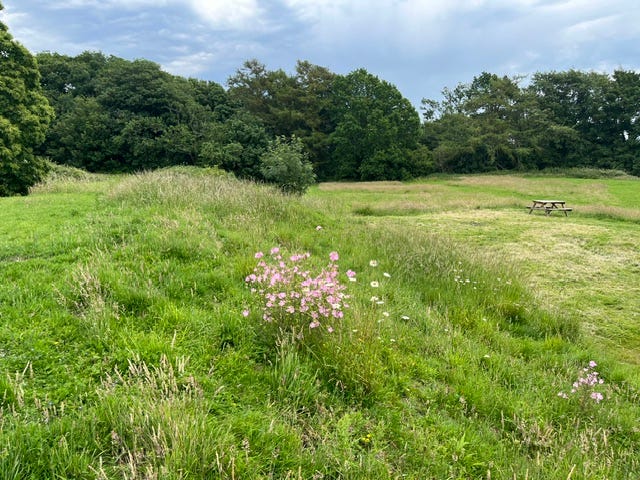
Behind me to the north a horse chestnut tree whose main trunk died decades ago has found new life (stump sprouting) so that stark darkly-edged tree top protrudes above a canopy of fluttering leaves.
A song thrush chirps from the highest dead branch.
Now the sun begins to descend beyond the ancient oak to my right. Was it here when he was?
All day this arboreal Majesty had occasionally stirred, giving symphony to the light wind, but now it graciously provides relief from the direct heat.
Later an owl will begin its eerie hoot amid its branches, the next Act of the play nature is putting on for me here.
And then, as darkness falls, the finale. I hear before I see. The beating of wings in perfect time, coming closer.
I gaze to the sky trying to understand what is happening and suddenly, out of the gloom and, what seems. only a few feet above, a perfect V formation of Canada Geese perform a fly over.
Their white cheeks and breasts shine out from the darkness.
I’m moved to stand and applaud the show as the curtain falls.
Earlier in the day, exploring this largely undiscovered part of Sussex, I visited the Church of the Holy Sepulchre.
It is a couple of stone throws, from where I had parked my 1977 Westfalia VW campervan, Nessie (for all real VWs have to have a name) on the site of his former home.
The 13th century tiny church is decommissioned and now beautifully preserved by the Churches Conservation Trust.
Inside its sandstone walls there is a remarkable memorial to Edward Shelley, ancestor of poet Percy Bysshe, and his family. All seven sons are portrayed in brass but Edward jr is without his head.
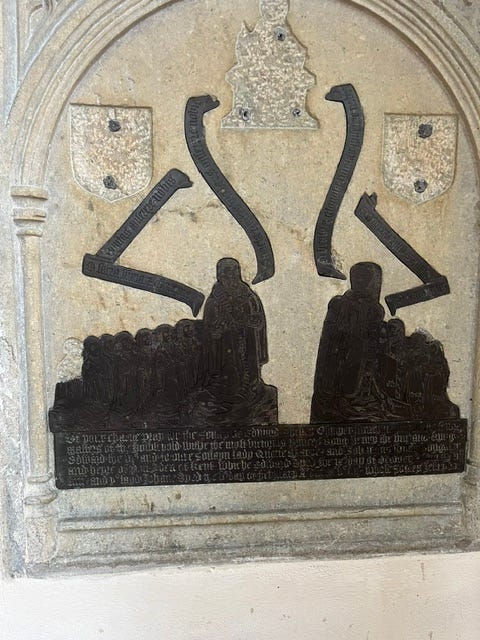
In 1588 he brought ‘disgrace’ on the family by harbouring a Catholic priest during the reign of Protestant Elizabeth I and was hanged at Tyburn jail.
His head was removed from the memorial by his family.
There’s an irony that the church was under the advowson of the man who lived here a century later for he was a non-conformist himself, jailed multiple times for his Quaker beliefs.
The church was a tiny speck on the 350 acres of his estate.
It comprised a park, three houses, two cottages, two barns, a water mill, a dove house, four gardens, four orchards, 20 acres acres of arable farmland, 80 of meadow, 200 of pasture, 40 of woods, a lake and a mill pond and, as mentioned, the right to appoint the local Church of England vicar.
There is no record of him showing the slightest interest in the latter task.
Here, high up in the Downs, he could hold secret Quaker meetings, often in the open and formulate his beliefs on equality and justice, central to his faith’s foundational doctrines.
An already wealthy man, he bought the estate in 1676 at the prompting of his wife having lost three infant children in their cold damp Essex home.
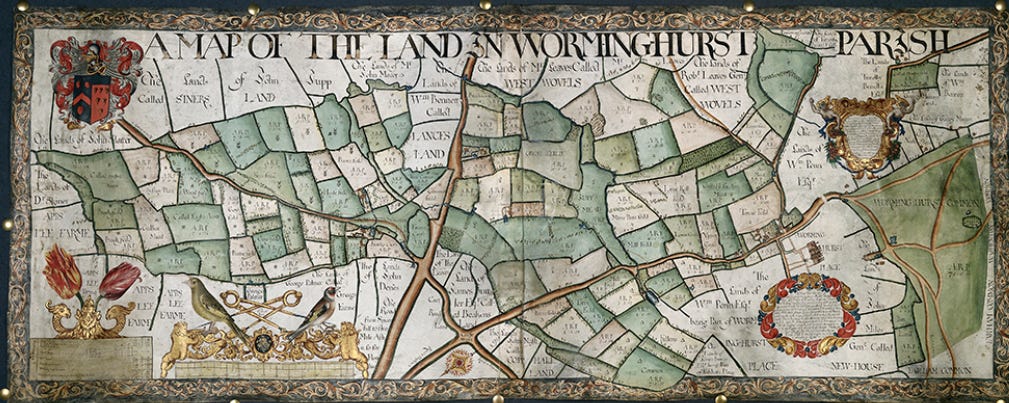
It remained the family home for 40 years until it was sold and promptly demolished to make way for a new mansion.
Involved in the colonisation of America, he was granted ownership of a vast tract of land to the west of the Delaware River from King James II who owed his father a substantial amount of money.
Fearing that Europe would never be a place of tolerance and freedom he wanted to establish the land as a haven for persecuted people of Europe, a new holy land or a Christian commonwealth.
Between 1680 and 1682 he wrote the Articles including the preface, part of which is quoted at the top of this piece, that he hoped would set the tone for the way the people would govern themselves in this new land.
A century later many of its principals were adopted in the Declaration of Independence and then the Constitution of a new country.
For the man himself events didn’t quite turn out the way he had dreamt when staring out over the Downs, scratching at his parchment.
Some poor judgement, too much trust in those around him and a change on the throne cast him under a new cloud of suspicion.
Returning to England he spent time in a debtor’s prison and died, paralysed by a stroke, in 1712.
Up on the South Downs, where once his house stood, a simple but perfect campsite now exists.
Two tiers of land mark the upper and lower part of the old buildings that once imperiously dominated the view.
There is no memorial to the man whose vision helped develop the principles on which a new nation was founded and which are still learned by millions of young children today.
Except for the campsite the land is private so there are no visitors. Perhaps that is for the best.
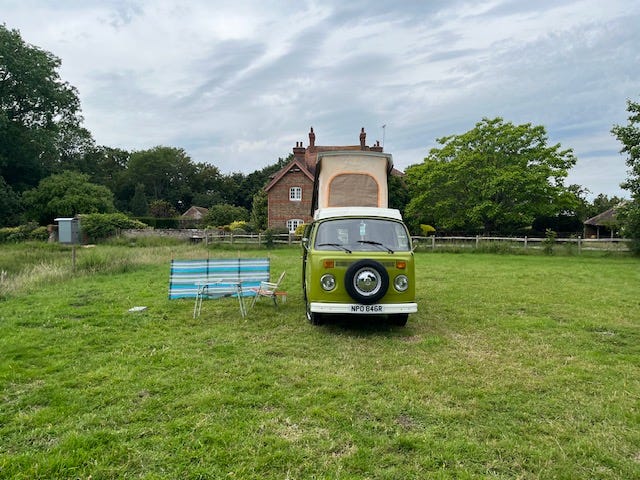
For the landscape remains his memorial, the unspoilt rolling hills, the soaring Kites, the ancient oaks, his inspirations, are still there.
They speak of a harmony, a peace, we should constantly strive towards. It was true in 1680 and it is as true today as I stare out over the same view.
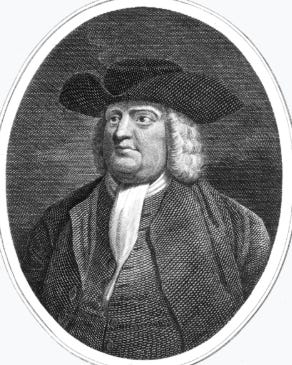
William Penn wrote the Frame of Government of Pennsylvania for two years at Warminghurst Place, high up in the Sussex Downs of England and was the governor of the American Commonwealth holding the title until his death. The principles meant that neither he nor leaders would have ‘...power of doing mischief, that the will of one man may not hinder the good of a whole country.’
More details about Penn and Sussex can be found here at the Transatlantic Ties website.
Comments
Nothing yet. Say the first thing.
Sign in to join the conversation.