
Credit: Henry Martin, The New Yorker, The Cartoon Bank
They didn’t document scopes during the commission era, and they still don’t do it today. They have very little interest in quantifying their workloads.
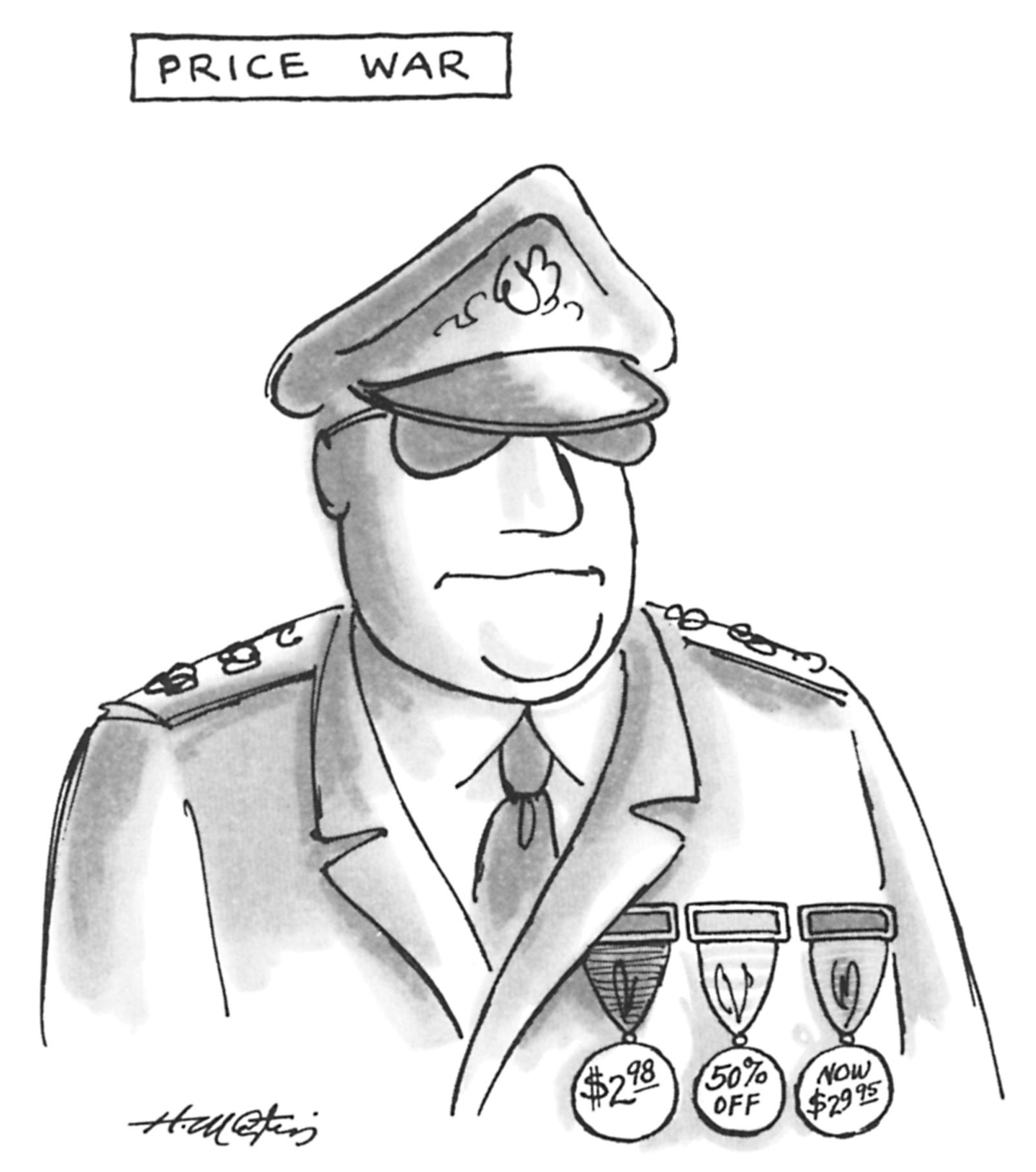
Consequently, during the 30+ years I have been involved in the advertising industry, I have seen creative agency workloads doubled…and fees halved.
Every year for the past 30 years, workloads have grown by 2.8% per year, and fees have declined by 2.0% per year.
This may not seem significant, but it has led to a 75% decline in the price of agency outputs.
Even worse, the decline in price has led agencies to downsize, liquidating their proprietary talent.
Nevertheless, I encounter a lot of resistance when I suggest that “creative agencies need to begin documenting, with some seriousness, how many deliverables they do, and what kind of deliverables they are — so they can price for the deliverables. And the more successful your work, the higher the prices you can charge.”
The number of arguments coming back to me is astonishing in its variety:
“That’s old hat,” I’m told. “We’re moving to outcome-based pricing. We don’t need to know our outputs. The new deliverable is an outcome.”
“We’re paid for creating brands. We aren’t really paid for staff-hours or deliverables.” Or alternatively, “we’re paid for our creativity, not for the work we’re given.” Or “we’re paid for coming up with Big Ideas.”
“Counting up what we do and charging for it would make usa commodity shop.”
“Are you crazy? You want us to stop and count deliverables when we’re facing threats like AI? We have bigger challenges.”
“We’re more concerned about doing work that can win awards.”
“We’re too understaffed to spend time doing this kind of admin.”
“Procurement does not want to change the way we’re paid. So we’re stuck.”
There is an absolute agency allergy to documenting and measuring work, as if the activity was purely administrative and bureaucratic rather than strategically essential.
A creative agency office I diagnosed was doing 15,000 deliverables, of which 13,000 were low-value adaptations — without having any idea that their workload was this large and diverse.
First, we need some way to measure and quantify the different types of deliverables.
In our SOW measurement system for creative agencies, we’ve identified 231 unique deliverable types, and each of them can be an Origination or an Adaptation. Effectively, then, there are 462 different deliverables.
Each of the 462 deliverables has a unique ScopeMetric® Unit (SMU) value. SMUs are like pounds, kilos or calories — and we fixed it so 1.0 SMUs is the size of a typical TV:30 origination.
A creative team of one copywriter and one art director should do 10 SMUs per year.
For 10 SMUs of Outputs, or 10 TV:30 originations, resources would typically include (for one full year):
Creatives…………………………………… 2.00 FTEs
Client Service……………………………. 1.60 FTEs
Strategic Planning…………………… 0.40 FTEs
Production………………………………… 0.62 FTEs
Total……………………………………….. 4.62 FTEs
4.62 FTEs for 10 SMUs is 0.462 FTEs per SMU.
From this point on, the billing rates of the 0.462 FTEs are the deciding factor for the price of a deliverable.
Let’s assume a blended rate of $200 per hour for an 1800 hour FTE.
$200 x 0.462 FTEs x 1800 hours = $166,500: the price for a TV:30 origination.
We can use this basis to calculate the price of every other deliverable in a SOW, using its SMU value and an agency’s internal billing rates.
I created a new SOW of 95 deliverables that has 9.03 SMUs, and the fee for the calculated 4.38 FTEs @ $200 per hour is $1,576,435.
Each deliverable in the SOW has a price, based on its SMU value and the cost of the calculated FTEs.
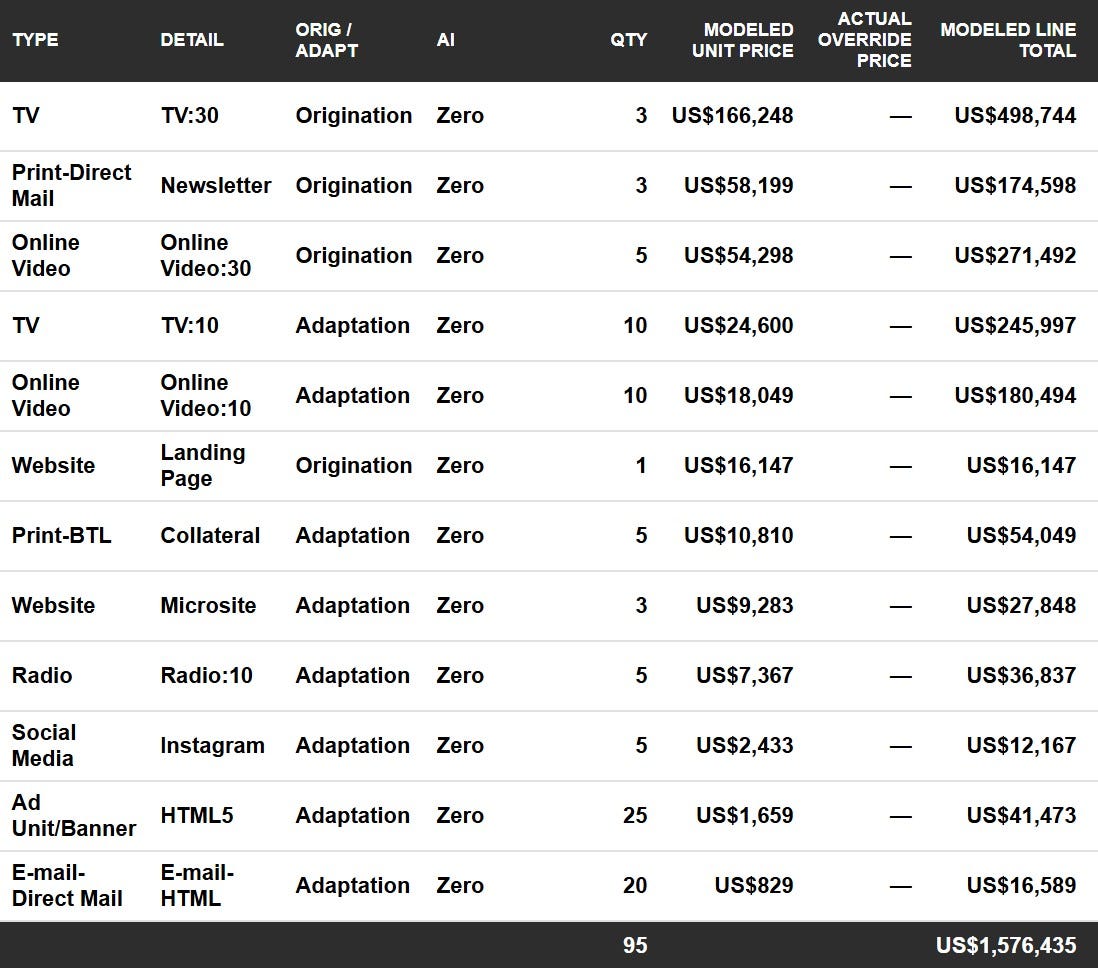
If AI were used, the SMU values would be lower, and so would the Price of each deliverable.
It’s a nothing job, requiring nothing more than listing the deliverables from a dropdown list of names, putting in the quantities and setting the model up with appropriate internal billing rates.
$200 per hour was the selected rate here, but if the agency is successful in achieving its Outcome KPIs, the Price per hour or Price per SMU can be higher, with increased fees reflecting the agency’s success.
My third book about the advertising industry, Madison Avenue Revisited, is available on Amazon. The book, which focuses on the evolution of media and creative operations, the effect of holding company ownership and the brand performance challenges faced by clients was launched at Cannes this year. Foreword by the inimitable Rory Sutherland of Ogilvy Consulting.
No posts
Comments
Nothing yet. Say the first thing.
Sign in to join the conversation.