
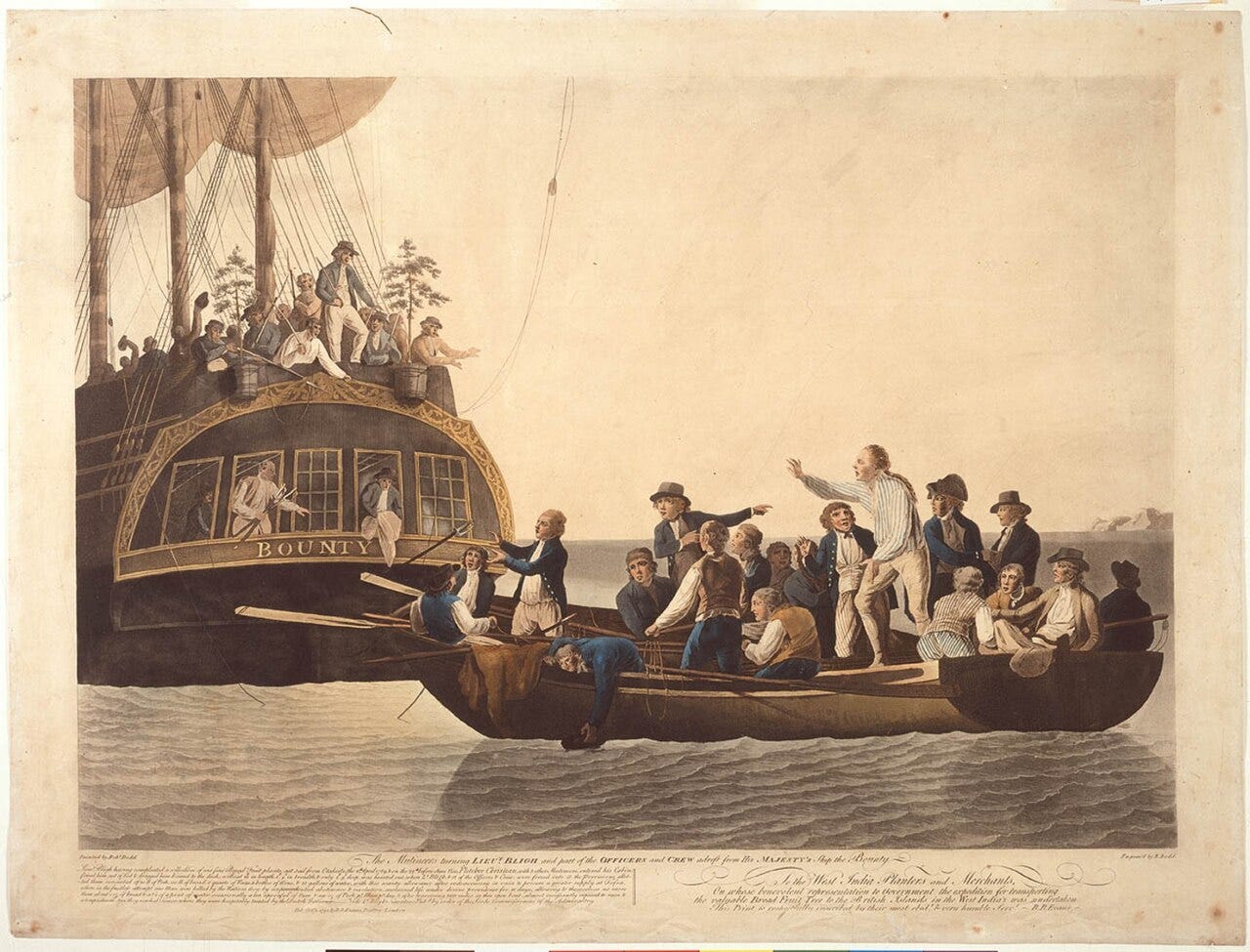
Credit: Painter Robert Dodd (1748–1815), Wikimedia.org, https://bit.ly/4wIPJvr
Captain Bligh, put adrift in the South Pacific in 1789 with 18 loyal crewmen, had no maps or charts, but from his daily logs and personal navigation records, he knew the exact position of the ship at the time of the mutiny.
Before setting course in the lifeboat, Bligh put a plan to his men, and he got their assent. Eighteen people agreed on a destination, 3,600 nautical miles away, and on a daily ration of an ounce of bread and a quarter-pint of water per man.
This harsh but realistic plan allowed them to survive
For navigation, Bligh had a pocket watch, a quadrant and a compass — barely enough for dead reckoning, but he made it with only one loss of life. It was a remarkable achievement.
Madison Avenue, by contrast, has neither a consensus understanding of its current position nor an agreed heading — and there is little organizational consensus about what it will take to get to a healthy future.
Fix today’s low fee levels, inadequate for the vast quantities of media and creative work in scopes of work.
Fix juniorization and understaffing.
Increase advertising’s effectiveness.
Retain clients for long-term relationships rather than face frequent reviews.
Improve the quality of media and creative scopes of work.
Help clients achieve higher brand growth rates.
Collapse the holding company into a single company with four operating units unified under WPP Open.
Stabilize in 2026, build in 2027, accelerate from 2028.
Save £500m of gross annualized cost savings.
Become a simpler, lower-cost, AI-enabled business.
Stop being a holding company.
“We don’t want to be a holding company anymore,” said Cindy Rose.
Wren’s strategy? “We are building for an era where speed, integration and scale matter most.”
Integration will “make it easier for clients to buy all their marketing and sales needs from a single partner.”
More than 20 agency brands have been merged or sunset, including DDB, FCB and MullenLowe.
$1.5 billion in cost reductions have been programmed.
Omnicom’s CTO Paolo Yuvienco, explaining AI, said “creative teams that used to bring three concepts to a client can now bring 25 to 50 in the same time.”
AI is more likely to lead to continued fee reductions than improve the quality of media or creative efforts.
Reorganizations and cost reductions are more likely to create organizational anxiety and uncertainty than build trust and confidence.
Holding company dialogues may have been more designed for Wall Street and The City than the lifeboat crew.
“We’re a long way from safety, now, but we can navigate to where we need to go.”
“Here’s our current position:”
In learning to master digital, social and programmatic advertising, we lost sight of our need to deliver topline growth for our clients.
We let ourselves become vendors rather than partners.
We accepted unknown quantities of growing work for inadequate and declining fees.
We downsized our talent to make our margins rather than fix our pricing.
We got rid of much of talent required to be more effective for clients.
“Here’s our course to safety:”
We will set out to fix the scopes of work and the pricing of our services.
We will charge for outputs and price on outcomes.
We will rebalance our organization by substituting AI for junior resources…while we rehire senior talent.
We will restore partnerships with our clients.
We will regain trust and respect for the quality of our services.
We will retain our clients and depend less on new business for our growth and success.
That’s the voyage that we must take.
***
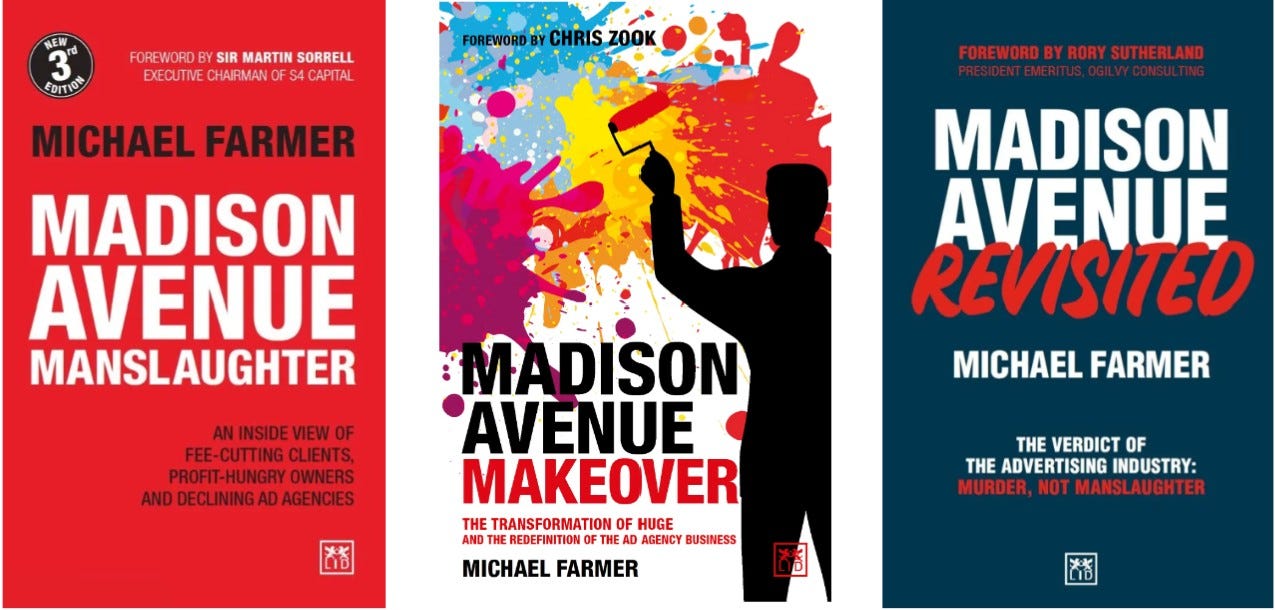
My third book about the advertising industry, Madison Avenue Revisited, is available on Amazon. The book, which focuses on the evolution of media and creative operations, the effect of holding company ownership and the brand performance challenges faced by clients was launched at Cannes this year. Foreword by the inimitable Rory Sutherland of Ogilvy Consulting.
No posts
Comments
Nothing yet. Say the first thing.
Sign in to join the conversation.