
Credit: Donald Reilly, The New Yorker, The Cartoon Bank
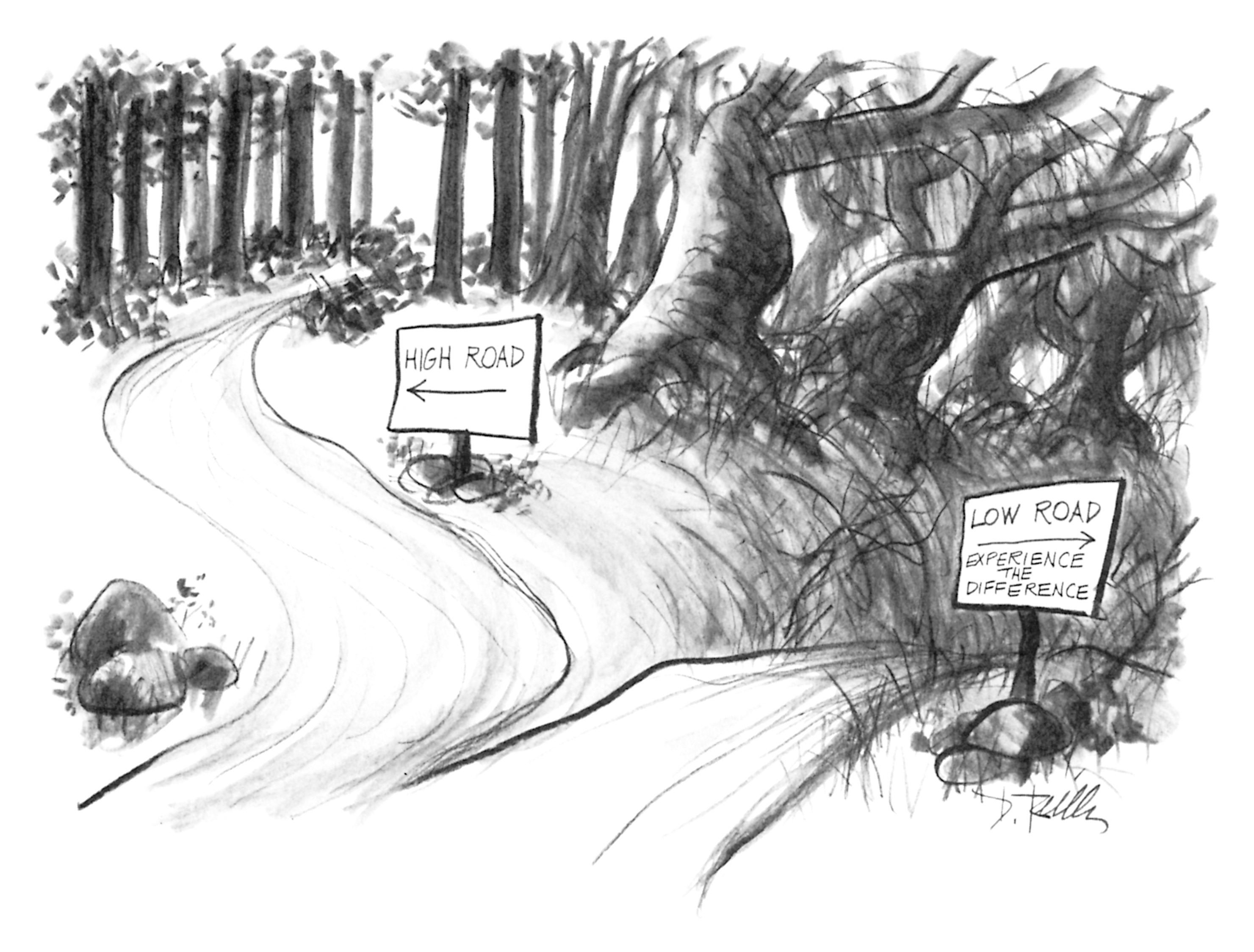
Two roads take us in different directions from today’s starting point.
The High Road sees improvements in relationships between advertisers and their agencies, and revisions in media / creative scopes of work that reignite brand growth rates. The parties operate as strategic partners, both of them committed to improving the advertiser’s topline performance.
The Low Road sees a continued acceptance of low growth as the advertiser’s status quo, and the use of low-cost media, low fees for agencies and a flooding of the marketplace with ads that annoy, interrupt and fail to deliver improved performance.
The High Road requires a concerted effort by CMOs, Procurement and Agencies to transform their relationships. The effort needs to be led from the top.
The Low Road continues current practices, which are not working for anyone. Marketing will continue to grow scopes of work. Procurement will continue to cut fees. Agencies will downsize and juniorize to protect margins while liquidating their talent base. Brands will continue to stagnate.
Sooner or later, though, this unhealthy strategy will destroy the basis for client-agency relationships.
Brand Performance Diagnoses. Agencies and clients need to diagnose the reasons for the chronic slowdown in brand growth rates that began 15 years ago.
Scope of Work Diagnoses. Agencies and clients need to diagnose the quality of the marketing mix and the deliverables in media and creative scopes of work.
Are the scopes designed to drive brand growth?
Or are they simply low-cost scopes that are meant to protect margins?
Revised Scopes of Work. Agencies and clients need to revise the spend levels, marketing mixes and lists of deliverables to align SOWs to achieve higher rates of brand growth.
Revised agency remuneration. Agencies need to revise the remuneration system so that agencies are paid for their outputs on a “price per deliverable” basis, with the understanding that “prices will rise over time when results are achieved.”
This is the correct route for “outcome-based pricing.”
Improve relationship partnerships and efficiencies. Scope of work diagnoses need to be carried out on a joint basis. Briefing and ad approval processes need to be upgraded so that unnecessary rework is not generated.
Relationship longevity needs to be the desired outcome. The industry’s obsession with agency reviews, RFPs and agency changes needs to be abandoned. The turnover of agencies leads to a loss of intimacy, a loss of trust, a loss of expertise and unnecessary costs.
Relationships in trouble need to be fixed, not consigned to the trash heap.
Marketing Mix diagnoses. The use of AI-enabled MMM programs like Mutinex can be very helpful to give insights about the spend and mixes that actually drive sales. Today’s fragmented media landscape is much too complicated for mere mortals to diagnose. Sophisticated regression programs built on a universal (rather than bespoke) basis are tailor-made for this challenge. Mutinex is among the best MMM programs in the marketplace.
Media Scope of Work documentation tools. What is the actual media spend by channel — direct-bought versus programmatic?
Existing platforms like Mediaocean, Basis Technologies and Skai do a good job of documenting media spend by channel.
Media SOWs need to be examined carefully to see if they are “aligned” with the mission of driving higher rates of brand growth.
Much of the programmatic spend may be inappropriate for this mission, since programmatic spend is “bottom of the funnel” and has no track record of driving brand growth since 2009.
Creative Scope of Work documentation tools. What is the actual list of creative deliverables in the SOW? How many are original pieces of work? How many are mere adaptations? How appropriate are the deliverables for driving brand growth?
Decideware does a fine job documenting creative deliverables for advertisers, but the platform does not quantify the deliverables for pricing purposes.
ScopeMetrics®AI, my proprietary platform, can take Decideware outputs (where Decideware is already installed) and quantify them for output-based pricing.
In the absence of Decideware, ScopeMetrics®AI can both document and measure creative SOWs.
Education and Training. There has been zero training within the industry for today’s key strategic question:
“How do we organize ourselves, our processes and our client-agency relationships to achieve improved topline performance?”
Training for Brand Strategic Diagnoses. Consulting firms have long trained their newly-hired consultants how to diagnose product growth problems and create positive action plans. The methodologies are well-known and can be easily taught. I participated in this training during my nearly two-decades at The Boston Consulting Group and Bain & Company.
Training for improved SOW Management. The City College of New York has, for the past decade, taught graduate students in the Branding and Integrated Communications (BIC) program how to diagnose and manage media and creative SOWs to achieve improved brand performance.
Your author, Michael Farmer, who teaches at CCNY, has developed and taught the SOW Management course and has a fully-developed curriculum that can be taught to agency, marketing and procurement executives.
Contact me at mfarmer@ccny.cuny.edu for further information.
The High Road is the desired road, but it is a more arduous climb, and it cannot be done alone.
Marketing, Procurement and Agencies need to jointly agree that they’d prefer to climb the High Road together, supporting one another on its long and rewarding journey.
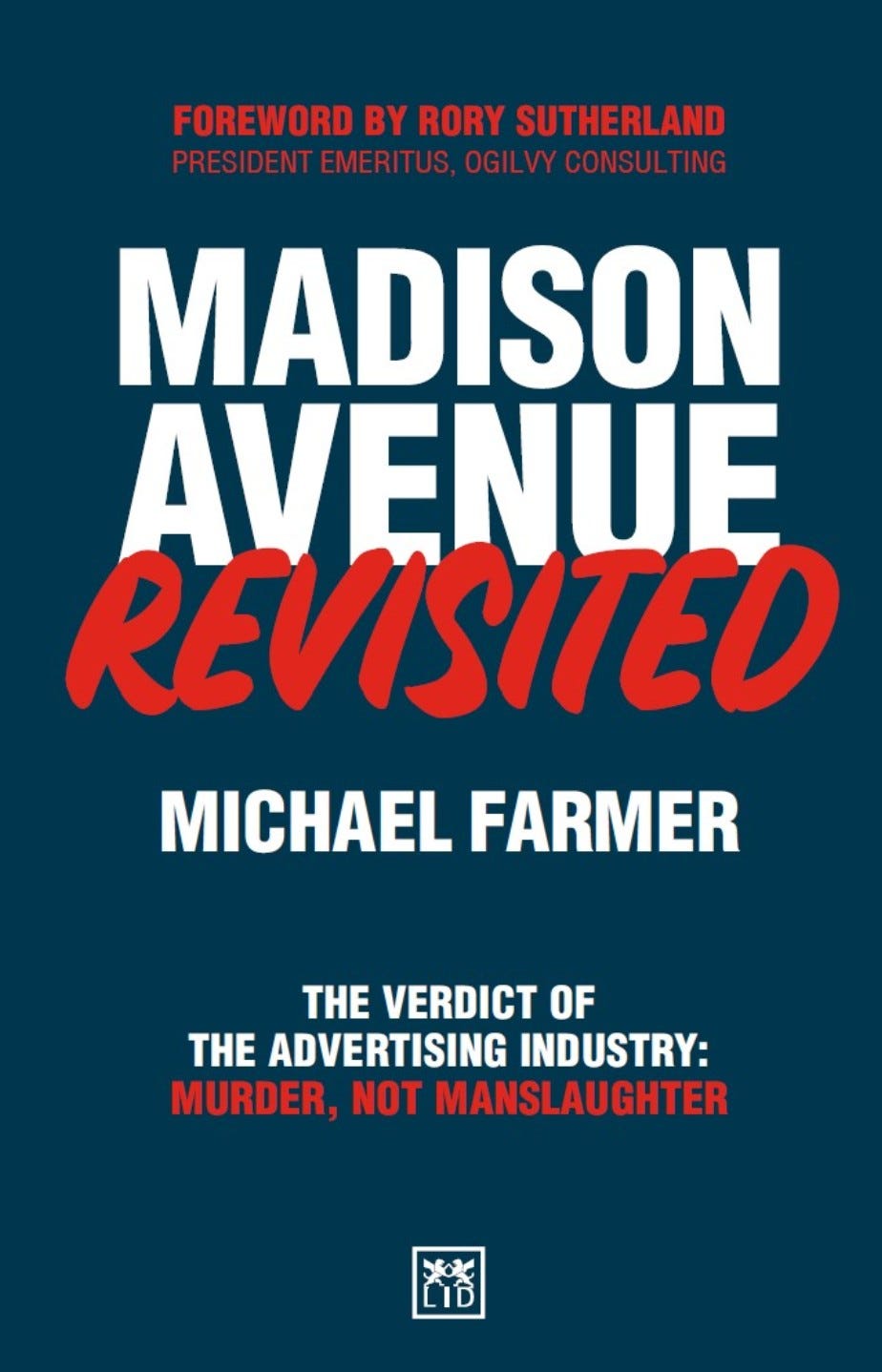
My third book about the advertising industry, Madison Avenue Revisited, is now available on Amazon. The book, which focuses on the evolution of media and creative operations, the effect of holding company ownership and the brand performance challenges faced by clients was launched at Cannes in June 2026.
No posts
Comments
Nothing yet. Say the first thing.
Sign in to join the conversation.