
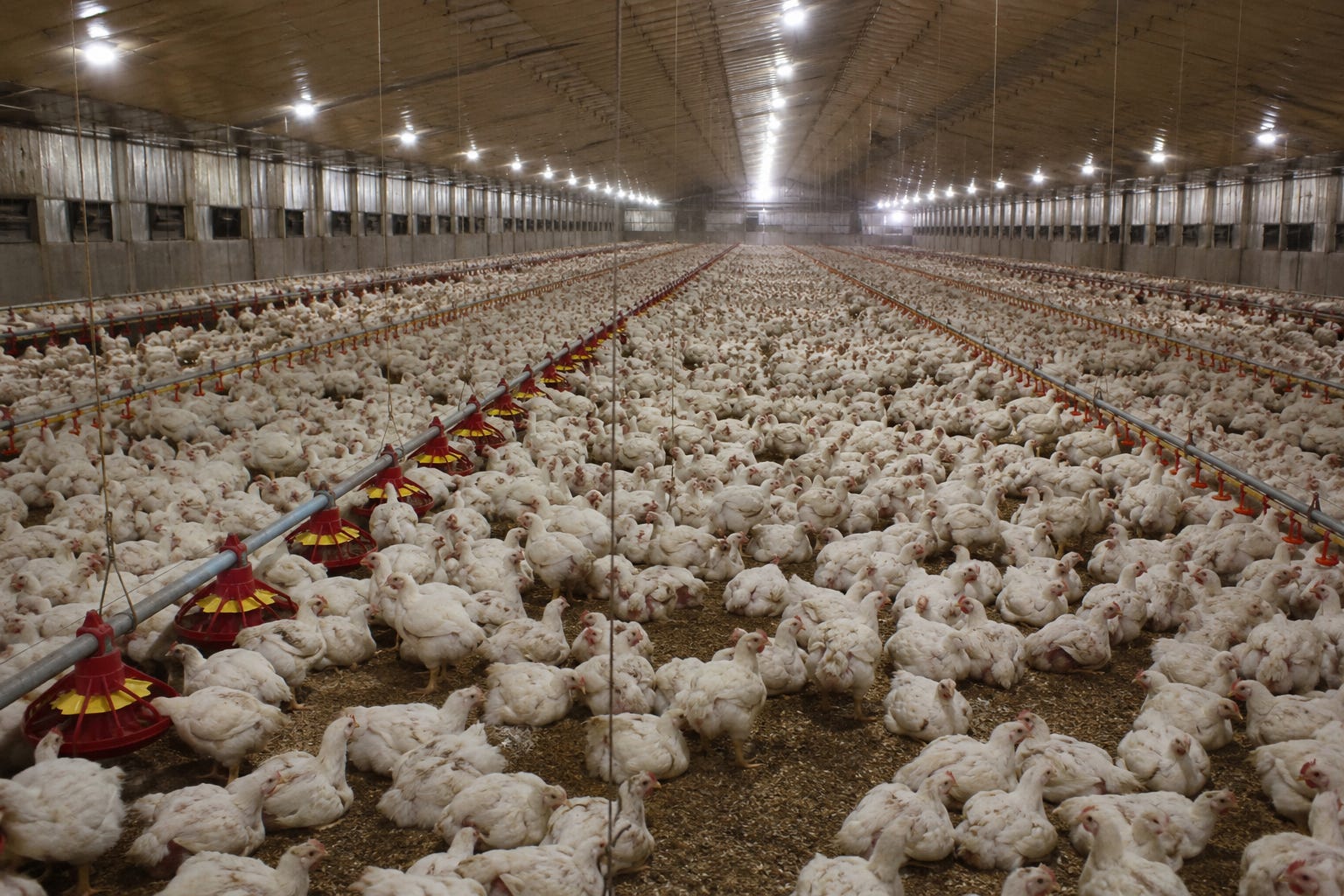
“Industrial farming has created one of the largest animal habitats on the planet.”
For decades, critics of factory farming have focused on what these systems do to animals. Chickens packed by the tens of thousands into industrial sheds live according to the demands of production efficiency, not their own needs.
But concentrating billions of animals in industrial systems has consequences beyond animal suffering.
It may also change how disease evolves.
A new study published in the Proceedings of the National Academy of Sciences examined how intensive poultry farming has affected Campylobacter jejuni, one of the world’s leading bacterial causes of gastroenteritis.
The researchers found evidence that the enormous growth of industrial chicken farming has reshaped the ecology and evolution of the bacterium, increasing opportunities for transmission, genetic exchange, adaptation, and movement between animal populations.
That makes this more than a chicken-industry problem.
Researchers from the University of Oxford and collaborating institutions analyzed 2,747 C. jejuni genomes collected from chickens and wild birds. Using genomic analysis and evolutionary modeling, they reconstructed how bacterial populations changed as chicken farming expanded.
One finding was especially striking.
The estimated rate of Campylobacter transitions from chickens into wild birds has increased roughly 100-fold since 1900 compared with predomestication levels.
The researchers also found major expansions in chicken-associated bacterial lineages following the rapid growth of industrial poultry farming beginning in the 1960s.
That matters because modern poultry production created something evolution had never encountered on this scale before: billions of genetically similar birds concentrated into an enormous human-managed population.
For a bacterium capable of living in chickens, that is a vast new habitat.
Global chicken populations have risen dramatically since the middle of the twentieth century. Today, chickens represent an extraordinary share of the world’s bird biomass.
Industrial production made that possible by concentrating large numbers of birds into standardized systems built around rapid growth and high output.
The Oxford researchers describe these enormous poultry populations as potential “pathogen sponges.”
Bacterial strains entering chicken populations can circulate through huge numbers of hosts and encounter strains arriving from other sources. The greater the host population, the easier it can become for bacterial populations to persist.
The researchers’ modeling suggests that once chicken populations become sufficiently large, even strains that are not particularly well adapted to chickens may survive and establish themselves.
Scale changes the biological equation.
When billions of animals become available as hosts, pathogens gain opportunities that simply did not exist when chickens lived in far smaller and more dispersed populations.
Bacteria are not plotting against us. They adapt to their environment because natural selection favors organisms capable of surviving and reproducing under existing conditions.
Industrial agriculture creates conditions of its own.
The researchers identified genetic characteristics in chicken-associated Campylobacter connected with functions including oxidative stress response, movement, metal homeostasis, and antimicrobial resistance.
Antimicrobial resistance is especially concerning because resistant bacterial infections are already a major global public-health problem.
This study does not show that factory farming created every antibiotic-resistant strain of Campylobacter. Nor does it show that poultry farming alone explains the broader crisis of antimicrobial resistance.
Its conclusion is more specific.
Industrial poultry production has created ecological conditions that can increase bacterial transmission, mixing, persistence, and adaptation.
That alone deserves serious attention.
Agricultural policy often treats factory farms as though their consequences remain within the buildings where animals are confined.
Biology is not that cooperative.
Bacteria move through animals, people, water, soil, equipment, transport systems, and wildlife.
The study found evidence that the historical separation between Campylobacter populations associated with wild birds and those associated with chickens has weakened as poultry farming has intensified.
That means changes occurring inside industrial farming systems can spread into surrounding ecosystems.
Professor Sam Sheppard, senior author of the study and professor of microbial genomics and evolution at Oxford, described the scale of the transformation plainly:
“Industrial farming has created one of the largest animal habitats on the planet.”
Humans created that habitat deliberately, but not because chickens needed it.
We created it because modern agriculture wanted inexpensive animal flesh in enormous quantities.
The microbes simply responded to the world we built.
This research also exposes something broader about factory farming.
Animal welfare, environmental protection, antimicrobial resistance, food safety, and zoonotic disease are often discussed as separate problems. In reality, they frequently grow from the same agricultural system.
Industrial chicken farming depends on enormous numbers of birds being raised quickly and cheaply.
Economic efficiency rewards scale and density.
But biological systems have their own rules.
When humans create huge concentrations of living animals, we also create huge concentrations of biological opportunity for organisms capable of exploiting them.
The suffering experienced by chickens is therefore not isolated from human interests. The same production model that treats animals as units of output can also produce environmental and public-health consequences that extend well beyond the barn.
That does not mean every chicken farm will cause an outbreak, or that eating chicken guarantees illness.
It means the structure of the system deserves scrutiny.
The most important question is not whether scientists can find better ways to manage the risks created by industrial animal agriculture.
It is whether we should remain so dependent on a system that creates those risks in the first place.
A food system that relies less heavily on raising enormous populations of animals would also reduce many of the opportunities for animal-associated pathogens to circulate through industrial livestock populations.
Plant-based foods do not require billions of sentient animals to be bred, crowded into production facilities, transported, and slaughtered.
That ethical difference matters by itself.
But research like this reminds us that the consequences of factory farming do not stop with the animals.
Industrial animal agriculture changes landscapes. It changes ecosystems. It affects water, climate, antibiotic use, wildlife, and human health.
Now we have more evidence that, at sufficient scale, it can also reshape the evolutionary environment in which pathogens live.
Factory farming has always imposed costs that never appear on the supermarket price tag.
The chickens pay the most obvious price.
The rest of us may be paying more of it than we realize.
Oakem J. Kyne, Bridget S. Penman, David J. Kelly, and Samuel K. Sheppard, “Accelerating Campylobacter zoonosis in the Anthropocene,” Proceedings of the National Academy of Sciences, July 27, 2026.
University of Oxford research summary
Veganism is more than a diet. It is a way of looking at our relationship with animals, the planet, and our own choices.
The Vegan Handbook offers a thoughtful introduction to vegan living, answering common questions while exploring the ethical and practical foundations of a compassionate lifestyle.
Comments
Nothing yet. Say the first thing.
Sign in to join the conversation.