

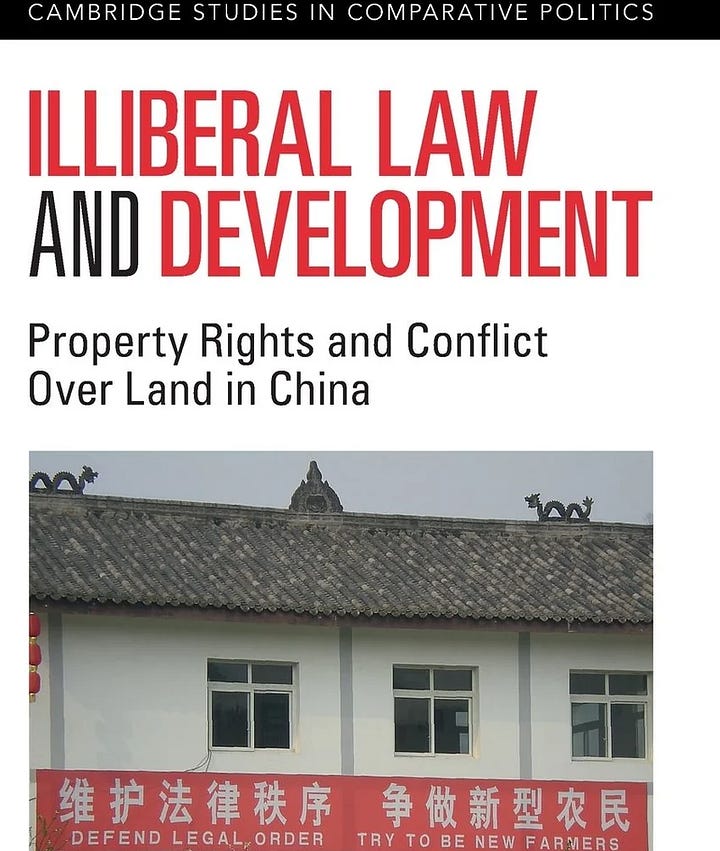
This post is an interview with Susan Whiting, Professor of Political Science at the University of Washington, who works at the intersection of law, property rights, and political economy in China. She is the author of an important new book, “Illiberal Law and Development: Property Rights and Conflict Over Land in China,” that draws on an original household survey of rural Chinese residents and deep fieldwork in rural China to investigate a question that is at the heart of China’s extraordinary economic growth and transformation over the last three decades: how has the country grown so fast with such insecure property rights, and what does that tell us about the relationship between law and development more broadly? Her answer is that China’s rapid development is rooted in a legal system that facilitates the reassignment of land rights toward higher-value uses when technology and the economy change. That means taking rural agricultural land on the cheap and converting it into urban land for industrial use, while containing the inevitable discontents that arise among rural residents. Her argument reframes conventional understandings of Britain’s industrial transformation and India’s struggles with land acquisition, and it challenges predominant institutions-first theories of development. With China’s land-backed growth model now in crisis — local government debt is mounting, property values are falling, and banks are sitting on massive paper losses — Susan’s work sheds light on what has gone right in China, what has gone wrong, and what comes next.
1) Your book opens with a puzzle that cuts against a core tenet of institutional economics: the idea that secure property rights are a precondition for robust economic growth. China has defied this expectation. It has sustained decades of extraordinary growth despite property rights – especially in land – that are, by design, insecure. How has it managed that, and what does it tell us about where conventional wisdom goes wrong?
I argue that, under conditions of technological change, a legal system that facilitates the reassignment of property rights from lower- to higher-values uses plays an undertheorized role in development.
The core tenet you refer to—that secure, private property rights, enforced through the legal system, are a prerequisite for economic growth—is certainly relevant in explaining the Chinese case. We can see this point within the agricultural sector, for example. The state implemented reforms, later reflected in formal law, that strengthened the rights of rural households to arable land. These property rights reforms contributed to growth in agricultural output and increases in productivity, in part through better incentives—even in the absence of technological change.
Existing theory is not as adept, however, at explaining the relationship between land rights and growth in the context of technological change—think of the transition from an agricultural to an industrial economy. This technological transition shapes the nature of demand for and use of land in urbanization, industrialization, and infrastructure development. Consistent with mainstream theory, any state has an interest in promoting innovation that expands economic activity from which it can extract revenue.
The Chinese system gives local governments the legal authority to take land from the rural sector and sell it into the urban sector at prices it determines. In other words, rural land rights have a systematic element of insecurity. The state shifts land from lower-value uses in agriculture to higher-value uses in industry, real estate, etc. We have witnessed the state use its legal authority to take land in order to build cities, industrial parks, and railways faster than anywhere else in history. Importantly, the Chinese system is less responsive to demand than it would be if it were fully marketized, and the lack of demand responsiveness leads to misallocation. China has over-built. At the same time, its transformation is dramatic, unmistakable, and demands explanation.
2) You put contemporary China in comparison with post-Glorious Revolution Britain, a case usually treated as the textbook example of secure property rights and inclusive institutions. What did revisiting this English episode of development through the lens of China teach you, and should we be more skeptical of how that story is typically told?
China’s experience made me wonder about other instances of transformative economic growth. What happened to rural land rights in transitions to urban, industrial economies elsewhere? While China’s “great transformation” took place in the late 20th/early-21st centuries, in Britain it occurred in the 18th century. There is a growing literature by economists and historians re-examining land rights in England’s industrial revolution. Scholars document that parliament, elected by only a small fraction of the adult population, intervened to reassign rural land rights to new uses through enclosure, estate, and statutory authority acts, often against resistance by those less likely to benefit. The majority of these acts were passed after the Glorious Revolution in 1688—when property rights are characterized as secure in mainstream accounts—and affected a significant share of the land area of England. They reassigned land rights to allow factories, warehouses, roads, bridges, and railways to be constructed around places like London, Manchester and Liverpool. In the English system, parliamentary acts were more responsive to demand than in China, but, in both cases, the state used law to make rural land rights less secure, playing an important role in fostering growth. My book builds on this research by theorizing the reorganization of land rights in development, specifically under conditions of technological change.
3) What pulled you toward land law as the main focus of this book, rather than property rights in other sectors or broader fiscal capacity?
Property rights and fiscal capacity are closely linked. China’s Land Management Law gives the local state a near monopoly over the conversion of land from rural to urban. At the same time, the expenditure responsibilities of local officials (paying for health care, education, and other services, as well as infrastructure development) exceed their revenue assignments under the current fiscal system[SHW1] . To fill this fiscal gap, state officials have captured the gains from selling use rights to land requisitioned from the rural sector at low prices into the urban sector at higher prices. During the period of fastest urban expansion, revenue from local governments’ land sales soared from 5 percent of fiscal revenue in the mid-1990s to a peak of 45 percent in 2020. Of course, land is a finite resource, and this fiscal strategy was unsustainable.
My first book, Power and Wealth in Rural China, examines the relationship between property rights and revenue extraction in China’s rural industrial sector. I explain how different forms of ownership (private, collective, state) shaped the way enterprises were taxed, with implications for the fiscal capacity of the state. In the post-Mao era, the Chinese state grappled with how to specify property rights to incentivize private entrepreneurs to invest; at the same time, the state struggled to learn how to audit and tax private firms, which had not existed in China since 1956. The emergence of non-state firms is part of the explanation for the fiscal crisis China experienced in the mid-1990s..
My latest research project focuses on water rights. I’m interested in explaining who exercises effective claims to water, an increasingly scarce and valuable resource in the twenty-first century. 4) This book draws on an original survey of nearly 1,900 rural households, a quasi-experiment built around a media campaign, and deep fieldwork in a select rural county in central China. Land disputes and local governance are politically sensitive subjects. While you have been doing fieldwork in China for decades, and in that sense approach this with expertise and sensitivity, what were the biggest challenges in designing and carrying out this research, and how did you build enough trust with local officials and villagers to get people to talk honestly about land grievances?
The research environment is always changing, but any issue that may be associated with protest or unrest can be particularly challenging. The survey would probably not be possible today—at least not with the involvement of foreign researchers. Fieldwork is the art of the possible, and interviews, case studies, and archival work continues. Local colleagues with shared scholarly commitments are essential in gaining acceptance in a community. It also helps to be an informed interlocutor. First immersing oneself in local scholarship, local media, and relevant policy documents allows one to ask questions that are relevant and meaningful. In-depth interviews were a foundation for the design of the large survey. In addition, since the study involved land rights and land disputes, it was possible in the case study to validate interview and survey responses with documentary records, like land certificates and court and mediation records.
5) An important argument in the book is that the law does two separate jobs: it reassigns property rights toward higher-value uses (such as converting land from rural to urban), and it channels and contains the conflict that reassignment produces. Why did you come to see these as two distinct mechanisms, and what do your data show about how the second job – deflecting conflict away from the state and onto villages and neighbors – actually operates on the ground?
The role of law in reassigning land rights and the use of law to manage the resulting conflict are related but distinct phenomena. I learned a lot from people who had been caught up in land takings, most of whom took some action (negotiating, mediating, petitioning, litigating, protesting) to assert their rights. Going into the project, I had thought that most state-land-takings disputes would take the form of administrative lawsuits, in which the local state is the defendant. Not only it is often difficult to file and to get courts to accept administrative suits, but Chinese land law does not favor rural landholders whose land is taken for development; they are not legally entitled to compensation for the value of land in its first-best use. As a result, it is difficult to successfully challenge the total compensation package. So, rural residents who seek more compensation often challenge their village leaders—including in civil lawsuits—over the rules leaders set to allocate the compensation package from the state to households and individuals. Rural residents also challenge their neighbors over land boundaries or over the status of land transfers between households, seeking to prove that they hold more land for which compensation is owed. The system has the effect of deflecting conflict away from the state to the village and into the community—a pattern that appeared in the larger survey data as well as the case study.
6) You also compare China to contemporary India, another huge, rapidly urbanizing country wrestling with repurposing rural land for industrial uses. What does that comparison tell us about how much democracy versus authoritarianism matters for whether and how states reassign property rights, and for how they manage the conflict that follows?
Similar to China, India’s 1894 Land Acquisition Act (a legacy of British colonialism in force until 2013) and its 2005 Special Economic Zone Act (modeled after Chinese practice) empowered the Indian state to take land at below-market prices to provide for industrial parks and real estate development in special economic zones. However, in contrast to China, citizens have more opportunities to advocate for their land claims against the state. Electoral competition among political parties at the national and state levels, relatively independent courts, and political space for civil society and social movement activism enable citizens to more effectively defend their claims to land. These factors directly contributed to the passage of the 2013 Right to Fair Compensation and Transparency in Land Acquisition, Rehabilitation, and Resettlement Act, which put in place new protections for both landowners and landless farm workers. The Modi Administration tried and failed to roll back these protections. Democracy matters. By contrast, the rights defense movement in China, which included defending citizens’ land rights among its causes, faced a major crackdown in 2015, significantly curtailing its activities. 7) China’s land-backed growth model – which has flipped rural land into urban land on the cheap for industry and which has laid the foundations for ever-more expensive real estate in cities – is now in real crisis. Land sales and home values are declining and local government debt is mounting. How far might the crisis go, and is there a realistic path away from this model?
Policymakers like former Minister of Finance Lou Jiwei have long stressed the unsustainability of China’s land-backed growth model, but the political will was lacking to implement system-wide reforms proposed back in 2013.
Local governments have used land sales to cover the fiscal gap between their expenditure responsibilities and revenues assigned to them. Proposals put forward over the last decade would have put in place a new property tax to provide a more solid fiscal foundation for local governments. At the same time, a functioning property tax system would likely have reduced local government windfalls from land sales and dampened real estate speculation. Such reforms are even more politically difficult to contemplate now.
Local governments have also relied on land as collateral for borrowing to pay for infrastructure development—debt that is unlikely to be paid back in the context of over-supply and declining property values. The central government has allowed local governments to issue trillions of yuan in bonds to facilitate debt repayment, but even this step is inadequate, leaving risks for the broader financial system.
Write-offs of non-performing bank assets and bank recapitalization are likely to become necessary, but, even in the absence of meaningful reforms, the system is capable of limping along in the same way for years to come.
No posts
Comments
Nothing yet. Say the first thing.
Sign in to join the conversation.