
As the US House and then the Senate wrangled to pass the “Big Beautiful Bill” early in the Trump administration, a slice of Republican legislators in each body tried to pack in provisions to sell off public lands. The Senate version of the bill was bolder than the House version: it aimed to dispose of between 2 million and 3 million acres of land across 11 Western states that belong the Bureau of Land Management and the U.S. Forest Service. That provision was ultimately stripped from the bill at the last minute to enable its passage.
But the reprieve for public lands has proven short-lived. In the last week, several major threats to public lands have resurfaced. The most expansive one is a Trump administration plan to repeal the “roadless rule” that protects about 45 million acres of wilderness in national forests. The plan would remove protections from these lands and open them for logging. On August 18, the Forest Service made this official, filing to rescind the 2001 Roadless Area Conservation Rule in its entirety and opening a month-long public comment period. Meanwhile, in Texas and Arizona, government contractors have been bulldozing sensitive national park and national monument land in order to fortify the southern border with Mexico. Taken together, these actions demonstrate the disregard for the long role that public lands have played in conservation, recreation, and cultural preservation.
Public lands are a unique feature of the American West. While there is a small collection of public land in eastern states, slightly over half of all land in the West, comprising hundreds of millions of acres of land, is owned by the federal government. As America expanded westward in the 1800s and settlers felled forests, threatened major species, and exploited natural resources at an alarming scale, a growing conservation movement arose to preserve the landscapes and ecosystems that remained. Because of this history, the federal government held onto hundreds of millions of acres of land and has extended various protections to them.
It has been clear since the start of the Trump administration that the government instead views public lands as a resource to exploit for narrow interests. Early leaked documents from the Department of Interior clearly indicated that that the agency wanted to make it easier to use public lands for mining, logging, and oil drilling. The removal of the “roadless rule” would be a big step in that direction. The rule, which dates back to the Clinton administration, aims to preserve the wilderness character of forest land. It prevents road-building in about 30% of national forests and also blocks mining and logging on those lands. A public comment period on the same proposal to rescind the rule last fall drew more than 625,000 responses, 99% of them in opposition – a sign of how unpopular this move is outside Washington.
The Trump administration argues that introducing logging in these areas would reduce wildfire risks and building roads would enable fire fighters to more easily reach blazes that start. And it’s true that forest management for wildfire risk has been limited for decades, enabling fuel buildup. Raging fires across the West this summer are a testament to that. Critics also point out, however, that roads bring people, and that that over 80% of wildfires are sparked from human activity like discarding cigarette butts and car accidents. Most fires sparked in remote areas come from lightning strikes, and they tend not to grow as large as human-induced fires. There are other consequences of roads, too, like the introduction of invasive species. And the forest service already struggles to maintain the roads they have.
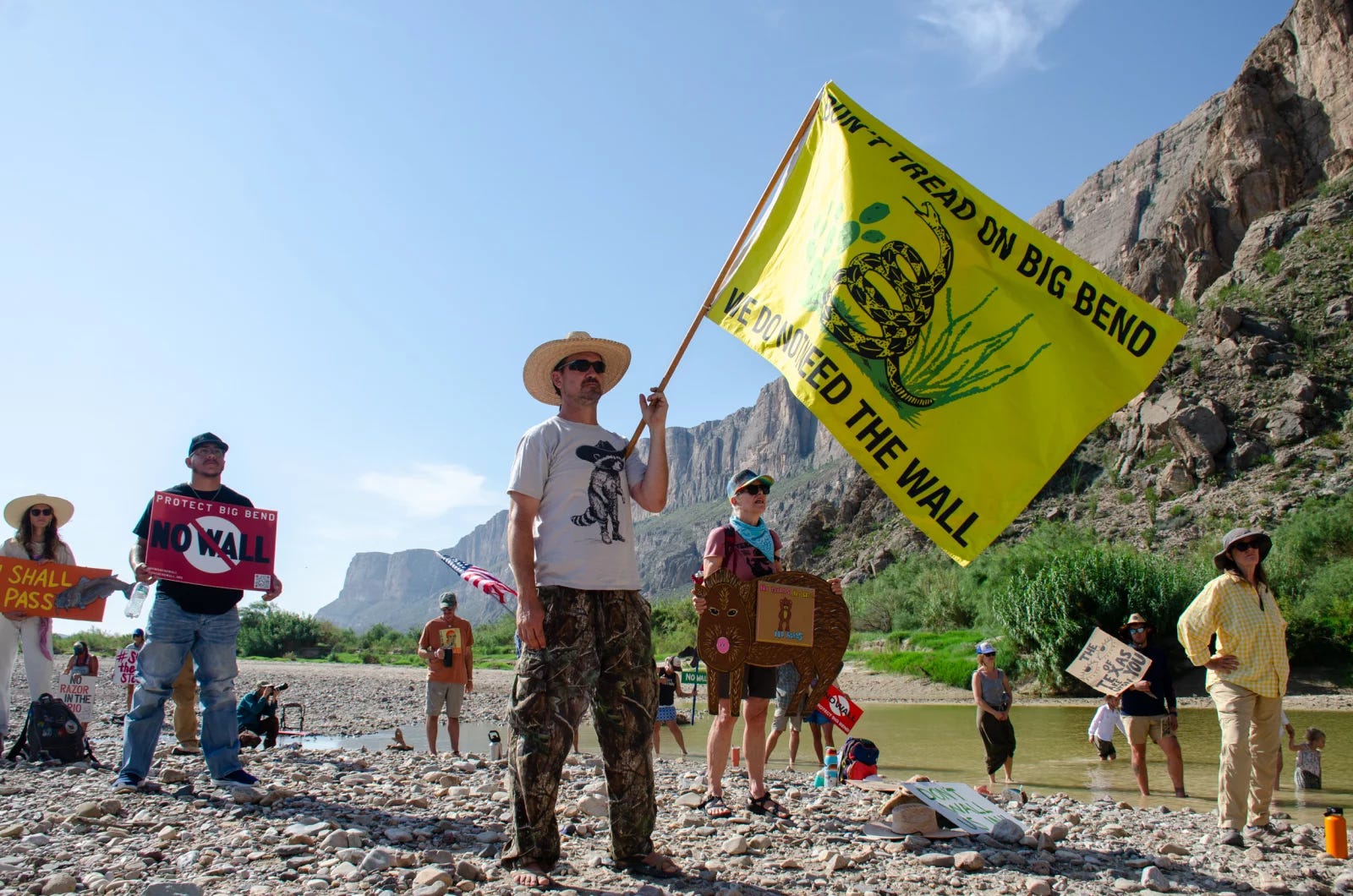
The attack on public lands extends farther, too. In the last several weeks, federal contractors started bulldozing ecologically sensitive areas in Big Bend National Park to clear land in order to build patrol roads, vehicle barriers and surveillance systems along the border with Mexico. The work is part of a $1.7 billion construction project inside the park, and it proceeded only after the administration waived dozens of environmental and historic-preservation laws in June, including the National Park Service Organic Act and the Endangered Species Act. That has sparked public outcry among landowners, outdoor enthusiasts, and businesses across the political spectrum that fear the landscape could be permanently altered. A bipartisan group of 46 Texas state representatives wrote to Governor Greg Abbott urging him to intervene.
Farther west along the southern border in southern Arizona, Organ Pipe Cactus National Monument is also being disturbed. During the first Trump administration, work crews built a 30-foot steel wall straight through the monument, including through Quitobaquito, the ancestral homeland of the Hia-Ced O’odham nation over strong tribal objection. Now the Department of Homeland Security is building a second, parallel wall to double the barrier. This week, the Center for Biological Diversity released photos of bulldozers clearing protected lands inside the park.
The nearby Tohono O’odham Nation is also impacted. They sued the Department of Homeland Security several months ago over another stretch of wall that would cut through their reservation land, arguing that it violates their sovereignty, divide the reservation, and damage the land and historical sites. A federal judge denied their request for an injunction earlier this week. As in Texas, both of these federal actions in Arizona have drawn organized community protests.
All of this shows that the government doesn’t respect public lands or feel bound by the rules guiding their treatment. Its efforts to sneak in major changes under the radar or invoke emergency authority in order to waive laws that would mandate public input have – as in other domains – catalyzed resistance. Public lands remain one of the few American institutions that command support across the political spectrum, from ranchers to conservationists and tribal nations to select House and Senate Republicans. So far that has been enough to slow the administration down, but it has not stopped. The roadless rule could be the clearest test of which way the balance tips: the comment period is open through September 21, and last time the public weighed in on the same question, it forced the administration to back down.
No posts
Comments
Nothing yet. Say the first thing.
Sign in to join the conversation.