
From the Past is a collection of pieces I’ve written before starting my Substack. Full disclosure: This is a final draft submitted to the now-defunct media network and news curator thepoc.net (The Philippine Online Chronicles) in 2013.
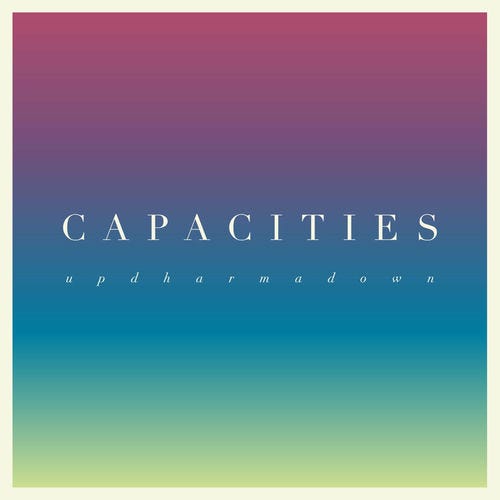
When Capacities came out in 2012, it seemed like the hype surrounding the album was threatening to overshadow the actual merits of Up Dharma Down’s long-awaited third release. The focus was on the fact that it took the band four years to finally come out with Capacities after critically acclaimed and well-received albums, Fragmented and Bipolar—as if Up Dharma Down had come back from a hiatus, when in fact they had been performing and releasing songs regularly.
Anticipatory single “Tadhana” fared well as GMA Network television show Ilumina’s signature theme in 2010. In 2011, a live recording session of Up Dharma Down’s track “Indak” was featured in an episode of production house Tower of Doom’s YouTube series Tower Sessions. Terno Recordings’ flagship act is also often seen and heard during the independent record label’s Terno Inferno events. When they’re not there, chances are they are performing somewhere else—sometimes in a completely different time zone.
Second albums are often said to be the most difficult to make, because it is the moment of truth for most musicians and songwriters. Though it may take someone a lifetime to produce an amazing debut, typically a sophomore release is expected after a few years—not, obviously, another lifetime.
With every successive project, a musician is tested. How long before exhaustion wins out? How long before the well is dry, and there is nothing more to write about? Up Dharma Down skillfully sidestepped the sophomore curse, in part by releasing Bipolar two years after Fragmented—allowing time for the band to mature and further develop their distinctive, though still mainstream-friendly, sound.
It is worth noting that though Armi Millare is the band’s frontwoman, singer, and main songwriter, the songs are polished and arranged by the band as a whole—making Up Dharma Down’s music the product of collective and collaborative input, which does require that the band go through their share of growing pains.
Their approach with Capacities seemed no different. The beauty of being independent is that there is more leeway for Up Dharma Down to be able to release new music when they feel they are ready, instead of doing it on a schedule. Hence, the third album is still unmistakably Up Dharma Down—just older, wiser, more refined, and more experienced.
This time, the band’s electronic influences led them further down the road of ‘80s synth pop and off the beaten path. Is it also very consistent. While there is no overt sign of it, Capacities feels wholly like a conceptual undertaking. Not a single track sounds rushed, half-hearted, dragging, or in any way designed to be a filler to stick in between radio singles.
How much the band must have grown in four years, to be able to produce such a compact, cohesive work of art—alongside maintaining a grueling performance schedule—may very well be colossal in scale.
“Turn It Well” functions as the first track and Capacities’ lead single, not counting pre-album releases “Tadhana” and “Indak.” It is a faultless opening track, setting the tone for the rest of the release. There is a palpable feeling of excitement that builds up as the ‘80s-drenched four-on-the-floor settles in. Right from the very beginning, it feels like Capacities is the sophisticated, exclusive, invite-only afterparty following the previous two albums.
Whereas early on in Up Dharma Down’s career, there was a tendency to rely on Millare’s vocal skills to fill out otherwise spare or predictable songs, there is none of that here. The brilliance of the collective effort shines through. It is fantastically arranged, as evidenced by the song’s surprising length. It clocks in at over six minutes, but as you listen to it, there is no sense of boredom. You never feel like you want it to end.
In the same vein, “Parks” is a glorious culmination of Up Dharma Down’s predilection for sample use and synth dependency. The distorted guitar riffs and little dissonant piano fills particularly lend color and strength to an otherwise wistful, passive track.
Again, the lulling beat under Millare’s crooning carries you away, and when the song ends, it almost feels like a betrayal of confidence—like there should be more to the song than the already long five and a half minutes. Thankfully, the next track is the beautiful “Indak.”
There is something different about Up Dharma Down songs in the vernacular—they’re more intimate, more delicate, more heartbreaking. However, more than “Indak” or “Tadhana,” the killer Tagalog song of Capacities is “Kulang”—it is very slightly The Cure, very slightly Depeche Mode, and very much Up Dharma Down at their best.
“Kulang” is such a full track, precisely because there’s room for each influence, each vocal inflection, and each part of the song to breathe. The restraint shown in the arrangement is commendable. And as always, Millare’s voice paints sadness and pain so beautifully.
If there’s anything to be disappointed about when it comes to Capacities, it’s at the end, when the version of “Feelings” with Paul Buchanan follows strong album ender “Night Drops”—Buchanan’s unaccompanied vocals start the song, stark and nearly shocking after nine tracks of Millare’s voice leading Capacities.
While it’s understandable for Up Dharma Down to create an album version without Buchanan—the frontman of Scottish band the Blue Nile, who has collaborated with the likes of Peter Gabriel, Aqualung, and Annie Lennox—the version with him is so much better that it naturally relegates the other to an inferior position, though in essence it is the same song.
Placing the better, collaborative “Feelings” at the end negated the track order—which employed similar-sounding “Turn It Well” and “Night Drops” to bookend the release—and made it seem like the obviously well-planned song was an afterthought.
Overall, Capacities is a solid album. Well worth listening to and purchasing, even though at three singles in, you don’t even really need to weigh your options—the product speaks for itself. Up Dharma Down can only get better from here. Let’s just hope it doesn’t take them longer than four years for the next album to come out.
Image by Up Dharma Down on Deezer
If you’ve enjoyed reading this or something else I’ve written, please consider clicking the subscribe button or buying me a coffee. ☕ Thank you!
Comments
Nothing yet. Say the first thing.
Sign in to join the conversation.