
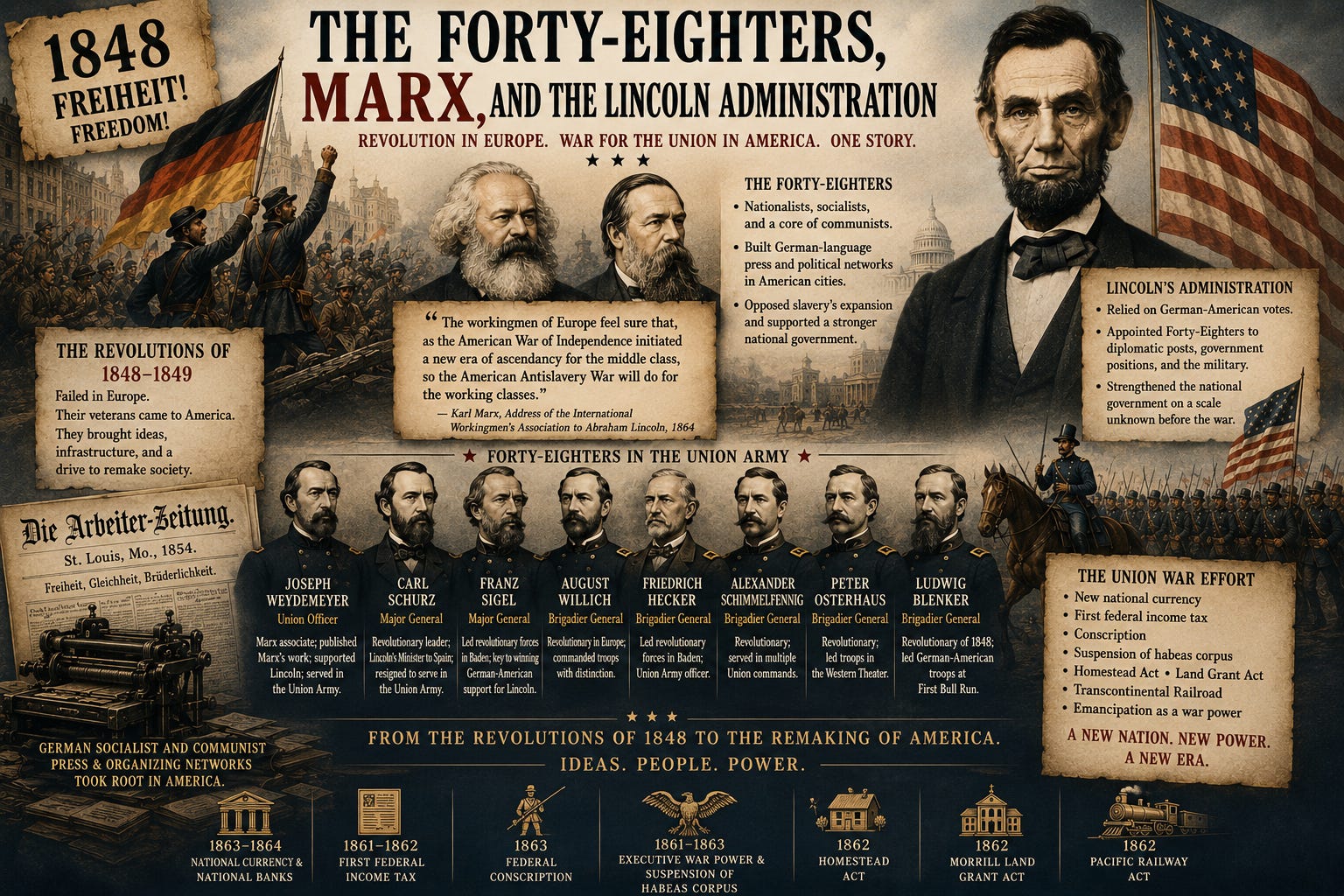
A reader asked me recently who the Forty-Eighters were, and why any of it matters today. It is a fair question, and the short answer deserves the long version, because the story runs straight through Karl Marx, the German vote that helped elect Lincoln, and the Union officer corps itself.
WHO THE FORTY-EIGHTERS WERE
The Forty-Eighters were the refugees of the failed European revolutions of 1848 and 1849, most of them from the German states. When those revolutions collapsed, the men who had led them, organized them, and fought in their street battles left Europe by the boatload and landed in America. They came to a country that offered land, work, and a political fight of its own already building.
They were not a single ideological bloc. There were nationalists, socialists, and a hard core of committed communists among them. What bound them together was 1848 itself, not a shared program.
That hard core matters, because the Forty-Eighters were the first substantial, organized influx of socialists and communists into the United States (1). Before 1848, socialist and communist thought in America existed mostly as isolated utopian experiments, communes and colonies with no political infrastructure behind them. The Forty-Eighters brought something different. They brought veterans of the Communist League, men who had organized workers' associations and printed radical newspapers in Europe, and they set that same infrastructure down inside American cities with large German populations. St. Louis, Cincinnati, Chicago, and New York all had German language socialist and communist press and organizing networks by the 1850s that traced their roots directly to 1848 (2).
MARX AND THE MEN WHO CARRIED HIS POLITICS WEST
Karl Marx and Friedrich Engels were themselves participants in the revolutionary movement of 1848. Marx wrote the Communist Manifesto that same year, and the Communist League he helped lead supplied cadre to the uprisings across the German states (3). When those uprisings failed, some of that cadre crossed the ocean.
Joseph Weydemeyer was the clearest case. He was a member of the Communist League, a personal correspondent of Marx and Engels, and after he reached America he published Marx's The Eighteenth Brumaire of Louis Bonaparte. He stayed active in socialist organizing among German immigrants, supported Lincoln in 1860, and took a commission in the Union Army (4). Weydemeyer connects Marx's own inner circle directly to a Union uniform.
Marx himself stayed engaged with the American conflict from London. In November 1864, days after Lincoln's reelection, Marx drafted an address on behalf of the International Workingmen's Association and signed it as the group's corresponding secretary for Germany. The message called the Union's fight the triumphant war cry against the slave power and framed it as a struggle carrying the destiny of Europe's working class (5). Ambassador Charles Francis Adams delivered it in London, and Lincoln sent back a brief, formal thank you through Adams, the same kind of reply any foreign well wisher would have received (6). There is no evidence Lincoln read Marx's economic theory or grasped who Marx was beyond one signature among many on a congratulatory note (7).
MARX AS WAR CORRESPONDENT
Marx was also a working journalist covering American affairs for an American audience. Charles Dana, managing editor of the New York Tribune, had met Marx in Cologne in 1848 and hired him in 1852 as the paper's London correspondent. Over the following ten years Marx wrote more than five hundred articles for the Tribune, some under his own byline, others unsigned, many drafted with Engels, who specialized in military analysis while Marx handled the political and economic picture (8).
His private assessment of Lincoln, delivered to Engels rather than to Tribune readers, was impatience rather than admiration. In a letter dated August 7, 1862, Marx told Engels plainly that a war of this kind had to be fought on revolutionary lines, and that the Union so far had only tried to fight it constitutionally (9). He wanted Lincoln to go further and faster, and to use the full weight of national power against the South.
He got his wish within months. When the Emancipation Proclamation came, Marx's tone changed. He described the fighting up to that point as merely the constitutional waging of war, language that marked the Proclamation as the moment the conflict crossed into the revolutionary register he had been demanding (10). Emancipation was, in Marx's reading, an executive war power reaching directly into the internal affairs of the Southern states, precisely the kind of extraordinary national authority he had wanted the Union to use from the start (11).
THE LINCOLN ADMINISTRATION AND HOW IT TIES IN
Weydemeyer was not the only Forty-Eighter who put on a Union uniform, and he was not the most prominent. Carl Schurz, Franz Sigel, August Willich, Friedrich Hecker, Alexander Schimmelfennig, Peter Osterhaus, and Ludwig Blenker all became Union officers after careers as European revolutionaries (12). Sigel had commanded revolutionary forces in Baden.
The Forty-Eighters were not confined to the officer corps. Lincoln put them inside his administration directly, as a matter of deliberate political strategy, because German American votes were decisive in states his coalition needed.
Schurz is the clearest case. Before he ever wore a general's stars, Lincoln appointed him minister to Spain in 1861, a diplomatic post handed to a man who had been leading revolutionary troops in Baden thirteen years earlier (13). Schurz treated the appointment as a stepping stone and pushed Lincoln for a military command instead, which he received in 1862.
George Schneider is a second, less famous case worth naming. Schneider had been an active participant in the 1848 revolutions and became a German language newspaper editor in Chicago and a driving force in mobilizing the German American vote for Lincoln's nomination. Lincoln rewarded him with an appointment as United States consul at Elsinore, Denmark, at the outbreak of the war, and later named him Collector of Internal Revenue for Illinois's first district (14).
These were not isolated favors. Consulships, revenue posts, and lesser diplomatic appointments went to Forty-Eighter editors and organizers across the German American press network as payment for the votes and the organizing they delivered (15). Large German immigrant communities sat in states Lincoln needed to win, and the Forty-Eighters carried real weight inside those communities. Many of them opposed slavery's expansion on principle and pushed for a stronger national government than the country had known before the war.
The tie runs deeper still. The 1840s and 1850s were a single transatlantic moment. Europe was breaking apart old orders that had stood since Napoleon, and the men doing the breaking wanted centralized nations, industrial economies, and governments strong enough to remake society from above. That fight failed in Baden, in Prussia, in the Austrian Empire in 1849. It did not fail in America.
Lincoln's presidency delivered the American version of that same centralizing turn. Consider what changed between 1861 and 1865. A national currency replaced a patchwork of state and private bank notes (16). The first federal income tax in American history passed to fund the war (17). The first federal conscription law compelled men into national service (18). Lincoln suspended habeas corpus and expanded executive war power beyond anything Jackson or Polk had claimed (19). The Homestead Act, the Morrill Land Grant Act, and the transcontinental railroad charter used federal power to remake the economy and the West in a single stroke (20). Emancipation itself came as a war power, an act of the national government reaching directly into the internal affairs of the states in a way the antebellum constitutional order had never permitted.
WHY IT MATTERS NOW
The revolutions of 1848 failed in Europe. Their veterans, including organized socialists and communists, emigrated to America in numbers and with an infrastructure the country had not seen before. Many joined Lincoln's political coalition. A meaningful number became Union officers, and some took posts inside his administration directly. Marx's own circle in the Communist League produced Weydemeyer, who carried that lineage into the Union Army, and Marx himself watched the war from London, first as a critic of Lincoln's caution and then as a supporter of the executive power Lincoln finally used.
That first influx planted something that did not disappear. The German language socialist and communist press networks the Forty-Eighters built kept operating for decades after the war, and the organizing habits they brought with them became part of the template for the American labor and socialist movements that followed into the twentieth century (21). The Forty-Eighters are a real, documentable place to start looking for the roots of that history.
Don't take my word for it. Read the documents.
By Mindy Esposito/ August 16, 2026/ Nashville, Tennessee
NOTES
1. Bruce Levine, The Spirit of 1848: German Immigrants, Labor Conflict, and the Coming of the Civil War (Urbana: University of Illinois Press, 1992).
2. Carl Wittke, Refugees of Revolution: The German Forty-Eighters in America (Philadelphia: University of Pennsylvania Press, 1952).
3. Karl Marx and Friedrich Engels, Manifesto of the Communist Party (London, 1848).
4. Karl Obermann, Joseph Weydemeyer: Pioneer of American Socialism (New York: International Publishers, 1947).
5. Karl Marx, "Address of the International Working Men's Association to Abraham Lincoln, President of the United States of America," drafted November 22-29, 1864, presented to Ambassador Charles Francis Adams, January 28, 1865.
6. Charles Francis Adams to the International Workingmen's Association, conveying President Lincoln's reply, January 1865.
7. Phillip W. Magness, American Institute for Economic Research, response to claims of a Marx-Lincoln intellectual relationship, 2018.
8. James Ledbetter, ed., Dispatches for the New York Tribune: Selected Journalism of Karl Marx (London: Penguin, 2007).
9. Karl Marx to Friedrich Engels, August 7, 1862, in Marx and Engels Collected Works, vol. 41 (New York: International Publishers, 1985).
10. Karl Marx, "The Situation in America," Die Presse, October 1862.
11. Karl Marx and Friedrich Engels, The Civil War in the United States, ed. Andrew Zimmerman (New York: International Publishers, 2016).
12. Levine, The Spirit of 1848.
13. Hans L. Trefousse, Carl Schurz: A Biography (Knoxville: University of Tennessee Press, 1982).
14. James M. Bergquist, "German Americans," in Ethnic Chicago, ed. Melvin G. Holli and Peter d'A. Jones (Grand Rapids: Eerdmans, 1984).
15. Wittke, Refugees of Revolution.
16. National Currency Act, 1863, and National Bank Act, 1864.
17. Revenue Act of 1861, expanded by the Revenue Act of 1862.
18. Enrollment Act of 1863.
19. Lincoln's suspension of habeas corpus, beginning April 1861, and the Habeas Corpus Suspension Act of 1863.
20. Homestead Act of 1862; Morrill Land Grant Act of 1862; Pacific Railway Act of 1862.
21. Wittke, Refugees of Revolution.
No posts
Comments
Nothing yet. Say the first thing.
Sign in to join the conversation.