
I have not written a new chapter of this book in six weeks.
I have been rewriting the old ones instead.
Chapters Six through Thirteen went back to the workbench, one at a time, because I realized somewhere around the middle of this project that they did not fully tell the story I set out to tell. They told part of it. They got the dates right and the quotes right and the battles right. What they didn't do, not fully, was show the whole Confederacy failing to defend that river at once, Virginia getting the men and the attention while Missouri lost its government, while Kentucky split in half, while New Orleans sat behind a chain that broke two months before anyone tested it. I left the original dates on every rewritten chapter. That is when I actually wrote them, in the order I actually wrote them, mistakes and corrections and all.
AUGUST 14TH
I went back to the river.
Memphis first, then across the bridge into Arkansas, looking for Hopefield.
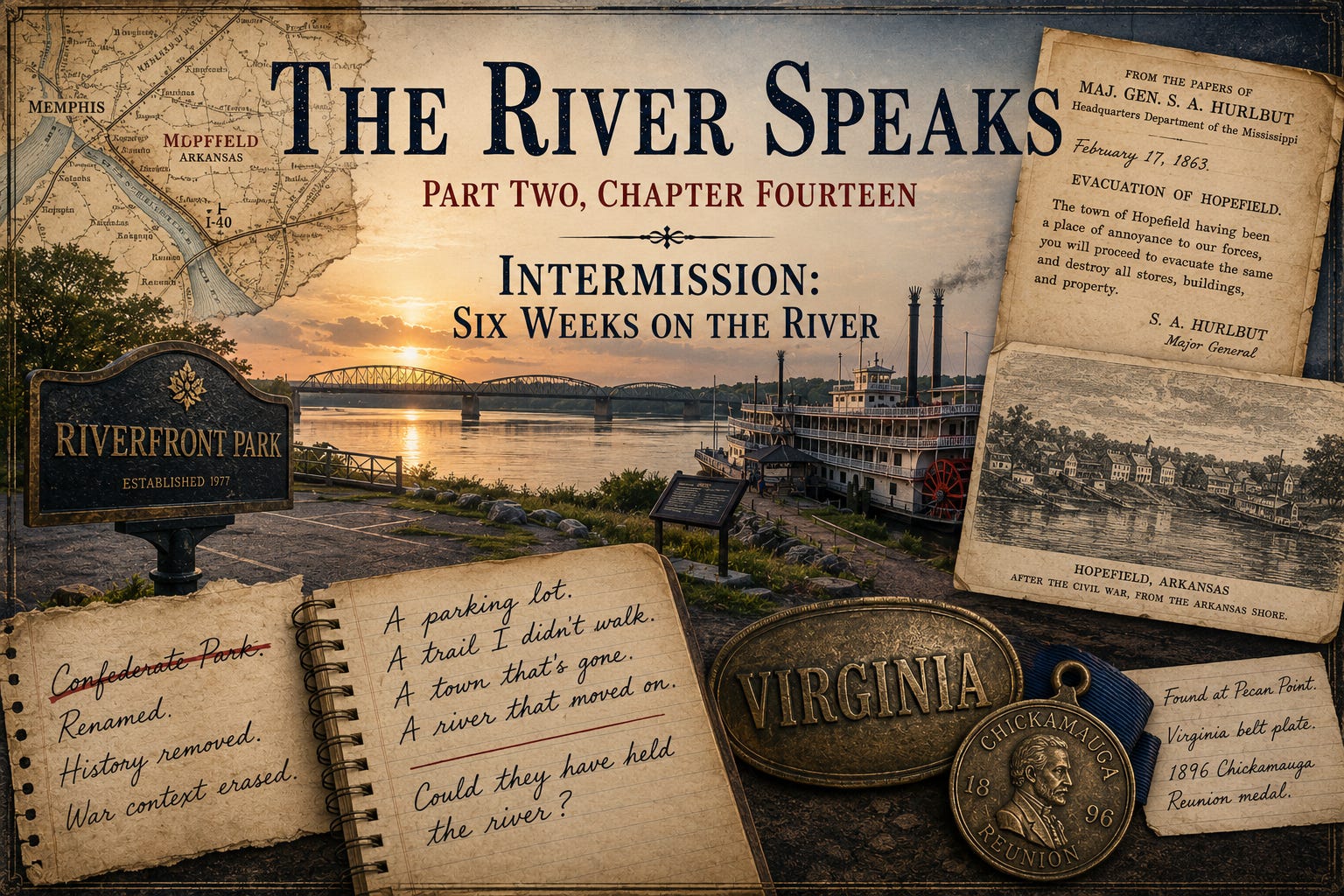
I had done the research before I went. I knew what I was looking for. Hopefield sat on the Arkansas side directly across from Memphis, the eastern end of the Memphis and Little Rock Railroad, important enough that the Confederacy converted its railroad machine shops into an armory during the war. After Memphis fell in June 1862, Confederate soldiers and partisans used the town and the country around it to keep fighting from the far bank, threatening Federal river traffic while Memphis turned into a Union supply and hospital base for the push toward Vicksburg. In February 1863, Federal commander Stephen Hurlbut had enough of it. He ordered the town evacuated, and on February 19th his men burned it to the ground.
The river finished what the fire started. Flooding and erosion took the rest of it, decade by decade, until there was nothing left to stand on. Today the I-40 bridge crosses roughly where the town once was.
My GPS took me to a parking lot on the Big River Trail, about a mile and a half south of the bridge. There was a trail leading off from it that I didn't walk. I assume it led down to the river, but downstream now of where Hopefield actually stood, the water having moved west of the old town site the same way it has moved everywhere else along this stretch. There is no preserved Hopefield to walk through. There is a parking lot, a trail I didn't take, a levee, and the river.
I was disappointed. There isn't anything left that I could see. And the river has changed course.
Memphis gave me something, at least, and something worse than I expected in a different way.
I went to what used to be called Confederate Park, the ground that overlooks the river where thousands of Memphis civilians once stood before dawn to watch the Battle of Memphis unfold on June 6th, 1862, a battle that ended in under two hours with the Confederate River Defense Fleet essentially destroyed and Memphis handed to the Union. The park has been renamed. Every reference to the Civil War is gone. Stripped of any war context whatsoever. Not for historical accuracy, but rather for modern political characterizations... There is nothing there now to tell you that this ground watched a naval battle for the Mississippi River, nothing to mark it as the vantage point for one of the most consequential mornings in the whole river campaign. You could stand on that bluff and never know what happened in the water below you.
The water below you has changed too. There is a river channel running right up to the bank now. Two sternwheelers were docked there the day I visited. The main channel of the Mississippi has moved west, the way it always does, indifferent to the battle it once carried on its back.
I looked for Hopefield and found a parking lot and a trail I didn't walk. I looked for the ground that watched Memphis fall and found a name with the history scrubbed off it. Both trips left me a little sad. I don't think that's the wrong thing to feel standing on ground like that.
WHAT MY READERS FOUND
I asked for help. I always do.
I put out a call for any photograph, drawing, engraving, or map of Hopefield itself before 1864, not just the famous 1862 Harper's Weekly view of Memphis drawn from the Hopefield side, but something that actually showed the town, its riverfront, its railroad, its armory.
Reed Ryals answered first. His family had farmed at Pecan Point and owned what was once called Shawnee Village, ground that belonged to the McGavock family before his people bought it in the 1820s. "It's been years since I went there," he wrote. "Back in the 80s when the river got really low. There was a riverboat and some other wooden ships. Just down from it I took my metal detector but didn't find anything. A friend found a metal box with some gold coins in it." He had dug things out of that same ground himself, a Virginia belt plate, and a reunion medal for General George Thomas, made for a veterans' gathering commemorating Chickamauga. His own uncle, who worked for a Memphis paper, had etched an illustration for the war's centennial using acid on a printing plate, an image of Hopefield itself, titled "After the Civil War, From the Arkansas Shore."
A neighbor of Reed's, Stuart Els, asked the question I had already been asking myself. "Didn't the Yankees burn the town to the ground and make it disappear?" Reed's answer matched everything I had already found. Yes, and the river did the rest.
I did not find a photograph of Hopefield. I found something else. I found the people who still remember standing on the ground where it used to be.
WHAT MY READERS THOUGHT ABOUT SCOTT
I asked one more question before this intermission ends.
We got Robert E. Lee. But what might the outcome have been had Winfield Scott joined the Confederacy? Scott was a Virginian, and in my own opinion, the Union's greatest grand strategist. His Anaconda Plan was the whole idea this book has been arguing the Confederacy never took seriously. I asked my readers what they thought.
Rich Garcia knows this ground better than most people writing about it today. He has spent years documenting the Confederacy's use of the Mexican border, and he pushed back on how far the Anaconda Plan actually reached. "The Anaconda Plan targeted Texas's Gulf ports, but it never succeeded in stopping Texas's trade," he wrote. "When the Union Navy tightened its blockade along the coast, the Confederacy simply shifted its lifeline to the Texas-Mexico border, a frontier the Union could not legally blockade and could not militarily seal. As a result, Texas became the Confederacy's last open international gateway, moving cotton out through Brownsville into Matamoros and bringing weapons, cloth, medicine, and European goods back across the Rio Grande. The blockade may have pressured Texas's coastal shipping, but it never closed the door because the door to Mexico remained wide open."
I told him he was right, and that it actually illustrated the argument I was making. Because even with that corridor open the whole war, it couldn't save the Confederacy as a whole. Once the Mississippi itself was lost, whatever came across the Rio Grande through Brownsville and Matamoros had no way to reach Tennessee, or Mississippi, or anywhere east of the river. The corridor kept Texas and the Trans-Mississippi alive. It could not get a single rifle or bolt of cloth to the armies that were actually losing the war on the other side of the water.
Tim Duskin raised something I had already run down myself in researching this book, that newspapers at the time credited the Anaconda Plan to Scott, but that recent research points more precisely to Gideon Welles, Lincoln's Secretary of the Navy, as the man who actually developed it, with Scott serving as General-in-Chief at the time the war began. Tim also explained something I hadn't fully weighed: why Scott, at seventy-four and visibly failing, didn't simply retire sooner. He would not have received a pension without it, and Congress didn't grant one until 1861. He retired three days after the First Battle of Manassas, "too infirmed to be able to serve any longer," Tim wrote, and too unwell even to travel and observe that battle when it happened.
Perry Neal Smith wrote something that stopped me. "In my opinion we should have gave up Virginia and defended the Deep South and the Mississippi River," he wrote, "but that was not going to happen. But maybe with him on our side, who knows."
That is the whole argument of this book, handed back to me by a reader who had no idea he was doing it.
Chip Webber disagreed with me directly, and I think fairly. He didn't consider the plan brilliant so much as obvious. "Defeating the Confederacy one step at a time as opposed to attempting to straight up conquer the South is common sense," he wrote.
Scott Bowden pushed back from a different direction entirely. "No chance that Scott would have sided with his mortal enemy, Jefferson Davis," he wrote, arguing that Lee, not Scott, was the man whose decisions actually mattered most. When another reader said Davis wouldn't have listened to Scott any more than he listened to anyone else, I answered that Davis did listen to Lee. Bowden's reply: "Not always. Among others, after the Seven Days campaign and again prior to the 1863 Pennsylvania campaign."
Claude Overstreet reminded everyone Scott wasn't the only Virginian who stayed. General George Thomas did too, the Rock of Chickamauga, "a very capable officer," as he put it. "History is full of what ifs. I haven't studied the men enough to know or understand the reasons for their decisions. I'm sure it was heartbreaking at times."
I don't have a clean answer to what any of this means yet. I'm not sure I'm supposed to.
What I have is a parking lot where a town used to be, and a trail I didn't walk down to a river that isn't where it used to be either. A renamed park with the history removed. A river that keeps moving, indifferent to what any of us build on its banks or forget to mark. And a small army of readers, digging in old ground, arguing about a general who's been dead a hundred and fifty years, still trying to answer the same question I keep asking.
Could they have held the river?
Back to the chapters. I have more of them to write. Next, in Chapter Fifteen, we will pick up at the fall of Baton Rouge.
Stay tuned.
By Mindy Esposito / August 25, 2026 / Nashville, Tennessee
No posts
Comments
Nothing yet. Say the first thing.
Sign in to join the conversation.