
Never underestimate a Southern woman who has made up her mind. Especially when she has the deed.
Wednesday evening, at a cookout in Hot Springs, Arkansas, I met Crystal Harvey, wife of SCV Camp Commander Harvey and treasurer of Hot Springs Chapter No. 80 of the United Daughters of the Confederacy. Somewhere in the course of the evening, Crystal began telling me about the Confederate monument in Hot Springs National Park and the battle she had fought to protect it. Before she finished, I knew I was going to see it.
Yesterday, I did.
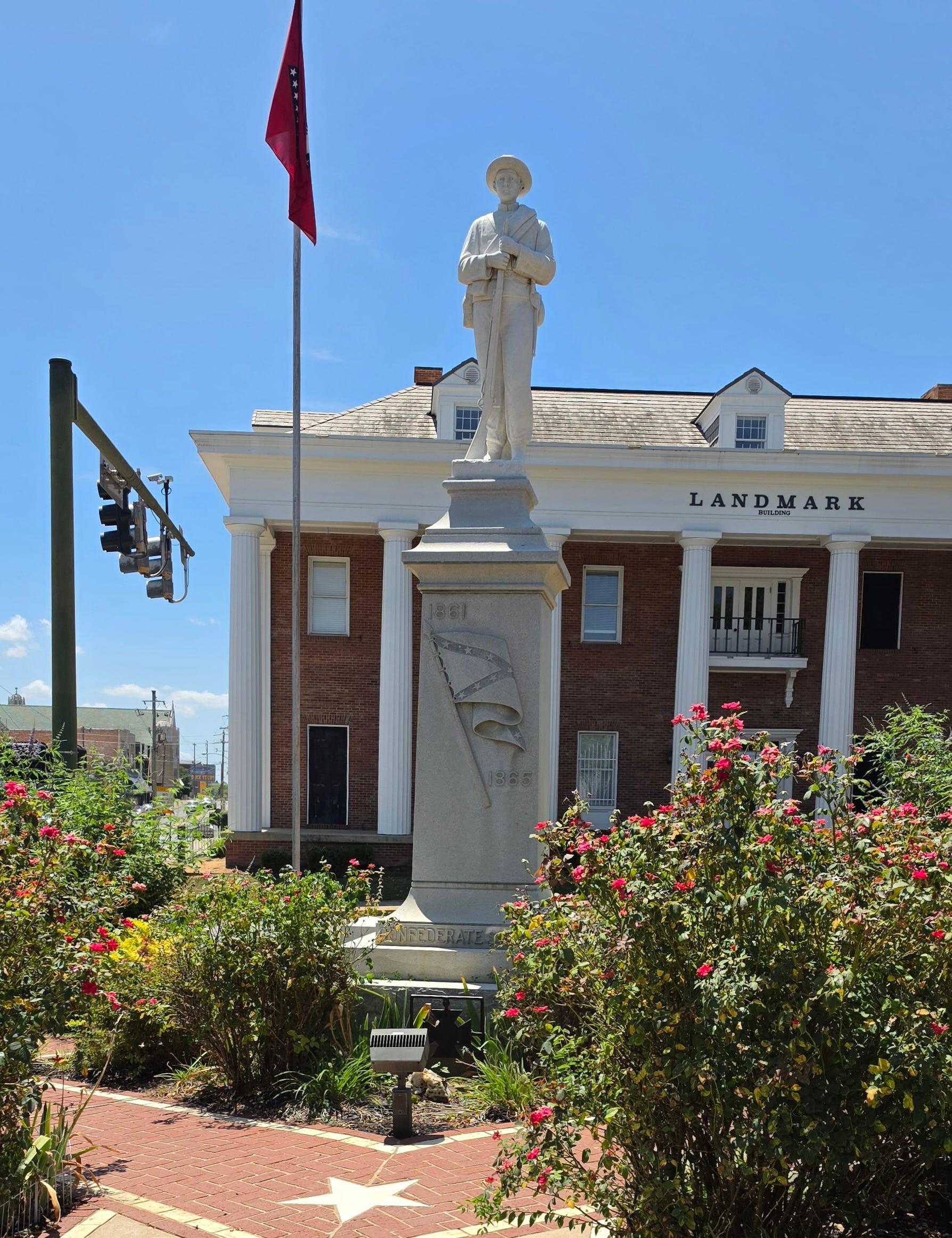
The monument stands in a small, beautifully maintained square in the heart of Hot Springs National Park. Flowering shrubs line the brick walkways, their blooms pink and red against the stone. Confederate flags fly overhead. Eighteen feet of marble and granite rise above the grounds, topped by a Confederate soldier who has been standing watch over Hot Springs since 1934. Carved into the base are the years 1861 to 1865 and the words, "Erected in Loving Memory by the Hot Springs Chapter United Daughters of the Confederacy."
That he is still standing should not be taken for granted. Not anymore.
In 2020, Confederate monuments were coming down across America. Some were removed by governments who no longer had the stomach to defend them. Some were pulled down by mobs who never asked permission. Others simply disappeared in the middle of the night, quietly, so nobody would have to answer for it in daylight. In Hot Springs, thousands signed a petition demanding that this monument be removed, and the city manager publicly supported relocating it.
There was just one problem.
Crystal Harvey wasn't moving.
She did not sit at home complaining about what somebody ought to do. She became that somebody. She started digging through old records and documents. She filed Freedom of Information requests. She researched the history of the monument, and more importantly, the little piece of ground beneath it.
And she found what she was looking for.
The women of Hot Springs Chapter No. 80 had spent years raising the money to erect their monument. In 1933, they persuaded the Hot Springs City Council to allow it to be placed on Como Triangle, and on June 2, 1934, they unveiled their Confederate soldier. Then, in 1953, the City of Hot Springs deeded the memorial property to the United Daughters of the Confederacy outright. Among the original records Crystal uncovered was language making clear that Hot Springs had surrendered any claim to take that gift back.
The people demanding removal had petitions and public pressure. Crystal had the documents. In a fight over history, the documents win.
The monument stayed.
That should have been the end of it. It wasn't. Crystal's fight did not end in 2020. Later, when the surrounding area was converted to paid parking, even the UDC ladies who came to tend the monument faced having to pay the city to park while caring for their own property. Crystal fought City Hall again. Today, one street beside the monument remains free parking, because she would not let that slide either.
Then there were the people who threatened the monument itself. Crystal had trail cameras installed to watch the property, and those cameras have caught would be vandals approaching in the dark. But they have caught something else too. Crystal began noticing people coming to the monument, stopping before the Confederate soldier, and saluting him before they left. She started asking questions and discovered that the site had somehow become a stop on an interactive scavenger hunt. Saluting the soldier, she learned, isn't optional. It's the task. Anyone who wants to check this stop off their list has to do it.
I asked her if it was geocaching. She wasn't sure.
I love the irony of it. Nearly a century after the UDC ladies of Hot Springs placed that soldier there, strangers are still hunting him down on their phones. And the app itself, whatever it is, is making them salute to prove they found him.
But the more Crystal talked Wednesday night, the more I realized her story was about something larger than one monument in one Arkansas town. Crystal Harvey is carrying on a tradition Southern women began more than 160 years ago, and she is doing it against an erasure campaign her great grandmothers never had to imagine.
When the war ended, much of the South lay devastated and its dead were scattered across battlefields hundreds of miles from home. Southern women stepped into the breach. They buried the dead. They marked the graves. They preserved the letters and recorded the names. They raised money when there was precious little money to raise. They built cemeteries and erected monuments so that generations not yet born would know who these men were.
They remembered, when it would have been easier to forget.
And when the United Daughters of the Confederacy was formed, those women carried that work forward. The monuments scattered across the South did not simply appear. Women held teas, dinners, card parties, and fundraisers. Dime by dime. Dollar by dollar. They paid for them. They negotiated for the land. They fought through committees and city councils. They did the tedious, unglamorous work that nobody sees when we look at a finished monument generations later and mistake it for something that was always just there.
It was never just there. Somebody put it there. Somebody fought for it.
There is something about Southern women that history has always underestimated. Perhaps it is because they don't look like warriors. They don't have to. There is steel underneath all that gentility, and it shows up exactly when it is needed.
A Southern woman can smile sweetly, mind her manners, carry her documents under one arm, and still make it perfectly clear that she has absolutely no intention of moving.
No. You move.
That is what I kept thinking about as Crystal told me her story. Nearly ninety years after the women of Hot Springs Chapter No. 80 fought to put that Confederate soldier there, another Daughter found herself fighting to keep him standing. Different generation. Different opponent. Same ground. Same refusal to give it up.
Crystal fought it the same way those women before her had fought theirs. She showed up. She did her homework. She found the records. She knew what belonged to the UDC and why. When another problem arose, she fought that one too. When the monument needed watching, she found a way to watch it. Nobody assigned her this work. She simply decided it was hers to do.
There is a lesson in that for anyone who has ever looked at what is happening to Southern history and wondered what one person could possibly do about it.
A great deal.
One person can ask the question nobody else thought to ask. One person can file the request. One person can open the dusty file. One person can find the forgotten deed. One person can walk into City Hall and make the government live by its own documents. One person can stand between a mob's petition and a monument her grandmothers' generation paid for in dollar bills and Saturday afternoons.
One person can decide that erasure stops here.
Yesterday, after hearing Crystal's story, I went downtown to see the monument for myself. I walked through the grounds she has fought to protect. I photographed the flags and the flowers along the walkway. Then I stood beneath that Confederate soldier and looked up, and I thought about everyone, across this country, who no longer has a soldier to stand beneath.
There are Confederate monuments across America that are gone today, torn down, carted off, melted, and renamed into forgetting. This one isn't. This one is still standing in the Arkansas sun because a treasurer of a small UDC chapter refused to let it fall.
Somebody stood in the breach.
Her name is Crystal Harvey, treasurer of Hot Springs Chapter No. 80, United Daughters of the Confederacy. She fought City Hall, and she won. She is still fighting, quietly, every single day, and nobody hands out medals for that kind of war.
The flowers are still blooming along the walkway. The flags are still flying. And more than ninety years after the women of Hot Springs placed him there, their Confederate soldier is still standing beneath the Arkansas sky, because one woman decided he was worth defending.
Sometimes we don't need thousands.
Sometimes we just need one person who refuses to move.
Mindy Esposito/ August 14, 2026/
Memphis, Tennessee (passing through)
No posts
Comments
Nothing yet. Say the first thing.
Sign in to join the conversation.