
Nobody teaches pottery. I was about ten or twelve. I used to go to visit my aunt and watch. My mother said, ‘Don’t stay long; your aunt may get tired.’ But I stayed until it was time to go home for supper. They didn’t make black then, just polychrome. There were other good potters, too. My grandmother made cooking pots, and I remember Martina Montoya and her husband Florentino. They were very good potters. Nobody can touch them. They made those great big pots with lids. I did not make lids. (…) Nicolasa, Martina, and my grandmother-they didn’t teach. Nobody teaches. But in 1932 much later, someone took me to the government Indian school in Santa Fe and told me to teach. I said no, I come and I work, and they can watch.1
I used to watch my grandmother sew. She used to make my clothes, curtains for the house, pillows and all manner of things. I silently watched her from our living room chair, trying not to get in the way. I asked a few questions here and there but she never stopped so I could practice. It wasn’t expected. She had learned the same way from her mother. 20 years later I picked up my first sewing machine and, while re-learning what I thought I already knew, I tried to remember her gestures.
I often think about my role as a teacher of ceramics as that of someone who is responsible to pass on a craft. But of course the way a lot of us teach ceramics mostly involves a demonstration followed by assisting the students in making something that they will be proud of. It is a transactional exercise: they are here to learn, which mostly means they are here to make things. Learning through observation, visiting and watching someone work, requires a different kind of patience. It relies on an invitation, on permission granted. It is an inherently different exercise in that the transfer of knowledge happens in the slow digestion of what has happened in front of us. On the way home, we may replay the way someone’s hands moved and we may attempt to replicate it in our own space. It invites reflection.
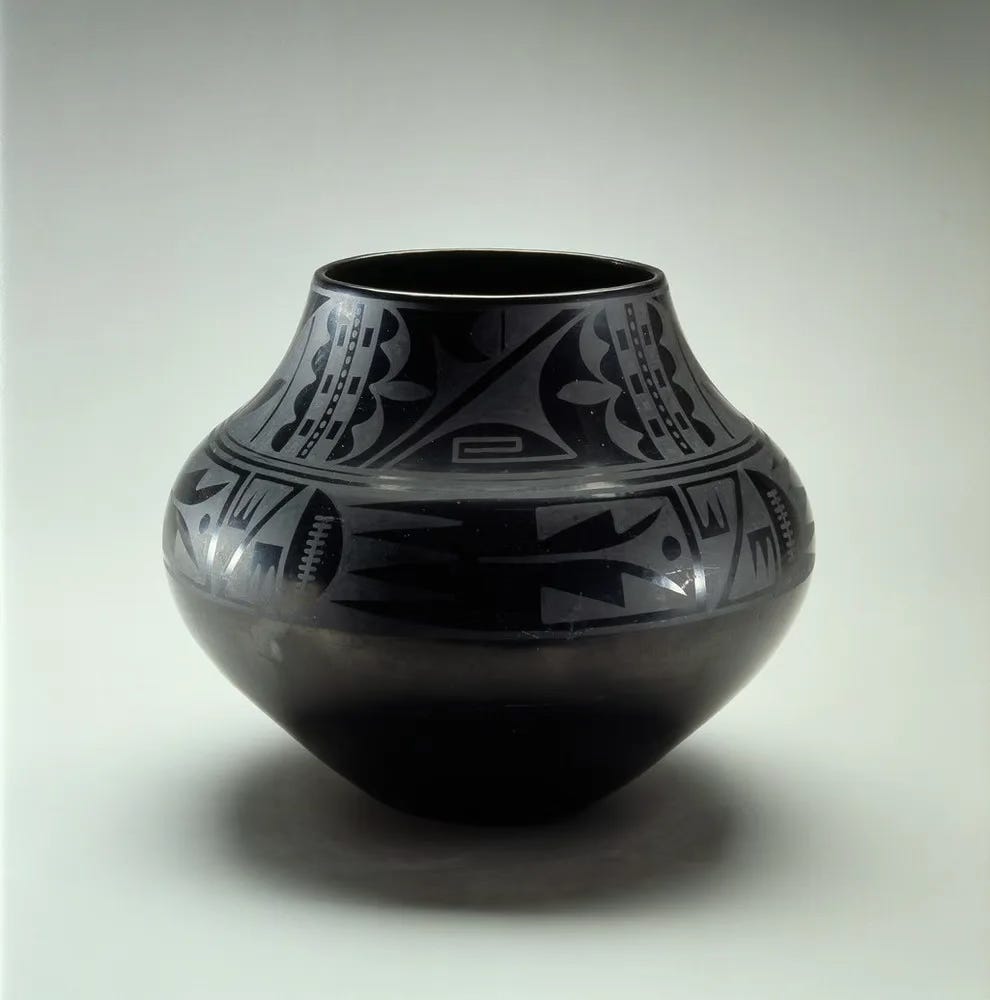
Maria Martinez (c.1887 - 1980) was a ceramicist from the San Ildefonso Pueblo, a community located close to Santa Fe, New Mexico. She revived the ancient technique of blackware pottery, which she is known for. Her work, widely celebrated, was deeply embedded in her community: she learned by watching other family members and she passed the same skills onto new generations.
Further reading
National Museum of Women in the Arts, https://nmwa.org/art/collection/martinez-jar/
Hazel Hyde, “Maria Making Pottery: The Story of Famous American Indian Potter Maria Martinez” (Santa Fe: Sunstone Press, 1992)
Peterson, Susan (Susan Harnly), “The living tradition of Maria Martinez”, Kodansha USA 1992
Peterson, Susan (Susan Harnly), “The living tradition of Maria Martinez”, Kodansha USA 1992, p.83
No posts
Comments
Nothing yet. Say the first thing.
Sign in to join the conversation.