
“Everyday, ordinary birds, animals and people: thin, hollow constructions that collapse if I try to make plastic clay go against its physical properties, so that I am forced to make clay the clay way. (…)
I try to identify myself with a sparrow, for instance, its articulation and aspirations, its physical form and mythical associations; get some clay, twiddle my fingers, think vaguely about something else and, with lots of luck plus some judgement, a tangible object results which symbolises the intangible sparrowness of sparrows. If I choose to believe hard enough that this hollow bit of clay is a sparrow, other people believe it too: which never fails to surprise me. As the conception gets increasingly abstracted, people are tending to want them because of something about the shape and then to tell me afterwards that real-life sparrows now look like mine. Like Turner and sunsets, a great compliment. Someone even said they looked inevitable, but of course I didn't invent logical form anymore than Bach invented logic in music: it is more a matter of trying not to put spanners in the works.”1
Clay demands attention. Something happens when we settle in the space where we feel comfortable making things: the material talks back and, in this conversation, our plans adapt. I often feel like working with clay is an exercise in listening to the material and pushing it just the right amount. Clay is a malleable material but it has its physical limitations and artists learn to play with those limitations, learning the rules and then breaking them.
Rosemary D. Wren (1922–2013) was a British potter. She was born into a family of ceramic artists and is famous for her hollow sculptures of animals that she created using hand-building techniques, mostly pinching and coiling.
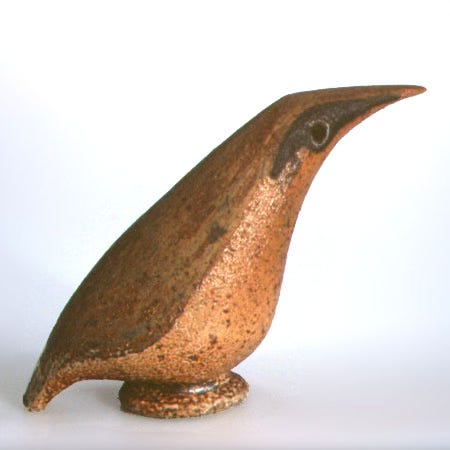
Further reading on Rosemary D. Wren:
https://collections.vam.ac.uk/item/O19835/figure-wren-rosemary-d/
https://elmbridgemuseum.org.uk/online-exhibitions/the-wrens-of-oxshott/
While researching my long-form articles, which are the results of many weeks of work, I have been coming across very interesting quotes or snippets from artists’ notebooks that I have been collecting and stashing away, waiting for the right time and format for them to be shared. I will be publishing these on a weekly basis. I hope they bring you inspiration. For the first one, I pulled a quote from the very first issue of the magazine Ceramic Review, from February 1970.
Ceramic Review, Number One, February 1970, p.9
No posts
Comments
Nothing yet. Say the first thing.
Sign in to join the conversation.