
The beautiful and immediately iconic design of Botswana's Okavango Bridge was opened in 2023. The 60-meter pylons are designed to mimic elephant tusks, symbolising the region's rich wildlife heritage.
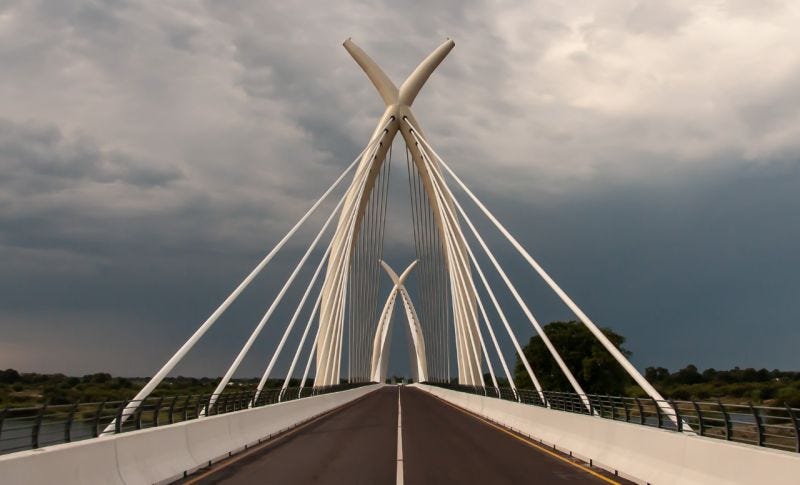
The main features comprise a 488m cable-stayed bridge over the main channel and an incrementally landed pre-stressed concrete box girder bridge.
I read that this is the first incrementally launched pre-stressed bridge in Southern Africa. I'm unsure about this, so if any bridge engineers read this, please let us know in the comments.
The project's objective was to provide an all-weather 24/7 river crossing, replace the unreliable pontoon that had restricted operational hours, and enable people on the eastern side of the river to access social, health and education facilities on the west side.
A gorgeous way to create a vital link over the Okavango River's floodplains.
Concrete is very strong when you push it. But try to pull it apart, and it breaks easily. That’s why engineers add steel inside it.
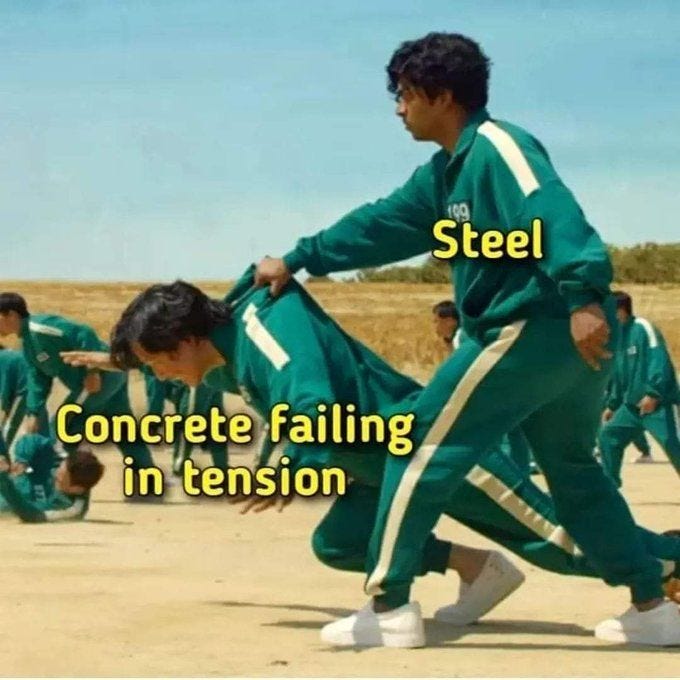
(Engineers, bear with me. Many non-engineers don't know this, and I now have many non-engineering followers; welcome!) Steel handles the pulling forces, while concrete handles the pushing. Together, they make reinforced concrete, used in almost every major structure today. It's also why every modern structure is doomed from the beginning, as you simply cannot keep the rust out forever; eventually, it will get in. It works so well because concrete and steel expand at very similar rates when they heat up or cool down, keeping them tightly connected. Ribbed steel bars, commonly referred to as rebar, are placed inside the concrete before it sets. These ribs help the concrete grip the steel. This bond is what allows the two materials to act as a single solid unit. When engineers design concrete beams, they often ignore concrete in areas under tension. The steel does the hard work there. That’s why you see rebar placed near the bottom of most beams. You might also notice steel loops around the main bars. These are called stirrups. They stop the concrete from cracking sideways, especially near the supports. Reinforced concrete is simple but powerful. It made bridges, towers, tunnels and dams stronger, safer and cheaper to build. It is one of the most important tools in structural engineering. And it all comes down to knowing where each material is strongest.
The Delmag jumping jack is a vintage impact rammer used to compact soil and ground layers through repeated vertical jumping motions.
The cool part is that the classic version powered each jump with a small controlled explosion, not an engine. It is an explosion rammer, patented by Delmag in 1926 and sold for decades as the Frosch, German for frog. Lol. The principle is the free piston. A single piston sits in a vertical cylinder with the compaction shoe fixed to the base, and there is no crankshaft, gearbox, or flywheel anywhere in the design. The operator injects a small charge of diesel fuel and triggers ignition. The explosion throws the whole machine off the ground, lifting well over a hundred kilograms to roughly a quarter of a metre. Then gravity takes over. The falling piston compresses the trapped fuel and air until it ignites from the heat of compression alone, exactly as it does in a diesel engine. That single ignition compacts the soil and launches the next hop, so the rammer powers itself. The point of the machine is that it drives all its force straight down into a small footprint. But why this odd compaction? That suits narrow ground a roller cannot reach, such as pipe trenches, foundation footings, and the tight strips against retaining walls. It also suits cohesive soils like clay and silt, where trapped air must be pounded out by direct impact rather than shaken loose by vibration. A flat plate compactor works best on open granular ground like sand and gravel, so the two solve different problems. Where the jumping jack wins is depth. Delmag later scaled the same free piston cycle into its famous diesel pile hammer, which drove foundation piles worldwide. The explosion rammers were retired because they were punishing to operate and slower than the petrol engine machines that replaced them. Yet the idea endured, and a free piston that burns fuel to lift itself, then falls under its own weight to do useful work, remains one of the neater pieces of mechanical engineering from early twentieth century construction.
The gorgeous Hallgrimskirkja in Reykjavik is Iceland’s tallest church, standing at 74.5 meters. Its facade was inspired by Iceland’s basalt columns.

Its concrete spire pierces the sky like a volcanic shard. Designed to resemble the trap rocks, mountains and glaciers of Iceland's landscape, in particular, its columnar basalt "organ pipe" formations Reinforced concrete, shaped to echo nature, withstands Iceland’s brutal climate. The tower, doubling as an observation deck, offers a panoramic view of Reykjavik’s colourful rooftops and distant mountains. While I am not a fan of expressionist architecture, this works beautifully. It's on my must-see list.
Construction started in 1937 and lasted 41 years, finally completed in 1986 after weathering war delays and public scepticism.
Inside, a 15-meter pipe organ with 5,275 pipes dominates the minimalist nave, its sound reverberating through the stark, Gothic-influenced space (so I am told)
Beautiful structural engineering simplicity:
A statue of Leif Erikson, the Viking explorer (a gift from the USA), guards the entrance, a nod to Iceland’s rugged heritage.
It's all very symbolic.
No posts
Comments
Nothing yet. Say the first thing.
Sign in to join the conversation.