
Interior of a Gothic Church by Pieter Neefs the Elder. Pieter was a Flemish specialist of architectural interiors. His most frequent subject is the interior of churches and cathedrals.

Many of Neefs' paintings drew inspiration from the Cathedral of Antwerp, The soaring ceilings inside a Gothic cathedral did more than cover the building. They are what made the great stained glass windows of the era possible in the first place. The link between the two is structure. The earlier Romanesque style used heavy barrel vaults that pushed outward along their entire length, so holding them up demanded thick, solid walls pierced by only tiny openings. Those walls were the load-bearing structure, which is why the light had nowhere to enter. Why they were so dark. The Gothic breakthrough was to gather the roof load onto points rather than spreading it along whole walls. A ribbed vault does this, channelling the weight of the ceiling down through stone ribs onto a few columns at the corners of each bay. The pointed arch sharpened the effect by directing the load more steeply downward, cutting the sideways shove that had always forced walls to be thick. Once the ceiling carried its weight through ribs and columns rather than through the wall, the wall was freed from its structural job. It no longer had to hold anything up. The masons cut those redundant stone panels away and replaced them with vast frames of glass. The outward thrust that remained was caught outside the building by flying buttresses, so the residual force never had to be resisted by a thick, windowless wall. The most famous example of these flying buttresses can be seen at Notre Dame in Paris. The stained glass we admire is not only an ornament added to the architecture but a direct consequence of how the vault above it carries its load. It is the space that structural engineering opened up once the ceiling learned to stand on its own.
Beautiful biomedical engineering. A titanium heart with a magnetically levitated rotary pump helped a patient from Sydney, Australia, become one of the first to be sent home with a Total Artificial Heart last year.
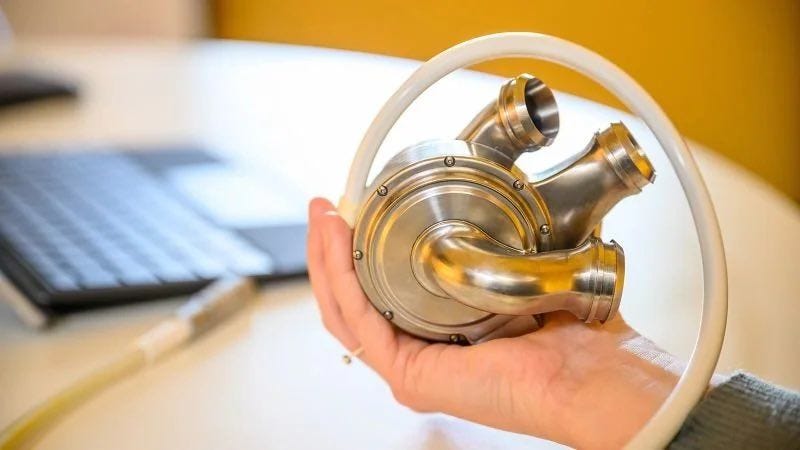
Usually, patients with these systems are kept in the hospital for ongoing monitoring. But this patient was discharged after approximately 100 days, a significant milestone. Artificial hearts are not new, with successful technologies implemented since the early 1980s. The most famous artificial hearts, like the SynCardia Total Artificial Heart, have been around for decades and are typically based on polymer diaphragms or sacs to mimic the heart’s pumping action. But this new titanium (mostly) heart, from BiVACOR, introduces cutting-edge technology. BiVACOR is notable for its compact size, magnetically levitated rotary pump, and potential for long-term use. Unlike other approaches, which often use volume displacement pumps that can damage delicate red blood cells, the BiVACOR heart uses an electromechanical rotary blood pump with a magnetically levitated impeller. This reduces friction or shear hotspots that can crush or tear red blood cells, improving biocompatibility and durability. That’s incredible. By monitoring changes in venous return (the amount of blood returning to the heart) and inflow pressures, the heart can detect a patient’s activity level and automatically adjust its speed to match the body’s blood flow needs. But did you know that these heart pumps provide continuous blood flow rather than pulsing like a natural heart? It’s both fascinating and unsettling to imagine being alive without a pulse. This patient lived for those 100 days without a heartbeat, their body sustained by a constant low-level hum as blood flowed continuously. (Typically, a natural heart beats roughly 100,000 times a day and over 36 million times a year—an extraordinary feat of consistent performance.) - - Could we reach a point where hearts like these become long-term solutions?
The inventor, Dr. Daniel Timms, the son of a plumber and inspired by his father’s work with fluid dynamics, spent over 20 years developing this high-end, medically engineered artificial heart.
Biomedical engineering solutions like these could be a game-changer for patients on long waitlists for donor heart transplants.
The tap water quality in Warsaw, Poland, is tested and controlled by clams. Eight live clams sit in individual chambers connected to the Vistula River intake. When they sense a threat (like toxins, chemical imbalance, or low oxygen) they shut their shells.
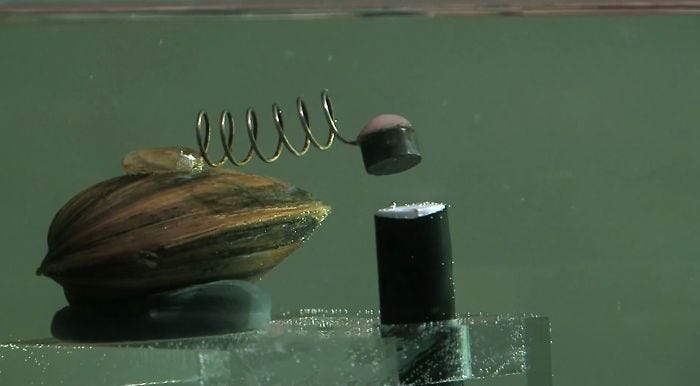
That movement is tracked by a magnet and sensor on each shell. If six out of eight stay closed for more than four minutes, and the average opening drops below 25%, the system flags a potential contamination. It’s called biomonitoring. And they have been doing it since 1994. Before they go online, the clams are collected from a clean lake, acclimatised for two weeks in a lab, and calibrated, measuring their full-open and fully-closed angles. Sensors are attached using non-toxic glue. After about three months on duty, they’re returned to their natural habitat. The clams are just one layer of Warsaw’s early warning system. Water quality is also monitored using ultra-modern automated chemical detectors and lab sampling. But these clams provide something different: a real-time biological response that reacts to subtle threats that instruments can potentially miss. They’re silent. Low-tech. And extremely sensitive. They are not the only city or institution to use such methods. There are other examples: 🐟 Fish in Minneapolis, USA The city of Minneapolis uses bluegill sunfish to monitor drinking water. The fish are housed in a specially designed tank through which treated water flows. Their movement, gill activity, and heart rate are monitored in real time. Sudden changes can indicate contamination. 🐌 Snails in Japan In Japan, particularly in cities like Osaka, freshwater snails are used in similar biomonitoring systems (mostly in research settings). Their behaviour is monitored continuously; shell closure or reduced movement can indicate pollutants like heavy metals or pesticides. 🦐 Daphnia in the Netherlands In the Netherlands, Daphnia (tiny freshwater crustaceans also called water fleas) are used to monitor water quality. Changes in swimming behaviour or reproduction rate can be early indicators of contamination. Automated systems even use cameras and AI to track behaviour. 🌿 Aquatic plants and algae in various countries Some systems in Sweden, Finland, and Canada use algae or aquatic plants as indicators. Changes in chlorophyll fluorescence, photosynthesis rates, or growth patterns can signal the presence of toxins, such as herbicides or industrial runoff.
Pretty neat-looking small-scale LPG barge pressurised storage solution we developed for a client in the Caribbean. Unfortunately, it stayed in concept phase, but I always thought it was cool.
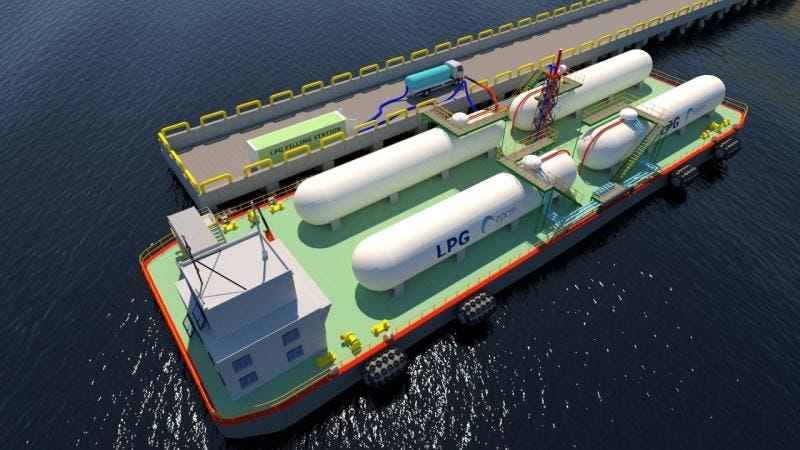
The concept provides rapid LPG storage deployment, while more permanent and larger storage is either under construction or not feasible due to cost. And the LPG storage bullets are moved to become permanent onshore storage when ready, while the barge is decommissioned after a period. At least that is the idea. This setup will allow clients to pay part of their capital projects through early cash generation. We were quite busy at one point in the Caribbean, and they were seriously looking at this. Pity it never happened. - Diesel, LPG and Paraffin. For now only South Africa. We are most likely to get you a better deal (cost, payment terms and credit) than what you are paying now. So get in touch if you churn a lot of fuel.
It can include modular bottling carousels on or near the barge.
Oh, did I tell you we trade in fuel now?
Japan leads the world in earthquake-resilient design. And it doesn’t rely on a single method. It uses a combination of three core systems: seismic resistance, seismic damping, and seismic isolation.
Each of them has a different engineering approach to managing seismic energy. 1️⃣ Seismic resistance is the most straightforward. Structures are designed to be stiff and strong — reinforced with steel, cross-bracing, and moment-resisting frames. This approach absorbs seismic loads through strength alone. But high rigidity means higher stress — and more damage. 1️⃣ Seismic damping adds mechanical systems that _absorb_ motion. These include oil dampers, tuned mass dampers, and friction devices that convert kinetic energy into heat or controlled friction. Think of it like shock absorbers in a car — but scaled up to handle thousands of tonnes of structural mass. 3️⃣ Seismic isolation is the most advanced. Entire buildings are built on flexible base isolators — often made of laminated rubber and lead cores — that _decouple_ the structure from ground motion. During a quake, the ground moves, but the building barely does. This method can reduce seismic acceleration by up to 90%. These systems are often used in combination. Engineers might pair base isolation with damping, or use resistance as the first line of defense. Japan’s seismic engineering isn’t a single technology. It’s a layered defence system — mechanical, structural, and strategic. The result? Buildings that are not only safe, but reusable after major quakes.
No posts
Comments
Nothing yet. Say the first thing.
Sign in to join the conversation.