
The world's largest battery contains no lithium. China's Fengning pumped storage plant in Hebei province reached full operation on 31 December 2024, after 11 years of construction.
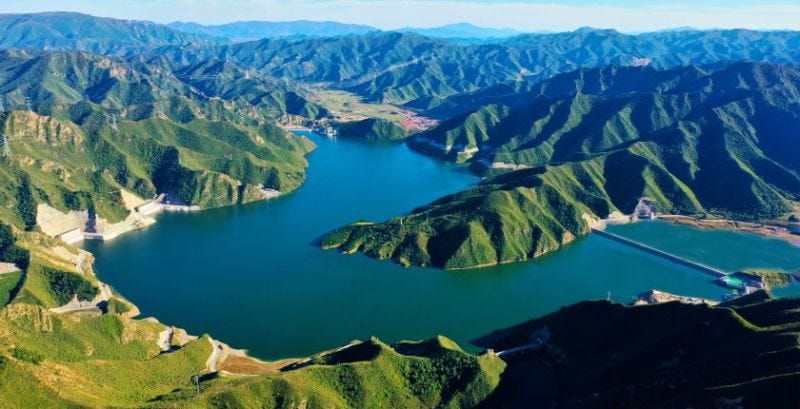
Becoming the largest pumped storage in the world. It dethroned the Bath County station in Virginia, USA, which held the world record at 3 GW for several decades. Fengning's total installed capacity is 3.6 GW, delivered by twelve reversible pump-turbine units, each rated at 300 MW, all housed in an underground powerhouse 414 metres long and 54.5 metres high. The logic of the system is straightforward: when the grid has surplus electricity, typically at night or when wind and solar output peaks, the plant runs its machines as pumps, pushing water from a lower reservoir up to an upper reservoir carved into the hills above. When demand peaks and prices rise, the flow reverses. Water drops back through the same machines, now acting as turbines, and the plant immediately dispatches power to the grid. The round-trip efficiency is around 70% to 80%, meaning a portion of every unit of energy is lost to friction and conversion losses, but the economics work because the plant buys cheaply and sells at peak rates. The upper reservoir holds 45 million cubic metres of water, enough to run the plant at full output for 10.8 hours continuously. At full capacity, the facility is designed to generate 6.61 TWh annually and offset an estimated 1.2 million tonnes of carbon dioxide emissions. Two of the twelve units use variable-speed technology, a relatively recent advance in pumped-storage engineering that enables faster frequency response and more precise load control during the pumping phase. Fengning is also the first pumped-storage plant connected to a flexible direct-current grid, enabling more efficient power exchange with distant wind and solar generation. China's grid operator now operates or is building 94 GW of pumped-storage capacity, with a target of 80 GW operational by 2027. At that scale, pumped storage stops being a grid balancing tool and becomes load-bearing infrastructure for the entire energy system.
The Ten-Arm Owens Automatic Bottle Machine was credited with doing more to end child labour in glass factories than legislative efforts. Unfortunately, engineering's impact on public health often goes unnoticed.
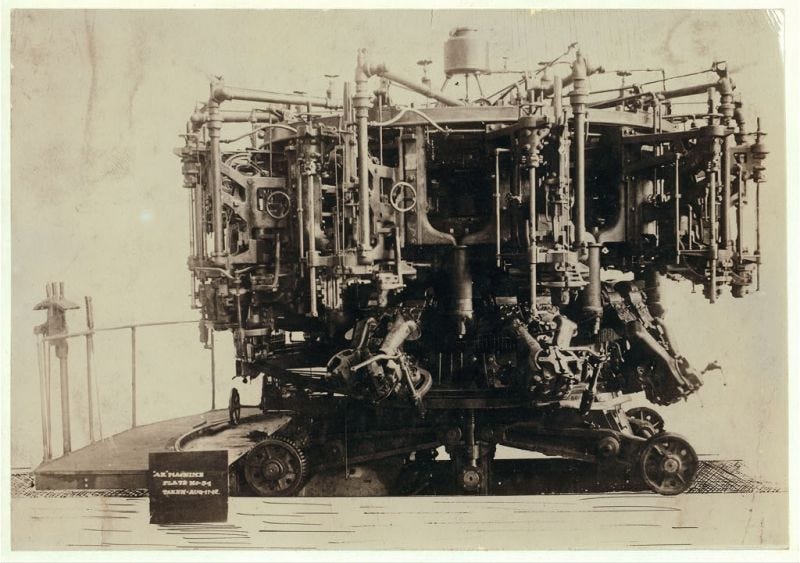
Developed in 1903 by Michael Owens, it was a groundbreaking invention that revolutionised the glass bottle manufacturing industry in the early 20th century.
His goal was to eliminate the need for skilled glassblowers and child labourers, who worked in hazardous conditions.
It was the world’s first fully automatic glass bottle-making machine, transforming a labour-intensive, artisanal process into a mechanised, high-volume production line.
By 1920, the machine weighed around 30 tons and comprised approximately 10,000 parts. It featured ten rotating arms, each equipped with a mould and connected to a suction mechanism.
Unlike semi-automatic machines that required workers to gather molten glass manually, the Owens machine used a vacuum to draw precise amounts of molten glass from a rotating pot directly into the moulds.
A small pump on each arm created a vacuum to draw up the glass, followed by a blast of air to shape it within the mould.
This eliminated the need for skilled “gatherers” and other forms of manual labour.
The finished bottle was severed and transferred via conveyor belt to an annealing lehr—a furnace used to gradually cool and temper the glass.
Bottles were produced with minimal human intervention, ensuring uniformity, efficiency, and improved hygiene.
Early models could produce 9–12 bottles per minute (approximately 13,000 per day), compared to about 3,500 per day by a team of seven skilled workers using manual methods.
Later models averaged 50,400 bottles per day and could produce a wide range of sizes, from small prescription vials to gallon containers.
The Owens machine drastically reduced production costs—from $1.80 per gross (144 bottles) to 10–12 cents per gross—an 80–90% reduction.
This made glass bottles affordable and widely accessible for pharmaceuticals, food, beverages, and household products.
It ensured uniformity in size, weight, and capacity, enabling standardisation essential for automated filling and capping machines in industries such as dairies, breweries, and distilleries. This also supported the 1906 Pure Food and Drug Act by facilitating consistent packaging standards.
By automating the glassblowing process, the machine eliminated the need for child labourers, who had previously performed hazardous tasks like carrying hot glass or operating moulds.
-
In 1983, the American Society of Mechanical Engineers designated the Owens machine an engineering landmark, calling it “the most significant advance in glass production in over 2,000 years.”
Let me show you Neft Daşları—Stalin's floating utopia, The City on Water. They built it in the Caspian Sea between 1949 and 1951. Although today it appears as a dystopian relic, it was once an industrial marvel, a complex network of oil platforms accommodating 5,000 workers
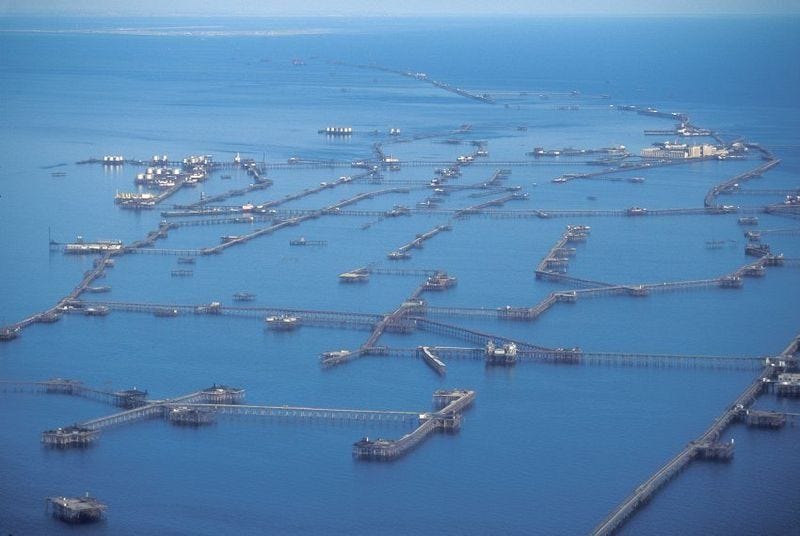
The artificial archipelago was built about 40 km from the coast of Azerbaijan, and more than 60 km from the capital, Baku The original foundation of Neft Daslari consisted of seven sunken ships, including the world’s first oil tanker, extensive mounds of soil, and landfill materials. Thanks to an underwater reef, the sea depth is only 20m there, which facilitates construction on solid ground Over the decades, this grew to some 2,000 drilling platforms spread in a 30-kilometre circle, joined by a network of bridge viaducts spanning 300 kilometres. Over these platforms, workers built eight-story apartment blocks, a beverage factory, soccer pitch, library, bakery, laundry, 300-seat cinema, bathhouse, vegetable garden and even a tree-lined park for which the soil was brought from the mainland. In 60 years, the Soviet industrial city produced more than 170 million tons of oil there. In 2009, it was estimated that about 30 million tons were still extractable, which is why the City on Water is still home to 2000 people today. Neft Daslari’s decline began with the collapse of the Soviet Union and the discovery of new oilfields elsewhere. The workforce was reduced, and many oil rigs were abandoned. Out of the 300 kilometres of roads, only 45 kilometres remain usable, and even they have fallen into disrepair. To the government, however, the place is still the proud, closely guarded secret it was in Soviet times. It is still very hard for foreigners to gain access to the city. You can’t even zoom into it on Google Maps! There is a nice 2008 documentary on Vimeo about Neft Daşları by a French film crew. They were the first Westerners ever allowed access to film there, and it's extraordinary.
No posts
Comments
Nothing yet. Say the first thing.
Sign in to join the conversation.