
The Winged Figures of the Republic are a pair of striking bronze statues located at the Hoover Dam on the Nevada-Arizona border. And one of my favourite sculptures.
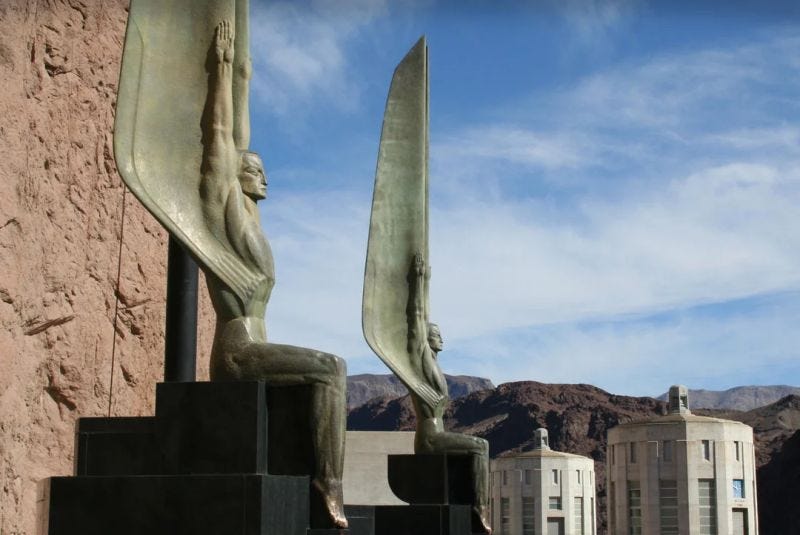
Not quite an industrial art Sunday post - but close enough. They were created by Norwegian-born sculptor Oskar J.W. Hansen and installed in 1935 when the dam was completed. Each figure stands about 30 feet (9 metres) tall, seated with massive wings swept back and upward. They flank a flagpole at the Nevada-side entrance to the dam. Designed them in an Art Deco style that was characteristic of major American public works projects of the 1930s. The thing I like most about Art Deco is the deliberate beautification of utilitarian objects, buildings, public works and environments. The figures are deliberately stylized rather than naturalistic. Angular, powerful, and monumental in keeping with the scale of the dam itself. They symbolize the "immense power of trained labor" and the republic's capacity for great collective achievement. And what a fitting the Hoover dam is to symbolize that. One of the greatest civil engineering achievements. The statues were cast in bronze and have developed a distinctive green patina over the decades, though their feet and shoes remain polished bright from the countless visitors who touch them for good luck. Hansen also designed the terrazzo floor beneath the figures, which features a celestial map. A star chart showing the sky as it appeared on September 30, 1935, the date President Roosevelt dedicated the dam. Hansen intended this as a kind of time marker, reasoning that the dam would outlast current civilizations, and future people could use the star chart to determine precisely when it was built. How cool is that for a project's lifespan to be measured in celestial positions. The figures are among the most recognizable examples of New Deal-era monumental art in the United States, and they've become iconic symbols of the Hoover Dam itself. They're sometimes informally called "angels" by visitors, though Hansen intended them as secular symbols of the republic and human achievement rather than religious figures.
The Costa Concordia salvage was one of the most complex and expensive marine engineering salvage operations ever attempted.
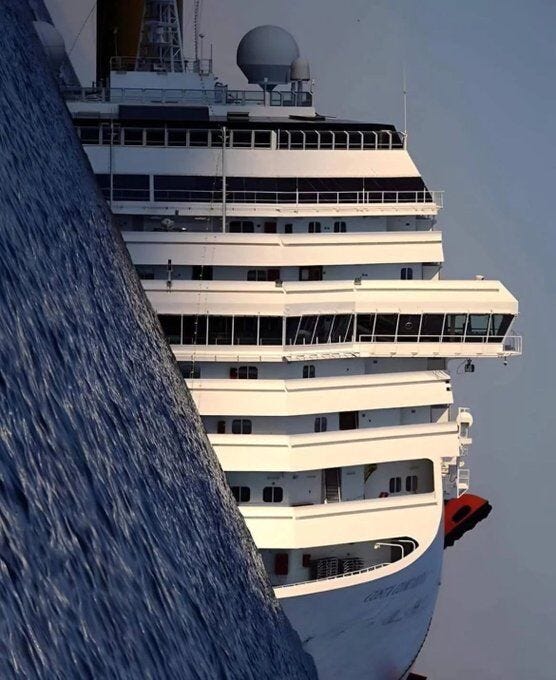
Famously done by my fellow South African, Salvage Master Nick Sloan. When the ship capsized off the coast of Italy in 2012, many assumed it would be dismantled on site. Instead, engineers and salvage masters set out to rotate it upright and refloat it, intact. The process they used was called '_parbuckling_': A controlled rotation of a 290-metre-long, half-submerged vessel lying on its side. (I explain this more in the comments) The structure was heavily deformed, resting on jagged rock, and had to be moved with tight tolerance precision to avoid tearing the hull. Engineers installed a custom underwater platform on the seabed, 21 steel sponsons, and a massive cable and pulley system. During the 19-hour rotation, 11,000 tonnes of force were applied to bring the ship upright — a load equal to lifting the Eiffel Tower 3 times over. And that was only half the job. To refloat the ship, engineers filled the sponsons with air, turning them into buoyancy tanks. Slowly, the ship rose, fully supported by external structures, not its own damaged hull. It was then towed 350 km to Genoa for dismantling. This was an incredible salvage project It involved structural, civil, marine, mechanical, and subsea engineering, all operating in an extraordinarily challenging environment. It worked. The Costa Concordia was removed without polluting the marine reserve in which it sank. A disaster answered with world-class engineering. -
Nick was awarded the German Ocean Award in 2015 and an Italian Knighthood after the Costa Concordia project.
The Hyundai 10000 is the world's largest shear-leg floating crane by lifting capacity. It exists because offshore construction eventually reaches a point where assembling things in small pieces at sea becomes the greater risk.
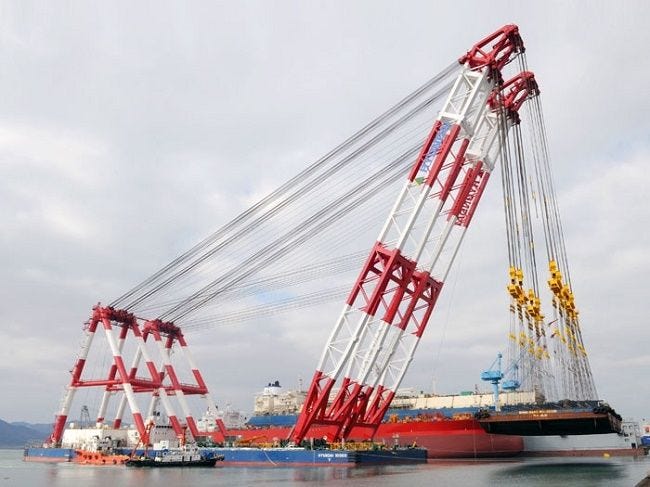
It looks deceptively simple. Two enormous steel legs, a barge hull, and none of the rotating superstructure most people associate with cranes. That simplicity is deliberate. The Hyundai 10000 can lift up to 10,000 tonnes in a single pick, and its signature job was hoisting a 6,500-tonne platform topside onto the Moho Nord field off the Congo coast. A shear-leg crane does not slew. The A-frame is fixed, so all forces flow straight down the legs into the hull, eliminating the need for bearings, slew rings, and rotating machinery that would be impractical at this scale. The engineering challenge moves elsewhere. Precision comes from marine operations, ballast control, and centimetre-level vessel positioning rather than rotation. During a heavy lift, ballast water is pumped between tanks in real time to counteract load movement and hold the hull within strict stress and trim limits. This is naval architecture and structural work running together under extreme conditions. Every tonne lifted shifts the centre of gravity, and every ballast adjustment changes the internal force paths through the hull. The payoff is enormous. Entire topsides, jackets, and subsea structures can be installed in one piece, avoiding the offshore bolting, welding, and alignment that would otherwise take weeks in exposed conditions. That cuts schedule risk, safety risk, and offshore man-hours. Built for problems that cannot be solved any other way, it marks the practical upper limit of dedicated shear-leg heavy lift work.
This is a Victorian Stink Pipe. Most people these days probably never notice them. However, the story is a pivotal part of the Victorian sewer network that kept London habitable while the modern system was being built and improved.
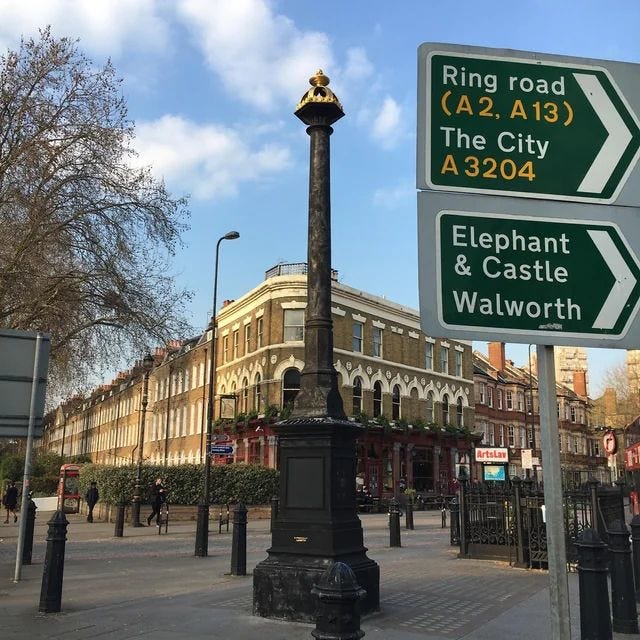
They were a simple yet surprisingly elegant engineering solution to a very physical problem caused by early sewer systems. They appeared in the mid-nineteenth century as cities began to lay combined sewers at scale. These new sewers moved waste far more efficiently, but they also trapped large volumes of gas. When pressure built up, that gas needed to escape somewhere. Without a controlled outlet, the easiest route was often back through the nearest household drain. Victorian engineers could not allow that. A stink pipe works by providing a controlled vent point for the sewer network. A vertical cast-iron riser was anchored beside the street and connected to a sewer branch below. Most were about ten metres tall, which was high enough to send odours into the wind above pedestrians and shopfronts. Their height is roughly equivalent to a three-storey building, and it was chosen to push airflow out of the human zone. The internal diameter was narrower than that of the main sewer. This kept the rising gas velocity high enough to prevent condensation and blockages. Many included an ornamental crown or finial that doubled as a weather cap. Several cities used copper or zinc tops because these metals resisted corrosion from hydrogen sulphide, which often formed inside the pipe. Their placement was deliberate. Engineers spaced them at intervals to evenly distribute pressure across a district. In some older maps, you can still trace these networks by the pattern of vents. They were an early attempt to balance a living system in which temperature, flow rate, rainfall, and decomposition interact. They fell out of favour once modern sewage treatment plants and improved trap designs reduced the need for open venting. Many were removed during road widening projects. A few survived because they looked like street furniture, which they now are. I hope they never remove them.
No posts
Comments
Nothing yet. Say the first thing.
Sign in to join the conversation.