
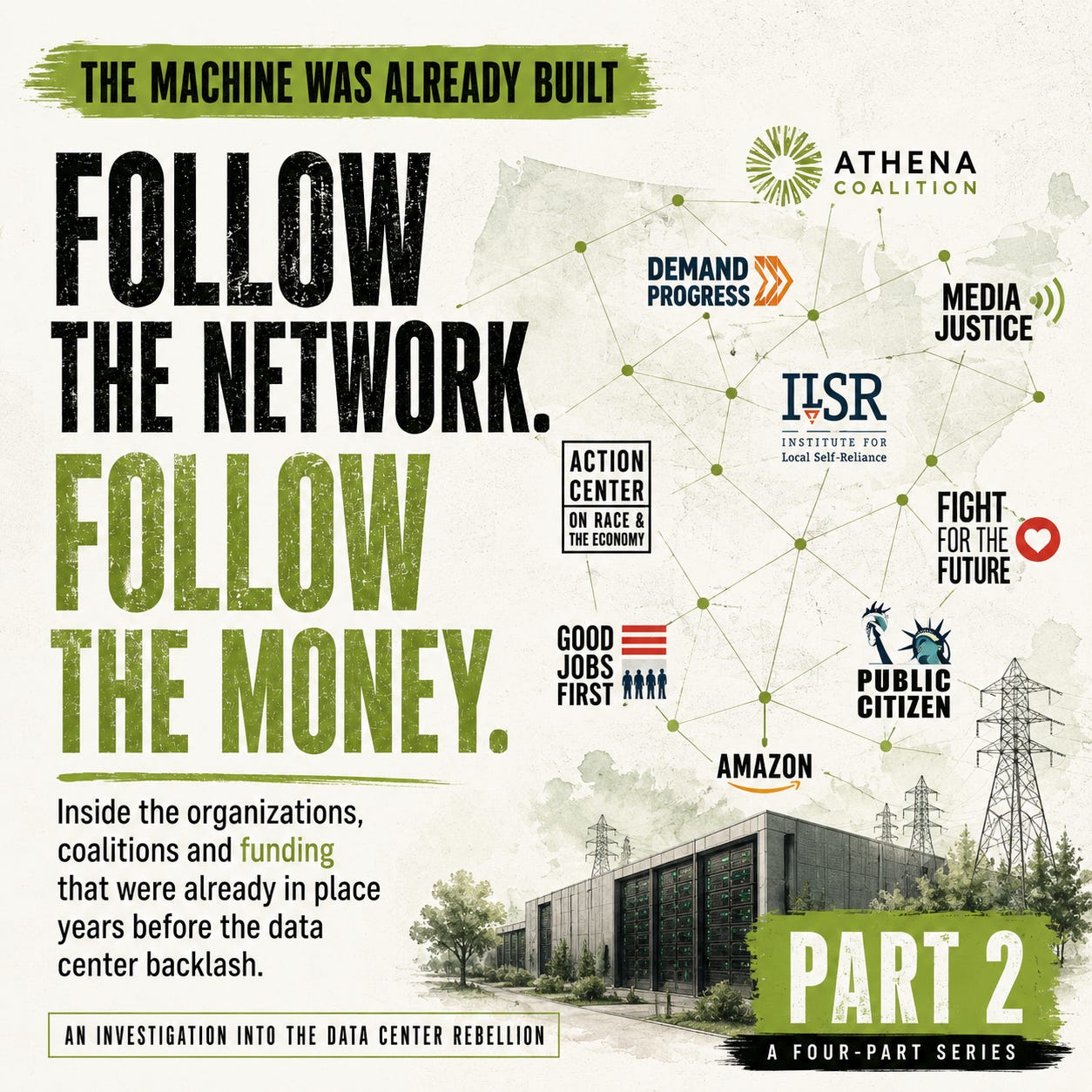
This is Part II of my investigation into the rapidly growing movement against hyperscale data centers. Part I followed the local backlash as it grew into a national political movement crossing party lines. Now we’re going underneath it, into the organizations, coalitions and money that were already there.
In October 2020, the Ford Foundation approved a $1.625 million grant to the Action Center on Race and the Economy Institute. The money was designated as core support for the Athena Coalition, which Ford described as a new “cross-issues and multi-geography alliance.”
That was five years before the current national data-center rebellion exploded.
I’m on a mission as a “history activist” to document Jewish history before it’s rewritten, distorted, or erased. Equally, I’m on a mission to uncover the truth. Every paid subscription helps fund the research behind these essays and enables me to continue this work full-time. For $75 a year (just 21¢ a day), you’re doing more than supporting a writer. You’re helping preserve the Jewish story.
Two years later, Ford approved another $225,000 for Athena. The description attached to that grant said the money would support Athena’s work in key geographic areas to “compress and amplify local actions” into national action. In 2024, Ford approved another $1.25 million for Athena through the Institute for Local Self-Reliance, supporting anti-monopoly protections, worker power and working conditions.
By then, Athena had spent years building a coalition around one enormously powerful corporate target: Amazon.
When I stopped looking at individual data-center protests and started tracing the organizations surrounding them backward, I found a national coalition that had been operating for years.
Athena describes itself as a coalition of more than 50 organizations working together against Amazon’s power. Its membership explains what Ford meant by describing Athena as “cross-issues.”
Action Center on Race and the Economy is there. So are Center for Popular Democracy, Demand Progress, Fight for the Future, Good Jobs First, Institute for Local Self-Reliance, Jobs With Justice, MediaJustice, Mijente, MPower Change, National Employment Law Project, New York Communities for Change, Open Markets Institute, PowerSwitch Action, Public Citizen and Amazon Employees for Climate Justice.
No Tech for Apartheid is there too.
These organizations came to Amazon through different issues. Some work primarily on labor, others on monopoly power, surveillance, climate, racial justice, technology policy, corporate subsidies, or Palestine activism. Athena brought organizations working across those issues together around Amazon.
A labor organization could challenge warehouse conditions, while a privacy organization could target surveillance. An anti-monopoly organization could go after Amazon’s market power, while another organization could fight its tax subsidies. Climate activists could target emissions and energy consumption. Other groups focused on Amazon’s government contracts and the uses of its technology.
Amazon is much more than a retailer with warehouses scattered across the country. Amazon Web Services, better known as AWS, rents computing power, storage, databases and other cloud services to businesses and governments. It’s one of the largest cloud-computing companies in the world. AI has driven demand for computing power even higher, and all that digital activity depends on physical facilities filled with servers.
That gives Amazon an unusual position inside this coalition. The company can draw opposition over warehouse conditions, monopoly power, surveillance, climate, government subsidies, government contracts and the data centers supporting its expanding computing business.
The organizations don’t have to arrive at Amazon for the same reason. They already have a place to meet once they get there.
                           AMAZON
                              │
        ┌─────────────┬───────┼───────┬──────────────┐
        ▼             ▼       ▼       ▼              ▼
      LABOR       MONOPOLY  SURVEILLANCE  CLIMATE   SUBSIDIES
        │             │       │       │              │
        └─────────────┴───────┼───────┴──────────────┘
                              │
                              ▼
                             AWS
                              │
                    ┌─────────┴─────────┐
                    ▼                   ▼
             CLOUD / MILITARY       AI EXPANSION
                CONTRACTS                │
                    │                    ▼
                    │              DATA CENTERS
                    │                    │
                    └──────────┬─────────┘
                               ▼
                       NEW SHARED TARGET
Athena’s early campaigns concentrated heavily on Amazon’s warehouses, worker injuries, surveillance practices and market power. By 2023, the coalition was also moving deeper into the technology behind Amazon’s business.
In June of that year, Athena and other organizations submitted comments to the Federal Trade Commission regarding the business practices of cloud computing providers. That month, Athena and coalition partners also submitted comments to the White House about automated worker surveillance and management. In October, Athena joined Amazon Employees for Climate Justice, AI Now Institute, Alphabet Workers Union-CWA, Center for Popular Democracy, Fight for the Future, Open Markets Institute, Public Citizen and others in a letter to Senate Majority Leader Chuck Schumer over AI policy.
Cloud computing and AI were already part of the coalition’s federal policy work before data centers became its next major target.
And then…Palestine enters the chat.
In July 2023, Amazon warehouse workers and tech workers protested outside the company’s AWS Summit over Project Nimbus, the nearly $1.2 billion Israeli government cloud project awarded to Amazon and Google. Nimbus was created to move Israeli government agencies onto commercial cloud infrastructure, and the project includes Israel’s defense establishment. That connection explains why a coalition that had been organizing around Amazon suddenly intersected with Palestine activism.
The protesters were joined by members of Alphabet Workers Union-CWA, MPower Change, Jewish Voice for Peace, Adalah Justice Project, Fight for the Future and Athena. Labor activists, tech workers, Palestine organizations and members of the existing Amazon coalition were now standing together outside an event devoted to Amazon’s cloud business.
The campaign continued. Project Nimbus became a sustained organizing target inside Google and Amazon, with employee actions and protests at corporate events. In April 2024, nine Google employees were arrested during sit-ins connected to the campaign, and Google later fired more than two dozen employees following the protests.
The campaign continued into 2026. By then, No Tech for Apartheid was organizing beyond Nimbus as well, supporting Google employees demanding an end to cloud contracts with ICE, CBP and DHS. In July, more than 100 Stanford students walked out during Google CEO Sundar Pichai's commencement address, with organizers tying Project Nimbus to Google's immigration-enforcement contracts and broader concerns about surveillance and militarized technology.
That sent me looking at the other foreign governments buying cloud services from American technology companies.
Bahrain has used AWS across government agencies. Kuwait entered a strategic partnership with Google Cloud covering government and state-run bodies. Qatar has moved scores of public entities onto Microsoft Azure and made Azure AI services available to government entities. Google has expanded cloud operations in Saudi Arabia, while AWS operates cloud regions in Bahrain and the United Arab Emirates.
I went looking for comparable campaigns against those relationships among the organizations in this network. I couldn’t find one that approaches the years of employee organizing, demonstrations, and coalition activism surrounding Project Nimbus.
Nimbus includes Israel’s defense establishment, while some of the other agreements involve civilian government services. Tech workers have also protested American military technology contracts, most famously Google’s Project Maven. Still, among the Middle Eastern government cloud relationships I examined, Israel’s became the sustained organizing target inside this network.
Keep Project Nimbus in mind. It comes back later.
By September 2024, the coalition’s attention had moved directly onto the physical infrastructure supporting AI. Executives representing technology companies, data center operators, and utilities met with the Biden administration at the White House to discuss AI infrastructure and electricity demand. Athena responded the next day, criticizing the meeting for giving Big Tech and utility companies access to energy policy discussions while workers, consumers, and environmental organizations were excluded.
Less than a month later, Athena joined a large coalition pushing the White House over AI data-center expansion. The organizations included 350, Amazon Employees for Climate Justice, Center for Biological Diversity Action Fund, Demand Progress Education Fund, Free Press Action, Good Jobs First, Institute for Local Self-Reliance, Missouri Workers Center, National Employment Law Project, Open Markets Institute, PowerSwitch Action, Public Citizen and Surveillance Technology Oversight Project.
The progression is visible in the organizations’ work: Amazon warehouses and monopoly power, surveillance and cloud computing, AI policy, Project Nimbus and, finally, the physical data centers supporting the AI boom.
Comments
Nothing yet. Say the first thing.
Sign in to join the conversation.