
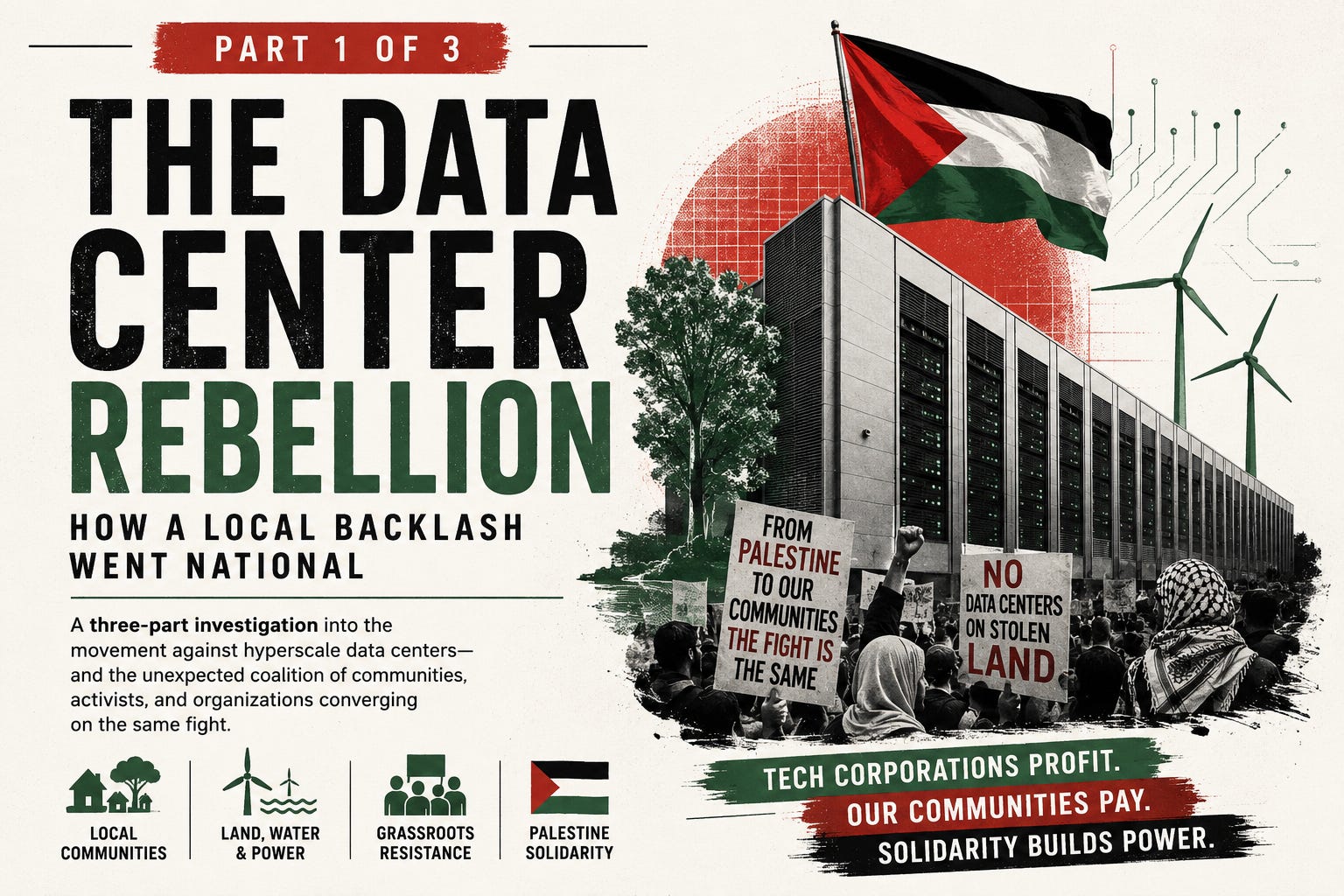
This is Part 1 of a three-part series digging into the rapidly growing movement against hyperscale data centers: how scattered local fights became a national political force, the organizations and money building infrastructure around them, and the surprising coalition of environmental activists, socialists, tech workers, Palestine-solidarity organizers and conservatives now converging on the same fight.
I’m on a mission as a “history activist” to document Jewish history before it’s rewritten, distorted, or erased. Equally, I’m on a mission to uncover the truth. Every paid subscription helps fund the research behind these essays and makes it possible for me to continue this work full-time. For $75 a year (just 21¢ a day), you’re doing more than supporting a writer. You’re helping preserve the Jewish story.
A rural township outside Ann Arbor probably wasn’t where anyone expected a national political fight over artificial intelligence to take shape. But Saline Township is a pretty good place to start.
The project proposed there is enormous: a hyperscale data center connected to Oracle and OpenAI’s Stargate buildout with a contracted electric demand of 1,383 megawatts. Governor Gretchen Whitmer announced it in October 2025 as the largest one-time investment in Michigan history, promising more than 2,500 union construction jobs, 450 permanent jobs at the site and another 1,500 across Washtenaw County. For perspective, Michigan Attorney General Dana Nessel’s office compared the project’s electric load to adding more than one million average American homes to DTE’s system.
Then people started asking who was going to pay for all of this.
DTE sought approval of two special contracts to provide power to Green Chile Ventures, an Oracle subsidiary, without a contested hearing. Nessel intervened, arguing that the heavily redacted contracts prevented the public and consumer advocates from determining whether existing customers could eventually be left paying costs associated with the project. More than 5,500 public comments reached the Michigan Public Service Commission before it conditionally approved the contracts in December 2025. Nessel challenged the decision, sought to reopen the case and ultimately appealed the approval to the Michigan Court of Appeals in April.
The MPSC imposed safeguards. DTE is responsible for costs it can’t recover from Green Chile Ventures, and the data center’s electric load must be reduced or interrupted before other customers during an energy emergency. Green Chile also agreed to bear the cost of energy-storage facilities matching the project’s contracted demand over a 15-year period.
That gives you some idea of the scale. Michigan’s utility regulator didn’t treat this like another large commercial customer. It built special protections around what happens if the project leaves, fails, doesn’t consume the electricity it contracted for, or puts pressure on the grid.
And Saline was only the beginning.
Data-center proposals began appearing across Michigan while residents and township officials were still trying to figure out what these facilities meant for their communities. The questions repeated themselves: electricity demand, water, farmland, noise, utility infrastructure, tax incentives, permanent jobs, and how much authority a township actually retains once a multibillion-dollar development is moving.
Communities responded with the fastest legal tool available to them. They stopped the clock.
EDRA, the Economic Development Responsibility Alliance of Michigan, now tracks 34 hyperscale data-center projects and 98 township moratoriums across the state. Its tally lists nine projects as “won for now,” 11 where opponents believe they are winning and 14 where campaigns remain active. Those numbers come from EDRA’s own project tracking, rather than a state database, but the geographic spread is hard to miss.
Lyon Township adopted a temporary moratorium after residents packed public meetings over data-center development. Meridian Township adopted one before a project had even arrived so officials could write regulations first. Lowell Township became another battleground. Similar fights have appeared in communities across Washtenaw, Oakland, Wayne, Kent, Kalamazoo and other counties.
The pressure reached Lansing. Republican state Rep. Jennifer Wortz introduced House Bills 5594 through 5596 in February 2026 to temporarily halt new data-center permits and operations until April 1, 2027. Democratic Rep. Dylan Wegela and Republican Rep. Joseph Fox joined as sponsors. Wortz framed the proposal around farmland, energy, water and local input. Wegela came to the same legislation from the left.
Michigan had managed to produce something increasingly rare: Democrats and Republicans looking at the same rapidly expanding industry and agreeing that somebody should hit the brakes.
Michigan had spent the previous two years doing the opposite.
Public Acts 181 and 207 of 2024 extended Michigan’s sales and use tax exemptions for qualifying data centers through December 31, 2050, and expanded eligibility to enterprise data centers beginning in April 2025. Certain facilities built on brownfields or former power-plant sites can receive the exemption through 2065. To qualify as an enterprise data center, a project generally must involve at least $250 million in capital investment and create and maintain at least 30 qualifying jobs at wages equal to 150 percent or more of the regional median.
Whitmer has been clear about why the state wanted the projects. Her announcement for Stargate called the Saline development the largest economic project in Michigan history and credited bipartisan legislation she signed with lowering the cost of building high-tech infrastructure in the state.
The developers and administration have also made commitments. The governor’s office says the Saline project will use a closed-loop water system, require no additional water from the Great Lakes, preserve more than 700 acres as farmland, wetlands and forest, and bring an additional $14 million in local investments for fire departments, farmland preservation and a community fund. The project is expected to generate thousands of construction jobs and hundreds of permanent positions.
The fight over Saline is happening because the promised benefits and the demands are both enormous.
A facility drawing nearly 1.4 gigawatts of electricity changes utility planning. It requires infrastructure, storage, contracts, regulatory oversight and contingency plans for what happens if the customer disappears. The MPSC ordered DTE to compare future resource requirements with and without the data center’s load and to analyze how incremental renewable-energy and energy-efficiency costs should be allocated.
Nationally, the power question is getting harder to ignore. The U.S. Department of Energy reported in December 2024 that data centers consumed about 4.4 percent of all U.S. electricity in 2023. By 2028, the department projected they could consume between 6.7 and 12 percent. Total data-center electricity use could rise from 176 terawatt-hours in 2023 to between 325 and 580 terawatt-hours by 2028.
Michigan’s township fights are part of a much larger argument over who gets the power, who builds the infrastructure and who pays for it.
Bernie Sanders and Alexandria Ocasio-Cortez introduced the Artificial Intelligence Data Center Moratorium Act in March 2026, calling for an immediate federal pause on AI data centers until Congress establishes safeguards covering electricity prices, workers, privacy, civil rights, communities and environmental impacts. Sanders put Big Tech and billionaire power at the center of his case. Ocasio-Cortez tied the issue to surveillance, jobs and rising electric bills.
The legislation’s sponsors said more than 100 local communities had already enacted data-center moratoriums and 12 states were considering statewide proposals.
Then the Tea Party entered the fight.
Humans First, chaired by longtime conservative activist Amy Kremer, began organizing against AI data centers around electricity prices, water, tax breaks, property rights and local control. Kremer came out of the Tea Party movement and later co-founded Women for Trump. Her organization announced a nationwide protest for July 18.
The turnout showed how far the issue had traveled.
According to Reuters, on July 18, opponents held 142 protests across 42 states in the first coordinated nationwide demonstration against the data-center expansion. Humans First coordinated the effort. Protesters in different states arrived with different politics, but the complaints kept circling the same subjects: water, electricity, development incentives, community input and the speed at which enormous projects were being approved.
A Reuters/Ipsos poll released around the protests found only 14 percent of Americans said they would support a data center being built in their community. Only about a third approved of the current pace of development.
That is an interesting, curious political problem for an industry planning one of the largest infrastructure buildouts in the country.
                         HYPERSCALE
                        DATA CENTER
                            │
          ┌─────────────────┼─────────────────┐
          ▼                 ▼                 ▼
       LAND USE         ELECTRICITY        WATER /
                          COSTS          ENVIRONMENT
          │                 │                 │
          └────────────┬────┴────┬────────────┘
                       ▼         ▼
                 LOCAL OPPOSITION
                       │
        ┌──────────────┼──────────────┐
        ▼              ▼              ▼
   CONSERVATIVE    ENVIRONMENTAL   LABOR / LEFT
   LOCAL CONTROL      GROUPS        ORGANIZERS
        │              │              │
        └──────────────┼──────────────┘
                       ▼
               NATIONAL BACKLASH
The people entering these fights don’t need a common ideology. A homeowner can care about noise and property values. A farmer can care about land. An environmental group can focus on water and fossil-fuel generation. A union can want the construction jobs while demanding guarantees about who gets them. A socialist can frame the project around monopoly power and corporate control of public resources. A conservative can see Big Tech arriving with government tax incentives and immediately reach for the language of corporate welfare and local sovereignty.
They can despise each other’s politics and still vote for the same moratorium.
The left was organizing nationally too.
On June 11, more than 520 organizations across 48 states sent Congress a letter demanding a nationwide moratorium on new hyperscale data centers. Food & Water Watch facilitated the effort. Signers included Greenpeace, Friends of the Earth, Americans for Financial Reform, Popular Democracy, People’s Action Institute, Good Jobs First and Honor the Earth.
A new Stop Data Centers Coalition launched with it, promising to support campaigns at the local, state and federal levels.
Now put the two national mobilizations next to each other.
On June 11, hundreds of environmental, progressive and community organizations launched a national coalition demanding a moratorium.
On July 18, a conservative organization rooted in Tea Party politics coordinated 142 protests in 42 states against the same industry.
Neither side needed the other to get there.
That is what makes the data-center backlash different from a normal partisan campaign. It has multiple organizing centers, multiple political languages and multiple reasons for existing. They converge on the same physical projects.
Michigan shows the same thing on a smaller scale.
There’s another current running into the data-center movement that has almost nothing to do with farmland or residential electric bills.
The same technology companies building the AI infrastructure boom are already targets of the Palestine-solidarity movement. Amazon and Google have faced years of organized opposition over Project Nimbus, the Israeli government’s cloud-computing contract. Microsoft has faced a separate employee campaign over its cloud and AI relationships with the Israeli military. No Tech for Apartheid has organized Google and Amazon workers against Nimbus, while tech-worker activists have increasingly focused on the physical infrastructure behind cloud computing itself.
Now some of those networks are appearing in the data-center fight.
Amazon Employees for Climate Justice is one of the clearest bridges. The worker organization has campaigned around Amazon’s data-center expansion and its environmental and energy consequences while also organizing with No Tech for Apartheid over Amazon’s relationship with the Israeli government. Those campaigns begin with different issues, but they lead back to the same company and increasingly to the same infrastructure.
MediaJustice followed a similar path. Years before the current data-center backlash, the organization was campaigning around Amazon Web Services, surveillance technology and the use of corporate technology by police and government agencies. It also participated in No Tech for Apartheid organizing. By 2026, MediaJustice was sitting on the coordinating committee of the national Stop Data Centers Coalition.
Then there is Athena, a coalition originally built around organizing against Amazon and corporate power. At a 2025 national gathering, Athena put a Tucson anti-data-center organizer on the same program with representatives connected to MediaJustice and No Tech for Apartheid. The issues that look separate on paper were already sharing organizing space before the national data-center coalition formally launched.
The connection is easier to see once the cloud stops sounding like something floating in the sky.
Project Nimbus runs on physical computing infrastructure. Amazon Web Services runs on physical computing infrastructure. Microsoft’s Azure runs on physical computing infrastructure. AI runs on physical computing infrastructure. That infrastructure requires enormous buildings, electricity, water, transmission capacity and land.
For activists who have spent years targeting what Big Tech’s cloud systems are used for, the expansion of the physical systems those companies depend on creates another place to apply pressure.
That doesn’t make the nationwide data-center backlash a Palestine-solidarity campaign. Most residents fighting projects in Michigan, Virginia, Georgia, Florida or elsewhere aren’t showing up at township meetings because of Project Nimbus. The local fights have their own causes and constituencies.
But Palestine activism gives the movement another front door, alongside climate politics, conservative local control, utility costs, farmland, labor and anti-monopoly organizing.
And that makes the coalition considerably bigger than an environmental movement.
EDRA didn’t begin with artificial intelligence.
The organization traces its creation directly to the battle over Gotion’s proposed $2.4 billion electric-vehicle battery-materials plant near Big Rapids. Michigan had approved a package that included hundreds of millions of dollars in state support and tax incentives. Local opponents organized around land, environmental questions, subsidies, transparency and the role residents had in the approval process.
EDRA grew out of that fight and expanded statewide.
By the time hyperscale data centers began appearing across Michigan, the organization already had experience digging through development agreements, following state incentives, lobbying lawmakers, organizing residents and connecting activists in different communities. Its current data-center operation includes a statewide project map, community organizing resources, legislative information and direct calls for residents to contact lawmakers.
The project changed. The machinery was already sitting there.
And EDRA isn’t the only example.
A resident who discovers that a data center is proposed near her home can now find model arguments, research on electricity and water, information about tax incentives, other communities considering moratoriums and national organizations already campaigning against the industry.
That changes how quickly a local fight can grow.
It also changes the question this investigation has to ask.
Because the national organizations now moving into data-center fights didn’t all appear when ChatGPT and other AI tools took off or when Stargate was announced. Some were built years earlier to organize against Amazon. Some worked on monopoly power. Some organized labor. Some fought surveillance technology. Some were built around climate justice. Some came through the pro-Palestine movement, where activists and tech workers were already targeting Amazon, Google, Microsoft and their cloud infrastructure over Project Nimbus, military contracts and surveillance. Some targeted AWS and other cloud infrastructure long before the physical buildings housing that infrastructure became a national political issue.
They already had staff, donor relationships, research operations, communications networks and coalition partners.
The grassroots anger came first in many communities. But once those local fights began appearing across the country, there was already an organizational system capable of connecting them.
That’s where Part II begins.
Part II: The Infrastructure Behind the Backlash: The Networks That Were Built Before the Data Center Fight - Stay tuned, coming soon.
I’m on a mission as a “history activist” to document Jewish history before it’s rewritten, distorted, or erased. Equally, I’m on a mission to uncover the truth. Every paid subscription helps fund the research behind these essays and makes it possible for me to continue this work full-time. For $75 a year (just 21¢ a day), you’re doing more than supporting a writer. You’re helping preserve the Jewish story.
I used way too many sources, so here are a few relevant ones:
Michigan Department of Treasury, Revenue Administrative Bulletin 2025-18
https://www.michigan.gov/taxes/rep-legal/rab/2025-revenue-administrative-bulletins/revenue-administrative-bulletin-2025-18
Office of Governor Gretchen Whitmer, Gov. Whitmer on Stargate Announcement from OpenAI, Oracle, & Related Digital Creating Thousands of Jobs, Largest Investment in Michigan History
https://www.michigan.gov/whitmer/news/press-releases/2025/10/30/whitmer-on-stargate-announcement-from-openai-oracle-related-digital-creating-thousands-of-jobs
Office of Governor Gretchen Whitmer, Gov. Whitmer Submits Public Comment in Support of Stargate Project, Creating Thousands of Jobs, Meeting Strong Environmental Standards
https://www.michigan.gov/whitmer/news/press-releases/2025/12/03/whitmer-submits-public-comment-in-support-of-stargate-project-creating-thousands-of-jobs
Michigan Public Service Commission, MPSC Approves DTE Electric Energy Contracts for Data Center With Conditions to Strengthen Protections for Other Customers
https://www.michigan.gov/mpsc/commission/events/2025/12/18/~/link.aspx?_id=5F5E5CA34D71466696AB507F9571E9FC&_z=z
Michigan Department of Attorney General, AG Nessel Intervenes in DTE Data Center Case, Seeks Formal Public Hearing to Review
https://www.michigan.gov/ag/news/press-releases/2025/11/06/ag-nessel-intervenes-in-dte-data-center-case-seeks-formal-public-hearing-to-review
Michigan Department of Attorney General, AG Nessel on the MPSC Approving DTE’s Application to Service Saline Data Center
https://www.michigan.gov/ag/news/press-releases/2025/12/18/ag-nessel-on-the-mpsc
Michigan Department of Attorney General, AG Nessel Files Appeal of MPSC Approval of DTE’s Saline Data Center Contracts
https://www.michigan.gov/ag/news/press-releases/2026/04/17/ag-nessel-files-appeal-of-mpsc-approval-of-dtes-saline-data-center-contracts
U.S. Department of Energy, DOE Releases New Report Evaluating Increase in Electricity Demand from Data Centers
https://www.energy.gov/articles/doe-releases-new-report-evaluating-increase-electricity-demand-data-centers
Office of Senator Bernie Sanders, Sanders, Ocasio-Cortez Announce AI Data Center Moratorium Act
https://www.sanders.senate.gov/press-releases/news-sanders-ocasio-cortez-announce-ai-data-center-moratorium-act/
Economic Development Responsibility Alliance of Michigan, AI Data Centers Coming to Michigan
https://edraofmi.org/ai-data-centers-in-mi
Economic Development Responsibility Alliance of Michigan, The Untold Story of Gotion
https://edraofmi.org/f/the-untold-story-of-gotion
Food & Water Watch, 500+ Groups from 47 States Call for Nationwide AI Data Center Moratorium
https://www.foodandwaterwatch.org/2026/06/11/500-groups-from-47-states-call-for-nationwide-ai-data-center-moratorium/
Reuters, Data Center Opponents Stage 142 Protests Across 42 U.S. States
https://www.reuters.com/business/retail-consumer/us-data-center-protests-go-national-backlash-grows-2026-07-18/
No posts
Comments
Nothing yet. Say the first thing.
Sign in to join the conversation.