
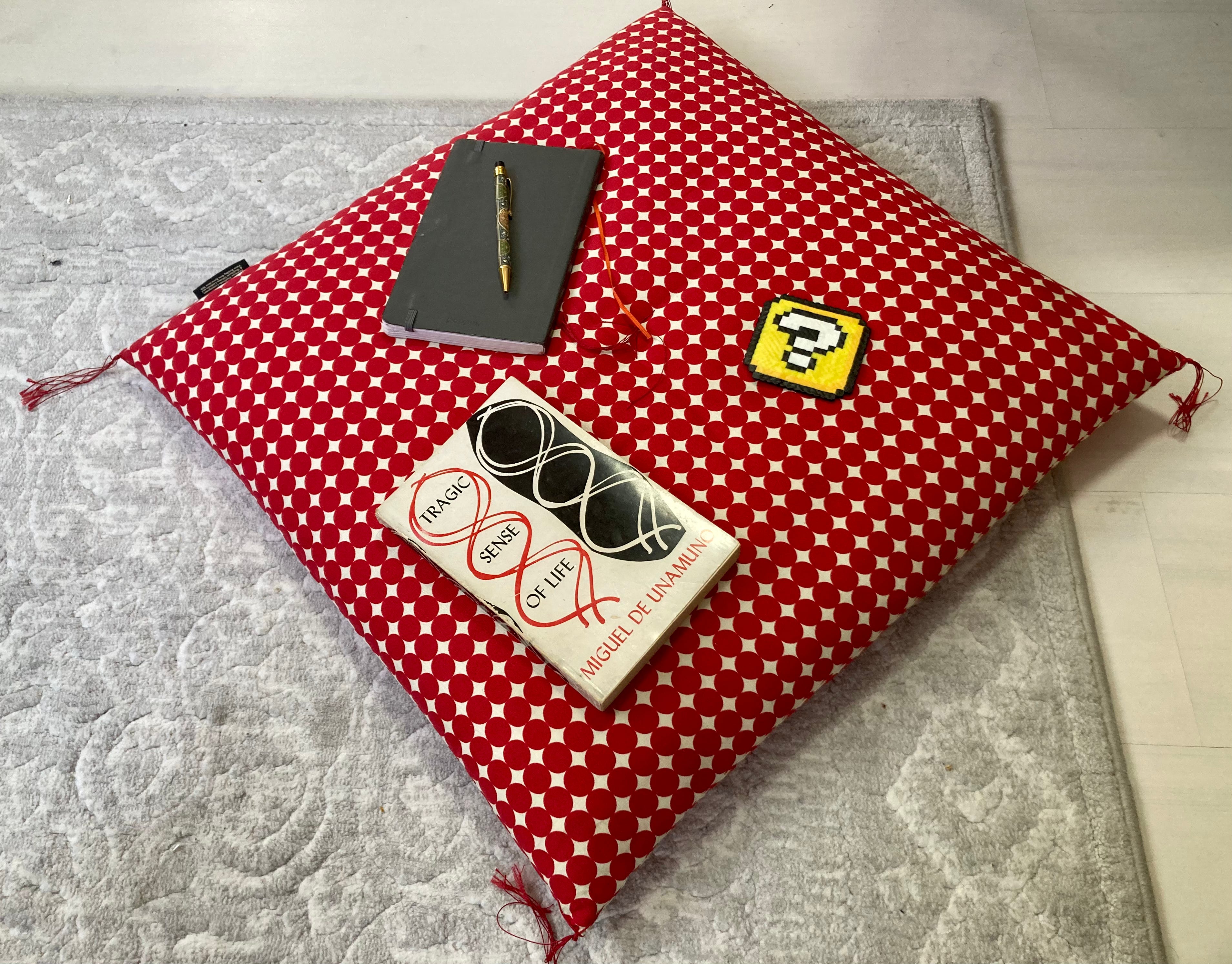
Why read? Why write? Why meditate?
I could quote the wisdom of the ages or the latest popular neuroscience. I could throw in alluringly foreign words like gnosis (Greek for knowledge) or satori (Japanese for awakening). I could drop bestselling buzzwords like neuroplasticity (training the brain to change) or emotional intelligence (recognizing and managing feelings). I could ask a chatbot, answer with a koan, or ask a chatbot to answer with a koan. But let me stay grounded and local to my mind and say, because they’re better than the alternatives.
If I wasn’t reading a book, I’d be scrolling the internet. Even while reading, I glance over at my phone lying seductively on the nightstand. It does a little striptease in the corner of my eye, with beeps and flashes like tits and asses. I can hold off for a while, but when I finish a chapter, I surrender to the allure of its alerts. Time and attention disappear like money down a 5G-string. I feel exploited and exploitative, a browser being browsed, less refreshed each time I hit refresh. Yet at least I return to my book once the lapse is complete. Without a book to read, I’d be permanently lapsed, scrolling my way to the end of the night.
After a long scrolling session, my mind is foggy, ill at ease, and self-accusatory about the time I’ve wasted. At the end of a deep reading session, my mind is clear, in a flow state, and forgetful there even is a self. Why then, do I still seek to scroll? Because the mind is at war with itself, the lust for instant gratification pitted against the patience for long-term reward. On the side of Instagrat: sly persuaders and dark influencers, Zuckerborgs and Muskorithms. Each evening, Moby Dick battles the harpooners of my attention span to a standstill. I can’t declare permanent victory over the expanding metaverse, but I can claw back my meta-Donbas, book by bloody book.
Besides defending my attention against the phone, books challenge me to write. I write because thinking about what to write supplants other, lesser thoughts. Instead of worrying about work and household chores, my mind turns phrases and mixes metaphors in the rarefied realm of ideas. The mind has only so much short-term memory, so the deeper I think, the more I forget my shallow thoughts. As an added bonus, my performance of work and household chores—the subjects of my set-aside to-do list—is improved by approaching them more serenely. By thinking through and writing down my thoughts, I calm and purify my mind, instead of being driven by its autopilot anxieties.
The actual output needs to meet my standards, which are not those of the world, though I take the world seriously. If the words on paper correspond, at least by two-thirds, with the inchoate thoughts and feelings that birthed them, then I’ve obtained a small victory. I’ve won over the disquiet of unexpressed, and so unfinished, inner truths. Unconscious unrest gives way to articulated order. And victory makes us feel powerful. I carry that power forward into other, quotidian domains until the humdrum beats me down. Then new, inchoate thoughts and feelings take form and the process of renewal starts again.
Meditation provides perspective on those inchoate thoughts and feelings. From a sitting stance, I can watch them wither on the vine or bloom into articulation. Most wither on the vine, as they should. World weariness is usually just post hoc rationalization for lack of sleep. Existential angst is often gross overreaction to social slights. Intoxicating ideas lose their buzz when you’re sober. Sit with yourself long enough and your inner landscape’s true nature, or lack thereof, reveals itself. Thoughts, cultivated by books, harvested by meditation, become either writing or fertilizer for future writing. Most become fertilizer but that’s how we grow.
There’s a subtle but important distinction between lying down thinking and sitting up meditating. If thoughts are going to pour through your mind regardless, best to subject them to a controlled stance and calming environment. When you meditate, you think, but you also create the slightest bit of distance between yourself and your thoughts. That distance is enough to prevent you, sometimes, from mistaking them for reality. Even when you’re overwhelmed by your thoughts, even when meditation is an exercise in failure, the realized intent to meditate is itself a success. You sat up and took it instead of taking it lying down.
The alternative to consciously participating in a virtuous cycle is being taken for a ride. Put another way, the trifecta of reading, writing, and meditating is a routine to develop in place of bad habits. Replaying missed opportunities in your head, reading the replies of anonymous trolls on Twitter, and getting angry at inanimate objects are just a few of their potential rivals in repetition. I can’t scientifically or mystically prove that disciplined introspection is better than slavish careening. But I can use words to gesture at the truths I experience. Nature abhors a vacuum, and though all is empty, some ways of spending time are less empty than others.
Comments
Nothing yet. Say the first thing.
Sign in to join the conversation.