
This year I’ve been exerting bonus mental labor speculating about the potential origin of horror fiction and its relationship to early ancestral human tribal creation myths. This is partially inspired by a quality of modern horror stories: an effectively scary horror narrative need not be based in realism. A successfully scary film, for example, does not require logical or even totally coherent parameters to evoke fear, it need only absorb the attention of the viewer or audience.
There is a specific Roger Ebert quote regarding horror movies which conveyed this theme quite succinctly, but which I have been unable to locate. The elusiveness of such a quote by him is appropriate, given that Ebert had a reputation (based on lots of his own willful examples) for disliking most horror films (especially after the onset of the slasher genre). But he did understand what made horror so cathartic.
We're instinctively afraid of natural things (snakes, barking dogs, the dark) but have to be taught to fear walking into traffic or touching an electrical wire. Horror films that tap into our hard-wired instinctive fears probe a deeper place than movies with more sophisticated threats. A villain is only an actor, but a shark is more than a shark. (Roger Ebert)1
Ebert’s observation supposes horror tales are long since embedded in the human psyche. Perhaps horror is the first and oldest genre of storytelling. The horror story is a simple but effective vehicle for the complex and conscious fears (stress) of the human brain’s neocortex. One early development must have been the arrival of supernatural fears—fear of spirits of the dead. Fears of this kind tend to become even more enamoring with unkempt speculation. Such new mental experiences in the ancestral psyche meant the crossing of an evolutionary cognitive threshold, from animalistic perception (fear which is consciously connected to and preoccupied with physical survival alone) to increasing self-awareness and a growing imagination.
The central fear of a horror story is an unavoidable event or actor which is incomprehensible to the affected community. It is a circumstance in which the society lacks recognizable labels used to give coherence to its own conceptual collective social identity. A group creation myth is a symbolic recognition of the collective social identity. Like new experiences of horror, origin stories also would have gestated alongside an imaginative and permeating early human cognition of layered fears. The creation mythos is a map2 through what is originally an abstract and meaningless wilderness, whereas the horror story relays a psychologically traumatic experience which occurs outside the known boundaries of the map. Cerebral fears correspond with an insufficiency in our psychological defenses—resources of our communal notions of meaning, purpose, and healthy socialization. The experience of trauma and the conveyance of horror take place in (or simply are) the absence of functional surrounding social and cultural structures.
I like to imagine that at some era in our early ancestors’ emerging psychic awareness of overlapping sensory and imagined activity, there was an ephemeral threnody (a growing sense of dread) gradually oscillating throughout the unsubtle perpetual patterns of daily lived group experience. Humans and pre-humans experience the same fear and physical pain as any (other) animal, but a haunted recollection of recurring otherworldly night time visits remains a unique disturbance of ours. When certain individuals were particularly prone to vivid shifting narrative experiences during sleep, and were able to recall the details of recent and reoccurring dreams (the first to write down dreams immediately upon waking in order to remember them!), the steady, cumulative process of supernatural correspondence and beliefs had begun.
A sense of existential terror probably naturally yielded simple associative identities or group concepts, or early creation mythologies and origin stories. While I describe these (mystically speculated) dynamics of tribal humanity as concrete arrangements and experiences, clearly stuff like this would have been developing extremely slowly across giant expanses of time, and would not be perceptibly noticeable in direct observation between generations. The technological development of the Paleolithic and Bronze Eras of human civilization occurred on such a gradual cultural scale, if we could hypothetically take a time traveling American automobile to go back and visit those eras in different separate windows of time centuries apart, most of the technology and culture would seem, to the casual observer from our present (a non-expert on the period), to barely be changing at all.
Still, our age is similar: we record specific dates as milestones, our major events are chronological snapshots which give context and narrative meaning to our arrived cultural trajectory—and yet everything (everything) is a ceaseless ongoing transition which originated in the mists of prehistory and continues onward. The windows of time that even human civilization occurs within is too large and abstract for realistic assessment at the individual or generational level of comprehension.
This issue is at the conceptual center of the famous sci-fi (horror!) movie, 2001: A Space Odyssey. The mysterious monolith’s appearance and presence, influencing the evolutionary shift of consciousness of our ancestors, is inherently allegorical. Allegory is how we exist within a universe which is too complex and chaotic for us to directly ascertain. Allegory is what we weave culture with, it’s what we swim in. Hence the movie conveys a story about evolution wherein it is observable by a dramatic narrative milestone and event in time, a depiction which is conceivable and tangible to our framing of the breadth of history. The final act and scenes of the film continue the exploration of this idea, demonstrating the human incapacity to process the scale of time or the species’ presumable next distinct experience of evolution.
Contemporary horror stories play and prey upon contemporary avenues of human stress and trauma within a simple storytelling structure. The directness, effectiveness, and symbolic obtuseness makes it a genre which humanity can use to actively probe at its own psychological illusions and dogmas with contemporary media forms. Perhaps existential human maps and corresponding horror potentialities co-dependently articulate, inform and change each other as part of the shifting identity process of civilization’s socio-cultural evolution.
The permeating accessibility and evolution of horror is recognizable in the popularization of formerly niche hybrid formats like dark fantasy, a storytelling setting merging original mythological, supernatural and heroic tales with violent, existential and cosmological tragedy and terror. Dark fantasy cathartically soothes some of the stresses of the contemporary secular experience, particularly the uncertainty that goes along with a decoupling from traditional religious rituals, beliefs, and meaning. Such feelings pair innately with the reasonable, ongoing curiosity for ancient human cosmological perspectives, the grim origins of vicious deities. The popular acceptance and even appetite for decadent, grisly violence in a show like Game of Thrones feels reminiscent of how earlier eras of humanity would have related to the ornately gruesome artistic depictions of the afterlife in religious artwork.
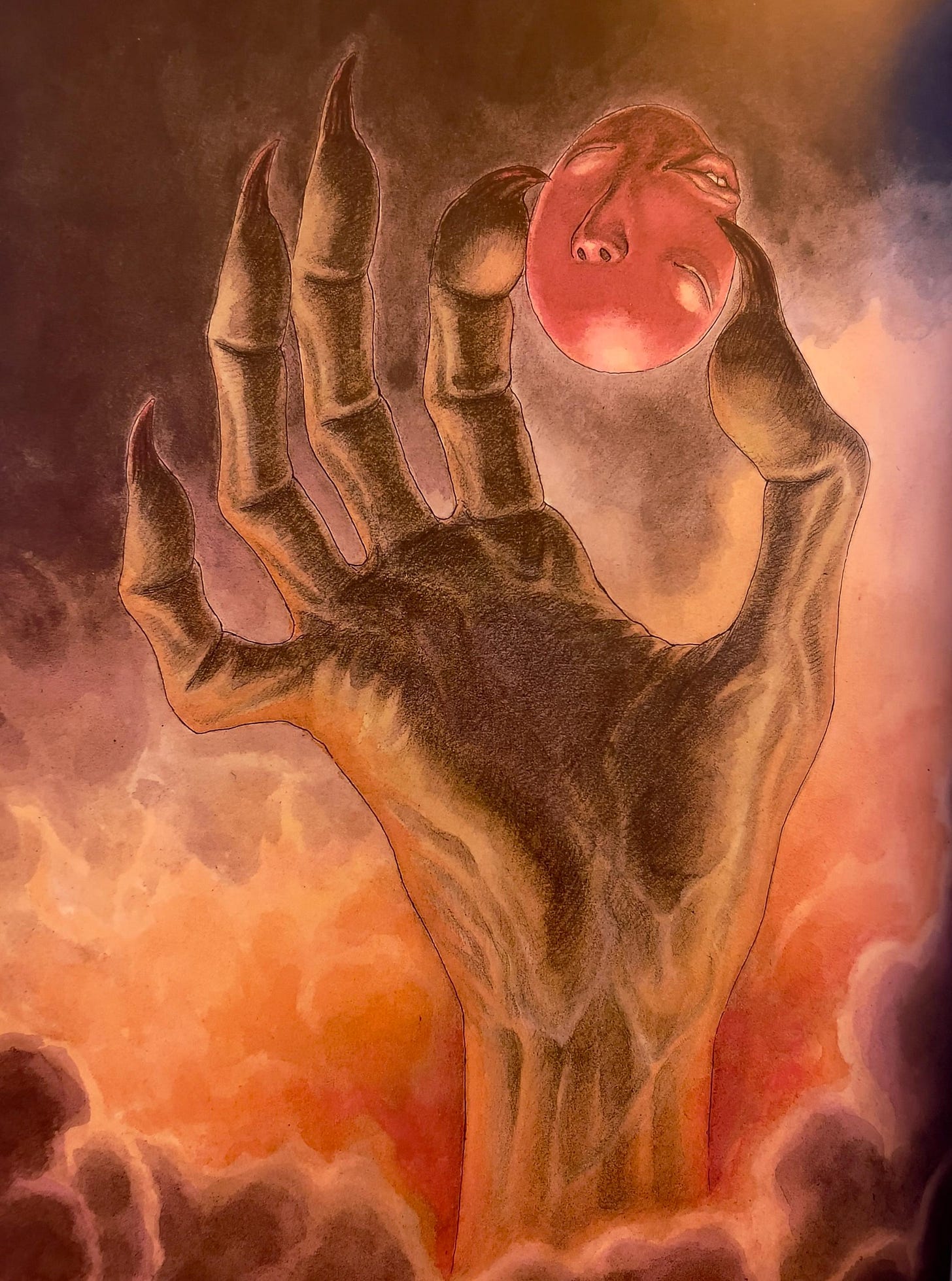
Perhaps collective tribal identity co-arose gradually in early human societies in direct correspondence with increasingly complex fears and memories, such as recollection of dreams. The co-arising creation myths providing a vehicle by which to purposefully direct a narrative linear path through abstract, frightening chaos and the self-evident violence of nature and existence. Within the abstract and ambitious qualities of the creation myth, the interior reasoning, we recognize elements of contemporary expression—consideration of art and its various forms of media. Mirroring the experience of horror and its most effective scary stories, creation myths or stories of identity are not constructed as scientific explanations, but as narrative trajectories which exist out of necessity to convey a sense of collective purpose. What matters is not logic, but internally cohesive events and details which fend off violence and meaninglessness.
https://www.rogerebert.com/reviews/the-blair-witch-project-1999
Eliade & Couliano, “Introduction: Religion as a System,” The Harpercollins Concise Guide to World Religions.
Comments
Nothing yet. Say the first thing.
Sign in to join the conversation.