
So, about a month ago, I was back east and visited the New Bedford Whaling Museum. Amongst other things, it sparked a desire to read Moby Dick.
(TLDR: Richard the Lionheart song at the end)
Perhaps like you, I’ve been afraid of this book my entire life, on bulk and reputation alone. But I bought a copy there, and I’ve been tearing it up. This book is not what you think—it’s funny and fast paced, before it turns dark—many of the chapters are just a few pages—and you’ll be halfway done before you realize it. But Moby Dick is a post for another day and another blog. We’re about Richard the Lionheart here, right?
But, I’ve been digging deep on the Age of Sail for a project I’m working on, and sea-shanties in particular. There’s sea shanties in Moby Dick, and I’m trying to track down one of them that starts:
Our captain stood upon the deck,
A spy-glass in his hand,
A viewing of those gallant whales
That blew at every strand.
Turns out it’s the traditional Greenland Whale Fisheries shanty. My project is set in the early 1700s and Moby Dick is ca. 1850. I’m wondering how old this shanty is—was it sung during the 1700s? I learn that the shanty (or its antecedent, The Greenland Voyage) might be mentioned in the 1725 book A Collection of Old Ballads.
Stick with me, we’re almost there.
So I hit the Internet Archive, which miraculously has a scanned version. Indeed, The Greenland Voyage is there, though it bears little resemblance to what we know today as the Greenland Whale Fisheries. Vaguely disappointed, I turn to the table of contents to see what else might be there.
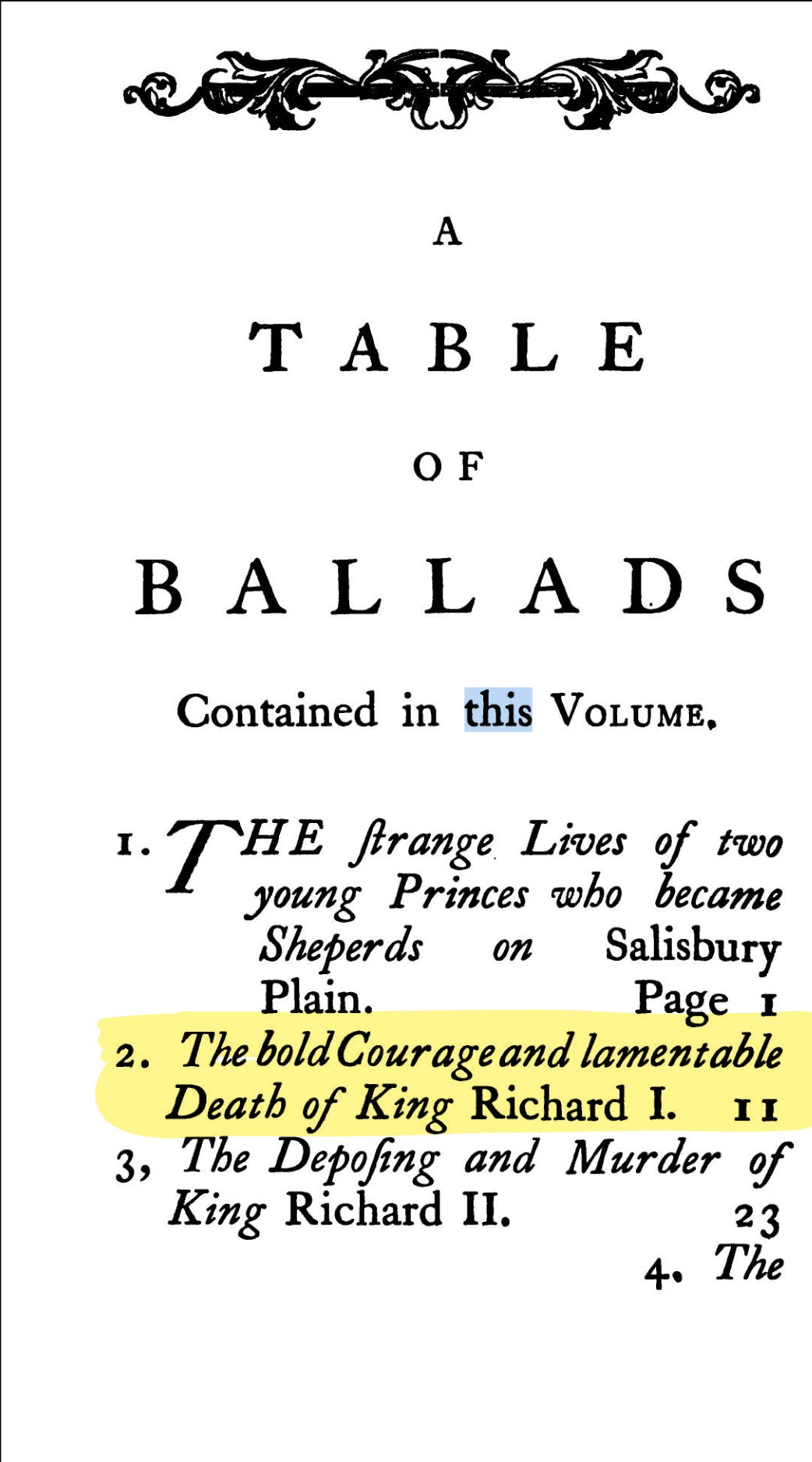
Boom. The bold Courage and lamentable Death of King Richard I.
I’ve read a lot — a lot — about King Richard and his era. Two dozen books or more, plus a million papers, articles, etc. I’ve never heard of this song. The author of the Ballads has seen fit to include a summary of Richard’s life, including (parts of) the Third Crusade, and it is solid. I’ve never seen this song before, and the book is inaccessible and archaic (ca. 1725), so I decided to transcribe and publish the full text of history and song.
But before that, here’s the fun part.
Ballads says this song is sung “To the Tune of You Batchelors, &c.”1 What tune is that, I wonder? Turns out there are historians of British folk tunes, just as there are historians of sea shanties. I read up. “You Batchelors” seems to refer to an old song called Advice to Batchelors, or The Married Man’s Lamentation, which was/is sung to the tune of an older song, Hey Boys up we go, which itself is derived from a yet-even-older song called Jenny Gin. I find a recording ( a few, actually ) of Jenny Gin here.
But how does does that song and melody sound with the Richard song from the book? No idea. There are of course no recordings. Hm….
AI to the rescue! Off I go to Suno, with lyrics in hand and a small recording of the source song. “Suno, please render the provided lyrics like an old English broadside ballad2, sung solo, a cappella by a woman, to the tune and style of the attached mp3.”
Suno isn’t perfect at following instructions—the ‘solo a cappella’ version ends up sounding like a Pentatonix Las Vegas show—but you really can get the sense of the song, and it’s not bad!
Here’s the original tune for Jenny Gin / You Batchelors.original Jenny Gin)
0:00
-0:38
Now, Suno’s Song of King Richard, to the same tune: (on Suno here):
0:00
-0:42
I also made a version in the style of Turpin Hero (a traditional sung by Jake Bugg that I like very much), and a version like a sea shanty.
Turpin Hero style: (I did not give this run access to the Jenny Gin melody)
0:00
-2:58
Sea-shanty style:
0:00
-2:39
Musical Archaeology, powered by AI. It’s quite striking how Suno has preserved so much of the melody of Jenny Gin! The song kinda works!
OK, for posterity’s sake, here is the complete transcription of history and lyrics from the book. I used my OCR Workbench software, as transcribing Colonial-era books is difficult for traditional OCR. I did something similar for the letter that inspired The Tempest, if you are curious; it’s another great Age of Sail sea-adventure.
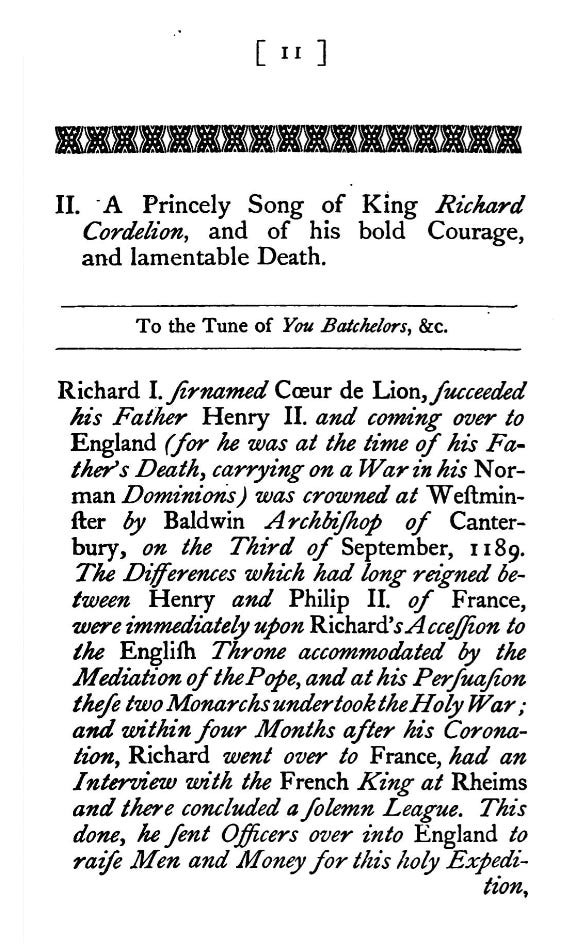
OK, I’m not going to give you the whole thing here due to Substack length limitations. If you want to read the entire content, go to my regular blog at this link. But here’s the first few verses.
Text within this block will maintain its original spacing when published
A Noble Christian Warrior,
    King Richard of this Land;
For Fame amongst our Worthies brave,
    Now orderly may stand:
The God of Battels gave him still.
    A gallant great Command,
To fight for our Saviour Jesus Christ.
Richard Cordelion in this Land,
    A noble English Name;
It fills the World with Wonders great,
    With Honour and with Fame:
Then gallantly good Soldiers all,
    Come thunder out the same,
That fights, &c.
When as fair Jerusalem,
    The City of our Lord,
Lay mourning all in heaviness,
    Consumed by the Sword;
To succour her, all Christendom
    Did willingly accord:
And to fight, &c.
https://en.wikipedia.org/wiki/Broadside_ballad
Comments
Nothing yet. Say the first thing.
Sign in to join the conversation.