
The silvery river whispers, a tide of murmurs over rock. The burnished steel of the knight’s armor glints, reflecting the sun and the river he rides beside. The woman is breathtaking, more beautiful than the river. He’s never seen her like. Beautiful and elfin, with none of the churlish features he expects of the peasants that work his land.
He wishes her a good morning. She responds kindly. The river is lovely, is it not? he says, making small talk. The water is my life, she replies, seriously. Her voice is fluid, the sound of water over stone, timeless, ageless. He must have her. For her part, he is not unattractive, and will give her strong sons and wise daughters. Perhaps he will give her a soul. When he asks for her hand in marriage, she agrees. But there is a condition. He must never see her when she bathes. Swiftly, he agrees. Too swiftly.
As men are often do in stories like these, he has not listened. Or he forgets. Or curiosity overcomes him. Or the hectoring of his friends. We cannot know. All we know is that one day, he opens the door as she bathes, and is transfixed. She bathes, but she is not a woman, at least not a human one—he knows her angelic face, her breasts are stunning, but her legs are…a tail. She is a creature of the water, elemental. With a look of reproach, she vanishes. He never sees her again. His children have vanished as well. But on his deathbed, he hears her singing an unearthly lament for him.
So goes the ancient tale of Mélusine, more or less.1
Last week, I was reading The White Queen by Philippa Gregory, the story of Elizabeth Woodville of the house of Lancaster (in the Plantagenet line), who marries Edward IV of house of York—a tale of the War of the Roses, set 250 years after Richard. Elizabeth is descended from Mélusine, and inherits her magic; Mélusine is a thread woven through the book.
It rings a bell. I recall that Richard the Lionheart also claims Mélusine as an ancestor, and this inheritance is the origin of his famous quote about the Angevins: Henry II, Eleanor, and their quarrelsome sons, who are often called the Devil’s Brood. Of his family, Richard said: “from the devil we came, and to the devil we shall return.”
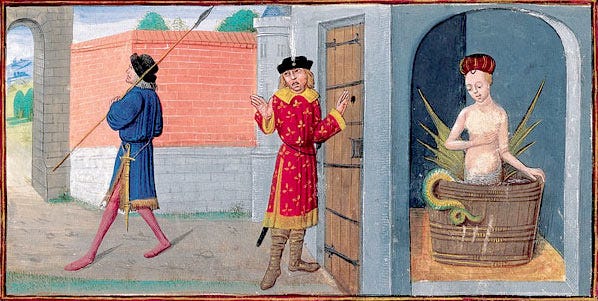
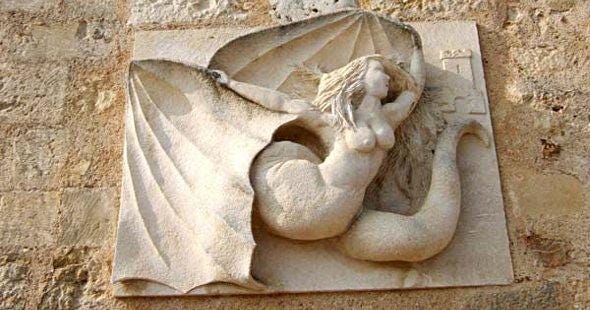
The most popular version of the Mélusine legend comes from Jean de Arras’ The Book of Melusine, written in 1478, and that is often described as the story’s origin. But as is common with these things, the story is far older than that, and has many variants. The knight doesn’t catch her in the bath, he sees her on a Saturday, or he enters her private room, or he forces her to take communion, or …etc2. He doesn’t find her by a river, he finds her on Crusade, or in Scotland, or … She doesn’t have a fish tail, she has a dragon’s tail. And so on. She doesn’t vanish, she turns into a dragon, or flies out a church window. Melusine is also regarded as a builder; many castles in France are attributed to her.3
The story is old, the variations are legion.
The version specific to Richard, and the origin of his quote about coming from the devil is very hard to track down, but the first (and only) contemporary mention I can find is in Instructions for a Ruler, by the historian Gerald of Wales, writing around 1191. We have encountered Gerald before, in our history of Excalibur: Gerald is the source of the story that Arthur’s bones were found at Glastonbury Abbey:
Gerald is an entertaining but notoriously unreliable historian, and in particular seems to despise all the Angevins. The only English translation of Instructions for a Ruler seems to be by Robert Bartlett (who also wrote a fine book on Richard), and it costs $250! Sheesh. So I’ve resorted to using Gemini to AI-translate from the original Latin via the Internet Archive:
Likewise, a certain Countess of Anjou4, of striking form but unknown nation, and taken by the Count solely for her bodily elegance, rarely came to church, and then showed little or no devotion in it, and never remained in church up to the secret of the Canon of the Mass, but always used to leave soon after the Gospel. At length, however, this having been noted with admiration both by the Count and by others, when she had come to church and was preparing to leave at the usual hour, seeing herself detained by four knights at the Count’s command, she immediately cast off the cloak by which she was held, and leaving her two small sons, whom she had with her under the fold of her cloak, with the others, and seizing the other two who stood on her left arm, she flew out through a high church window, with everyone watching. And so that woman, more beautiful in face than in faith, having taken her twin offspring with her, never appeared there again afterwards.
Moreover, King Richard often used to relate, saying that it was not to be wondered at if from such a lineage both sons and parents and brothers among themselves did not cease to vex each other; for he learned that they all came from the devil and would go to the devil. Since, therefore, the root on all sides was so vicious, how could a fruitful or virtuous offspring or progeny come from it?5
The knight that Mélusine marries is variously identified as Raymond of Portiers, or Black Fulk, Count of Anjou, or Siegfried, Count of Luxembourg, and even our old friend Guy de Lusignan! (here, and here).
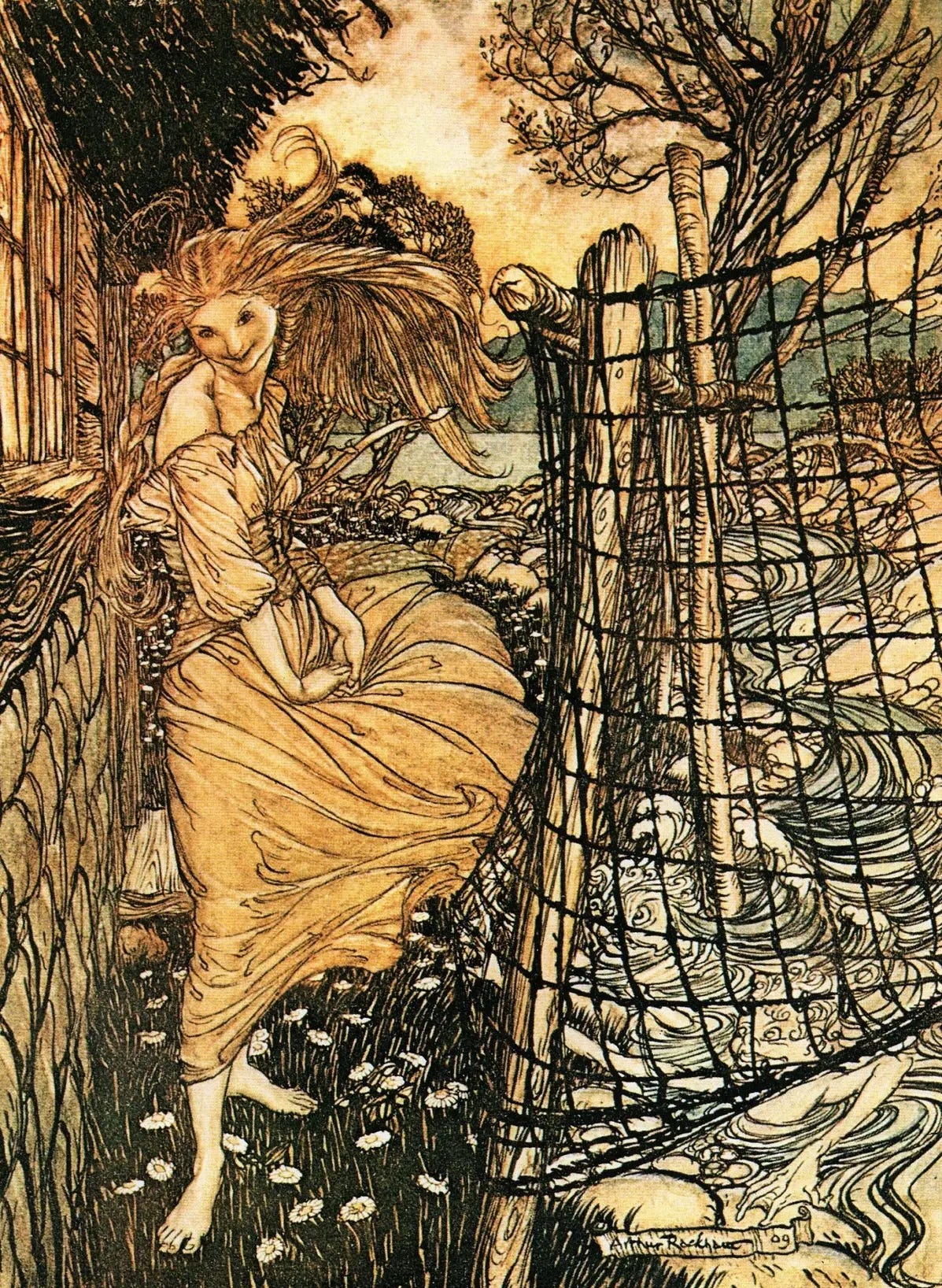
The legend of Mélusine goes back in time before Gerald, but it also continues forward in time. Lohengrin and the Knight of the Swan is a gender-swapped version. Undines are mythological water sprites discussed by Paracelsus in the 16th century, with Mélusine as an example; undines have no soul, but can gain one, and/or become human, by marrying a human. Paracelsus and his writings inspire Friedrich de la Motte Fouqué to produce Undine6, a fairy tale novella, gloriously illustrated by Arthur Rackham in one edition in 1909. In Fouqué’s version, Undine is a water sprite like Mélusine, but her husband is not forbidden from watching her bath, he is forbidden from speaking harshly to her (which of course is he does, in the logic of fairy tales).
The legend of Mélusine continues to this day: in 2015 the city of Luxembourg raised a statue in her honor to mark the 1050th anniversary of the city’s founding. She appears in A. S. Byatt’s novel Possession. And Laura Marling gave her (as Undine) her own song, as found at the top of this article.
And to deliver on the promise of the article’s title, a certain Hans Christian Andersen was inspired by Fouqué’s Undine to produce The Little Mermaid.

P.S. Oh. You will read that Mélusine is the woman in the Starbucks logo. This is, as they say, a story too good to fact check. Still, Starbucks themselves say something slightly different: they say she is a siren, which is close to Mélusine, but not quite…7
The story is ancient; the words are mine.
https://lionsandlilies.com/demons-and-devils/the-demon-countess-of-anjou/
https://artsandculture.google.com/story/melusine-the-builder-fairy-fondation-du-patrimoine/lgWhVziAoVApKA?hl=en
This is Melusine, nameless in this passage.
https://en.wikipedia.org/wiki/Undine_(novella)
https://about.starbucks.com/history/the-story-of-the-siren/
Comments
Nothing yet. Say the first thing.
Sign in to join the conversation.