
Fair companion, sit beside the window
And see the banners that the heavens show…
— Reis Gloria, Giraut de Borneil, ca 1200
Regular readers of this substack know we’re about things medieval, particularly the era of Richard the Lionheart. Today we have a short digression, though we’ll end up with a strange medieval connection.

I’ve been reading a lot about pirates for a project I am working on. I just finished Walking the Plank, by Steven Kiesling, which purports to be an inside history of the finding of the Whydah, the only validated pirate ship ever recovered. It was found by the pirate hunter / amateur archaeologist Barry Clifford in 1984, just off the coast of Wellfleet, on Cape Cod, Massachusetts.
It’s 1717, and the pirate “Black Sam” Bellamy has captured the slave ship Whydah and sailed it north to New England to meet his mistress. The ship carries a giant haul of treasure, reported to be 20,000 pounds of silver, gems and more. A massive storm comes up and the Whydah wrecks just off the coast of Cape Cod and is lost for 250 years. Barry Clifford reads the log of Captain Cyprian Southack, who was assigned to recover the treasure at the time, and failed. Clifford finds the treasure, or at least enough of it to validate he has found the wreck, including a bell inscribed with the ship’s name.
Clifford opened the Whydah Pirate Museum in West Yarmouth to display his findings. I’ve been. It’s fabulous. Unsurprisingly, Clifford comes off as a hero.
The thesis of Kiesling’s book, not to put words in his mouth, is that, “yes, he did find the Whydah, but everything else you’ve been told is a lie, and Clifford is kind of a scoundrel.” Disclaimer: I have no idea if this is true or not, but the book is fascinating, and that’s not the point of this. In the book, we encounter the following: (content warning, story has an objectionable sex act in it, skip at your discretion).
"Sorry!" I said, "I just figured it out."
"Figured what out?" my wife snapped.
"It's about pirates." I looked at Peter. He was into pirates.
He had offered me a free session to talk about them. "How well do you know your mythology—the legends of the Crusader knights and the Holy Grail?"
My wife scowled, but Peter took the bait—and I stripped line as fast as possible.
"Start in 1150 A.D.," I said. "A young virgin, the bride of the Captain of the Knights Templar, dies on the eve of her wedding, and the grief-stricken Knight ravishes her corpse. Nine months later the Captain is summoned to her grave by a voice. He digs up her body and finds a living head between her crossed leg bones. He carries them at the front of his army. He becomes invincible."
Peter nodded sagely and scratched his beard, probably wondering if he had chomped on a rubber worm.
"Fast forward to 1717," I said. "The Captain of a ship flying a skull and crossbones—a flag of resurrection—returns to Cape Cod to collect his young beauty, but wrecks his ship on the beach. Maybe the Captain drowns? But maybe not?"
I know a reasonable amount about things medieval, but this rings no bells. No idea what medieval story he’s talking about (and I would not characterize the Jolly Roger as a “resurrection” flag. 😊) And is not very respectable to women, which is unfortunately not uncommon in medieval stories.
Off I go to research, and sure enough, this is the legend of “The Skull of Sidon.” It occurs in a number of sources, but the most well-known is by Walter Map, in his De nugis curialium (“Courtiers Trifles”). Map was one of the courtiers of King Henry II, Richard the Lionheart’s father, who we have encountered many times, and Map’s book is filled with curious stories.
To complete the story, the magic head of Lady Maraclea was carried into battle by a Templar Lord of Sidon, and on to victory. The head, the legend says, was passed on the Templar order, and during the heresy trials of the Templars in 14th century France, the story was given as proof of heresy and witchcraft. The trials were a pretext—King Philip the Fair of France wanted the Templars’ money and feared their influence—but still led to the destruction the Templar order.
The skull and crossbones, aka the “Jolly Roger,” is one of the most iconic flags in history. There is a persistent legend that the Templars began displaying a “skull and crossbones” banner as they went into battle, emulating the Lord of Sidon, and it became their symbol. There is another persistent legend: the “Lost Fleet of the Templars,” ships manned by Templars who escaped the heresy trials and—wait for it—turned to piracy to survive.
There’s little real history to support this, at least that I can find. No footnoted documentation or pointers to contemporary sources that verify the use of the black flag. Still, as the joke goes, this is “a fact too good to fact-check.” Could it really be that the pirate emblem, the Skull and Crossbones, originated with the Knights Templar and the Crusades?
The skull and crossbones was a common medieval symbol for death1, and various Templar graves have the skull and crossbones on them, not unlike medieval occurrences of the symbol.
Historically, the connection seems pretty doubtful. But here’s something that might justify it.
The first documented use of the skull and crossbones, or the Jolly Roger as it came to be known, was by the French pirate Emmanuel Wynne2. The Templar heresy trials were held in France. Perhaps it was a folk legend that Emmanuel knew…but that is, of course, complete speculation. Almost nothing is known about Wynne except a short entry in the British Admiralty Records. A Captain Cranby is sent to Cape Verde to deal with pirates and chases Wynne into a cove. Wynne escapes, but Cranby mentions "a sable ensign with cross bones, a death's head, and an hour glass." It is 1700 and this is the earliest document mentioning the skull and bones use by pirates.
The earliest references to the term “Jolly Roger” goes back at least to the early 18th century, with one of the earliest documented instances appearing in Charles Johnson’s A General History of the Pyrates (1724). It was also apparently a practice at the time, that a death at sea was recorded in the logbook with a skull and crossbones.
There are a few other legendary stories about the origination of the Jolly Roger besides the simple association with death. Historian Dr. Rebecca Simon says that at the time, a red flag signaled that an attacking ship would offer no quarter (no mercy), whereas a black flag meant mercy would be shown.3 So some attribute the Jolly Roger name to the French words for red flag, “joli rouge.”4 Still others link it to King Roger II of Sicily (1095–1154), who had a massive fleet that flew the red flag, and who had association with the Templars. (King Roger was the grandfather of William II, who married Joan, Richard’s sister). Yet others link to word “Roger” to a synonym for the devil or for sex, but that all seems a bit of a stretch.
The flag quickly spread throughout the pirate world in the early 1700s. The flags were not flown continuously, but usually hoisted when the pirates attempted to capture another ship. The flag was part of the intimidation process, as pirates did not want a pitched battle, they wanted the ships to surrender without a fight. In fact they often rewarded the crews of ships that did not resist.
Most of the famous pirates had their own version, described in trial records and histories of the day. I’ve shown them below, keeping in mind these are reconstructions from written descriptions; the flags themselves have not survived.
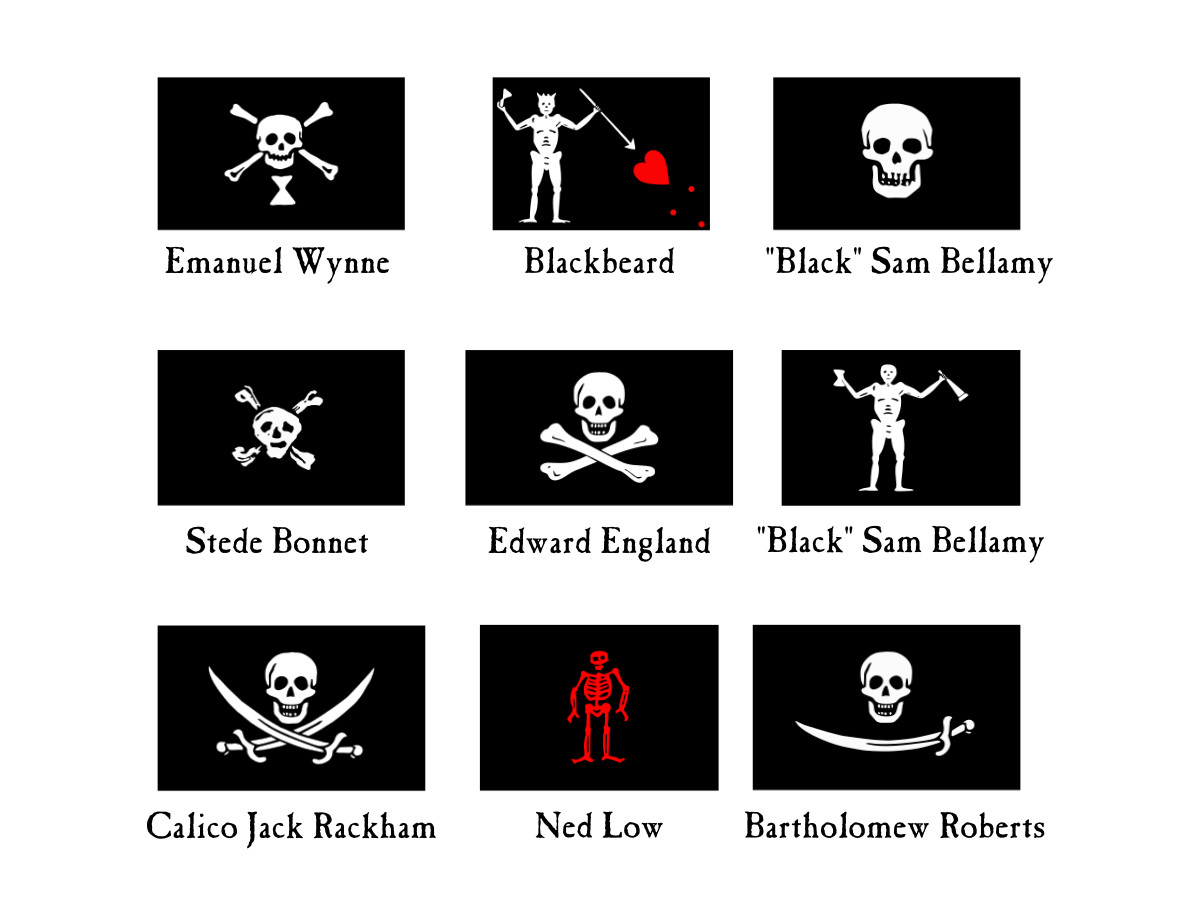
Few of these flags have survived, really none of the flags for the famous pirates. There are a few reported to be the flags of actual pirates (images and descriptions via Wikipedia):
A typical Jolly Roger flag. This 19th-century Barbary Corsairs flag is one of two known authentic Jolly Rogers in the world, currently residing at the Åland Maritime Museum in Finland.[1]. The fade is very faded but analysis indicates it was originally much darker, perhaps black.
This red flag, captured by the Royal Navy in 1780 and now on display at the National Museum of the Royal Navy, Portsmouth, is the only other surviving authentic Jolly Roger flag.[2]
There is another flag in St. Augustine Florida, but it’s historicity is of some debate.
Hope you have enjoyed this romp through pirate flags, and if you have a pointer to real history linking the Templars to the Skull and Crossbones flag, let me know!

https://en.wikipedia.org/wiki/Skull_and_crossbones
https://en.wikipedia.org/wiki/Emanuel_Wynn
https://www.abc.net.au/news/2022-12-13/the-history-of-the-jolly-roger-and-the-golden-age-of-piracy/101760436
https://www.rmg.co.uk/stories/maritime-history/pirate-flags-decoded
Comments
Nothing yet. Say the first thing.
Sign in to join the conversation.