
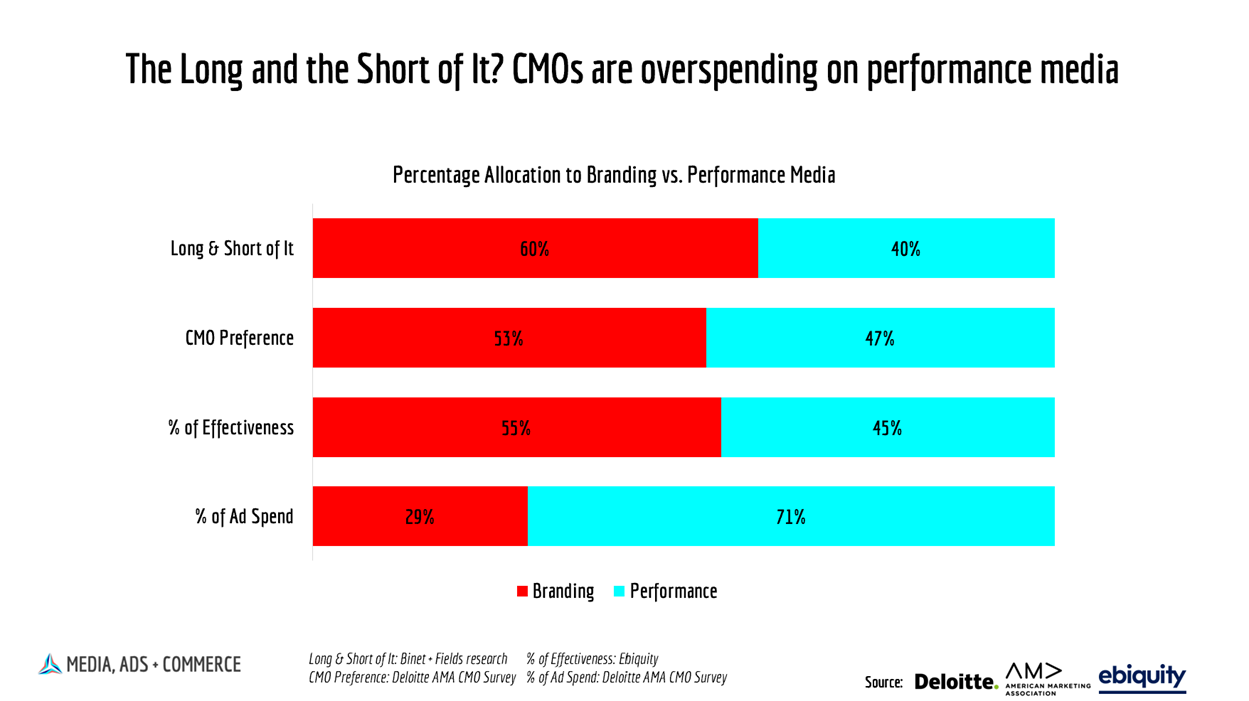
Les Binet, the godfather of marketing effectiveness and co-author of “The Long and the Short of It,” has long argued that brand growth requires an approximate 60/40 balance of long-term brand-building and short-term activation. This split roughly mirrors where CMOs would prefer to spend their budgets and the percentage of ad effectiveness each accounts for.
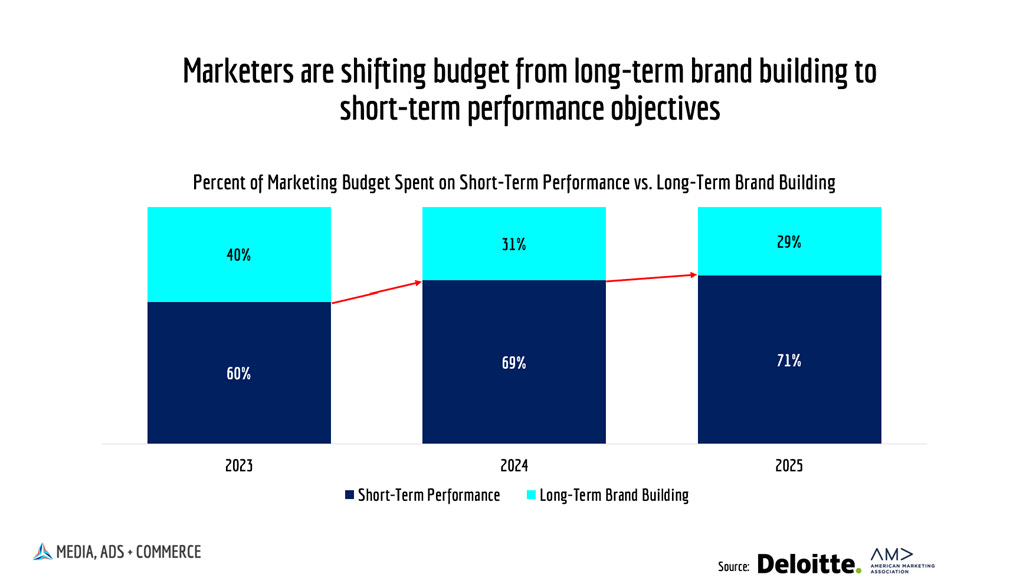
Yet according to Deloitte and the AMA’s 2025 CMO Survey, CMOs are now spending 71% of their budget on performance media and just 29% on brand-building. And budgets are moving fast, with performance media gaining 11 percentage points from 2023.
Binet’s famous description of how advertising works, from his time at adam&eveDDB, reveals just how misaligned current marketing budgets have become (my highlights added below).
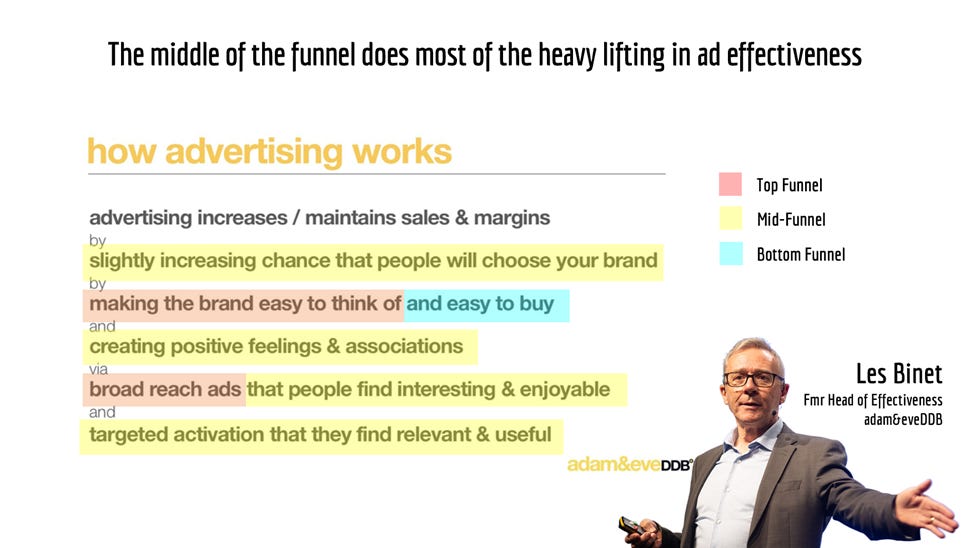
While this description references to the top of the funnel (“broad reach ads”) and bottom of the funnel (“easy to buy”), it’s the mid-funnel tactics that dominate the definition. THIS is where most of the work done by advertising actually happens.
Instead of adhering to Binet’s principles, the advertising industry has diverged into competing orthodoxies: brand vs. performance marketers. And given the dramatic budget shifts, it’s clear which of these two camps is winning.
The traditional currency for upper-funnel marketers—reach, frequency and demographics—exists but is losing relevance.
The currency for bottom-funnel marketers—clicks, conversions, and ROAS—is how the overwhelming majority of campaigns are measured today.
And the currency for mid-funnel marketers?
Your guess is as good as mine.
And maybe that’s the problem. Without agreed-upon KPIs, marketers aren’t speaking the same language.
It reminds me of the aphorism that “Not everything that can be measured, matters. And not everything that matters can be measured.”
There is ample evidence that the middle of the funnel matters. But because it isn’t easily measured, the industry has become convinced it doesn’t matter.
The middle of the funnel is where the magic happens in advertising. And the extent to which it moves the audiences towards conversion is a function of media quality.
A recent whitepaper published by The Coalition of Innovative Media Measurement (CIMM), Quality Matters: Navigating Quality in Media Buying and Measurement, defines media quality as “the attributes or characteristics of an advertising placement that are not tied to an individual user, but help predict how effective that placement is likely to be.”
“Our industry spent the last ~2 decades obsessing over user identifiers and the correlation-based attribution models they fed that were rarely causal, treating media as an undifferentiated commodity and ignoring the critical media quality dimensions that underpin our most essential, universally agreed-upon truism that not all impressions are created equal,” said Erez Levin, Principal at Emet Advisory and co-author of the whitepaper. “Re-embracing and incorporating media quality into our digital ad buying and measurement practices, assessing its value over both the short and long terms concurrently, will help re-align cost to true value across the industry.”
The most important dimensions of media quality are placement prominence, signaling the likelihood to get noticed, and contextual receptiveness, indicating how the media environment contributes to an advertising message’s salience.
Why do these factors matter? Because when they are present, the largest marketing effects occur in the middle of the funnel.
In the 2016 Comscore meta-study “The Halo Effect: How Advertising on Premium Publishers Drives Higher Ad Effectiveness,” upper-funnel, mid-funnel, and lower-funnel brand lift metrics were compared for impressions running on premium vs. non-premium digital publishers. All else equal, premium publishers will tend to outperform non-premium publishers on both placement prominence and contextual receptiveness.
The study found that impressions running on premium publishers performed better across all phases of the funnel. And while the outperformance at the upper funnel (+9% lift) and lower funnel (+32% lift) were modest, the middle of the funnel performed better by a factor of three (+267% lift).
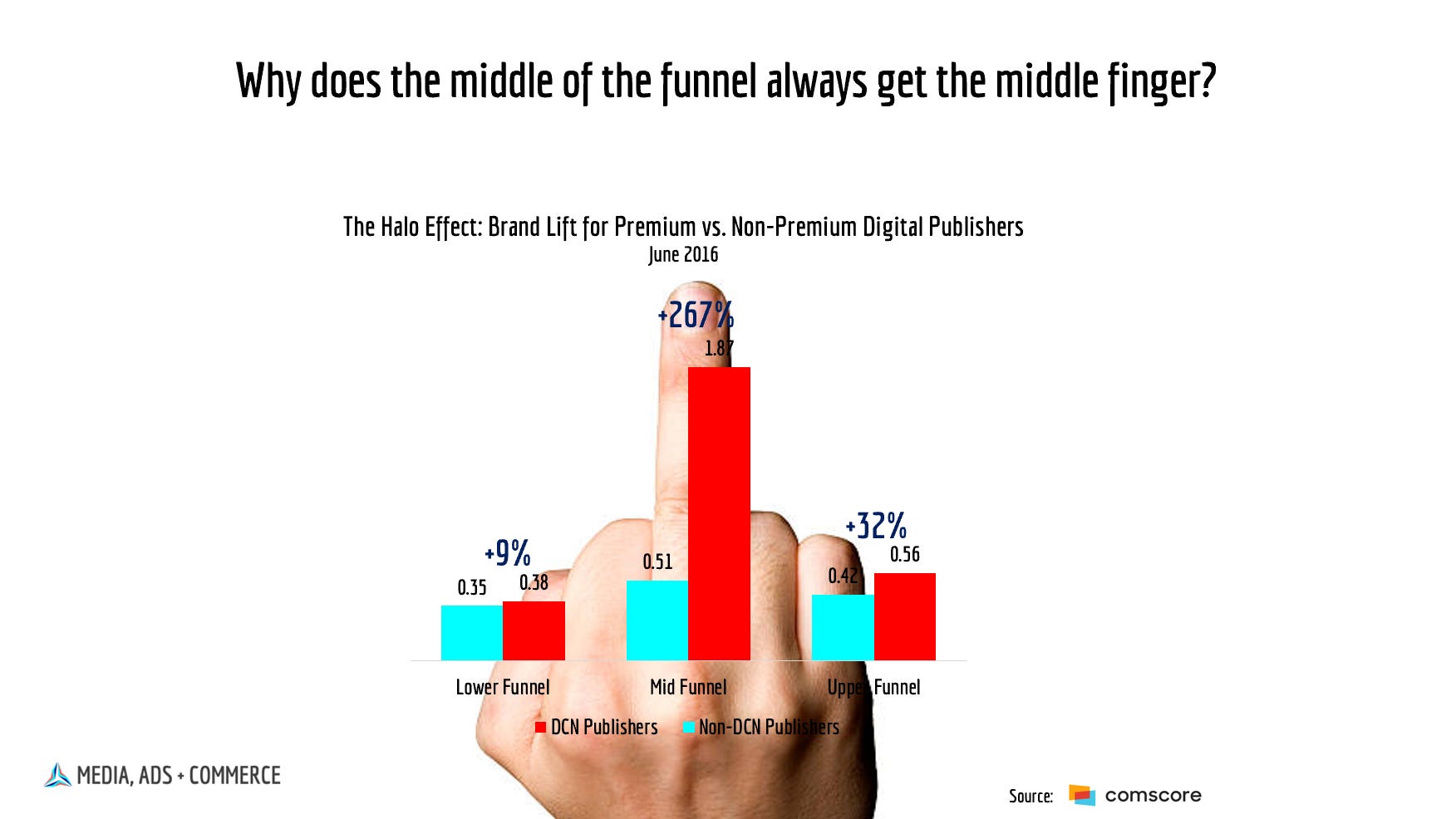
This of course begs the question: Why does the middle of the funnel always get the middle finger?
Pinterest is one of the most underrated advertising vehicles. Despite being one of the most brand-safe environments, with users engaging with commercially-relevant content, it captures the fewest ad dollars among major tech platforms.
Eric Seufert and I discussed this in an April 2026 episode of the MobileDevMemo podcast (my emphasis added):
AL: Pinterest is almost a perfect advertising channel in some ways because what you are doing on that site is so—you can draw a direct line from the behavior you are doing to a product purchase or commercial behavior. Yet it has been a very undervalued channel for a long time because it actually excels in the middle of the funnel, but it has always gotten under-attributed. They have actually had to steer more towards performance advertising just to get credit so then they can capture those ad dollars. It is not an easy challenge at all.
ES: Pinterest is a retail discovery platform. Fundamentally, that is what that product is. I am going there to find things to buy. It is almost tragic the degree to which they have just failed to gain traction or failed to grow that ads business because I imagine it is driving a lot of value. The problem is they are subject to the measurement limitations of their clients. That is why their client base are very large advertisers. It is not the long tail, because the long tail cannot convince themselves quantitatively of the value. The large clients can. They have the tools. They have the infrastructure. They have the measurement apparatus. The small clients cannot, and then they cannot directly make the case as a Meta can or as a Google can just through this massive corpus of data that they receive through all of their pixel and the CAPI. That is what I have called small platform syndrome.
Pinterest’s core problem: it does its best work in the middle of the funnel, the one part of the funnel most advertisers routinely fail to measure and adequately value. So, instead it competes against scaled channels like TikTok and YouTube for brand dollars on one end, and against Meta and Google for performance dollars on the other. These are battles Pinterest struggles to win given its comparatively modest audience size, engagement, and click-through rates. It’s a platform caught in no man’s land.
When Pinterest is measured properly, it stands above the competition. Incrementality studies—like the example below from Clerdata—tend to show Pinterest is strongly positive territory alongside leading RMNs and outpacing social and off-site programmatic by a healthy margin.
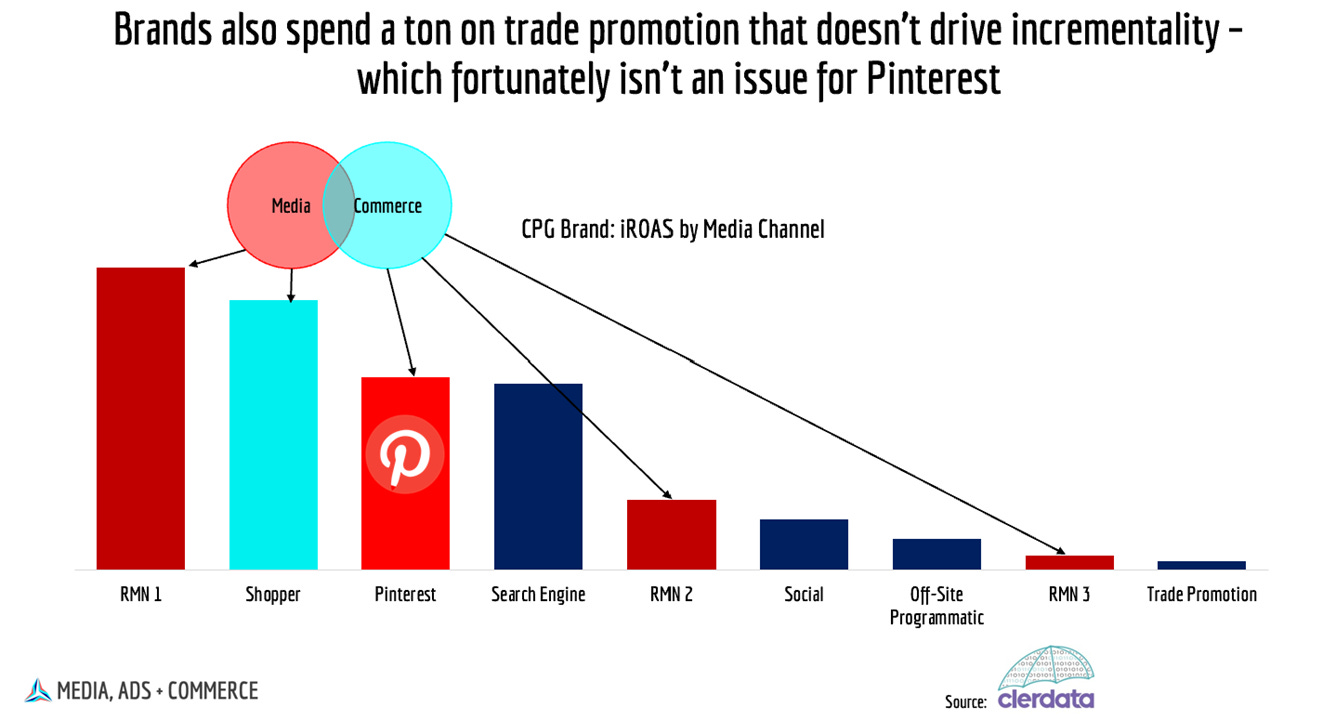
You could say that Pinterest is an OG of retail media. It’s a media platform built around commercial intent where every interest—whether its fashion, beauty, cooking, home décor, entertainment, or arts & crafts—maps to a retail category. It’s the epitome of media-commerce convergence, much like RMNs.
And where media and commerce converge—in the middle of the funnel—is where incrementality happens.
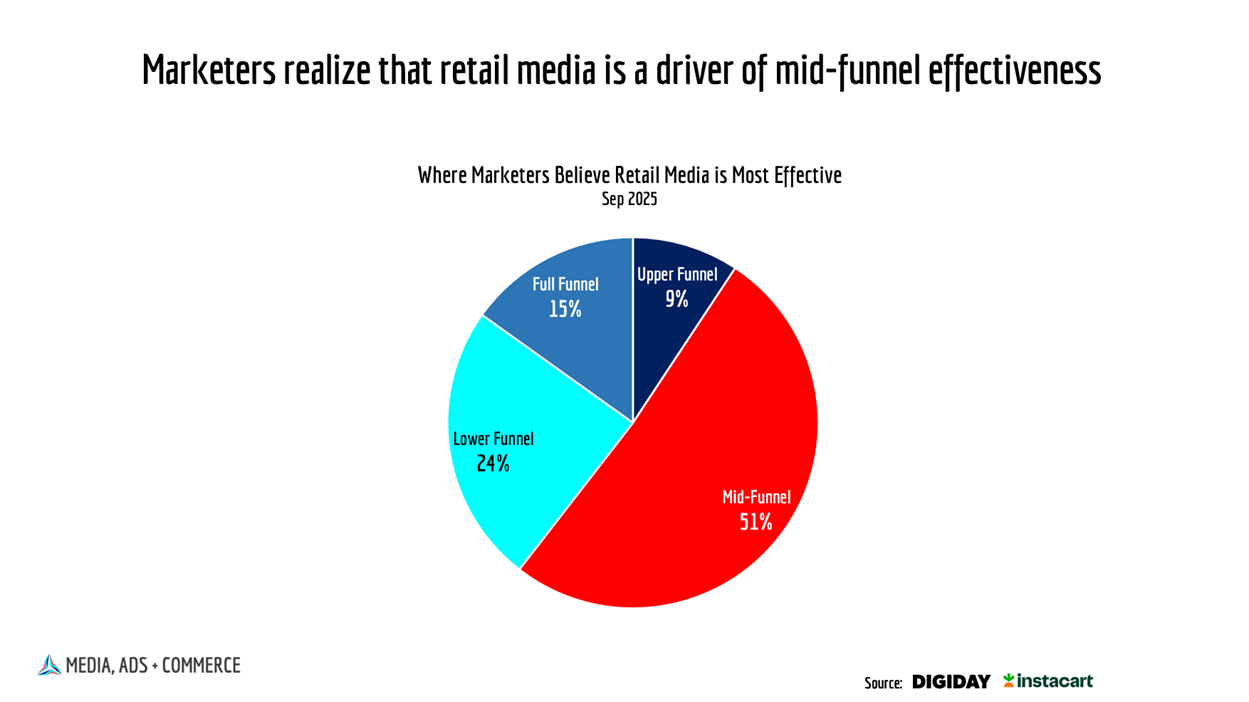
Despite its reputation as a bottom-funnel channel, marketers seem to grasp that retail media works the middle of the funnel. According to a September 2025 Digiday/Instacart study, more than half of marketers (51%) said that retail media is most effective in the middle of the funnel, even outpacing the lower funnel (24%) and upper funnel (9%). The remaining 15% believe it’s most effective at full-funnel marketing.
If you think about it, physical stores and ecommerce sites are primarily mid-funnel vehicles. While you can be introduced to brands and complete your checkout, most of shoppers’ time spent in these channels is considering, comparing, determining brand preference, and building conviction in the purchase decision. This is true today and will be true in the future of AI-assisted shopping.
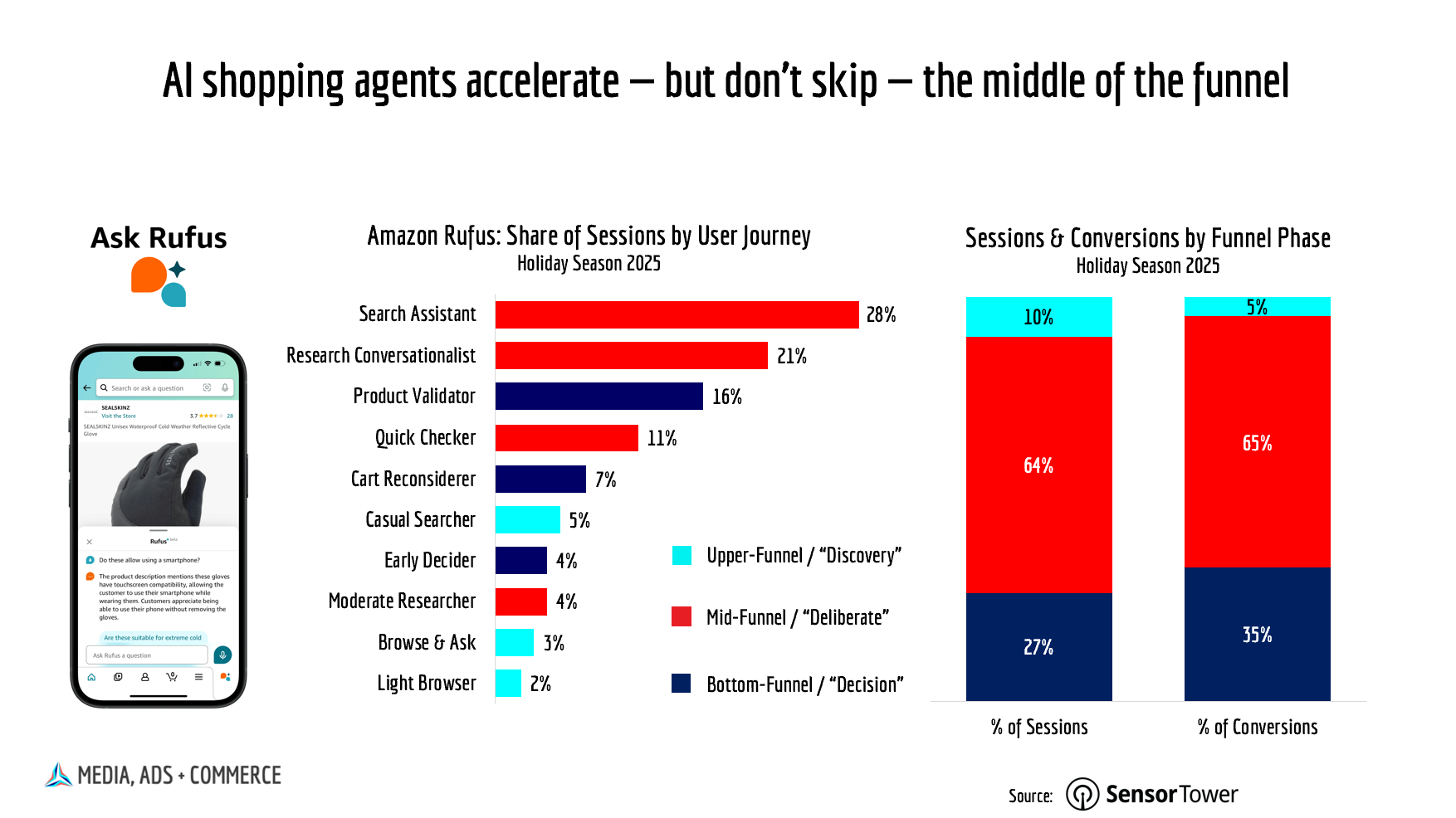
A Sensor Tower analysis from the 2025 Holiday Season shows how shoppers behaved on Amazon when engaging with the AI shopping assistant, Rufus. Shoppers were clustered into 10 different segments based on how they used Rufus—such as “research conversationalist”, “product validator” and “cart reconsiderer.”—each corresponding to either top, mid, or lower funnel shopping behavior.
It turns out that Rufus sessions overwhelmingly oriented to mid-funnel shopper segments, representing 64% of sessions and 65% of conversions.
Shoppers visit ecommerce sites to build conviction in their purchase, to work their way through the middle of the funnel. This is how, where, and why purchase decisions actually get made.
And this is why retail media is so valuable. When executed well, it should align with merchandising to streamline decision-making. It can build demand and sway demand in order to capture demand.
Instead, marketers will often complain about retail media as a “tax” or being too expensive. But that’s the thing about high-quality media (the kind that shepherds consumers through the messiest part of the funnel): it generally comes with a higher price tag, and its full value is not as easily measurable.
So, like Pinterest, retail media continues to be undervalued. Especially formats like on-site display and video that are less likely to drive last-click conversions. What they do have is placement prominence (typically above-the-fold) and contextual receptiveness (reaching shoppers looking to buy). Seeing these ads tilts consumers’ decision-making ever so slightly in favor of visible brands.
This is—as Les Binet tells us—simply how advertising works.
Maybe it’s time we extend the middle of the funnel the credit it deserves instead of the middle finger.
Comments
Nothing yet. Say the first thing.
Sign in to join the conversation.