
Commerce media continues to show up big at Cannes Lions. But the cacophony of content, commentary, and company comms is admittedly a challenge for any industry observer to digest.
Most of it is noise, but there’s valuable signal if you pay attention.

With some time to finally sift through and digest the cavalcade of news, a few headlines struck me as more consequential than most.
Three RMN announcements in particular—Instacart’s ‘Immersive Feed’, Albertsons’ in-store micro-dramas, and Walmart’s Vibe.co acquisition—rose above the fray as potential future-defining innovations, rather than half-baked partnership announcements grasping for relevance.
Each carry common throughlines indicative of the current moment in retail media:
Retailers are evolving into media companies
Content and commerce are converging
The future of retail media goes through grocery
When I first saw the headline around Instacart’s new “Immersive Feed” of TikTok-like shoppable video content, it looked like another solid upgrade to the app but not necessarily a gamechanger. But the more I sat with the news, the more disruptive it seemed.
In the past, I’d mostly written off shoppable media as wishful thinking. Social media buy buttons and shoppable TV consistently fail because lean-back media consumption doesn’t lend itself to sudden lean-forward moments like shopping.
The subtle brilliance of “Immersive Feed” is that it doesn’t require this context-shift.
Here’s how Ali Miller, GM of Instacart Ads, describes it:
“Snackable vertical video has transformed how people get inspired with new recipes or the latest food trends to bring into their kitchen. Our Immersive Feed brings that familiar experience directly into our shopping journey. Now, our brand partners can meet consumers at the moment of inspiration through our latest ad experiences that make it effortless to move from discovery to purchase.”
“Immersive feed” brings these familiar inspiration moments into the middle of the grocery shopping funnel, creating an organic discovery experiences when shoppers are most receptive and willing to take action.
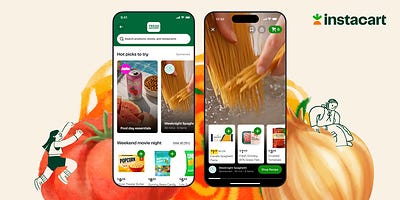
It layers on the contextual relevance of the weekly grocery shopping trip to the existing behavior of recipe browsing and discovery on TikTok. There is potentially a big difference, however, between TikTok’s passive-scrolling environment and Instacart’s intent-driven experience. Entering the Instacart app is the ideal moment for inspiration to instantly translate into action. This is the context where shoppable content is truly most valuable.
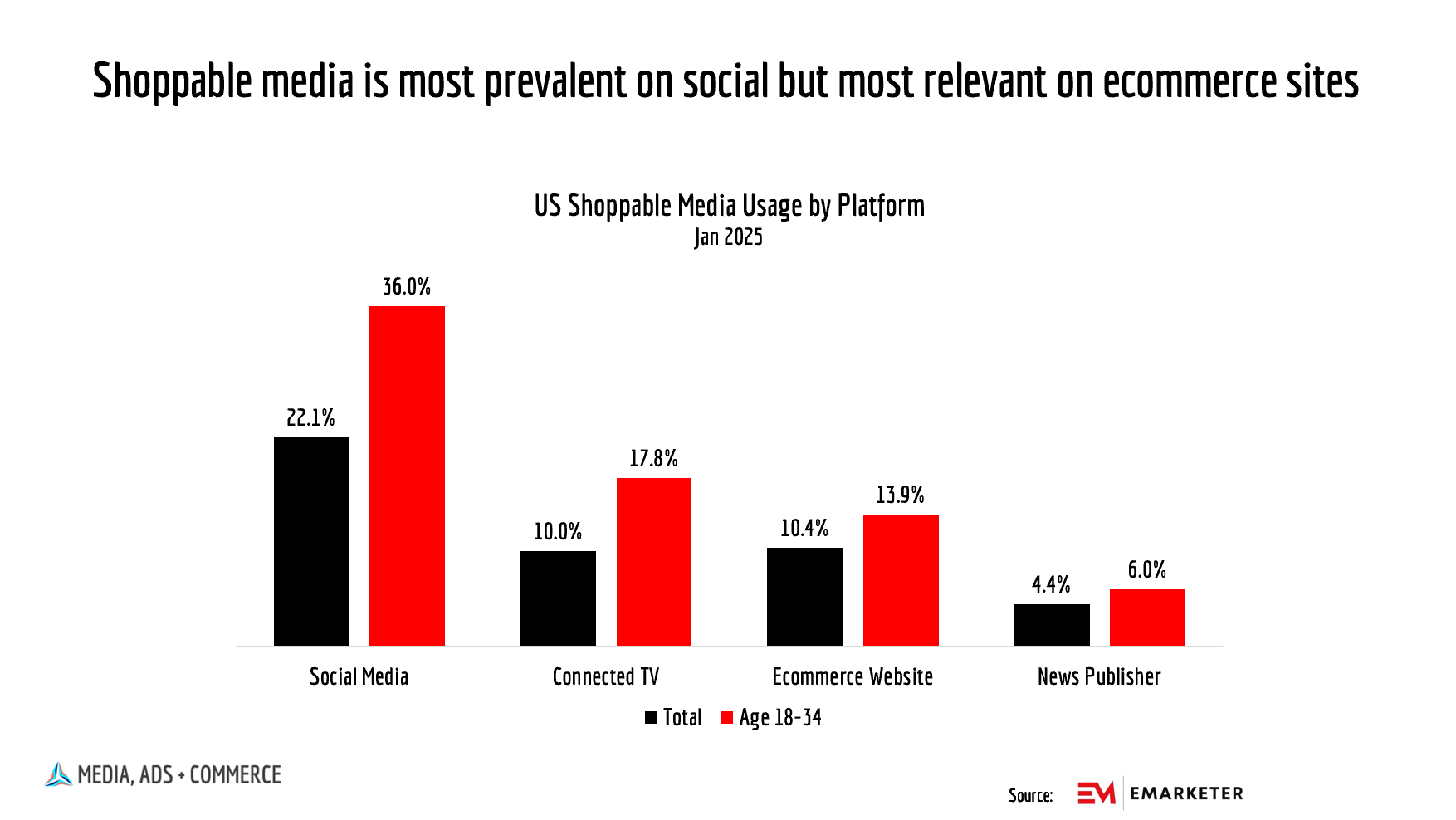
If there’s an impediment to adoption, it’s simply that shoppers haven’t historically browsed the feed in the context of an ecommerce visit—at least not to the same extent that social media is used as shoppable media, per a January 2025 Emarketer study.
But why shouldn’t shoppers use the app for this when it’s the right moment and context for inspiration?
That’s why it’s possible Instacart just cracked the code on shoppable media, one of digital’s most intractable problems. The challenge stems from the inherent divide between discovery and conversion. Bringing the two together is a non-trivial effort because the experiences must connect organically.
We’ve tried bolting on checkout to social feeds and it hasn’t worked so well. But what if we just had it backwards? Maybe it’s the media experience that needs to be integrated with the transaction.
Grocery may be the one category where this could work right now since grocery shoppers have a consistent, recurring need for recipe inspiration and an immediate intent to convert.
The “Immersive Feed” is also perfectly suited to advertising because shoppers like being introduced to new brands. In fact, the thesis for retail media ad effectiveness is that high-quality content adjacent to purchase is where incrementality happens. Brands should be able to increase awareness and acquire new customers in this context.
Finally, if the “Immersive Feed” meaningfully drives up engagement and increases visit frequency, Instacart will insulate itself from the “threat” of agentic commerce (if you buy into that narrative). And it would ultimately benefit from a monetization model that looks more like that of a true media company.
Patrick Coffee of the Wall Street Journal exclusively reported last week that Procter & Gamble will debut a scripted microdrama, “Rico’s Tacos,” across Albertsons stores. Brian Monahan, SVP of Albertsons Media Collective and veteran of Dentsu, Pinterest and Walmart, understands the power of creative to move shoppers from the couch to the checkout line.
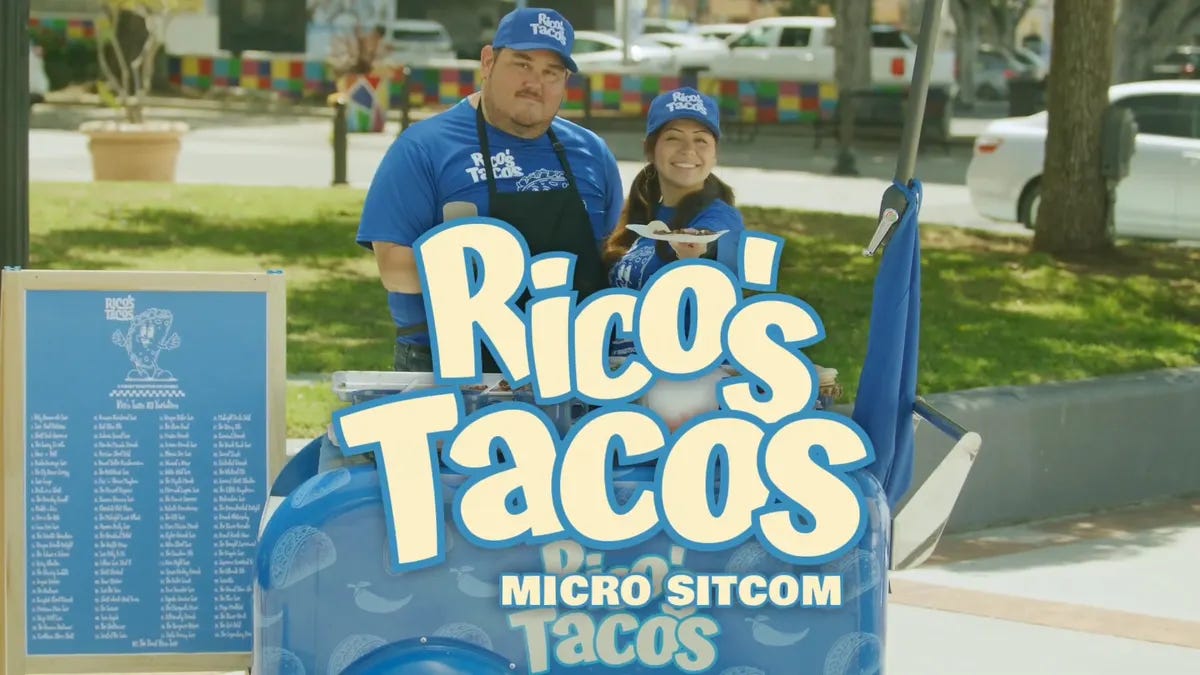
With in-store retail media, the path to purchase can be compressed, making any content that grabs the shopper’s attention particularly valuable. It puts the brand-building power of TV right next to the register.
Here’s how I described its potential to the WSJ:
“Rico’s Tacos” hints at retail media’s potential to evolve into a marketing channel comparable to television, according to Andrew Lipsman, founder of retail-focused consulting firm Media, Ads + Commerce.
“It has a lot of the same benefits of television. It’s got reach, quality inventory, scarcity, cultural relevance. It just doesn’t have the same attention span,” he said.
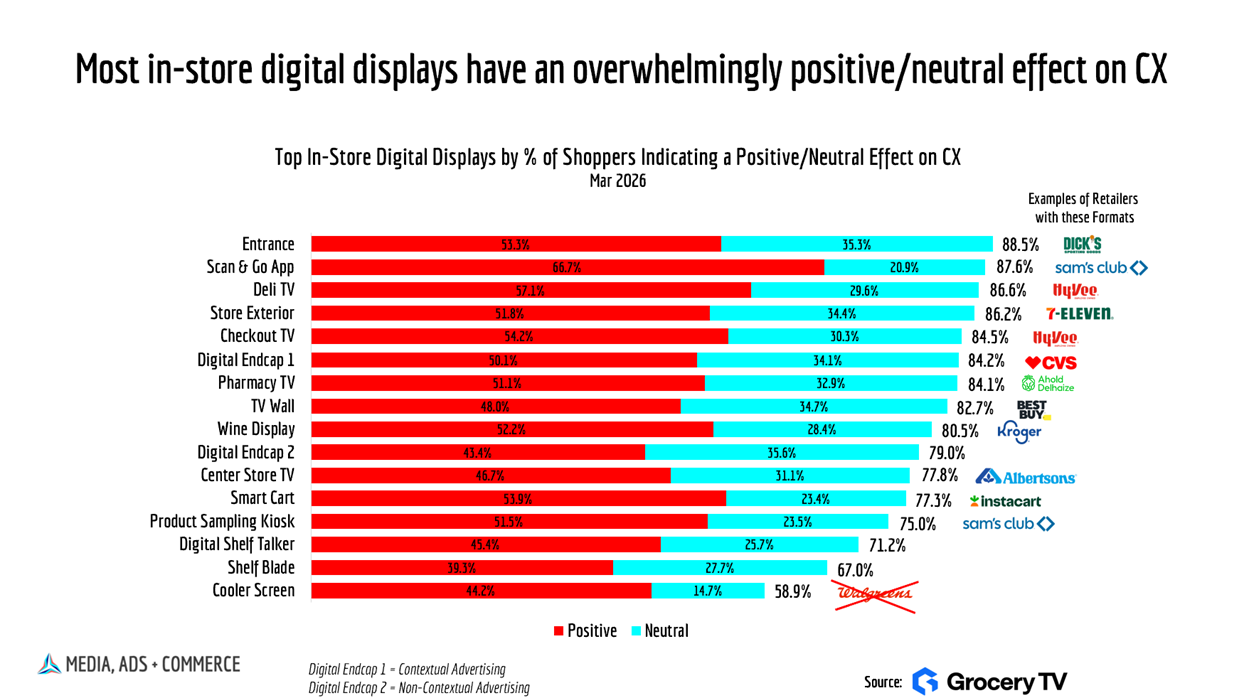
Shoppers are surprisingly receptive to brief bursts of sponsored entertainment during their supermarket excursions, especially in settings like the pharmacy, the checkout line and the deli counter, where they have no choice but to wait, according to a March research report from in-store media company Grocery TV.
“People will watch content anywhere, especially if they’ve got a minute or two to kill,” said Lipsman.
The recent Grocery TV study to which this alludes—and which I co-authored—offered a glimpse into how and where shoppers are more receptive to in-store content. In the past three years, US shoppers’ sentiment towards in-store retail media has dramatically improved, with the majority indicating that most in-store displays have a net positive impact on CX. Most in-store displays saw double-digit increases in positive sentiment.
The in-store activation of this microdrama will be interesting to watch. Different in-store displays will need to adapt the content to fit the attention of the average consumer in the moment. Storytelling will work better at Pharmacy, Deli, and Checkout, while Entrance and In-Aisle content will need to rely on quick-burst content, such as captivating visuals or physical comedy.
I don’t pretend this will be easy to pull off, but I admire the creativity that’s going into it. And any learnings that come from this experiment will be invaluable. If P&G figures out how to make short-form content work in-store before other CPG marketers, it will once again get a leg up on the competition.
It’s fitting that the same world-renowned consumer goods advertiser who launched the soap opera would bring its natural successor to in-store digital screens. Perhaps physical retail really is the new TV.
Walmart was never going to let Amazon run away with the Performance TV market, the next major wave in retail media advertising. The retail giant’s acquisition of Vizio last year first revealed its ambition to permeate Americans’ living rooms, capture a slice of the TV OS market, and control the pipes to valuable CTV ad inventory.
Walmart’s Vibe.co acquisition advances this position even further. The TV startup, which provides 10,000+ mid-market and SMB advertisers access to self-serve tools for targeted CTV ad buying and optimization, bolsters Walmart’s ad tech capabilities and gives an easy on-ramp for its huge ecosystem of 3P marketplace sellers.
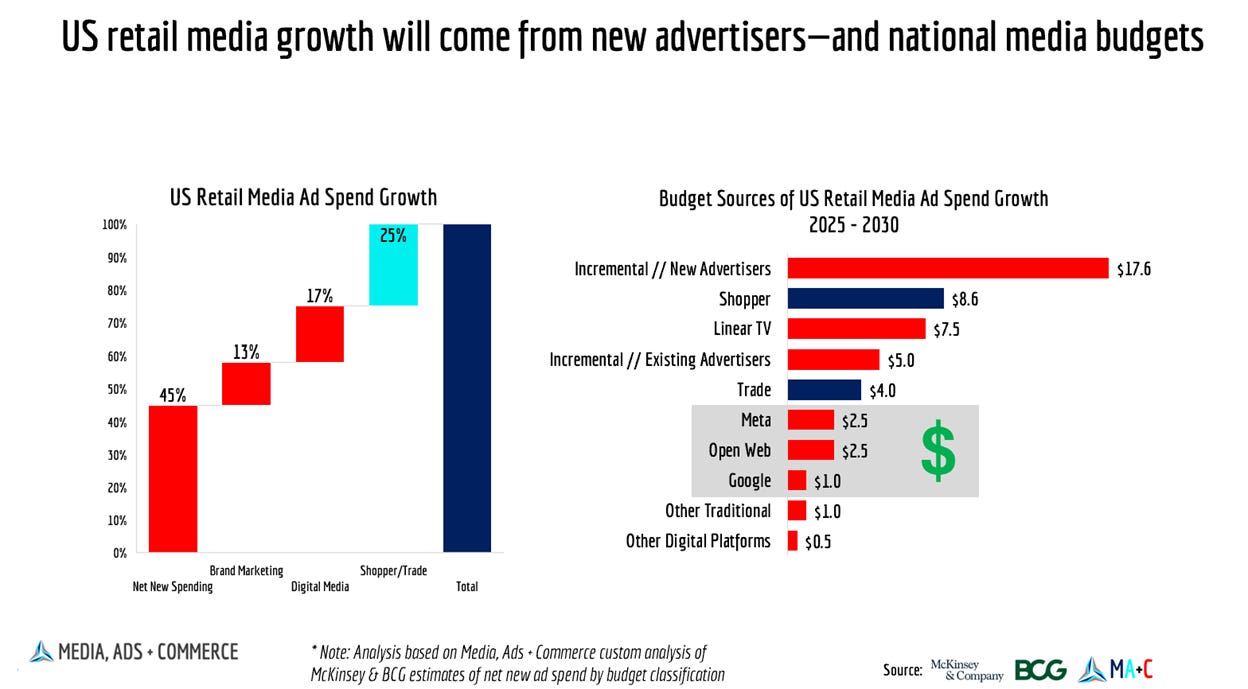
The long-term promise of Performance TV—and the reason its looking more like the 4th wave of digital advertising every day—is because it not only closes the loop between TV ad exposure and sales but also democratizes access to TV audiences beyond large national brands.
According to Ronan Shields of Digiday:
Through the acquisition, Walmart Connect is targeting the media budgets of businesses outside blue-chip, household-name brands — Vibe purportedly has more than 10,000 SMB and mid-market advertisers on its platforms.
The pitch to market is to combine Vibe’s self-serve campaign activation tools with the retail giant’s commerce data, closed-loop measurement capabilities, and growing media assets to deliver a demonstrable ROAS, i.e., attract more ad dollars to Walmart Connect.
Walmart Connect’s impressive multi-year run of strong revenue growth has been due to its 3P marketplace expansion more than any other factor. In ramping from ~30,000 sellers in 2020 to ~150,000 by 2025, Walmart Connect now boasts a vibrant, competitive marketplace of brands vying for premium positions. Expanding advertiser access to Walmart’s CTV footprint introduces these competition dynamics to Performance TV that will drive these high CPMs even higher.
Even as Walmart continues to fire on all cylinders in its core ad business, it’s already laying the groundwork for its next act—with a potentially much greater payoff.
Comments
Nothing yet. Say the first thing.
Sign in to join the conversation.