
We are only days away from La Croisette in Cannes being overtaken by a cacophony of RMNs pitching themselves as “Full-Funnel.”
The intent of this reposition is obvious. The easy money in retail media is gone, and they’re all figuring out how to capture upper-funnel budgets held by national media teams and non-endemic brands. But this comes with its own set of challenges.
A recent Digiday article by Kimeko McCoy explains the trend:
There’s been a recent push toward off-site channels, in which RMNs partner with streaming and social platforms, allowing advertisers to leverage RMN data and off-site ad inventory.
For example, Walmart Connect’s acquisition of smart-TV maker Vizio or Instacart’s partnerships with Roku. Target’s Roundel, seemingly saw the writing on the wall as well. Back in February, the retailer became one of the first to promote both its own business and select partners within the LLM, per Digiday reporting.
“The challenge there is does the value or really the performance of retail media advertising hold up in these environments,” [Digiday reporter Tim] Peterson said.
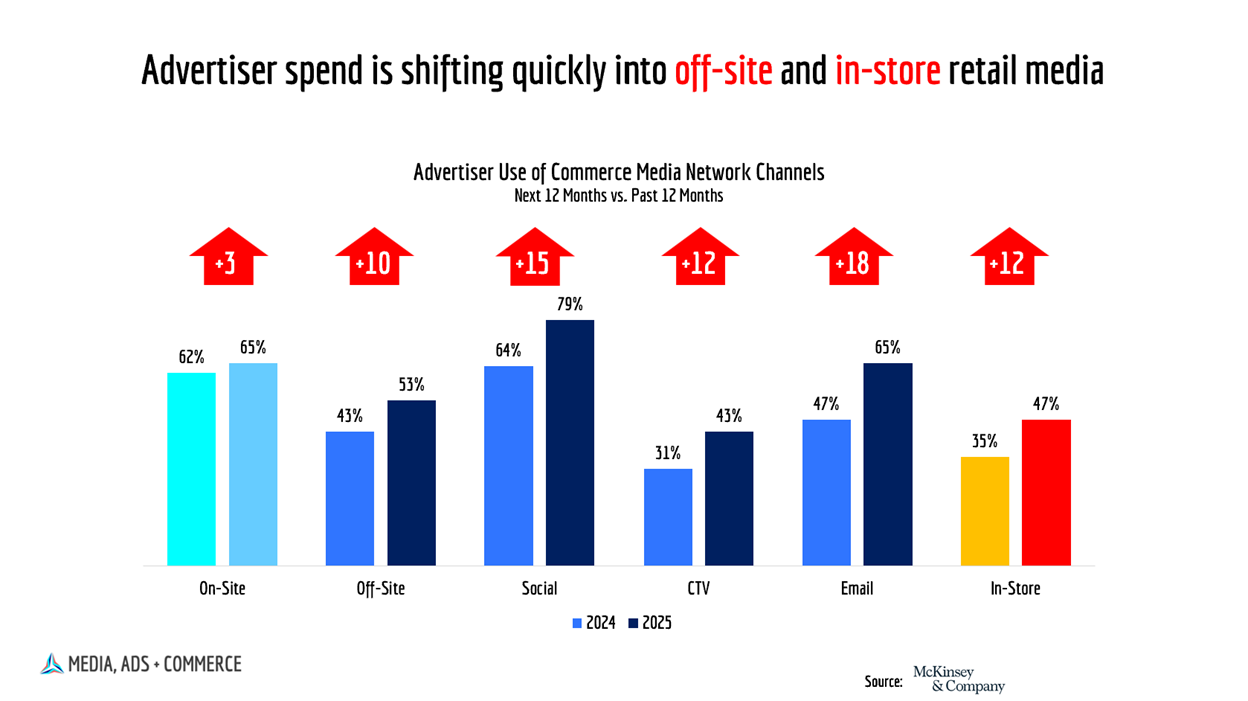
First, it’s clear that off-site retail media is a growth area and dollars are already flowing in its direction. A 2025 McKinsey study showed the various off-site retail media channels—programmatic, social, CTV and email—all saw 10 point or greater increases in advertiser investment vs. the prior year.
The Digiday article goes on to spell out the challenges for RMNs in establishing their upper-funnel bonafides:
There’s also the question of incrementality and attribution, something RMNs have been grappling with as the off-site push continues. Agentic commerce stands to compound that issue, muddying advertisers’ ability to prove RMNs are driving new sales.
“If they prove that out, then that will help them to continue to exist and attract some form of revenue in an agentic commerce world,” Peterson said.
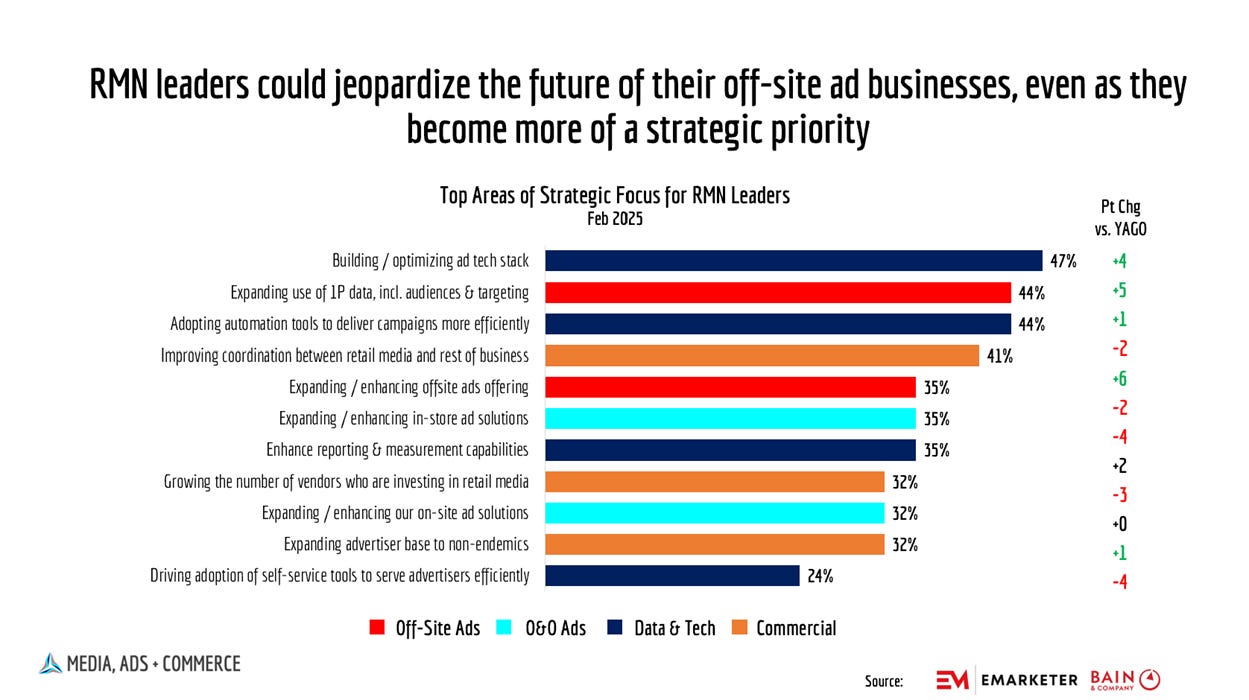
RMNs are now aggressively ramping off-site retail media capabilities as both an offensive and defensive move. A 2025 study by Emarketer and Bain found two of the top five areas of strategic focus for RMN leaders were expanding the use of first-party data for audience targeting (+5 pts to 44%) and expanding their off-site ads offering (+6 pts to 35%) at the same time Gen AI disrupting discovery ranked as their top concern.
To some extent, RMN leaders see off-site retail media as an easier path to revenue growth because it avoids tense political battles between media and merchandising teams over tradeoffs between advertising and CX. But it’s also the least valuable revenue to their business, and an area where retailers tend to be the least conversant with upper-funnel advertisers.
This current knowledge and communications gap is what ultimately contributes to off-site retail media being widely misunderstood by retailers (and their investors).
Here are 5 common misconceptions they harbor about off-site retail media:
Off-site retail media isn’t where future growth will come from, unless your name is Amazon. According to a Media, Ads + Commerce retail media ad spend forecast through 2035, non-Amazon RMNs will see the majority of their growth come from on-site search (54%) and in-store retail media (23%). By comparison, off-site display and video will account for just 8%.
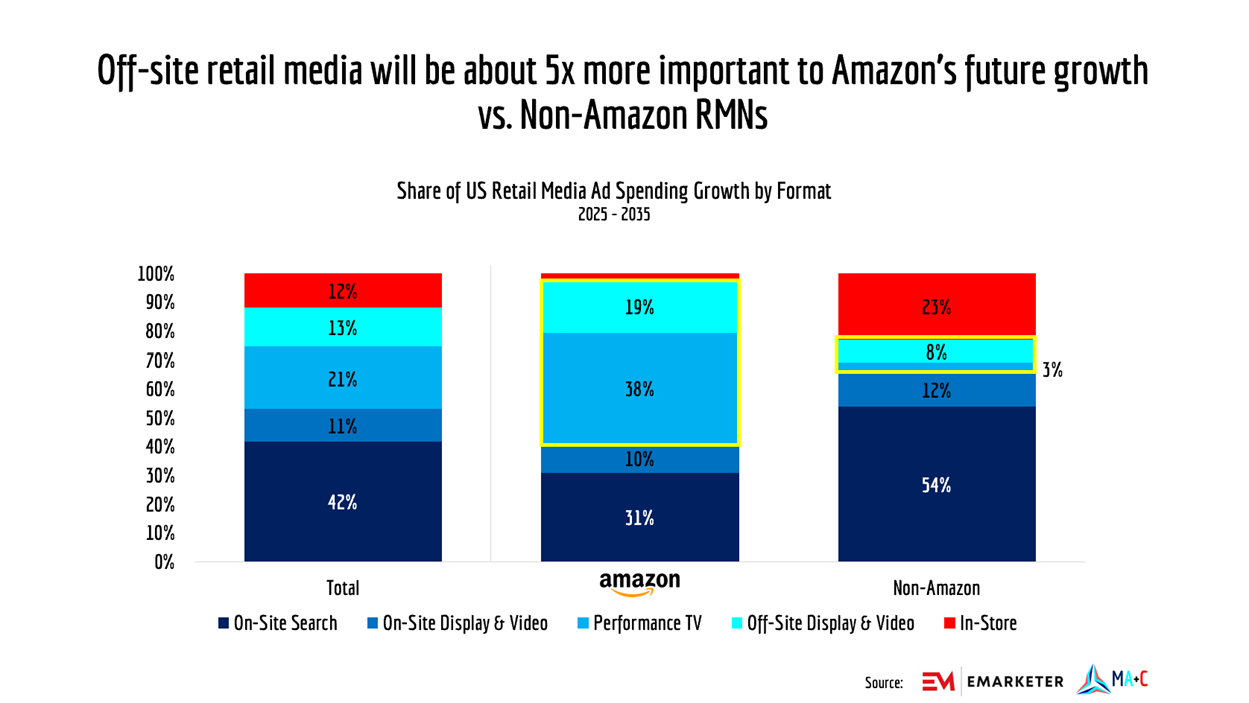
Amazon is a different story. As an RMN legitimately closer to on-site saturation, future growth will rely on off-site ads to a much greater extent. But Amazon has built for that opportunity with Amazon DSP and Prime Video, and it continues to quickly progress in these areas. The biggest growth opportunity for Amazon is Performance TV, which this forecast indicates will contribute the largest share (38%) of its revenue growth over the next decade.
Perhaps the over-emphasis on off-site is due to conflating Amazon’s opportunity with everyone else’s, or basing future growth assumptions on retail media market forecasts heavily influenced by Amazon.
For other RMNs, the off-site mandate often stems from a false narrative that they, too, are inventory-constrained with their on-site business. This is largely a self-imposed constraint as many retailers remain far too conservative with sponsored placement opportunities. Turf battles with ecommerce teams and overall CX concerns limit on-site inventory, even though online shoppers are largely unaffected by increased ad load as long as the search results maintain high relevance.
According to Pentaleap, most top RMNs are leaving a high percentage of searches unmonetized. And the average ad load remains well below the most mature networks, Amazon and Walmart.
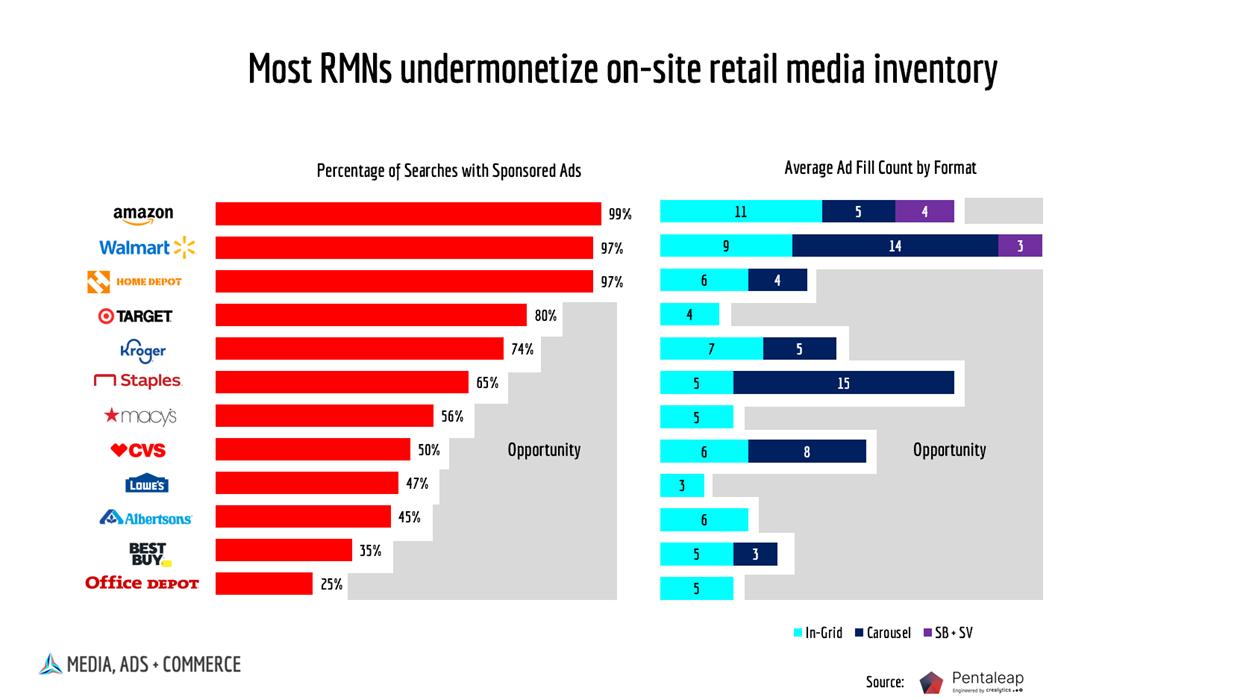
Importantly, on-site ads are both easier to monetize and higher margin. Media teams that go to bat for even a single additional ad slot could quickly unlock double-digit gains in ad revenue.
Comments
Nothing yet. Say the first thing.
Sign in to join the conversation.