
In this issue
we discover how dogs can be our new lab assistants in health-tech,
learn where a doctor sees the greatest potential for robotics in medicine and
get insights into some cool new med-dev projects.
Imagine a future where your doctor doesn’t listen to your lungs, but lets a dog sniff your T-shirt instead.
It’s not sci-fi. It’s science.
In our med-dev newsletter, we share the highlights and recent breakthroughs of health‑tech with you.
This time, it's about how trained dogs can detect Parkinson’s disease years before clinical symptoms show and what that means for diagnostics, med-tech, and your next trip to the vet.
Biomarkers are measurable biological characteristics that provide information about normal or pathological processes in the body. In medicine, they are used for diagnosis, prognosis, therapy monitoring, and risk assessment. Examples include C-reactive protein (CRP) for detecting inflammation, HbA1c for long-term monitoring of diabetes, or Prostate-specific antigen (PSA) for early detection of prostate cancer. Biomarkers can be obtained from blood, urine, tissue, or other samples and are especially important in personalized medicine. In oncology, for instance, they enable targeted therapy selection and improve treatment outcomes.
Parkinson’s disease is still difficult to diagnose definitively, as there is no definitive test. Identifying a biomarker could help—such as changes in body odor, particularly in sebum, which is noticeably altered in people with Parkinson’s. Since dogs are known for their highly developed sense of smell, a research team from the UK investigated whether they can detect the altered body odor of Parkinson’s patients.
Two dogs were trained to distinguish between skin swabs from Parkinson’s patients and healthy controls. A total of 205 samples were used over a period of 38 to 53 weeks. In a double-blind test with 60 controls and 40 Parkinson’s samples, the dogs showed a sensitivity of 70% and 80% in correctly identifying Parkinson’s samples, and a specificity of 90% and 98% in correctly rejecting control samples. The study could contribute to the development of new diagnostic methods in the long term—possibly even enabling earlier detection of the disease. And it could open up a new field of application for trained sniffer dogs.
Rooney N et al. Trained dogs can detect the odor of Parkinson's disease. J Parkinsons Dis. 2025 Jul 14:1877718X251342485. doi: 10.1177/1877718X251342485
Article by Katja Schäringer (medical journalist)
After all that nose talk, let’s switch gears or keyboards.
In this issue, we sat down with Richard, one of med-dev’s founding members, to talk about his journey between medical school, computer science and robotics.
This is for anyone who ever thought, “Medicine is cool - but what if I could automate this?”
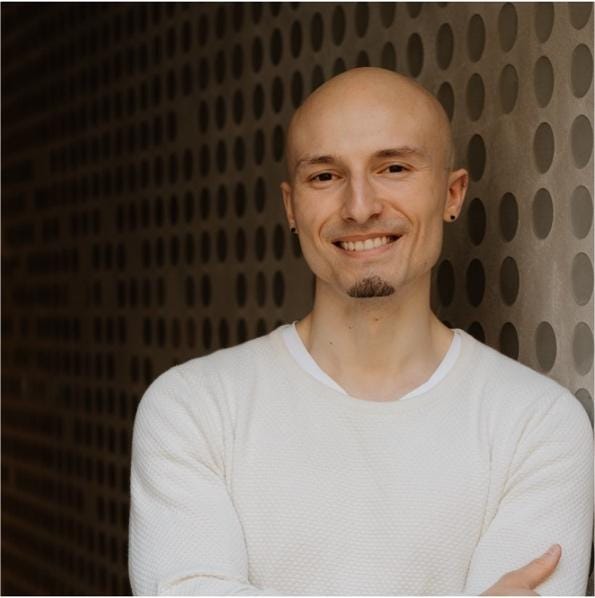
🩺 Richard, your path is truly unique. You studied computer science and medicine, gained experience in industry, and are now specializing in psychiatry at the LMU university clinic Munich. You are also completing your Master's in Robotics, with the thesis still ahead at Stanford. How did this path unfold?
Thank you. I’ve always enjoyed working with people, especially the question of how we can help others gain more self-efficacy and joy in life. That’s why I chose to study medicine: it offers a holistic view of the human being (and, admittedly, some advantages in terms of job security).
At the same time, I’ve always been passionate about math and computers. I missed the tinkering and puzzle-solving aspect during med school. That is why I decided to pursue a Master's degree in Robotics while also working as a physician.
Today, I’m really grateful I found ways to combine both of these passions.
🕰 Was there a key moment that sparked your fascination with the interface between tech and healthcare?
Honestly, the biggest driver for me has always been the lack of digitization in hospitals. The idea that so many things could be easier and more user-friendly drove me crazy.
With tighter feedback loops between healthcare workers and software engineers, we could have hospital IT systems that are as intuitive as an iPhone. The technical means to achieve this are already available, but they are not being applied effectively.
👥 Were there people along the way who really shaped or inspired your thinking?
That’s a tough one, I’ve had the privilege of meeting so many inspiring people.
One major influence during my studies was my volunteer work with TUM.ai, a wonderfully motivated and supportive student community passionate about AI.
As a working student at Virdx, I met many technically savvy (read: nerdy 😄) doctors who shared my drive to make healthcare more efficient through better digital tools.
And during my clinical rotation in Newcastle, I met some incredibly dedicated and inventive cardiologists who really shaped how I think about what makes a "good doctor."
I could go on forever, there are so many more!
🔍 Is there any technology you’re more skeptical about now than you were at first - or vice versa?
Like many others, my views on large language models (LLMs) have been a bit of a rollercoaster. At first, I saw massive potential for their use in healthcare. But over time, I’ve become more cautious about their limitations.
The underlying principles, autoregressive training and reinforcement learning on text, might simply be too narrow for many medical tasks, which often require very diverse and dynamic cognitive skills.
And of course, we still know very little about how these technologies will affect the doctor-patient relationship in the long run.
🚀 Looking ahead: where do you see yourself in a few years and where do you see the biggest potential for robotics in medicine?
I’ll admit I’m biased because of my training, but I strongly believe in the potential of AI in healthcare.
Despite current limitations, I’m convinced that radiological image analysis and even internal medicine decision-making could eventually be performed more safely and reliably by AI than by any individual doctor.
That said, many improvements don’t need futuristic tech.
Even simple usability upgrades to today’s hospital IT systems could make a huge difference for clinicians.
And we don’t need AI to make patients’ interactions with the healthcare system more humane and satisfying, we could do that right now with more thoughtful, patient-centered design.
Thanks, Richard and all the best for your next chapter at Stanford!
We can’t wait to see what you’ll build next.
👉 Know someone like Richard? Curious, crossover-minded, and quietly brilliant?
Tell them about med-dev. Or better yet, forward them this newsletter.
What happened in the community in the last month? Here are some insights for you:
👥 Buddy program
The first batch of the med-dev buddy program came to an end. This is the feedback from one of the participants:
“The buddy program helped me get more involved with med-dev, especially since I often can't attend in-person events. Highlights included visiting my buddy at work, discussing research ideas and bonding over motto parties and exchanging strategies on how to balance med school with our other interests. I really enjoyed it and look forward to the next round!”
(Spoiler alert: the next round will start soon! 🤫)
🔘 Inner circle
We selected 15 highly motivated people to be part of the med-dev inner circle. This gives them direct access to more resources and an option to help shape the future of health-tech. First projects of the inner circle include
reaching out to more interesting contacts,
organizing special events,
writing for social media and the newsletter,
analysis of past events and other med-dev stats
and many more.
Stay tuned, there is a lot more to come!
🇺🇸 First US-event
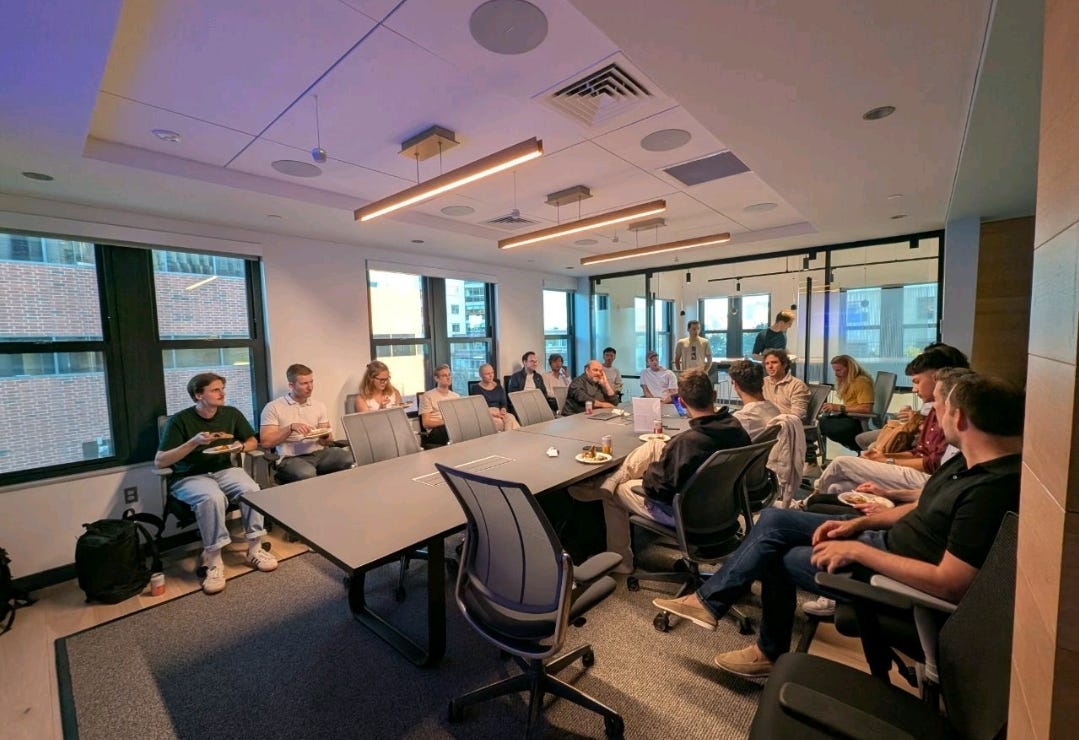
med-dev had its first event in Boston (and the US 🇺🇸 in general!) at the VirdX office in Cambridge MA. We are beyond excited to keep partnering with MIT Hacking Medicine and VirdX for events around the globe!
Upcoming events
🤫 On 20th October, there will be a big community event – so save the date!
Because medicine and technology belong together.
Because we believe innovation starts with curiosity and a little chaos.
And because your inbox deserves better than appointment reminders and spam.
Stay subscribed and tell your nerdy friends!
Until next time, keep building, questioning, sniffing, debugging.
Your med-dev Newsletter Team (Marlene, Anja & Julia)
No posts
Comments
Nothing yet. Say the first thing.
Sign in to join the conversation.