
In this issue
we discover what gets a doctor excited about health-tech,
learn how AI can help in research about diseases we still understand close to nothing about, and
hear about cool med-dev events.
Marlene is a physician specializing in psychiatry and psychotherapy - and a passionate science communicator. In her clinical work, she sees every day where digital solutions could truly make a difference. As a member of the Bavarian Ethics Council and an active medical journalist (e. g. for FAZ and Spektrum der Wissenschaft), she combines deep medical expertise with a keen eye for societal change.
As part of the med-dev community from the very beginning, Marlene supports the organization team, contributes to events and the newsletter, and builds bridges between medicine and technology. She advocates for user-centered design and sparks dialogue between clinicians and developers. Beyond the hospital walls, she reaches a wide audience through her social media channels, making complex topics accessible and relevant.
In this interview, she talks about why communication is the key to meaningful health-tech, which innovations excite her most, and where digital medicine still has room to grow.

💻 Why are you interested in health-tech?
In my daily work as a doctor, I repeatedly encounter problems that are just crying out for digital solutions. What strikes me is how far behind healthcare still is compared to other sectors. Why is that?
For me, the missing link is communication. We often start coding before truly understanding the problem. What we need are conversations between those who live the reality of care and those who can build solutions. A doctor experiences a real-world challenge; a tech expert translates that into a functional, user-friendly tool. Health-tech can only succeed if these worlds genuinely collaborate.
👥 How did you first get involved in med-dev?
I first heard about the med-dev kick-off event at Google through my friend Vivi, and I spontaneously decided to join. The vibe was fantastic - open, creative, inspiring. I met so many people who shared similar ideas and a genuine passion for improving healthcare. That energy was contagious. It made me want to contribute more actively, so I joined the organizational team shortly afterwards.
😍 What are technical developments you are really excited about?
I’m especially excited about automated documentation. In the past, I had to type everything during patient sessions, which meant barely looking at the patient. Now, with AI-powered systems, documentation can happen in the background. I was skeptical at first, but the technology has matured quickly. When it works well, it frees up enormous amounts of mental and emotional bandwidth. Instead of focusing on checkboxes, I can focus on the human being in front of me. That’s a game changer.
🍵 Be honest - do you think digital health apps really make a difference or are they just as good as prescribing chamomile tea?
Honestly, I have mixed feelings. Digital health apps can fill important gaps, especially in psychiatry - where patients often wait months for a therapy spot. Some apps can support them during that time and help stabilize their daily routines.
But whether an app works depends on the right match between tool and patient. They’re expensive, and many people open them once and never again. Patients need motivation, a basic level of digital literacy, and perseverance. And crucially, they need guidance.
Developers should work more closely with clinicians: What exactly does the app do? How should it be integrated into care? How can we help patients use it effectively? Personally, I only feel comfortable recommending an app after I’ve tested it myself with a demo account. Trust comes from experience - not from a glossy brochure.
❌ Are there any buzzwords in health-tech that are just annoying by now?
Definitely. Take the electronic patient file (ePA): the idea is excellent, but the implementation is exasperating. Instead of reinventing the wheel, we could have learned from countries that are much further ahead - and involved doctors and patients in the design process from the start. Right now, even finding your own data can feel like a scavenger hunt.
In the end, I support any digital solution that gives doctors more time with their patients. Tools that do the opposite - by adding friction, clicks, or admin work - quickly become a source of frustration, no matter how trendy the buzzword.
Thank you, Marlene!
Digital solutions in healthcare can reduce the workload for doctors. But regarding certain diseases, even doctors reach their limits. In these cases, AI might offer new hope - especially when it comes to identifying patterns.
Since the COVID-19-pandemic, the number of people suffering from ME/CFS has risen sharply. Although the illness was first described at the end of the 1960s, there is still little research, limited understanding, and - perhaps worst of all - very little public awareness. ME/CFS is a multisystemic condition with symptoms such as post-exertional malaise (PEM), brain fog, muscle and joint pain, non-restorative sleep, and orthostatic intolerance. In severe cases, patients may be hypersensitive to light, sound, or touch. Many are housebound or bedbound, facing a devastating loss of quality of life.
Research has been especially difficult because reliable biomarkers are missing. Symptoms vary greatly between patients and even fluctuate within the same person. This heterogeneity complicates both clinical trials and treatment approaches. The core symptom, PEM, is notoriously hard to predict, making disease management and study design even more challenging. Managing energies, so called pacing, is as of now the only approach to manage symptoms that doctors can recommend at the moment. Which makes research on this even more important.
Artificial intelligence offers a way forward. AI excels at analyzing complex, high-dimensional datasets, exactly the kind produced in ME/CFS research. A landmark example is BioMapAI, published in Nature Medicine in 2025 by The Jackson Laboratory and Duke University. This explainable deep learning platform integrated multi-omics data - including microbiome sequencing, metabolomics, immune profiles, blood tests, and symptom diaries - from over 240 participants followed for several years. BioMapAI distinguished ME/CFS patients from healthy controls with about 91% accuracy, reconstructed core symptoms, and identified both disease-specific and symptom-specific biomarkers. Crucially, it revealed disrupted networks linking the gut microbiome, immune system, and metabolism, suggesting that ME/CFS is a network disease rather than a single-organ disorder.
Other AI-driven efforts are also underway: machine learning models are searching for diagnostic signatures in blood and RNA, while wearables and apps track activity, sleep, and heart rate variability. Combined with algorithms, these tools may one day forecast so called crashes (severe REM) before they occur and support personalized pacing strategies. AI text-mining is even being used to uncover hidden links to related conditions such as Long Covid or autoimmune disease.
These approaches are still in their infancy, but they point in the same direction. By integrating diverse data streams and identifying hidden patterns, AI is opening new doors toward reliable biomarkers, objective measurement, and ultimately better care for millions of people living with ME/CFS.
Xiong R et al. BioMapAI: Artificial Intelligence Multi-Omics Modeling of Myalgic Encephalomyelitis / Chronic Fatigue Syndrome. bioRxiv [Preprint]. 2025 Feb 13:2024.06.24.600378. doi: 10.1101/2024.06.24.600378
Article by Natalie Koblischke
Lastly, we have some news from the med-dev community for you:
🚀 OMMAX event
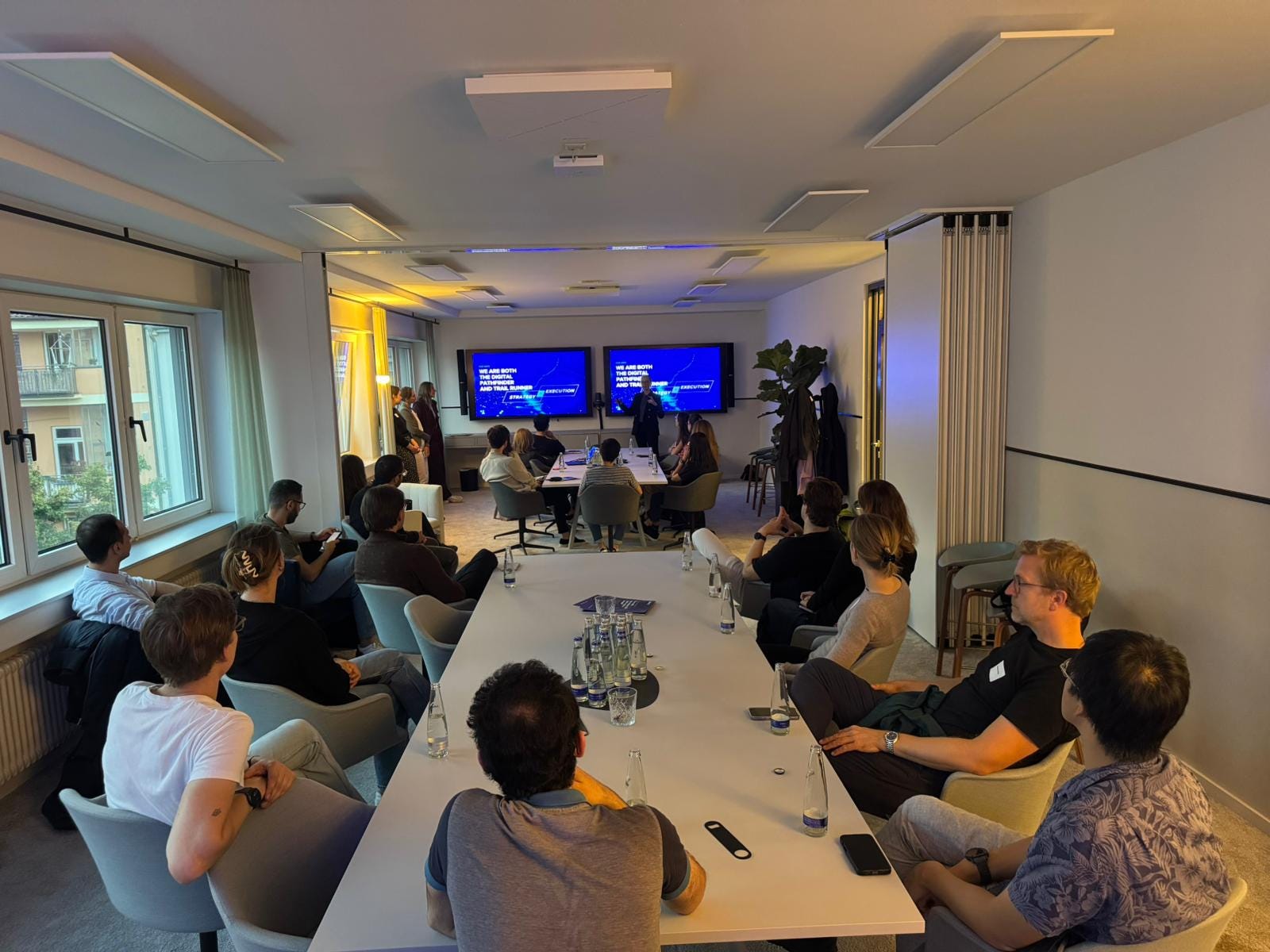
In September, we partnered with OMMAX for an exclusive session on startup exits in healthcare – and welcomed over young professionals, founders, and health enthusiasts to explore what truly matters when it comes to building acquirable ventures.
🧬 From Lab to Launch
On October 20th, we will have a big event with the communities FemTech Germany and Nucleate. From a science project to a successful startup - what is the best strategy? We hope to see you all there!
That’s all for now from the front lines of health-tech! Whether you’re building, coding, caring, or just curious - we hope this issue gave you some inspiration, insights and maybe even a new perspective. Stay tuned for more stories where med meets dev!
Stay subscribed and tell your nerdy friends!
Until next time - keep exploring, researching and stay curious!
Your med-dev Newsletter Team (Marlene, Anja & Julia)
No posts
Comments
Nothing yet. Say the first thing.
Sign in to join the conversation.