
In this issue
we learn how a camera can detect heart diseases by scanning your face,
find out what makes good science communication, and
get motivated to register for the next med-dev events (hopefully 🤭?)
Have you ever thought you could measure your pulse just by looking at a camera? It sounds like sci-fi, but it’s real - one of our med-dev members even demoed it at the first med-dev conference this year. Learn what he found out below!
Populations such as neonates, elderly patients, and individuals in intensive care units often face additional risks or challenges with contact-based monitoring. In neonates, especially those in intensive care, traditional contact-based heart rate monitoring can be problematic due to their delicate skin and the risk of injury. Instead of hooking up wires or wearing a smartwatch, remote photoplethysmography (rPPG) lets you check your heart rate with a regular camera. Each heartbeat pumps blood that changes your skin tone a teeny bit. rPPG watches those tiny color flickers on your face and calculates your pulse from them.
Now, I wondered: does it matter where on your face the camera looks to get the best heartbeat reading? To find out, I combed through about 70 studies and here’s what I learned:
First off, not all face regions are equal. Many studies used the whole face as one big signal source. That’s easy, but like using a giant mic to catch a whisper - you get a lot of noise along with the signal. It works much better to focus on specific spots. The champions? Forehead and cheeks. Thinner skin and lots of blood flow there mean a stronger pulse signal. Plus, those areas aren’t usually covered by hair or masks (meanwhile, the nose and chin were pretty much useless for this).
Next, why stop at one spot? Some researchers tried using multiple face patches at once. It’s like having a few mini-antennas instead of one big one - you can combine their info for a clearer picture. Sure enough, using a few regions together (say forehead plus both cheeks) was more accurate than one alone. One team even split the face into hundreds of tiny regions to push the limits. The takeaway: a handful of well-chosen patches give great results, but after a certain point, extra patches don’t add much information and just complicate things.
Finally, algorithms matter. Early methods used hand-tuned tricks to extract pulses, which worked okay if you sat still in good light. Now we’ve got smart machine learning stepping in. Researchers train neural networks on lots of face videos to automatically spot the pulse. These AI methods are now beating the older ones. They’re more flexible: a little movement or light change and they can still zero in on your heartbeat. They do need plenty of data and computing power, but that’s the trade-off.
Now, rPPG isn’t perfect yet. Try it in low light or while you’re jogging, and even the best system might struggle. Many experiments were conducted in ideal conditions (bright rooms, no sudden moves). The big challenge is making this tech work in the wild: at any time, any place, for people of all skin tones. The good news is that researchers are on it, tweaking and training systems to handle real-world scenarios.
Bottom line: Your face really can reveal your heart rate - especially your forehead and cheeks. Focusing on those prime spots (even a few at once) gives the best results for camera-based pulse checks. Add some smart algorithms, and we’re getting very close to turning your phone’s camera into a heart monitor. Checking your pulse might soon be as easy as taking a video selfie.
I think this is just the beginning → maybe measuring blood pressure by selfie is around the corner?
Reference
Bondarenko M, Menon C, Elgendi M. The role of face regions in remote photoplethysmography for contactless heart rate monitoring. NPJ Digit Med. 2025 Jul 26;8(1):479. doi: 10.1038/s41746-025-01814-9, https://www.nature.com/articles/s41746-025-01814-9
Article by Maksym Bondarenko
Did you read about detecting your heart rate by camera already? Or do you sometimes feel like you miss out on cool new research? This is where science communication enters the chat - to bring the research directly to you 🏹 Let’s learn more about science communication in the following interview!
Spoiler: she’ll ask more questions than you do – and already have the headline in mind.
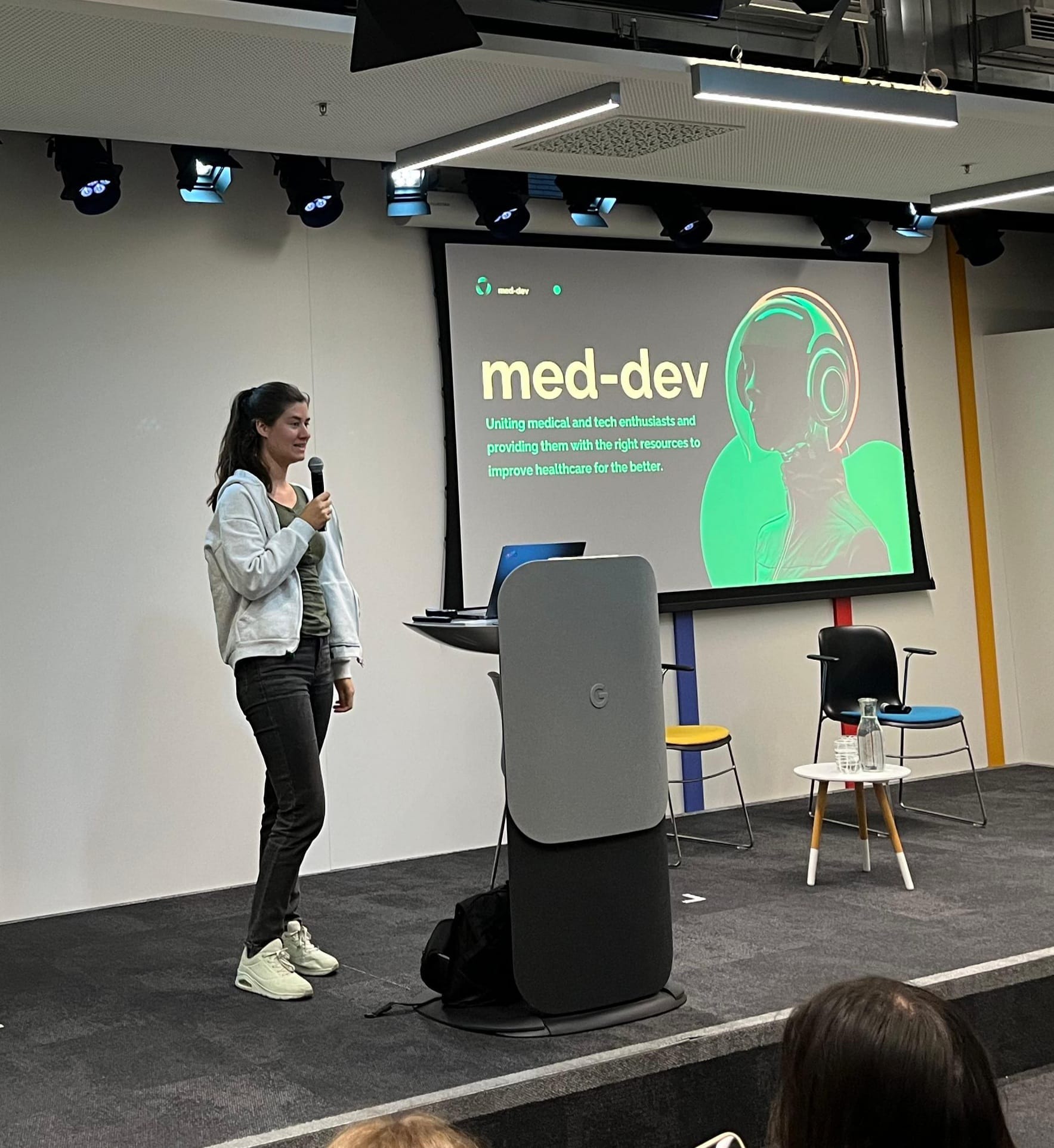
We sat down with Anja, editor at Springer Medizin (the German part of Springer Nature) and member of the med-dev core team, to talk about journalism in medtech, the buzzwords she’d like to ban, and why explaining things clearly might just be the most radical act in healthcare.
✍️ You’re a medical journalist by day and med-dev organizer by… also day. How did you end up here?
Combine a master’s degree in molecular biology and a love for texts and you somehow end up with a medical journalist! I just saw a job offer at Springer Medizin, the german Springer Nature, my brain connected some puzzle pieces and now I still work there three years later. In spring 2024, Vivi came up with the idea for med-dev, and because we have been close friends since high school, she asked me to build this community with her. Because I read so much about current problems in the medical field in my daily work, I was hooked within seconds 🪝
❌ What do medtech people not understand about the media, but really should?
Some parts of the medtech field are sadly not as science based as they should be - scientific studies are missing or the evidence for e.g. the usage of some apps is rather weak. This is also visible in the media, especially social media. It is important to filter whether a post is really good content or just an ad in disguise.
📢 In your view, what makes great science communication – especially at the intersection of medicine and technology?
The perfect mixture of informative, scientifically based and still fun to consume :) and most of all: understandable for both sides!
📚 You read like 10 studies a day – what’s a medtech trend you’re actually excited about… and what’s totally overhyped?
AI is one of the greatest buzzwords of our generation - but in the medical field, there are so many actually cool applications. Especially for diseases that are still a focus of scientific discoveries, e.g. inflammatory bowel diseases or neurological conditions. By analyzing huge data sets, it is possible to identify patterns that remained unknown before!
On the other hand… AI won’t cure all diseases, so it is also the most overhyped one :D
➡️ What needs to change for medical experts and tech developers to reconnect more deeply?
Both should try to understand the everyday life of the other!
⁉️ Which questions are we not asking enough when it comes to innovation in health?
… does it even help anybody? 👀
👂 Bonus question: If you hosted a med-dev podcast, what would it be called?
The med, the tech and the chaos?
There are some cool med-dev events coming up, again with limited spots (so be fast with saving one 🤫)!
Want to learn more about the daily challenges of a doctor, a software developer at Google or a medical journalist (somebody you already got to know in this newsletter 👀)?
This event is already on Monday, 24th of November. If you didn’t save a spot yet, this is your time to sign up here: https://luma.com/icmoy33k
Let’s turn the tables in women’s health! This event will be all about solutions for real world problems. A clinician will talk about real world struggles and we will talk about potential solutions. Do you already have an idea or are just curious about what we come up with? Then join us on December 2nd at 6 pm at TUM Venture Labs (Klinikum Rechts der Isar)! You can sign up here: https://luma.com/kq09j4x8
Thank’s for reading, for staying curious and for being such a great community. Together we can shape health-tech for the better! 🩺
Stay subscribed and tell your nerdy friends!
Until next time!
Your med-dev Newsletter Team (Marlene, Anja & Julia)
No posts
Comments
Nothing yet. Say the first thing.
Sign in to join the conversation.