
Part Four of a series. Read Part One, Part Two, and Part Three.
I’ve been writing about towns in RPGs for a while now. It’s been nice to both deepen and share my understanding of what makes a town tick. Like all good things, however, it must end. And like all good things on the internet, it must end with a list.
Here, then, are my favourite places in video games to kick up my feet, buy some new equipment, and while away the hours.
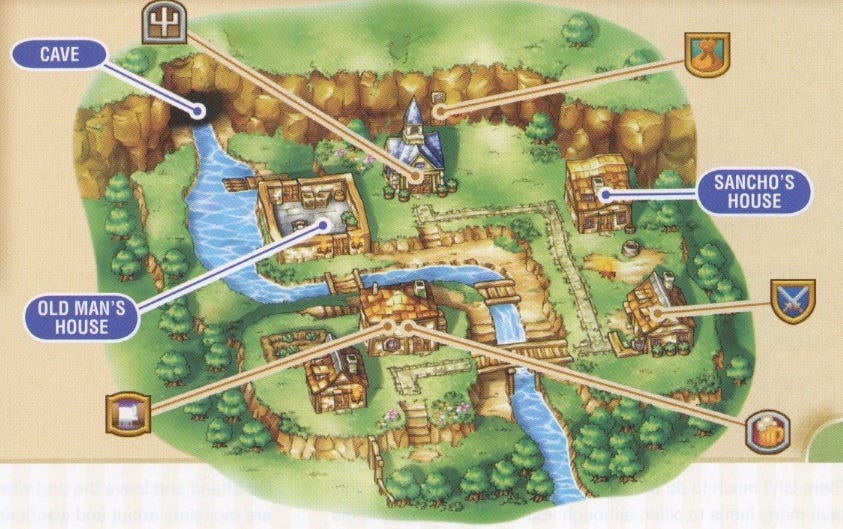
Whealbrook is the quintessential sleepy starting village. The hero of a JRPG beginning their journey in a rural hamlet is a common trope, as it contrasts nicely with the adventure that awaits beyond. Whealbrook perfects that atmosphere of safety and borders waiting to be tested.
DQ V is about growing up, following the hero from childhood all the way to having a family of his own. Whealbrook is the hero’s childhood town, and it creates an atmosphere of whimsy and thirst for novelty. It’s small, but large enough to take several screens to cross. The player’s house is prominent, as home looms large in a child’s mind. There’s even a mysterious – but ultimately fairly harmless – cave near the back of the town, showing us what challenges await the hero as he grows.
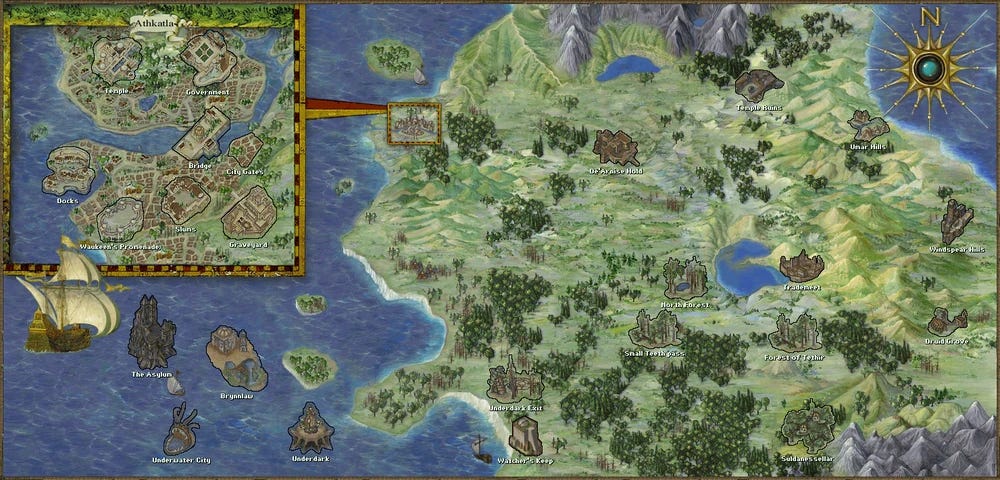
Baldur’s Gate II has what may be my favourite middle chapter in all of video games. The party is forced to come up with a large sum of money to help break a companion out of wizard jail, so it’s time to explore the Sword Coast and see what kind of lucrative trouble awaits. This freeform section captures that sense of roving adventure so common to tabletop RPGs. The overarching story pauses, allowing the party to root around the corners of the world.
And what a world we can discover in BG II. Athkatla supports this by acting as both a home base and a repository of weird, wonderful adventures of its own. The sheer density of strange and delightful events is staggering. A planar ship has crashed into the corner of one map. The circus has been taken over by a mad illusionist. Poking around the sewers of the Temple District reveals an entire beholder cult, complete with a huge dungeon and multi-hour side quest only hinted at by a street preacher on the surface.
Athkatla is bustling, with the drone of conversation and shouts of traders audible while wandering the streets. Each section has its own map that boasts a distinct personality, making it easy to learn while also seeming huge. During this freeform chapter, the party will not only adventure within the city but return to it as we explore the surrounding area. It’s a home that also bursts with secrets.
Shevat is a floating city that travels above the world of Xenogears. The player first sees it from the bottom several times, where it resembles a gigantic UFO. Finally ascending to Shevat signals a shift in the story, where the weirder sci fi elements start to shine.
Shevat is steeped in history as the last remnant of a once great civilization. It’s shabby in a way that hints at faded glory. It’s also alien in many ways, even in how it is built. Shevat breaks a rule I mentioned in a previous article about what makes a good RPG town in being difficult to navigate. The looping layout can be a little confusing, and some buildings can only be accessed by platforming. That speaks to how this city is not built for surface dwellers like Fei and the party.
Other highlights: the parallels to Chrono Trigger’s Zeal, the serene atmosphere reinforced by the clouds below, the ethereal music, and the room full of Chu-Chus, which is a bizarre, hilarious break in the vibe.
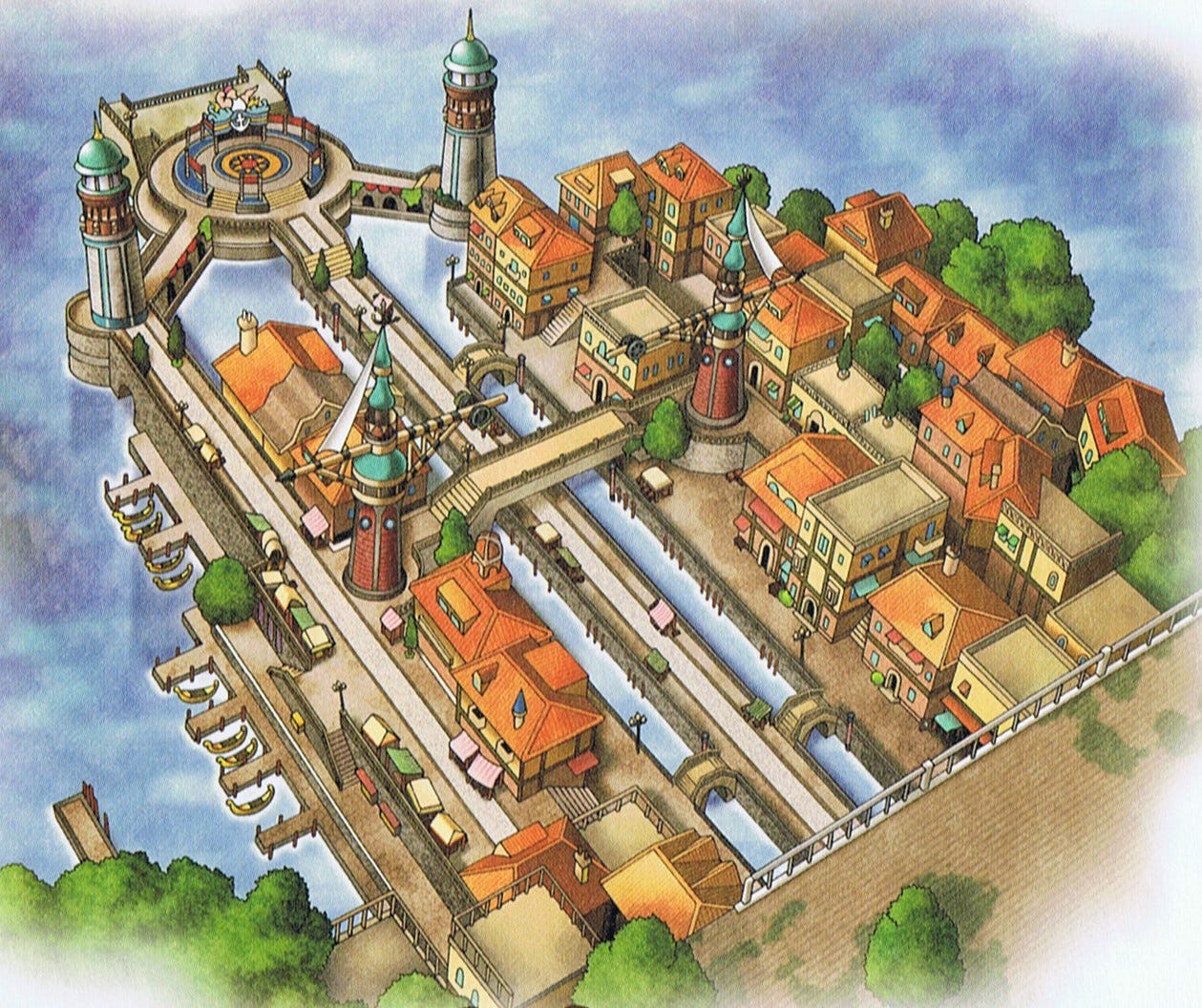
Gondolia’s sunny mood and gentle canals give way to a playful use of space and small touches that invite a slow amble. While neither the most relaxing DQ XI town nor the most intricate, it balances atmosphere, small stories, and clever planning to create one of my favourite RPG towns.
There is a lot to love here: the Spanish accents, the sea on the horizon, the sparkling NPC dialogue. But the real star is the layout, as the inside/outside geometry gives the entire town an intricate, yet easygoing pace. Most homes and shops can be accessed either from the upper walkways on their second floors, or through the ground entrances by the canal. Thus, there a dozen ways to go up and down between the docks or the residential street on the right and the canals, along with multiple bridges to cross. Due to the prevalent sightlines, however, the player never becomes lost, instead enjoying the bevy of routes wherever they are going. Tim Rogers once compared DQ XI’s towns to Quake maps, and Gondolia has that route density and sense of geometric perfection.
Also lovely is the festival atmosphere. The streets are packed with vendors, many of whom are selling trinkets or snacks instead of anything relevant to an adventurer. Its lavishly decorated and people are milling about, enjoying themselves and inviting us to do the same.
Plus, that festival is a buff dude competition! The rules are deliberately vague as a joke, with what initially seeming like a beauty contest turning out to be a general manliness competition. As one sailor puts it, “Signor Universo is for men of all ages. The winner, he must be powerful like the waves, graceful like the breeze and deep like the sea!” I chuckled when townspeople kept encouraging the Hero to sign up, given his skinny frame compared to all the other extremely buff contestants.
Obviously this features. I wrote a whole article about it. I won’t repeat myself, since you can take a guided tour courtesy of yours truly, but I think Rabanastre feels gloriously alive in a way that most towns do not. It’s just fantastical enough to inspire delight but still welcoming to the weariest of travelers. The city is full of tricks of perspective and small details that make it feel larger than it actually is, allowing us to become familiar with it while never losing that impression of a large, crowded city.
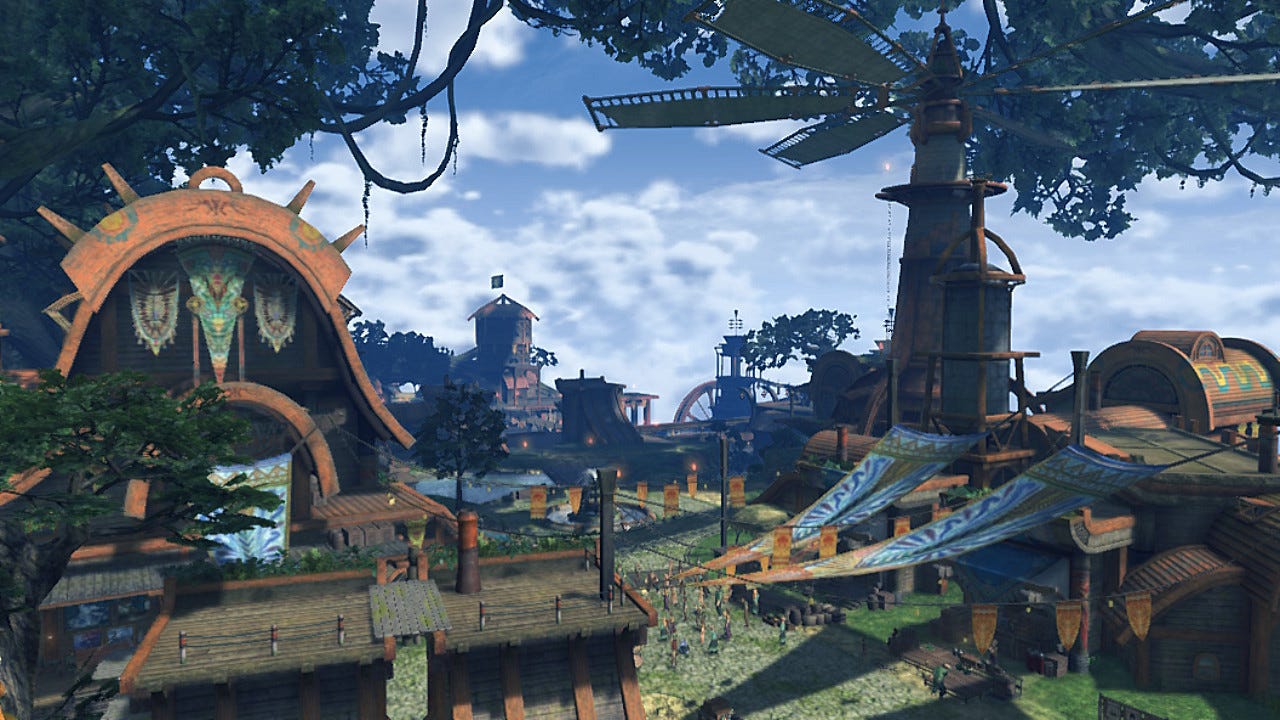
The locales in the Xenoblade Chronicles series are all stunning, with the first title boasting my favourite overall setting in all of games. But XC 2, perhaps because of its more individualized islands allowing for particular cultures to grow, has some truly incredible towns.
Torigoth has an enchanting use of verticality. While it doesn’t climb as high as some towns in RPGs (or even Goldmouth in XC 2), the way the lower levels dip into the cloud sea, with shops and homes open to the port, give it a slightly ramshackle, built-up feeling. Torigoth also opens up in a fascinating way. At first blush, it seems like a simple market, but stepping past the beautiful central plaza reveals an entire small city beyond, with alleys, secret passages, and a second section beyond the bridge. A bit of platforming even reveals some buildings and passageways on the upper levels. It’s a joy to just walk around the place.
On the whole, Torigoth feels consistent with the landscape. It’s built around two large ports, with one bisecting the town. In addition, it bleeds into the surrounding area in a way that other RPG towns often do not. This is much a product of the open-ish world as the town, but Torigoth peters out in an interesting way, with no hard delineation between the town and nature. There are walls, but with farms and a logging camp abutting them and one side of the town lacking any walls at all. As the folksy theme suggests, it’s a rural, welcoming place.
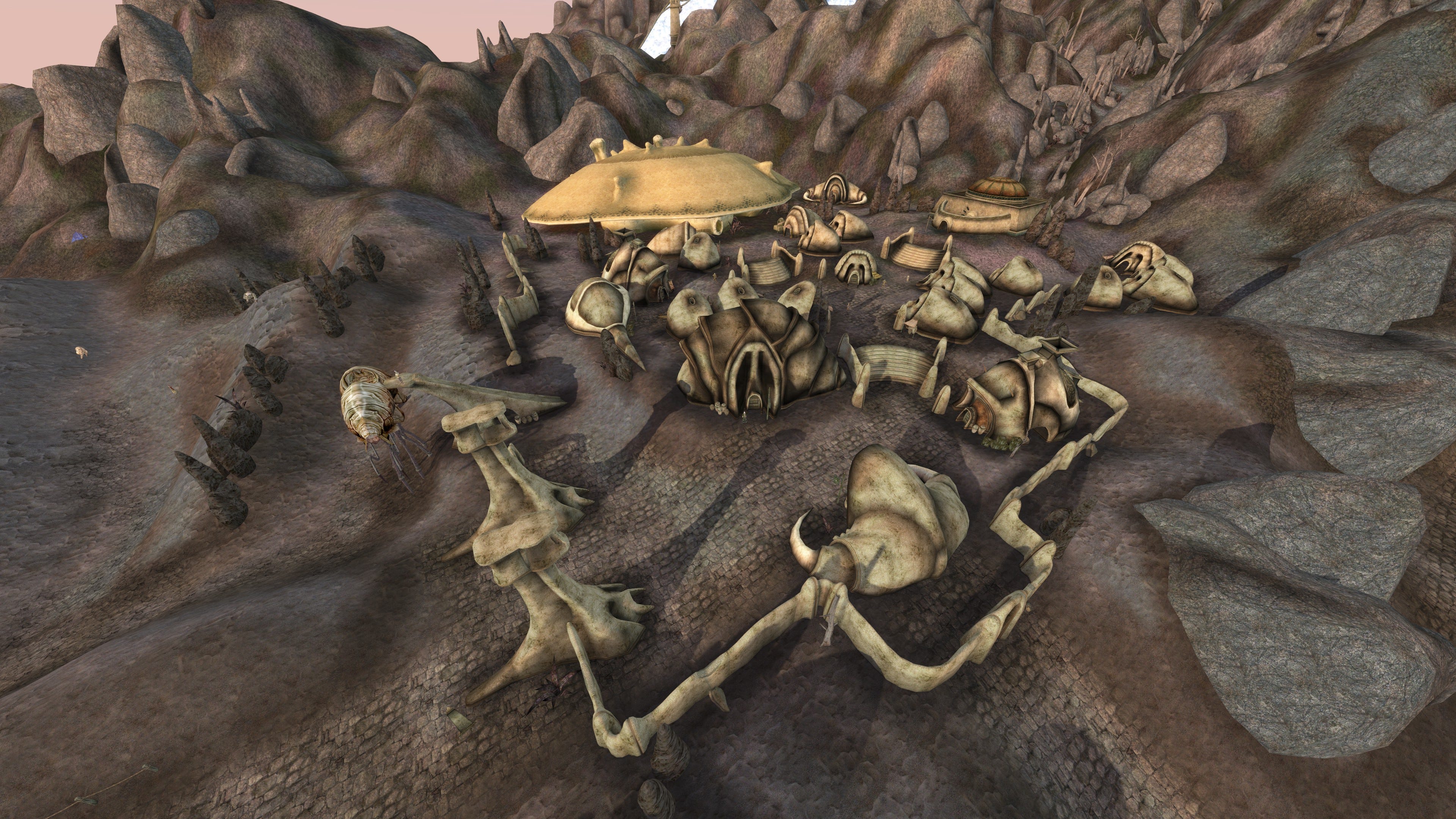
In contrast to the open arms of Torigoth, Morrowind is an odd and hostile land. One of the appeals of this game (especially compared to later Elder Scrolls titles) is just how weird the landscape and culture of this place is when compared to other fantasy locales.
The game eases the player in somewhat by having the most Imperial-inflected (i.e., more generic fantasy) locations feature early in the game. Balmora is remembered fondly due to it being the first likely town a player encounters — along with how off-puttingly jacked Caius Cosades is — but once we venture deeper into the province the true Morrowind shows itself.
Choked by ash storms, with organic, beige architecture, Ald-ruhn makes no concession to the ordinary or the expectations of the player. It is suited to its landscape and to a people uninterested in accommodating outsiders. Both Morrowind the province and Morrowind the game will kill or disorient the unwary without a second thought, but sights like Ald-ruhn make the danger worth braving.
The town’s showstopper is the district located inside the hollowed-out shell of a gargantuan crab. It’s wonderful to set a neighbourhood inside the bones of a huge creature — thus making us wonder is such creatures are still out there — but to choose such an alien, yet practical design as a crab is a stroke of genius. The inside of the crab, known as “Under-Skar” after the name of the famed beast, is crisscrossed with bridges, since the floor curves steeply in another odd touch.
There are simply too many towns I love, so I can’t end without naming some more:
Puerto Valour - Dragon Quest XI — I adore the white, Greek-inspired buildings and the fact that the hotel closer to the casino is more expensive than the other one.
Balamb Garden - Final Fantasy VIII — Balamb’s circular layout and wonky, sci-fi aesthetic are an excellent introduction to what is probably the oddest mainline Final Fantasy title. A great place to run around playing Triple Triad.
Dunan Castle - Suikoden II — Watching this headquarters grow alongside the army is one of the highlights of this wonderful game. It’s functional while still personable and comes with both an Iron Chef-style minigame and an octopus family in the basement.
Inaba - Persona 4 — Inaba oozes personality due to specificity. It’s slightly run down and rural. There’s not much to do, it’s often drizzly, and the buildings are a touch drab. While an ordinary place, the brilliance is in how much those details are cherished by the game.
New Vegas - Fallout: New Vegas — One of the best structural touches in this game is how long most players will go before setting foot in the titular city. The dazzling lights of New Vegas reward that anticipation.
Hateno Village - Breath of the Wild/Tears of the Kingdom — These two games encourage an itinerant lifestyle for Link, but it’s always nice to have such a relaxing, sleepy village waiting for us. Bonus points for how it’s built on a hill, with the homes following the natural slope of the landscape. That’s much rarer in games than you might think.
Winterbloom - Octopath Traveler II — There are many cozy winter towns in JRPGs, but this one takes the top spot due to the way the light spills from the homes while wandering about.
Zeal - Chrono Trigger — Essentially Shevat in 2D. Still great.
Rolent - Trails in the Sky 1st Chapter — More than any other RPG town, Rolent feels like a place where people actually live. It persists beyond the player while also welcoming us.
I grew up watching (among many other mystery shows) Inspector Morse with my parents, but I have only recently picked up the novels. I’ve started from the beginning and so far am delighted with their intricate plotting and strong prose. One refreshing touch, which may not be for everyone, is that Morse is an irascible jerk — neither a brooding Wallander nor a roguish Dr. House, rather just a bit of an asshole. I also enjoyed that the books function as something of a period piece nowadays, having been written and set in 1970s Oxfordshire.
Mega Man Legends is an early 3D platformer that is bursting with sincerity and personality. It has all the energy (and writing quality) of a Saturday morning cartoon, but it managed to charm me for its short runtime. It also looks gorgeous, with strong art direction that features 2D sprite faces mapped onto polygonal characters.
On the subject of intricate plotting, The Decagon House Murders by Yukito Ayatsuji is a puzzling delight. Harkening back to golden-age detective novelists like Christie or Seishi Yokomizo, the novel presents a series of bizarre murders in an equally bizarre house. I love mystery novels like this that play fair, allowing the reader at least a chance to guess the solution before the big reveal. Stylistically it’s a touch dry, but I still recommend it.
John Prebble was a journalist first, historian second, but his narrative histories of Scotland hold up as informative (albeit a little biased), entertaining reads. They are a bit out of date on the details, but Prebble should be commended for his courage in examining some ugly aspects of British history that were going unrecognized when he was writing in the 60s. His book on Glencoe is particularly gripping.
I’ve been playing Dungeon Encounters and listening to Ann Southam, so we’re going to talk about minimalism in games.
No posts
Comments
Nothing yet. Say the first thing.
Sign in to join the conversation.