
A recent, excellent article over at Word Play has been bouncing inside my skull for a little while.
In the essay, Zim wades into the (admittedly overdone) “but is it a game?” discussion by imagining a title that only features a single interactive element: the player is cast as a juror in a high-profile murder trial, and the only mechanical interaction besides paging through dialogue is the single choice of guilty or not guilty.
Ignoring the surrounding context/discourse, I love this example because it concisely illustrates how game mechanics change our relationship with narrative. Courtroom drama is a well-worn subject, but casting us as participants reframes our experience. Neither better nor worse than watching an episode of Law and Order, but certainly the weight of the decision makes the experience of the story distinct.
And all it took was a single choice.
While there are plenty of simple (or simplistic) games out there, a subset of them follows what I’ll call a minimalist design style: deliberately stripping down common mechanics or the presentation to sharpen the impression of what remains. In the above example, the single choice of the juror makes it more powerful. A different courtroom game, involving many choices and moments of questioning or investigation, might be interesting in different ways but not have quite the same effect when we are asked to cast our vote at the end.
Minimalist design is usually in service of highlighting certain mechanics or distilling styles of play. Trip Harrison’s review of two wargames illustrates this nicely for me. In one example (Lines of Battle), a simplistic presentation belies robust mechanics. In the second (War of Dots), everything is stripped down until we have Hearts of Iron by way of Pong: a minimalism intended to present only the necessary elements, thereby allowing people to appreciate them without distraction. Zim’s juror example is of the second type: only featuring a single choice makes that choice all the more dramatic.
But how can minimalism be applied to the notoriously maximalist genre of RPGs?
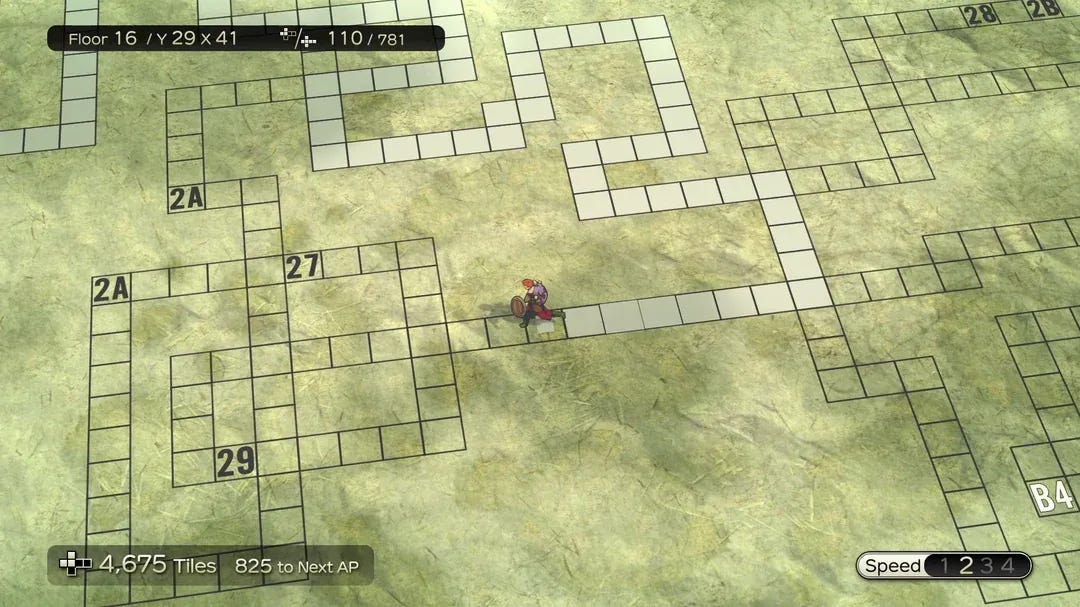
Released in 2021, Dungeon Encounters is an interesting example of RPG minimalism, along with a fairly unusual title from a large publisher like Square Enix1. A return to directing for Final Fantasy veteran Hiroyuki Ito, I suspect it got away with being such experimental title because its stripped-down presentation only required miniscule budget.
The screenshot above is, besides the menu and battle screen, more or less the entire game. The player controls a party of up to four, represented by a single character, navigating a grid-based dungeon. Blank squares are nothing, while numbers represent locations, items, fights, and so on. And so it goes for one hundred floors. While there are some interesting traversal mechanics as we descend, the game is remarkably consistent. We navigate maze-like floors, fight monsters using an ATB-style system, and listen to Uematsu’s prog-like arrangements of Chopin and Rossini2.
The narrative is limited to a single intro screen and some backstory for each character. The dungeon exists, and like an inverse mountain, its existence alone justifies delving into it.
A glance or a brief play session of this game wouldn’t surprise the more genre-savvy of readers. Some of you are no doubt thinking this appears to be just another dungeon crawling roguelike. It certainly has plenty of similarities, albeit with much less dying and restarting. But besides that, and the JRPG influences of an ATB system and combat happening on a separate screen, Dungeon Encounters plays like Angband or Dungeon Crawler Stone Soup.
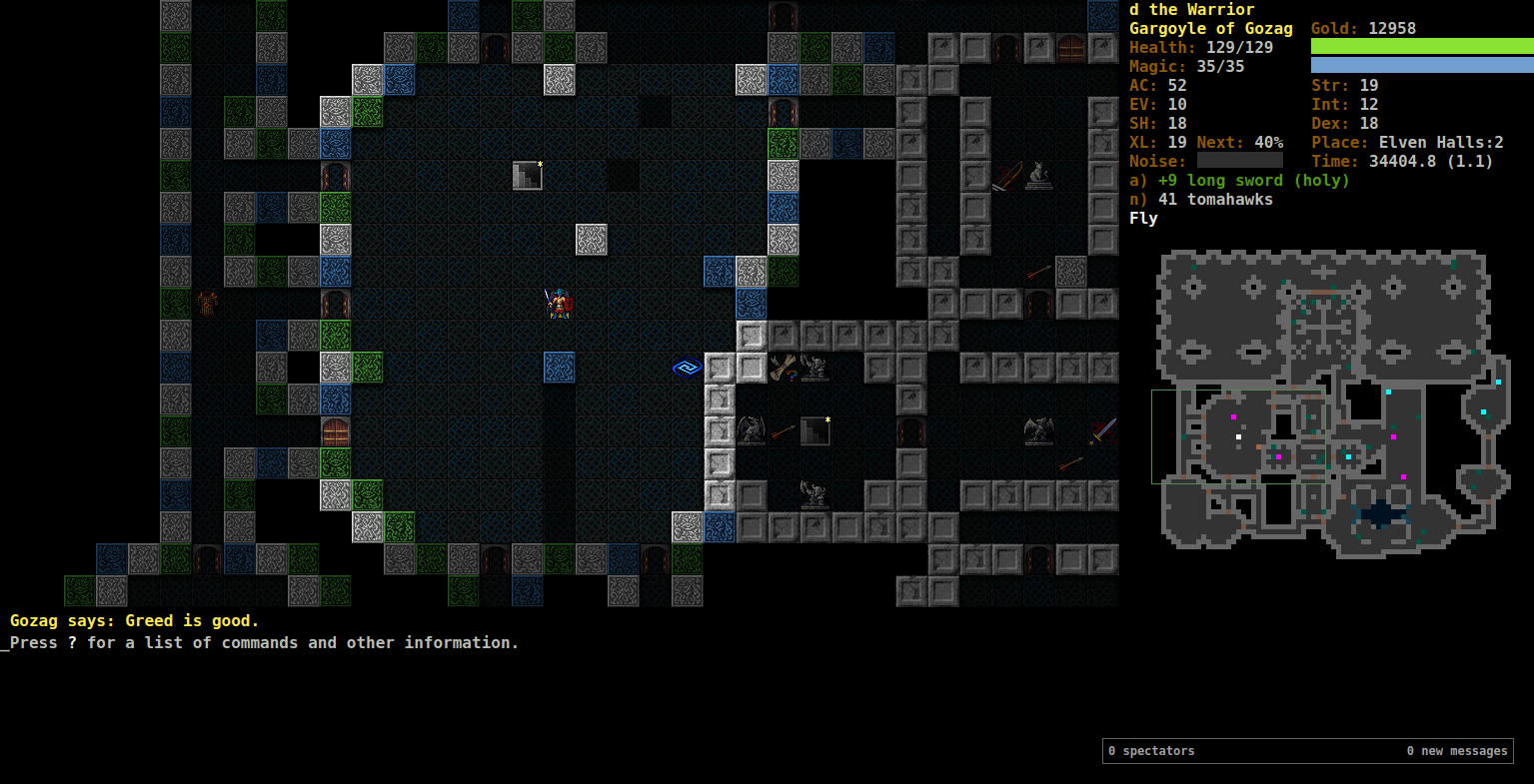
Heck, compared to the ASCII graphics of many similar games, Dungeon Encounters looks positively expensive. However, its presentation certainly is stripped down compared to most games, especially modern ones backed by a large publisher.
The difference is that most other dungeon delvers use simple presentation in the service of complex mechanics. Even DCSS — relatively streamlined to emphasize moment-to-moment tactics — is much more complex than Dungeon Encounters. Characters in Dungeon Encounters have no skills or magic, instead sharing a limited pool of traversal and battle skills. They can equip two weapons and a few pieces of armour. The primary point of leveling up isn’t to improve stats, but the ability to equip stronger items. There aren’t even any consumables.
As I said, there are some puzzles and more complicated traversal problems deeper in the dungeon, but by and large the experience is consistent. The ATB battles in the early days are much like those on floor 99, in stark contrast to most RPGs, which tend to introduce mechanics as we progress.
That’s why Dungeon Encounters is minimalist rather than simple. While still recognizably an RPG dungeon crawler, it shaves down the elements of an RPG until only the core remains. I’m not sure I even enjoyed my whole playthrough, but I admire the audacity of how far the developers were willing to push this ethos.
Going back to the imaginary single-choice juror game, I will say that in the above article Zim puts their thumb on the scale somewhat. The single decision they’ve chosen is high stakes, which is borrowing the dramatic tension of the story to lend weight to the interactivity. That symbiosis is a foundational element of good narrative design — to be expected from someone with a day job writing excellent titles like Life is Strange — but it’s a bit of a cheat in terms of the exercise. The example wouldn’t be as interesting or persuasive if the single choice was instead, say, which seat to take in the jury box.3
But Dungeon Encounters eschews this dynamic by not only featuring no narrative choices, but by having its mechanical choices remain simple throughout. Sid Meier famously (and rightfully, by and large) called games “a series of interesting decisions.” Zim’s example bucks that by questioning if there needs to be a series. Dungeon Encounters questions if the decisions need be interesting at all.
I think there is a second element to minimalist design that is best shown through the example of minimalist music, from composers like Philip Glass, Terry Riley, or Ann Southam. At the risk of being reductive, minimalist music tends to be about variance across repetition. Varying a theme is a common part of more archetypal pieces of classical music4. For example, the first movement of many major symphonies will often have a short section of music (called a theme) that changes and morphs throughout.
Minimalism took that further, having in some cases nothing but a simple theme that is repeated over and over, subtly changing over time. By the end the theme is different, but it’s hard to tell how or when it changes as we are being lulled by the repetitive drone5.
Dungeon Encounters does the same through a series of mundane, fairly repetitive decisions. While this may not be a compelling sales pitch for the game, I think Dungeon Encounters is somewhat boring mechanically and lacking in narrative for a purpose. Rather than using stripped down presentation/narrative to give the player mental bandwidth to focus on complex decisions or reducing the mechanical complexity to let other elements like narrative shine, Dungeon Encounters strips down everything to let us appreciate the nuances of repetition over the long term.
The drone of play allows us to appreciate smaller variations, bringing a different sort of experience and story to the surface. As anyone who has told an anecdote about a tabletop RPG session will know, stories can emerge as a byproduct of play. When that play is mundane, yet within the trappings and length of an RPG, the stories from play that arrive are of a different flavour.
The experience of Dungeon Encounters is a party wipe 50 levels down after being lulled into a false sense of security of hours of easy battles. Or it is leaving a petrified party member behind to make the long, boring trek ten floors back just to visit the shrine that will cure them. Those moments would be lost among the noise of following a traditional narrative or managing a burgeoning spell list. They are often annoying or tedious, yet there is a certain magic that comes with that.
Dungeon Encounters may not be the least interactive game in the world, but by stripping back what supposedly makes games interesting as a medium, the title forces us to pay attention to a different set of experiences and emotions. Play one note enough times and a new one will seem like a revelation. The same goes for the crawl. If the hallways are long and the battles are overly similar, the small differences emerge. By paying attention to our micro experiences, a healing spring or fresh enemy becomes a source of everyday wonder.
I used minimalism in music as a touchpoint, so I would be remiss if I didn’t recommend a few pieces. My favourites by Philip Glass are his String Quartets 2 and 3, the latter of which also features as part of the soundtrack for the haunting film Mishima: A Life in Four Chapters. Every piece by Ann Southam sparkles with vitality and simple joy. Terry Riley’s famous In C is interesting because it’s quasi-improvised: recognizable but a little different with every performance.
Speaking of Mishima, The Temple of the Golden Pavilion is an astonishing work. It’s full of strange longing and an undercurrent of violence. Moreso than other writers, Mishima’s work is a little hard to separate from his life of contradictions, but I think this novel confidently stands apart as a timeless masterpiece.
The Master of Go is very different from Yasunari Kawabata’s other works like the heartbreaking Snow Country. It’s a sparse (even minimalist!) novel that follows a single game of Go between a talented upstart and an aging master player. At first glance it reads almost like a magazine article about the game, but a closer look reveals the emotions roiling away underneath the surface. Just be prepared, like me, to unsuccessfully attempt to take up Go after reading.
I’ve previously mentioned my opinion that the ideal video game format is sailing around on a boat discovering adventures (Skies of Arcadia, LoZ: The Wind Waker, Ys X, Sunless Sea/Skies, Uncharted Waters, Horizon’s Gate, etc. etc.). I’m delighted to add Pillars of Eternity II: Deadfire to that list. I enjoyed but didn’t love the first Pillars, but the sequel is a step up in every way: from dialogue to quest design, everything is smarter and more tightly designed. Plus, the tropical archipelago setting makes for a good summer game.
Often when we talk about mechanics and story interacting, it’s through the lens of choice. But can narrative choice sometimes harm our appreciation of a story?
I will say that Square has done an impressive job of consistently publishing smaller/cheaper (at least in terms of presentation) RPGs over the past ten years, to great results. There is a grim irony watching some corners of the internet bemoan Final Fantasy’s direction while ignoring stellar titles like the Octopath series or Triangle Strategy.
In keeping with the minimalism, the soundtrack only ever features one or two instruments. I’ll admit the music wears thin fairly quickly.
In providing this counterexample I am in some ways proving Zim’s point. The mere presence of certain mechanics or a threshold of interactivity doesn’t say anything about the quality of the game any more than a certain amount of dialogue makes a story interesting. It is how mechanics are deployed and integrated into a game by the developers (alongside other elements) that makes it good.
I know “classical music” is a confusing and unhelpful term when the Classical Era exists in that tradition and we’re discussing 20th century composers. But until the critics come up with a better term than the awful mouthful that is “Western Art Music,” I’ll stick with calling it classical.
If you need a different example (and are also cool), think of drone metal bands like Sunn O))).
No posts
Comments
Nothing yet. Say the first thing.
Sign in to join the conversation.