
A Primary Supply Agreement made public in February 2026 put a number on what has historically been confidential: at full ramp, scheduled for December 2027, the Oracle subsidiary behind a 1.38 GW Michigan data center for OpenAI’s Stargate program owes the utility DTE Electric a minimum monthly charge of $19 million whether or not the load shows up — and $2.26 billion to terminate and walk away.
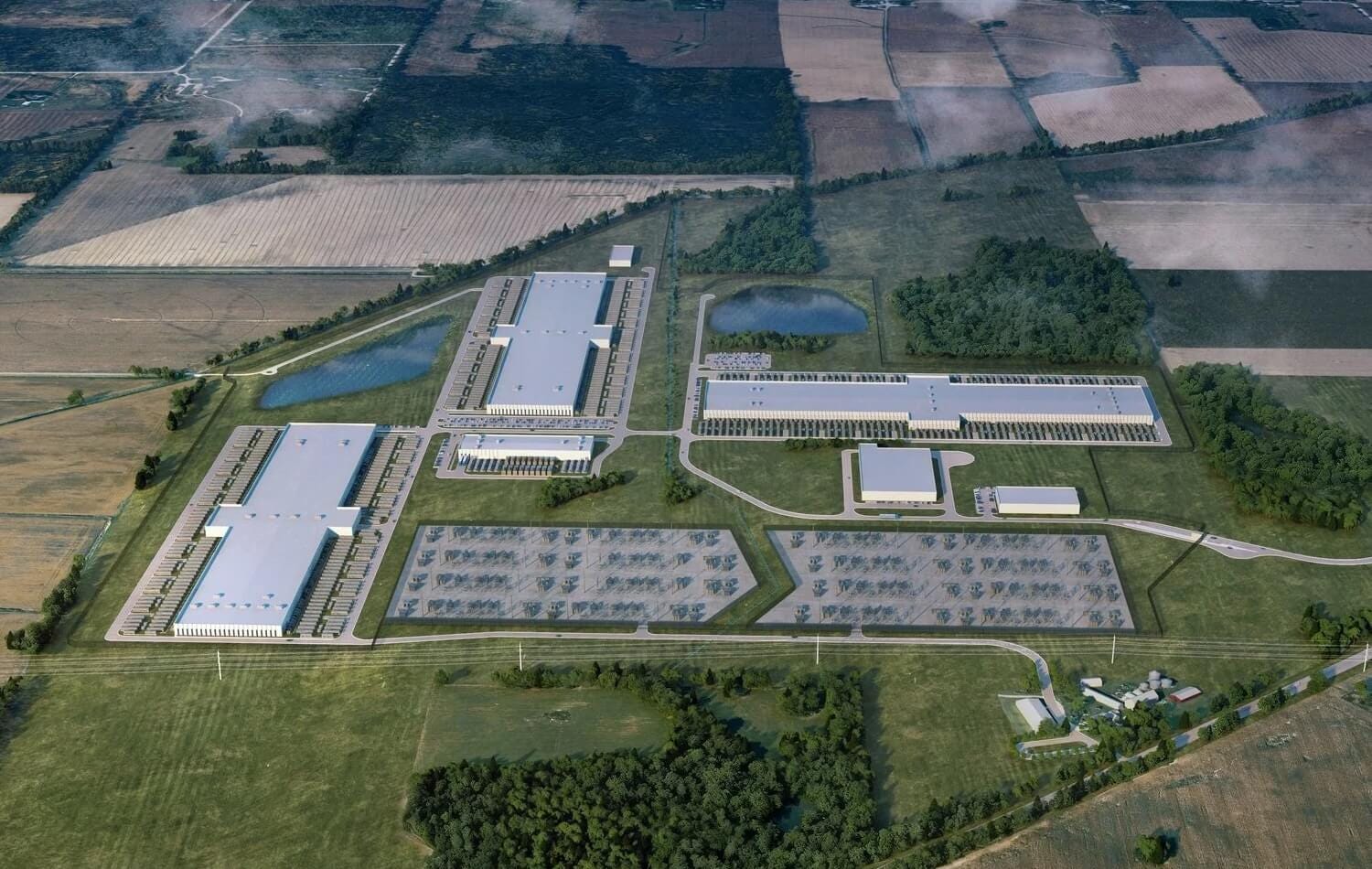
Source: Related Digital.
Historically, the commercial core of a utility’s contract with a data center stayed sealed by default; regulators approved the deals, and the public saw that an agreement existed but almost never its economics. Over the past 18 months, that default has been breaking: contracts and tariffs filed in Indiana, Michigan, Minnesota, and Ohio put minimum-bill floors, exit-fee formulas, and collateral tests for gigawatt-scale AI data center campuses on the public record.
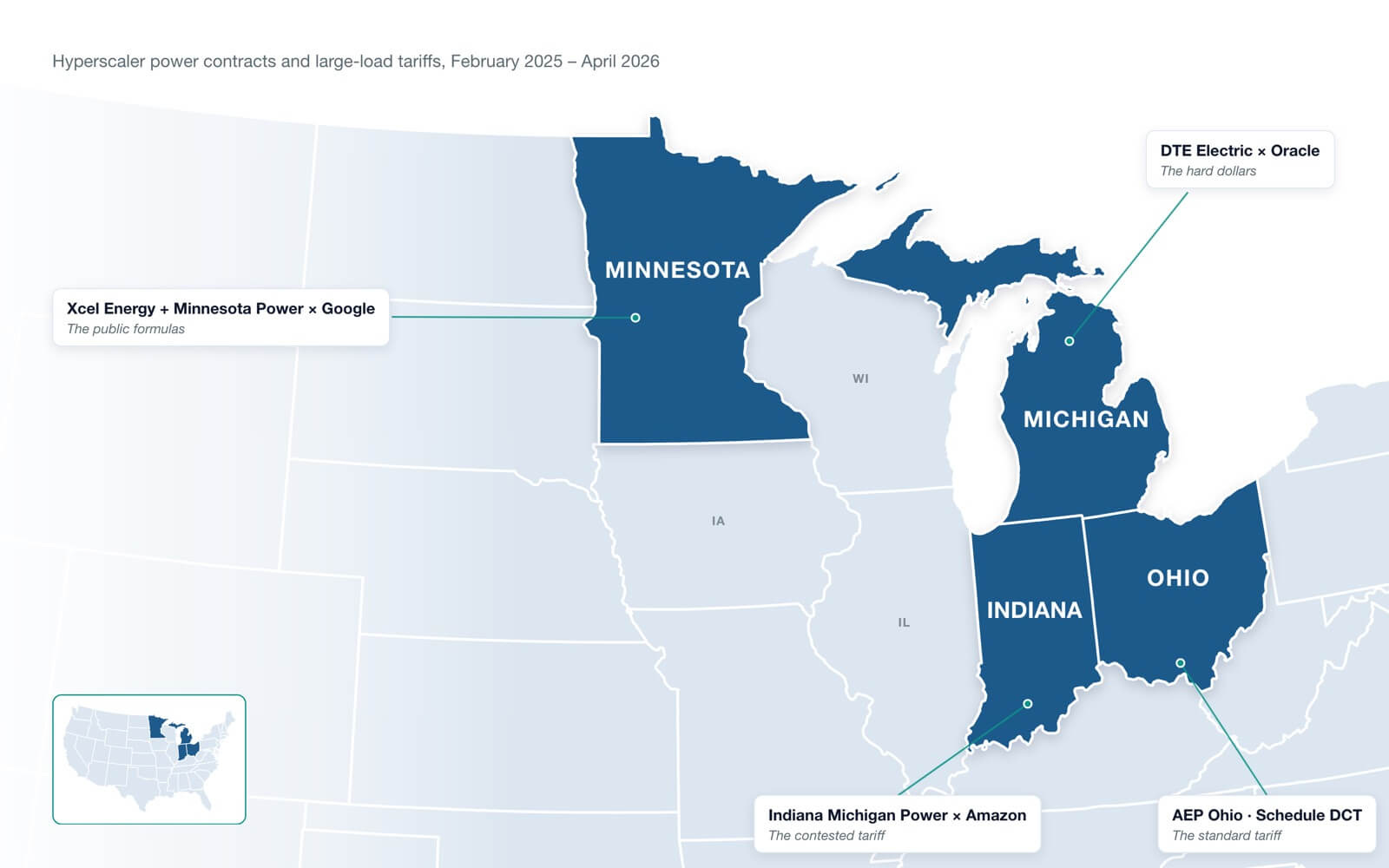
What became visible is not pricing but the risk-allocation architecture: the revenue floor, the exit liability, and the collateral securing it.
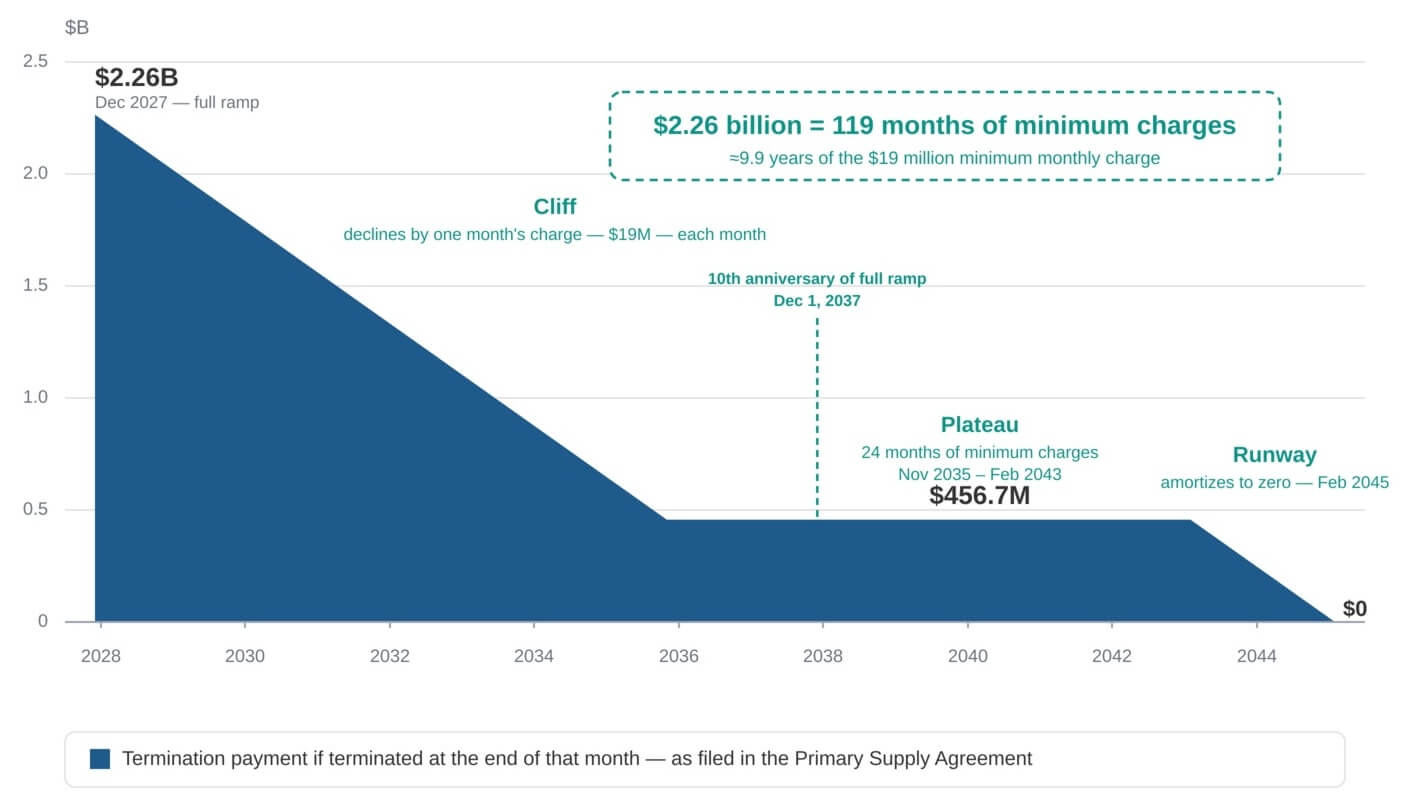
On February 17, 2026, DTE Energy filed the power contracts for Michigan’s largest-ever economic development project. Included in these filings was a Primary Supply Agreement between DTE Electric and Green Chile Ventures LLC, an Oracle subsidiary, which documented a month-by-month schedule of minimum monthly charges and termination payments running from December 2027 to February 2045. It shows that at full ramp, the 1.38 GW Saline Township data center operated by Oracle carries a minimum monthly charge of $19 million and a termination payment of $2.26 billion. The termination figure equals exactly 119 months (roughly 9.9 years) of minimum charges.
That level of visibility is unusual. Because special contracts for data centers are typically confidential, it has historically been difficult to determine whether utilities, with approval from public utility commissions, were shifting costs to ordinary ratepayers, such as residential customers and small businesses. Regulatory scrutiny was further limited because regulators routinely granted utilities’ requests to keep these filings confidential, while decisions approving special contracts often included little substantive analysis of the underlying economics. The Michigan filing therefore offered an unusually detailed look inside a class of agreements that had largely remained hidden from public view.
But Michigan was not an isolated disclosure. Between February 2025 and April 2026, four notable regulatory records put the commercial skeleton of the hyperscaler-utility power deal on the public record:
A contested Indiana tariff that Amazon, Google, and Microsoft litigated line by line
The Michigan special contracts behind the Oracle campus
A pair of Minnesota petitions carrying redacted Google contracts whose formulas are public even where every megawatt is sealed
A fully public Ohio tariff now under appeal at the state supreme court
The contract type is not new — public data center electric service agreements (ESAs) predate 2025. What is new is the frequent disclosure of economically meaningful terms across jurisdictions, in a pattern that is selective but mappable. Three terms organize everything that follows:
Minimum bill — the revenue floor
Exit fee — the price of leaving
Collateral — who guarantees payment
Those three terms are the key negotiation points between hyperscalers and utilities.
Disclosure of a utility special contract has never been binary. There are three levels, and historically the public record usually stopped at the first:
The confidentiality norm was deliberate. Regulators routinely allowed utilities to shield customer-specific load forecasts, infrastructure costs, construction schedules, negotiated rates, and other commercial terms as competitively sensitive information. The commissions could review the economics; the public generally could not. That distinction mattered because the sealed terms were often the terms that determined who bore the risk if the project arrived late, consumed less electricity than promised, or disappeared altogether.
Nor are data-center-style take-or-pay contracts themselves new. Minnesota Power was negotiating individual electric service agreements with minimum-purchase obligations in the 1970s. Decades later, Google’s 2019 “Honeycrisp” agreement with Xcel showed the modern disclosure pattern almost perfectly: the executed contract was public, but its 10-year incremental-cost schedule published the structure while replacing the economic values with trade-secret markers. In a 2022 Xcel proceeding involving QTS Data Centers, the customer’s site-selection rationale, contract term, and high-level load forecast became public, while the rate and renewal economics remained sealed.
The contract form was not new. What changed was the visibility of the economics.
That change happened for two related reasons.
A 20 MW or 50 MW customer could fit within an existing resource plan without turning its bilateral contract into statewide energy policy. A 1 GW campus is different. Utilities may have to build generation, transmission, substations, or storage years before the customer’s full load materializes. At that scale, the ESA becomes the instrument that decides who bears the cost if the forecast is wrong.
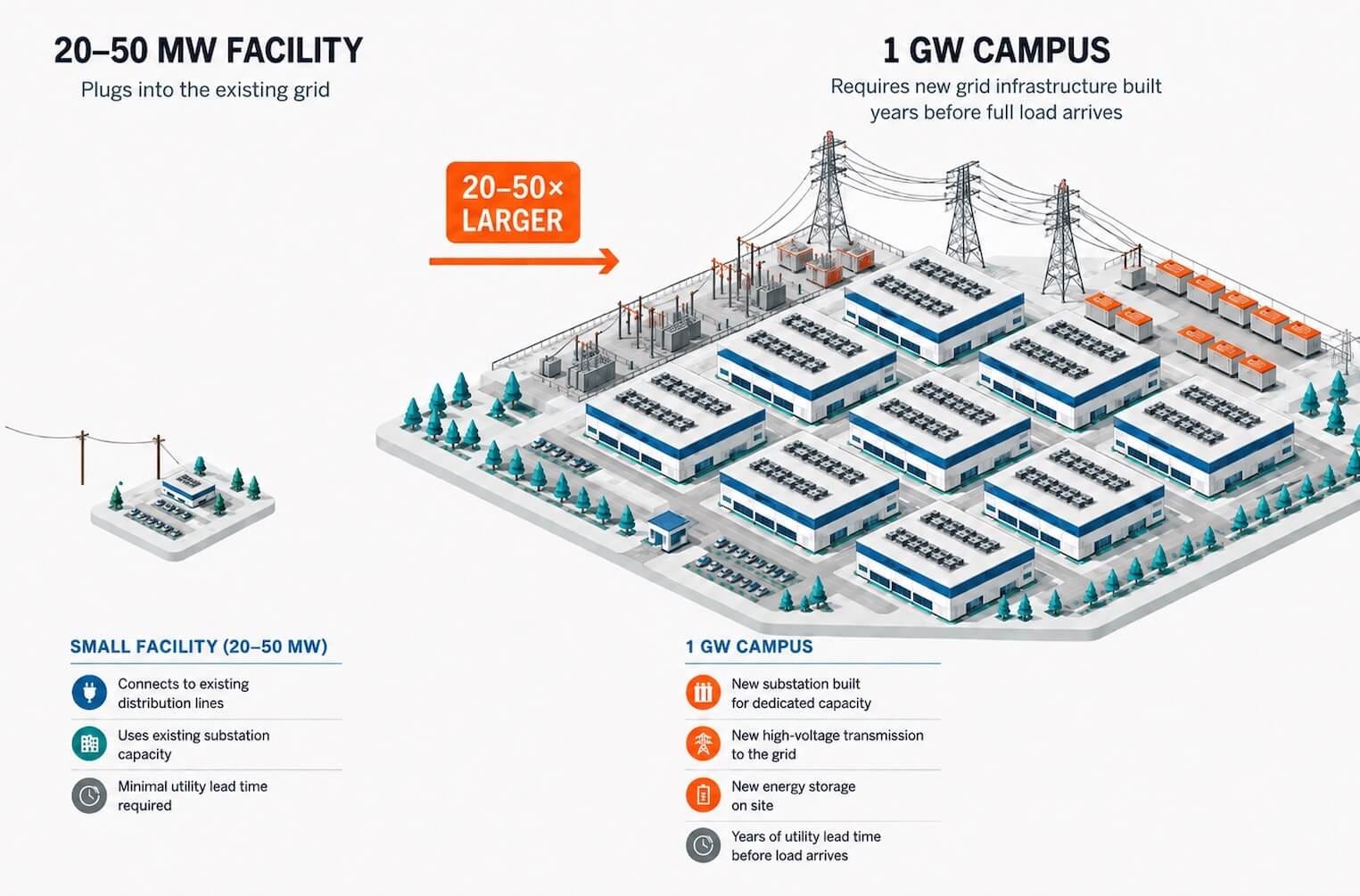
What happens if a 1 GW project ultimately uses 300 MW? Who pays for the infrastructure built around the original commitment? How long must the customer keep paying? How big is the check if it walks away?
Those are no longer merely questions of confidential pricing. They are questions of stranded-cost allocation.
Legislatures and commissions began forcing large-load risk protections into the regulatory framework itself.
Minnesota’s 2025 “Service to Very Large Customers” statute requires the Public Utilities Commission, when evaluating a large-customer tariff or ESA, to consider whether the agreement contains protections necessary to prevent other utility customers from bearing stranded costs associated with serving the large customer.
The same conversion was occurring elsewhere without a new statute. Michigan conditionally approved DTE’s Oracle contracts and ordered the utility to file a generally applicable large-load tariff. Indiana and Ohio moved the economics into contested tariff proceedings where Amazon, Google, Microsoft, consumer advocates, industrial customers, and utilities litigated minimum bills, exit rights, and collateral in public.
That is the shift that matters for the records that follow. The agreements themselves are not unprecedented. What is unprecedented is that economically meaningful pieces of the risk allocation are appearing across multiple jurisdictions at once — sometimes in customer contracts, sometimes in commission testimony, and increasingly in tariffs of general applicability.
Indiana published the tariff while sealing the executed customer agreement. Michigan exposed hard dollars while redacting parts of the underlying schedules. Minnesota published formulas while blacking out the quantities needed to calculate them. Ohio put the entire large-load tariff in public view.
Four proceedings, one architecture. The next question is what each one reveals.
The instrument in force is a settled large-load tariff for customers over 150 MW, approved with modifications on February 19, 2025, after Amazon, Google, Microsoft, the Data Center Coalition, and Indiana’s consumer advocates fought I&M’s proposal through a fully contested record to an all-party settlement. What this record uniquely contributes is the fight itself: testimony, workpapers, and a settlement that show exactly where each side gave ground.
The load driving that fight is Amazon’s $11 billion New Carlisle AI data center campus in St. Joseph County, Indiana, whose anticipated demand of 2.25 GW would make it the largest customer in I&M’s service territory.
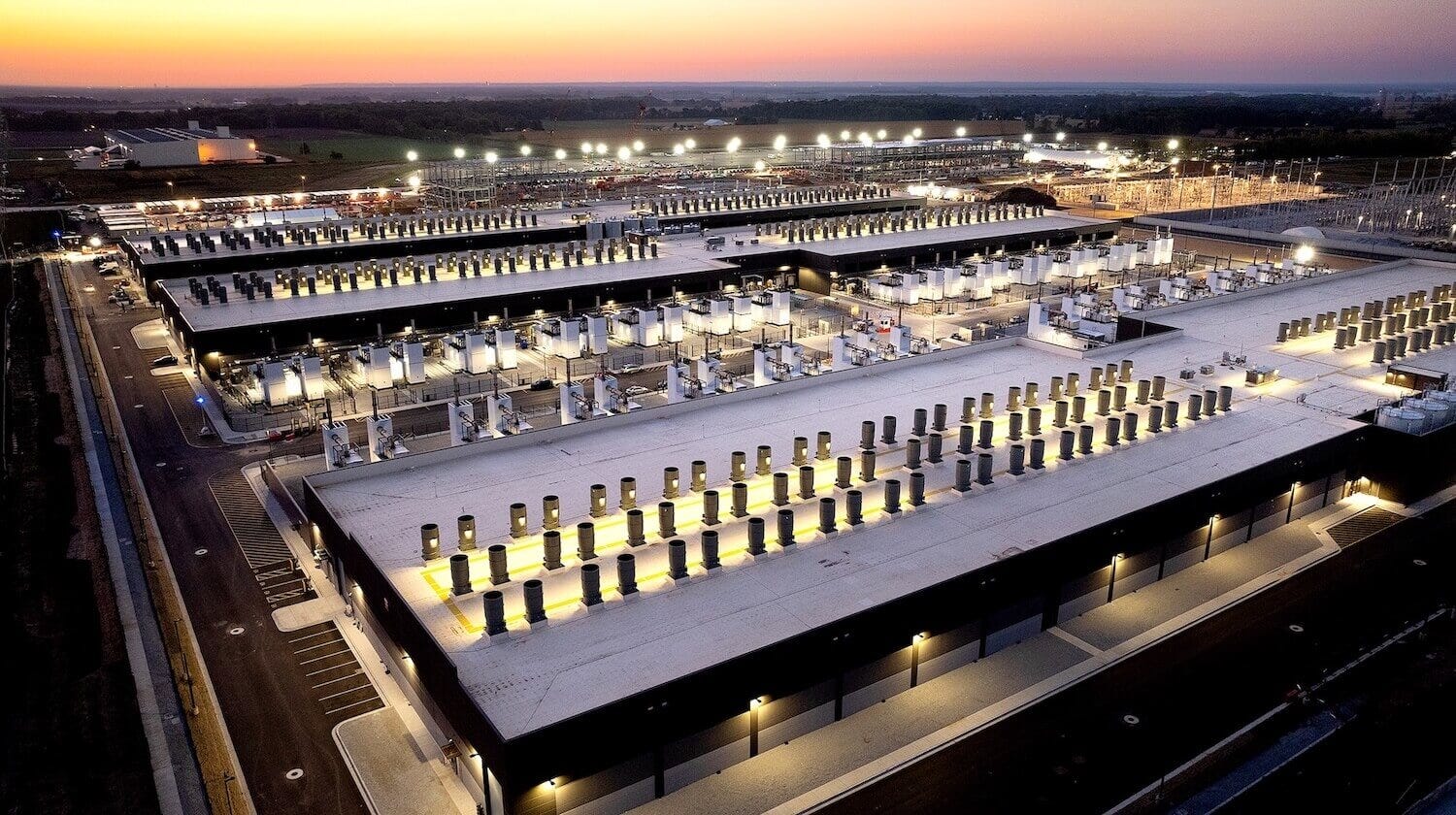
Source: Amazon.
The executed AWS contract, by contrast, sits behind protective orders shielding Amazon’s “energization needs, financial obligations, credit support, and load ramp” — Indiana’s public numbers are tariff-level, not customer-level.
DTE signed its Primary Supply Agreement and a companion Energy Storage Agreement — a distinct instrument, not an ESA — with Oracle’s Green Chile Ventures LLC on October 22, 2025, and filed the documents publicly on February 17, 2026. The Commission’s approval, granted December 18, 2025, was conditional — and it is now on appeal at the Michigan Court of Appeals, brought by environmental and renewable-energy groups and the state Attorney General. The Primary Supply Agreement covers 1.38 GW and runs through February 28, 2045 — roughly 19 years from signing, with two 10-year renewal options.

Source: Related Digital.
This record contributes hard dollars. And it is already generalizing: one condition of approval required DTE to file a standard large-load tariff, and the resulting proposal (filed March 2026) carries an 80% minimum billing demand, a termination fee of 15 years of the customer’s minimum billing demand, and collateral equal to the full termination fee — on exit and collateral, stricter than the bespoke deal it grew from.
Xcel Energy petitioned in April 2026 for approval of its Pine Island ESA with Echo Zone LLC, a Google subsidiary; Minnesota Power had petitioned one month earlier for a 15-year ESA with Harmony Group, LLC, a subsidiary of Alphabet, Inc. Neither campus is hypothetical:
Project Skyway, in the City of Pine Island in Goodhue County, is a 482-acre development where Google is the anchor tenant and the initial phase alone carries more than $700 million of construction
Project Loon, in the City of Hermantown in northern Minnesota, has a development agreement providing for up to four data center buildings and 1.2 million square feet, its first phase committed at no less than $650 million
Both petitions are pending with initial comments closing September 11, 2026, for Hermantown and September 28 for Pine Island. Same customer, same statute, two utilities, one month apart — direct comparability. What the pair contributes is the formulas: every economic mechanism is public; every megawatt and dollar is blacked out.
The data center tariff has been in effect since July 23, 2025 — and it got there over the hyperscalers’ objection: the Commission rejected an October 2024 settlement signed by Microsoft, Amazon, Google, Meta, and the Data Center Coalition, and instead adopted, as modified, AEP Ohio’s rival stipulation with commission staff and consumer and industrial groups. The Ohio Manufacturers’ Association Energy Group has appealed to the Ohio Supreme Court, where briefing closed in March 2026, but the August 2026 oral argument was canceled on AEP Ohio’s own motion, with nothing calendared since. Schedule DCT has already governed for more than a year with no argument date set.
The objectors had campuses on the line: Central Ohio is the densest hyperscaler cluster in the Midwest, where Google has invested more than $20 billion since 2019 and Meta’s New Albany Prometheus cluster has passed 3 GW of capacity.
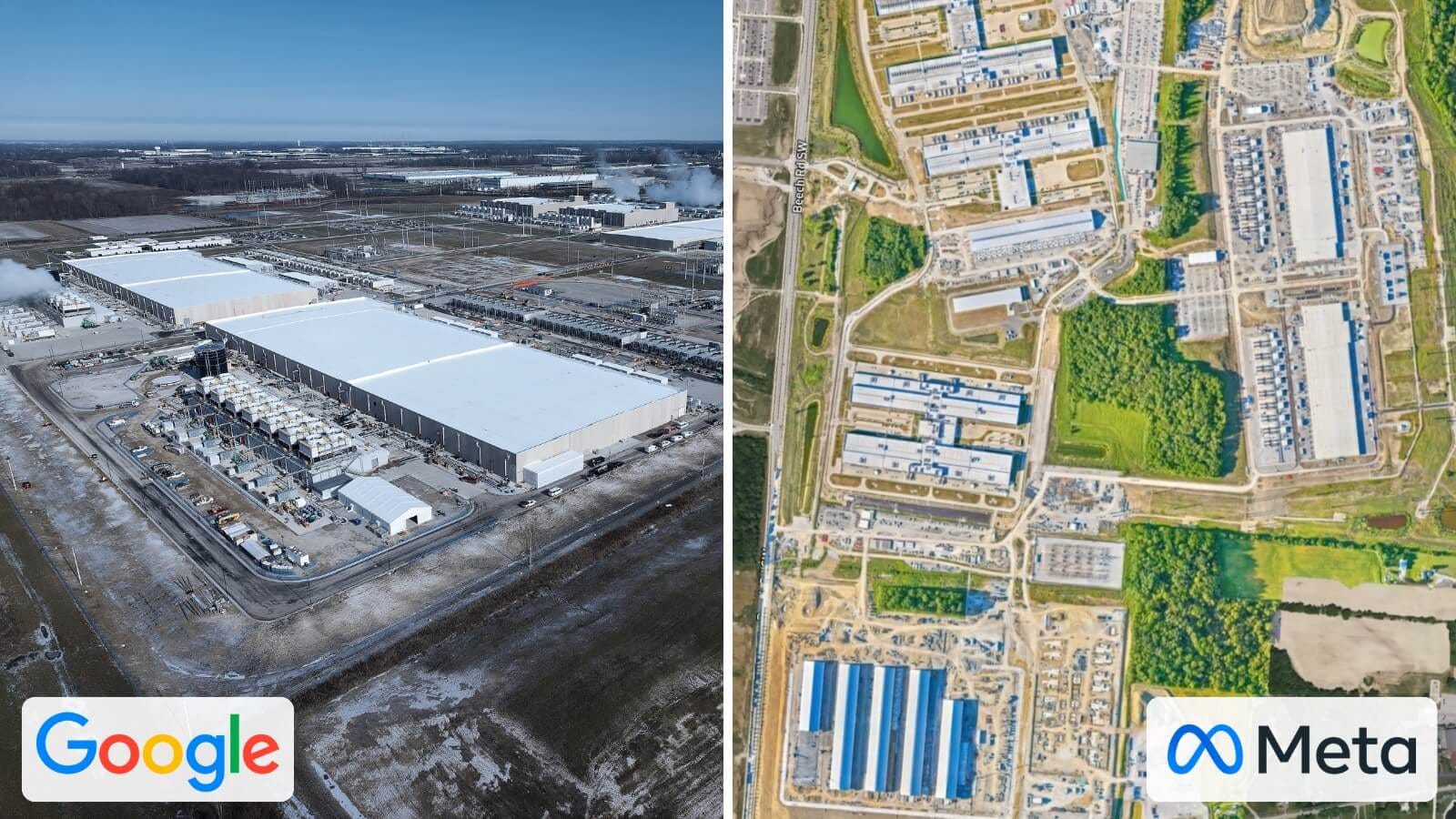
Source: Google and Meta Platforms.
What the tariff contributes is the generalization: a fully public instrument, litigated by the hyperscalers themselves, that converts bespoke terms into standard ones. A tariff has no customer to protect, so nothing is redacted.
The pattern across the four: the disclosure boundary follows the legal regime, not the size of the deal.
Start with the settled fact: across these four records, the world’s most sophisticated energy buyers are committing to pay for 75–85% of their contract capacity whether or not the load shows up — against standard-tariff norms of 50–60%, and against Amazon’s own disclosed history of 0–75%. In dollars, the minimum bill runs to nine figures a year: $336.3 million for a 1 GW customer under Indiana’s settled tariff, and $228.4 million for Oracle at full ramp in Michigan. And the percentage alone misleads, because what it multiplies differs in every record.
The floor exists because the utility finances lumpy infrastructure against a customer that might not arrive. As AEP Ohio’s regulatory vice president put it, investments like new 765 kV transmission lines are “lumpy” — completed all at once at the start of the load ramp, so the wires exist for Year 12’s load before Year 1’s revenue does. The economically important question in every one of these records is therefore what the customer pays when it under-uses.
I&M opened at a 90% minimum on contract capacity, against the existing 60%. Amazon called the number “unprecedented” — no other state commission, it told the regulator, had approved so one-sided a minimum — and disclosed its own book to prove it: AWS’s energy-strategy principal, Michael Fradette, testified that the company’s executed agreements run “from 0% up to 75% minimum demand obligations.” The settlement landed at 80% — of the greater of contract capacity or the customer’s highest billing demand in the past 11 months — on a 12-year minimum term.
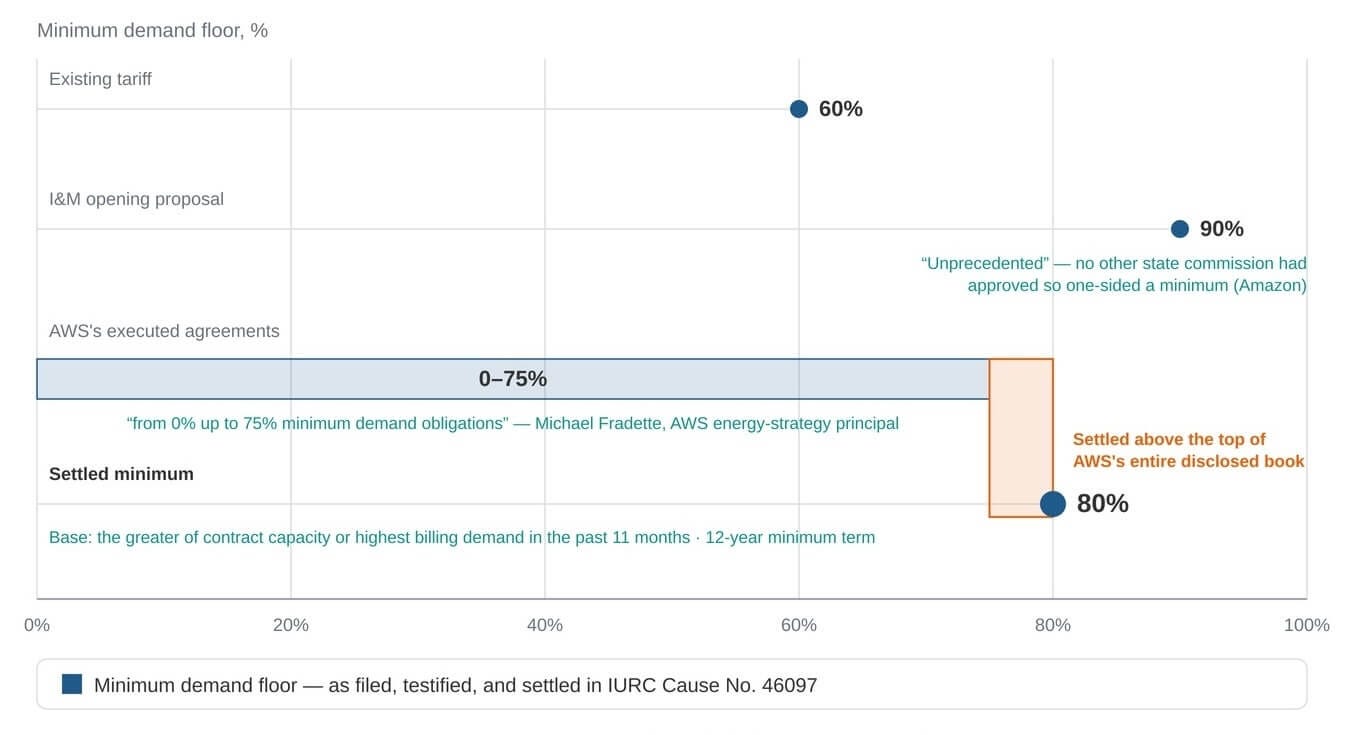
But the percentage tells less than the rate stack: the settlement also rebuilt the base the percentage multiplies, adding a $10.959 per kW embedded-capacity charge to produce an aggregate minimum demand charge of $35.034 per kW — an annual minimum roughly $76 million higher than under I&M’s original 90% proposal. For a 1 GW customer, the settled minimum is $336.3 million a year against an expected full bill of $492.6 million — I&M’s workpaper illustration at an 85% load factor.
The Indiana lesson generalizes: the floor percentage went down and the revenue went up. And what is not disclosed is any customer’s committed capacity — the executed agreement that would turn formula into bill is sealed. What the record does show is the forecast: at the 2.25 GW the consumer advocates attributed to New Carlisle, the settled tariff implies roughly $757 million a year in minimum charges.
A forecast is not a commitment. The floor exists because the utility cannot count on that demand until a customer is contractually bound to pay for it.
The DTE Primary Supply Agreement with Oracle applies the same 80% figure to a different base. When Oracle’s monthly on-peak billing demand falls to or below 80% of its committed-capacity ramp, DTE bills the floor on the lesser of that 80% or the maximum capacity DTE was actually capable of delivering that month — a genuine customer protection: Oracle does not pay the floor on capacity the utility could not have provided.
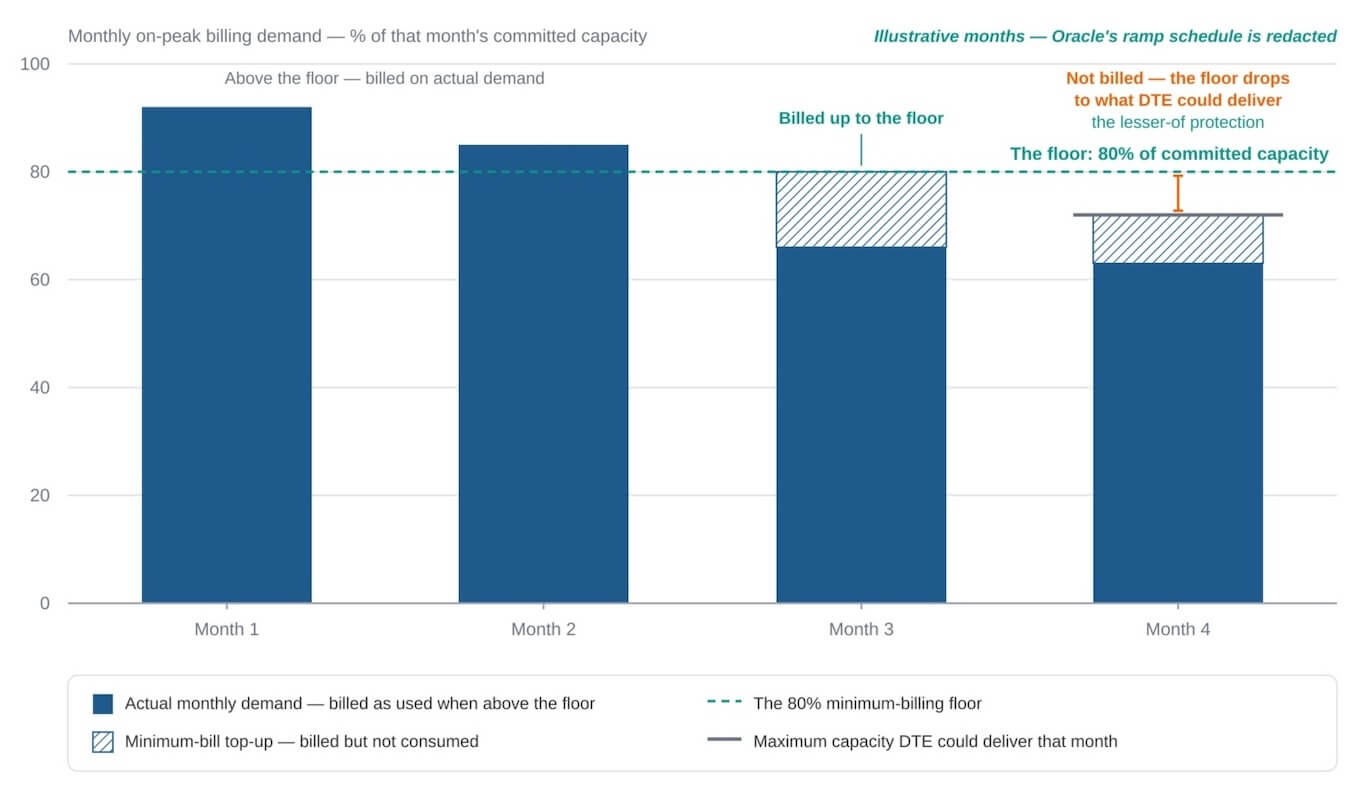
The Commission’s own disclosure shows how the deal compares with DTE’s standard terms: an 80% minimum billing demand, versus 50–60% in DTE’s general large-customer tariff. And the floor is inescapable by design — the load ramp’s timing can be delayed, but the maximum load cannot be reduced during the term.
Michigan’s disclosure stops at the next level of detail: the formula and the full-ramp dollars are public, while the ramp schedule itself — the base the floor multiplies in every month before full ramp — is redacted.
The Pine Island ESA’s minimum-bill clause is public in full: Google pays the greater of its actual on-peak demand or 75% of Contract Capacity, times the applicable demand charge, plus the customer charge, the tariff charges, and the Clean Energy Accelerator charges in full. Xcel’s petition states the commitment plainly: a minimum monthly bill of at least 75% of contracted demand for the full 15-year term. What the public record cannot do is turn that into dollars — the Contract Capacity, the ramp table, and every megawatt are blacked out.
The Hermantown agreement, filed one month earlier by Minnesota Power for another Alphabet subsidiary, runs the same structure through the utility’s standard Large Power Service schedule and sets the floor 5 percentage points higher: minimum billing demand is the greatest of a 10 MW absolute floor, measured demand, or 80% of Contract Capacity — with every ramp-schedule value redacted.
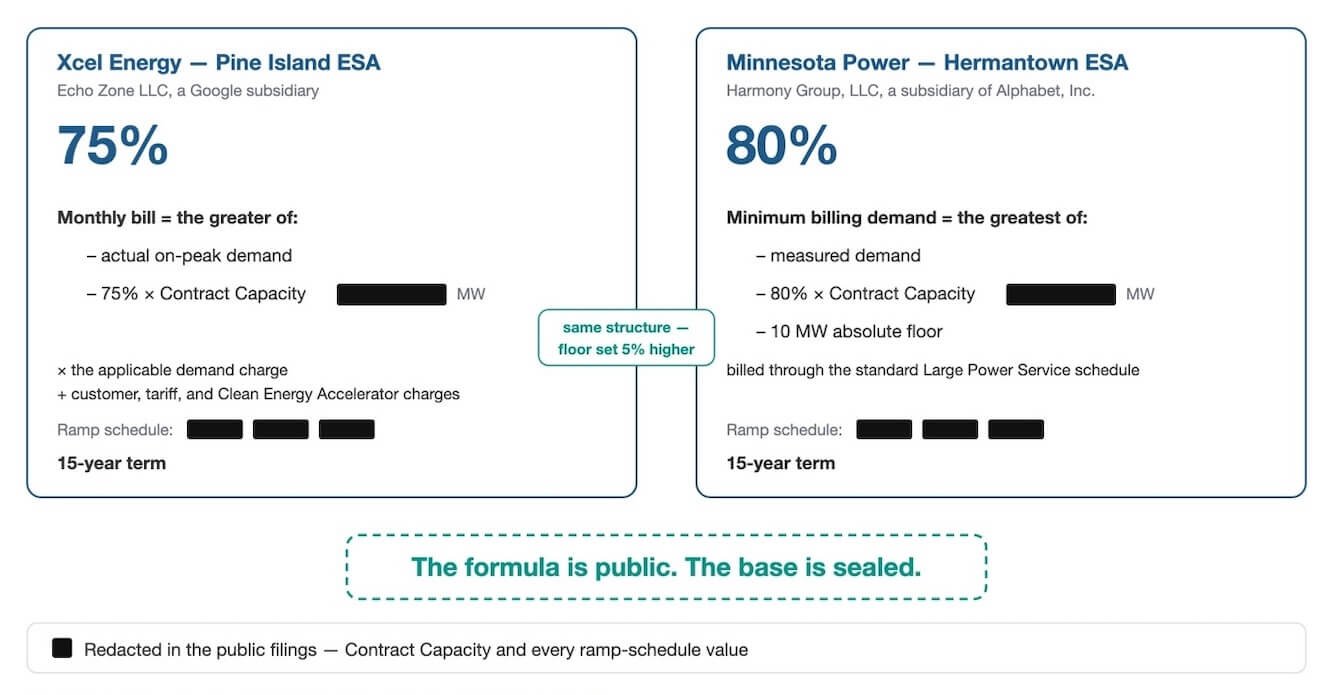
Procurement figures are the available proxy for the redacted load: Xcel is bringing 1.9 GW of new wind, solar, and storage onto the system to serve Pine Island, while Minnesota Power is procuring 700 MW for Hermantown. Those figures are not equivalent to campus demand, but they are the closest public indication of the scale concealed by the redactions.
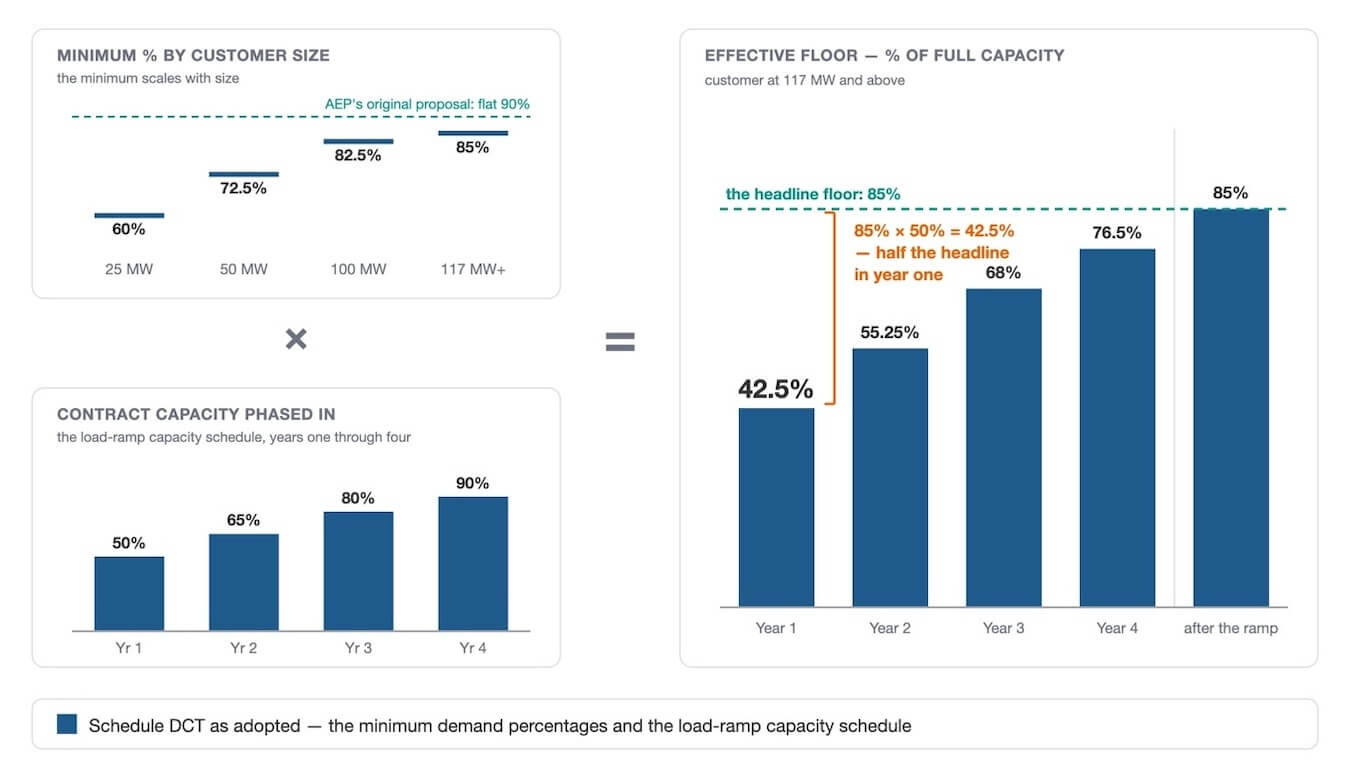
Schedule DCT splits the floor into two mechanisms that work together, and only the pair produces a bill:
Percentage: The minimum scales with size: 60% at 25 MW, 72.5% at 50 MW, 82.5% at 100 MW, and 85% at 117 MW and above — a deliberately more gradual ladder than AEP Ohio’s originally proposed flat 90%.
Base: The load-ramp capacity schedule phases contract capacity in at 50/65/80/90% across Years 1–4, so early-year billing runs against a fraction of the eventual campus.
To calculate the effective floor, multiply the “Percentage” and the “Base” percentages. For a hyperscaler (at 117 MW+), the ramp-year floor is 85% of the ramp value — an effective 42.5% to 76.5% of full capacity. A large customer’s headline 85% is far softer in Year 1 than it sounds.
Arguably the tariff’s most important effect was not revenue at all; it was demand quality. AEP Ohio filed against a speculative queue of more than 30 GW across some 90 sites that had not executed contracts. Once take-or-pay attached, the queue fell to 5.6 GW of signed ESAs under the tariff, with 13 GW across 36 sites paying for formal load studies. Take-or-pay is a demand filter, not just revenue protection.
The floor guarantees revenue while the customer stays; the exit fee prices the day the customer leaves.
Utilities build assets to last 30–40 years but sign customers to 12–15-year contracts, so the exit fee is meant to cover the gap if the customer leaves — and historically, that fee has most often been the number kept under seal.
Four examples are now public:
Michigan protects roughly 10 years of minimum charges ($2.26 billion at Oracle’s full ramp)
Minnesota’s Pine Island contract caps exposure at eight years of a 75% floor — but the tariff Minnesota approved two months later has no cap at all
Ohio pairs a 5-year lock with a 3-year fee
Indiana settled between, at one to five years of remaining minimums — more than $1 billion for a 1 GW customer
Every power-supply agreement whose formula is public stops short of sizing the exit fee against the full remaining term. All of the agreements are long enough to finance transmission against, which is the point.
The commercial meaning is blunt: walking away from a gigawatt-scale site is now a balance-sheet event measured in the hundreds of millions to billions of dollars. That disciplines speculative capacity reservations, prices the option of relocating a data center campus to another state, and makes term length, notice periods, and shed rights the levers worth negotiating.
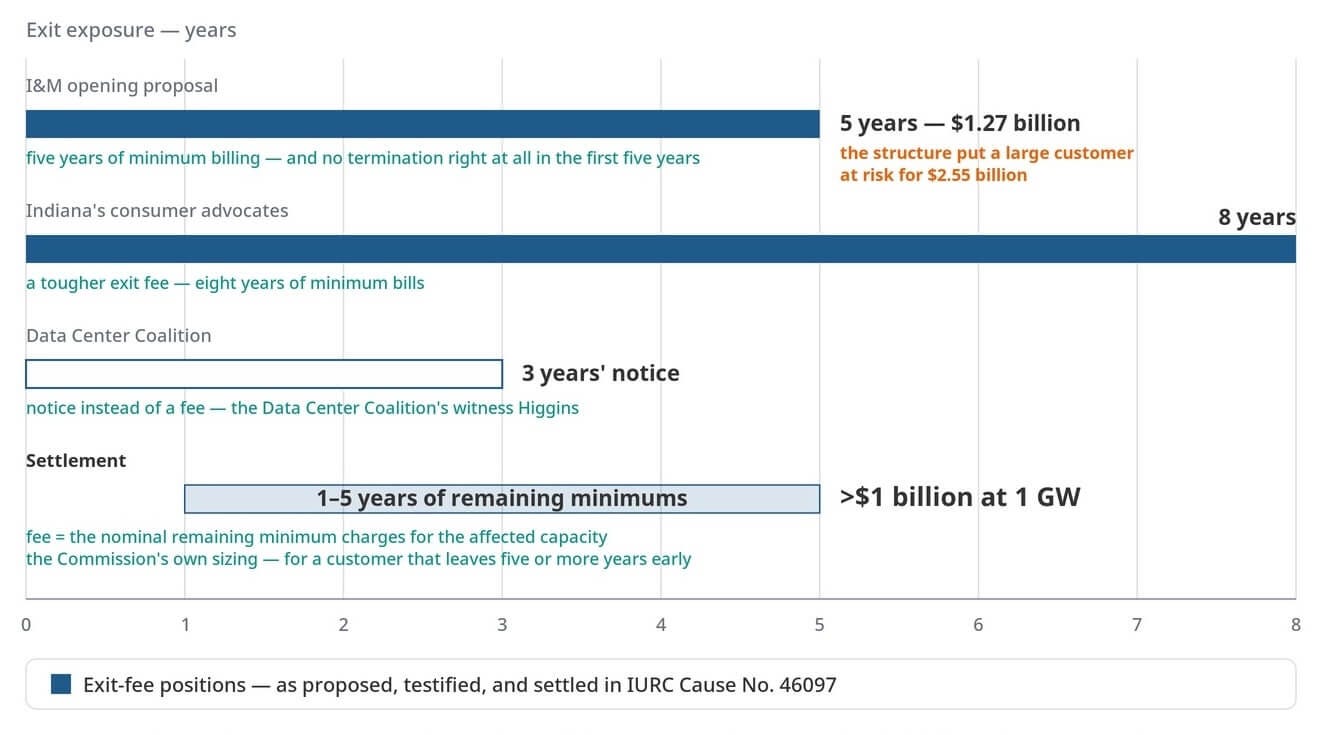
I&M’s opening proposal put the number in public: a termination fee of $1.27 billion — five years of minimum billing — with no termination right at all in the first five years, a structure that put a large customer at risk for $2.55 billion. Indiana’s consumer advocates wanted a tougher exit fee — eight years of minimum bills — while the Data Center Coalition’s witness Kevin Higgins (a utility-regulatory expert with Energy Strategies) argued for a three-year exit-notice framework instead.
The settlement produced an exit fee equal to the nominal remaining minimum charges for the affected capacity over a one-to-five-year period — in the Commission’s words, more than $1 billion for a 1 GW customer that leaves five or more years early.
The rules for reducing or ending the commitment are just as revealing as the fee itself: a customer may shed up to 20% of contract capacity after Year 5 on at least 3.5 years’ notice, and any deeper reduction — even one I&M agrees to — must go back to the Commission for approval before it takes effect.
The DTE-Oracle termination payment is not a flat amount; it follows a declining payment schedule over time. From full ramp (December 2027), it is effectively a cliff — the sum of every remaining monthly minimum through the tenth anniversary of ramp completion, starting at $2.26 billion and declining by one month’s charge each month. Then a plateau at $456.7 million — exactly two years of minimum charges — running from November 2035 through February 2043. Finally, a runway amortizing to zero at February 2045.
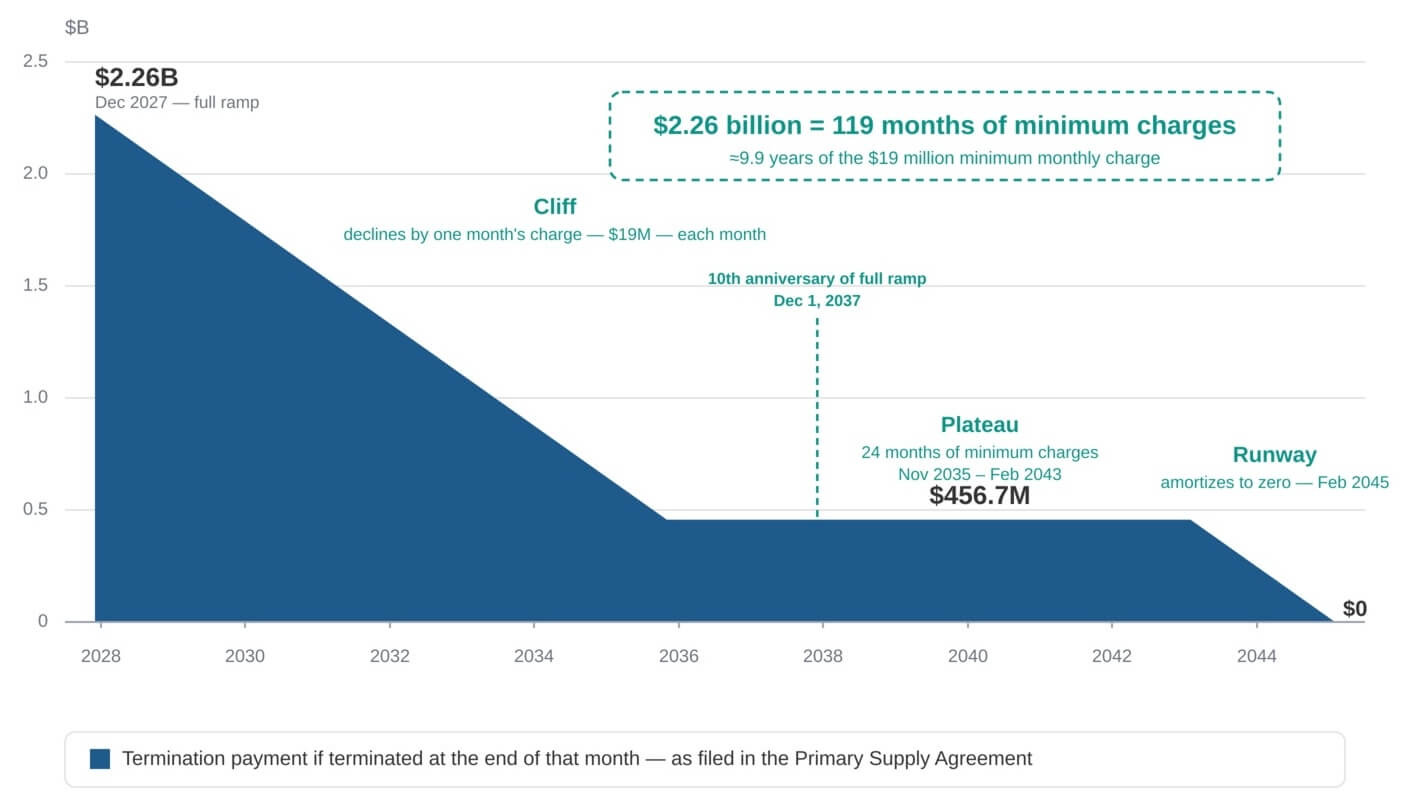
And if DTE is the defaulting party, no termination payment is owed by Oracle at all. For scale, DTE told the Commission the $2.26 billion termination payment far exceeds the roughly $500 million of estimated distribution and transmission upgrades.
A second exit liability sits beside the first: under the companion Energy Storage Agreement, DTE will build and own up to 1.38 GW of energy storage, bid it into the market, and charge Oracle the net cost of the fleet, not its gross capex. Oracle’s termination payment is the sum of the remaining subscription charges — roughly $3.9 billion, a figure the Commission’s order describes as an acceleration of remaining payments, not a stranded-cost estimate.
The DTE-Oracle exposure stopped being theoretical on March 27, 2026, when the Commission denied every rehearing petition, the motion to reopen, and the Attorney General’s request for a contested case — and, at the same meeting, approved the first 332 MW of the 1.38 GW fleet.
The Pine Island exit fee is a published formula: Contract Capacity, times the on-peak demand charge in effect at the termination notice, times 75%, times the lesser of the months remaining or eight years (i.e., 96 months) — plus any remaining clean-energy charges. Voluntary termination requires at least two years’ notice; an uncured customer breach triggers the same fee.
Even with every megawatt redacted, a negotiator learns the architecture: Xcel does not accelerate all 15 years; protection caps at eight; and the clean-energy obligation survives on top. Another mechanism prices partial retreat — the same formula run on the capacity being shed (reduced), priced at the demand charge in effect at the reduction notice, again on at least two years’ notice.
Hermantown draws the line differently: Minnesota Power’s termination mechanics are public — the window opens in Year 3 of the 15-year term, requires four years’ notice, and the fee is the utility’s “sole and exclusive remedy,” with none owed after the initial term — but the formula itself is blacked out.
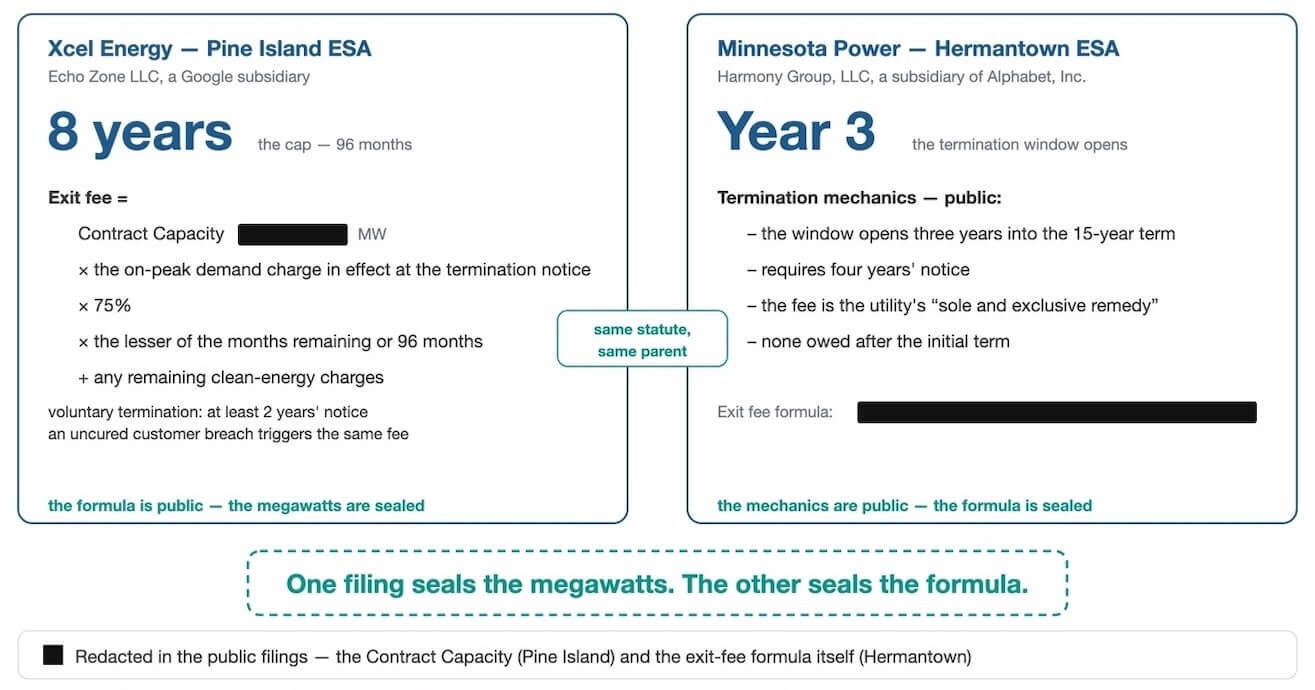
Same statute, same corporate parent, a different disclosure boundary.
Notably, a tariff of general applicability came out stricter than the bespoke deal before it. Google’s Pine Island contract was filed on April 15, 2026, with a 75% floor and an exit fee capped at eight years. On June 12, the same Commission approved Xcel’s general tariff at 80% with no cap at all, and stated that those percentages are minimums, with the terms of individual agreements subject to Commission review and approval. The contract is still pending, with comments closing September 28.
Under Schedule DCT, a customer may leave only after Year 5 following the load-ramp period, by paying three years of minimum charges — so a customer with a three-year ramp is locked in through Year 8.
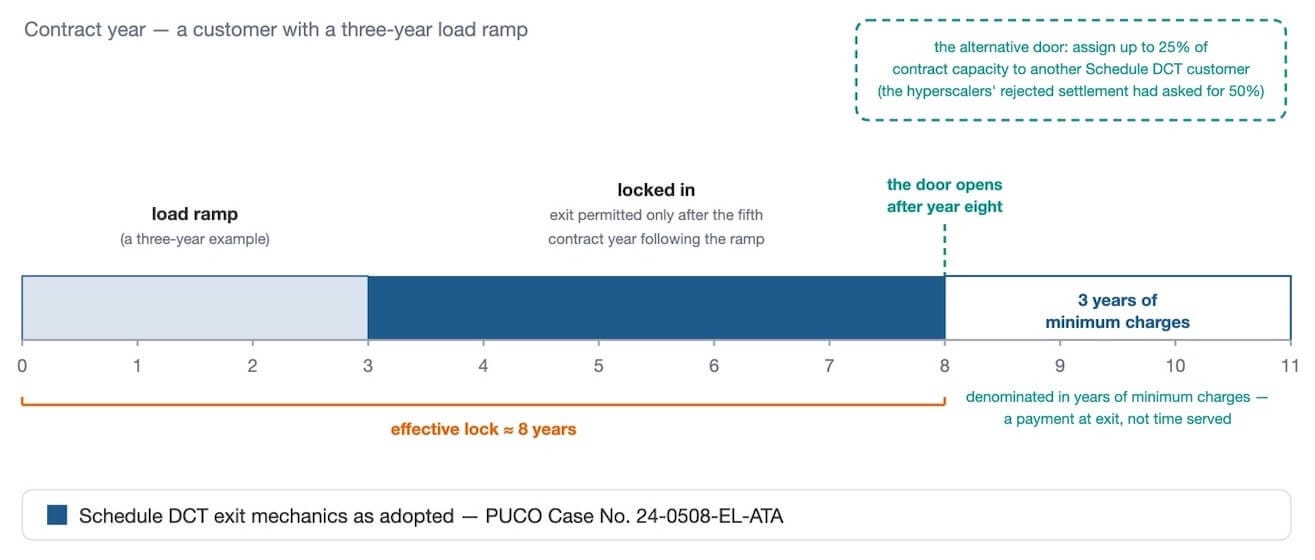
The alternative is assignment: up to 25% of contract capacity may be transferred to another Schedule DCT customer (the hyperscalers’ rejected settlement had asked for 50%, with no cost-responsibility qualifications).
The magnitude was quantified early, in an August 2024 critique of the original proposal: an exit fee of more than $120 million for a 500 MW data center, $4 billion or more across 5 GW. And one pattern is too clear to ignore: the framework Higgins lost in Indiana — a minimum no greater than 70%, a three-year exit notice, a 10-year maximum term — is almost precisely the design Ohio adopted a year later. What one state rejects, the state next door may standardize.
Strip away the defined terms, and every collateral section in these records asks one question: who stands behind a 15-year, billion-dollar promise to pay?
The answers come down to two basic options. Either an exceptionally strong parent — investment-grade or holding billions in cash — signs on for the term, or the customer posts security measured in months to years of bills: hundreds of millions of dollars at gigawatt scale.
That makes the critical negotiation a question of how much corporate balance-sheet capacity the power commitment consumes — and it is why Ohio’s decision to let a co-signing financial sponsor satisfy the test matters so much to anyone trying to project-finance a data center through an SPV.
The settled tariff requires collateral equal to 24 times the maximum expected monthly non-fuel bill, recalculated annually.
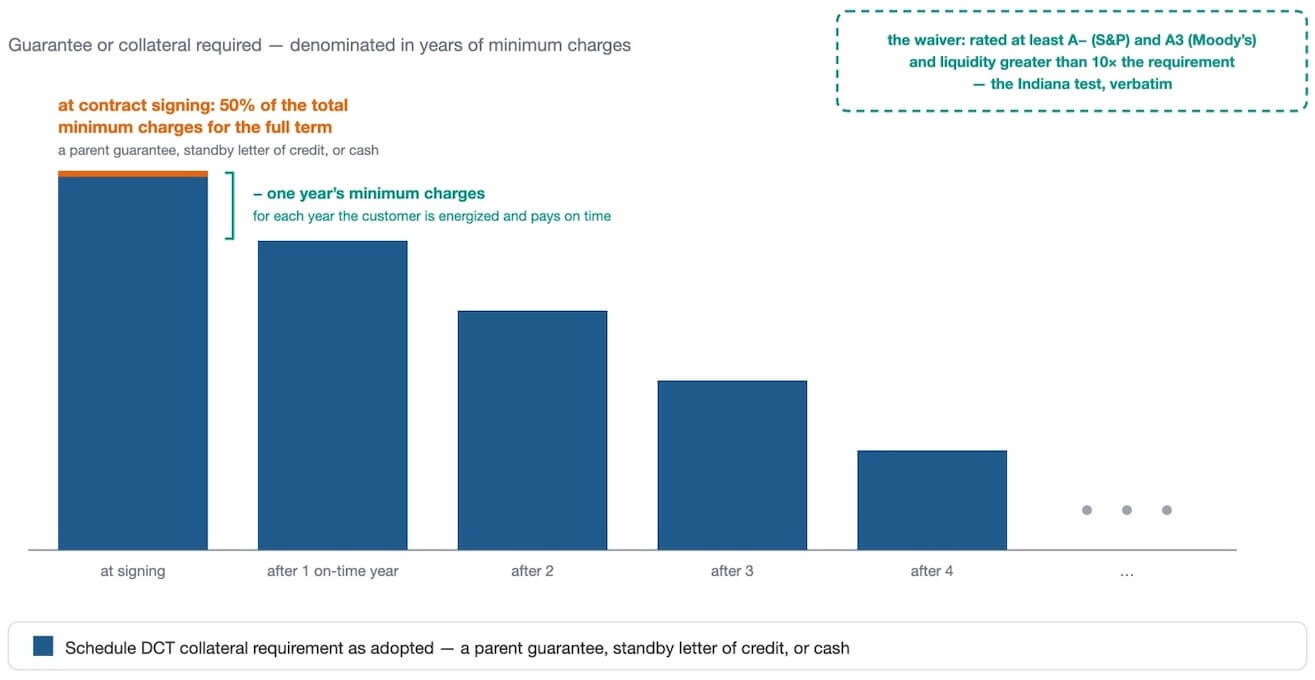
Full exemption requires a credit rating of at least A- from S&P and A3 from Moody’s, plus liquidity greater than 10 times the requirement. Amazon clears that bar comfortably, at AA from S&P and A1 from Moody’s.
An unrated customer that meets the liquidity test is exempt from half the requirement, up to $250 million — a cap on the exemption, not on the collateral.
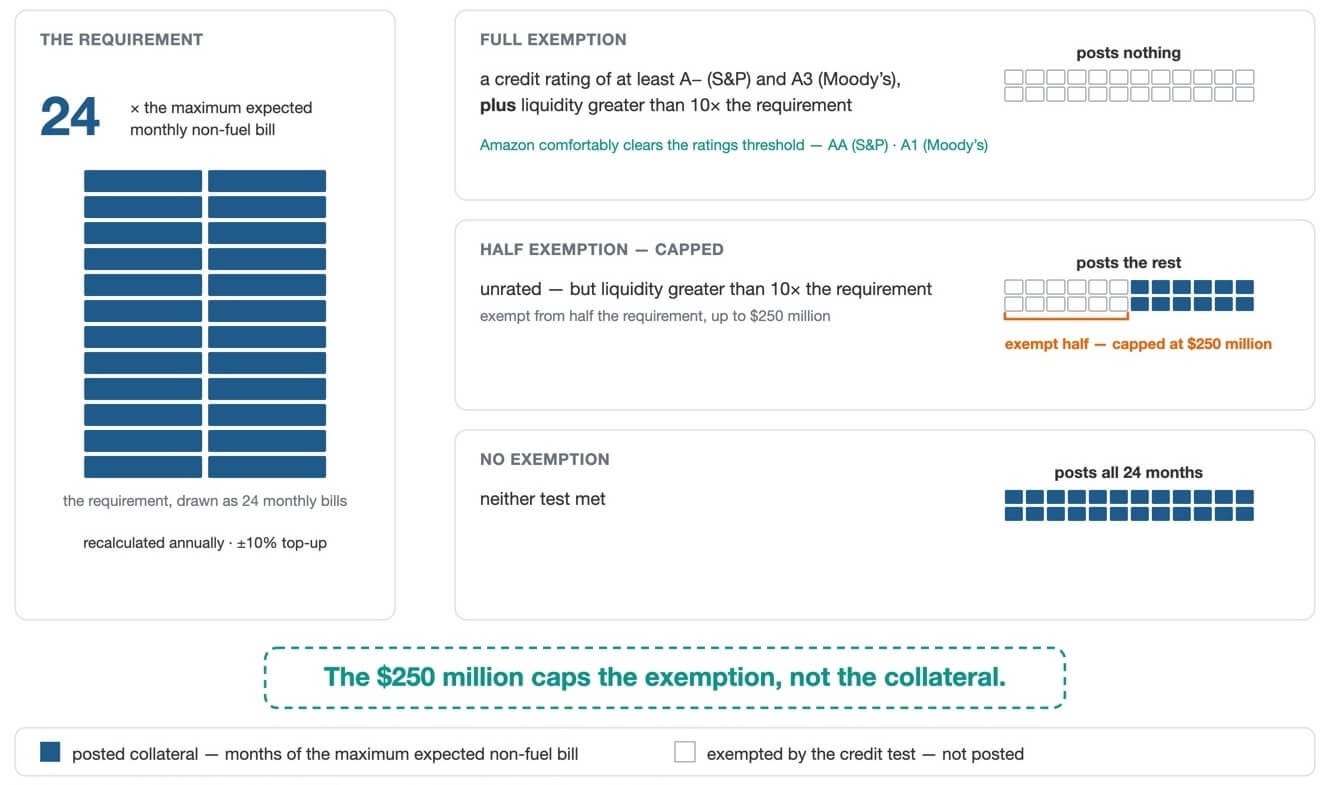
The origin of that test is the most telling disclosure of all: the Data Center Coalition’s own witness, Higgins, proposed the exemption standard and the acceptable forms — a parent guaranty, a standby letter of credit, or cash. The settlement adopted his test and tightened his “or” into “and.” The industry wrote the credit bar it now clears. What any specific customer actually posts sits behind the same protective orders that seal the AWS agreement.
Oracle Corporation, rated BBB- by S&P and Baa2 by Moody’s, guarantees its subsidiary’s payment obligations, supplemented by letters of credit on a schedule the public filing redacts. The downgrade provision is blacked out entirely — a trigger plainly exists, but its terms are not visible. Failing to maintain the collateral is itself an event of default.
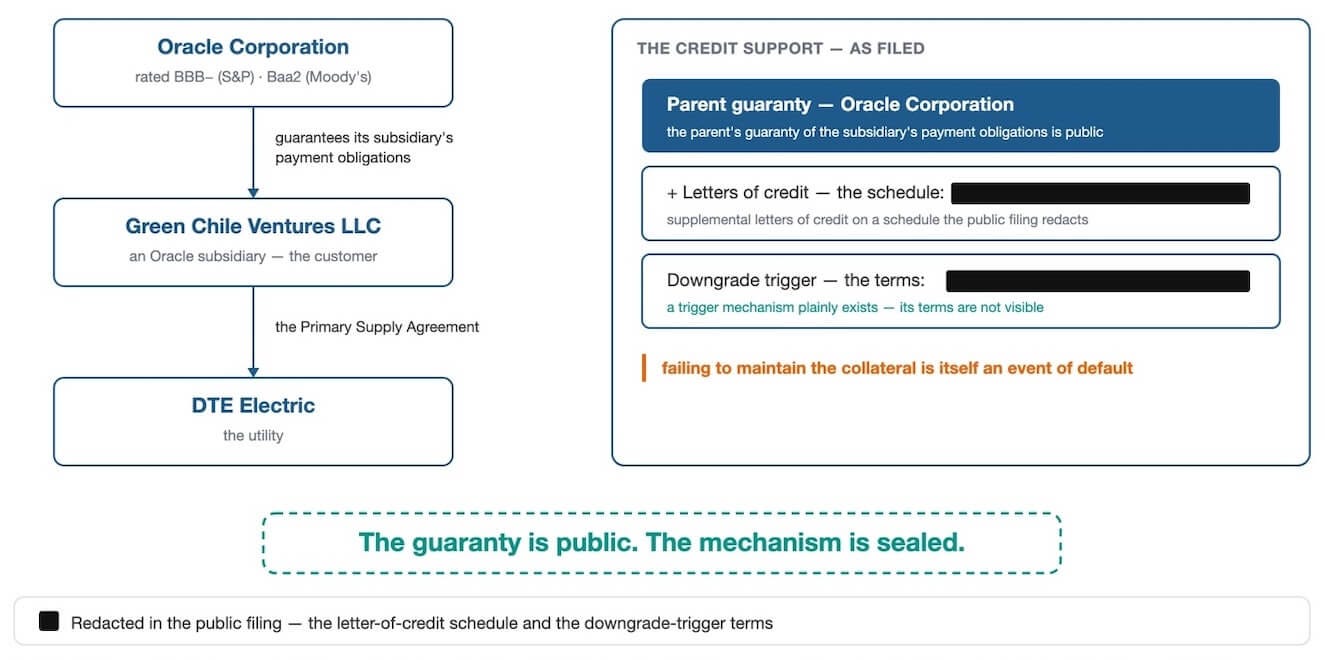
On July 9, 2026, S&P cut Oracle’s credit rating from BBB to BBB-, still investment grade. DTE confirmed on its Q2 2026 earnings call that the Oracle contract carries additional collateral requirements at downgrade triggers, specifics withheld at Oracle’s request.
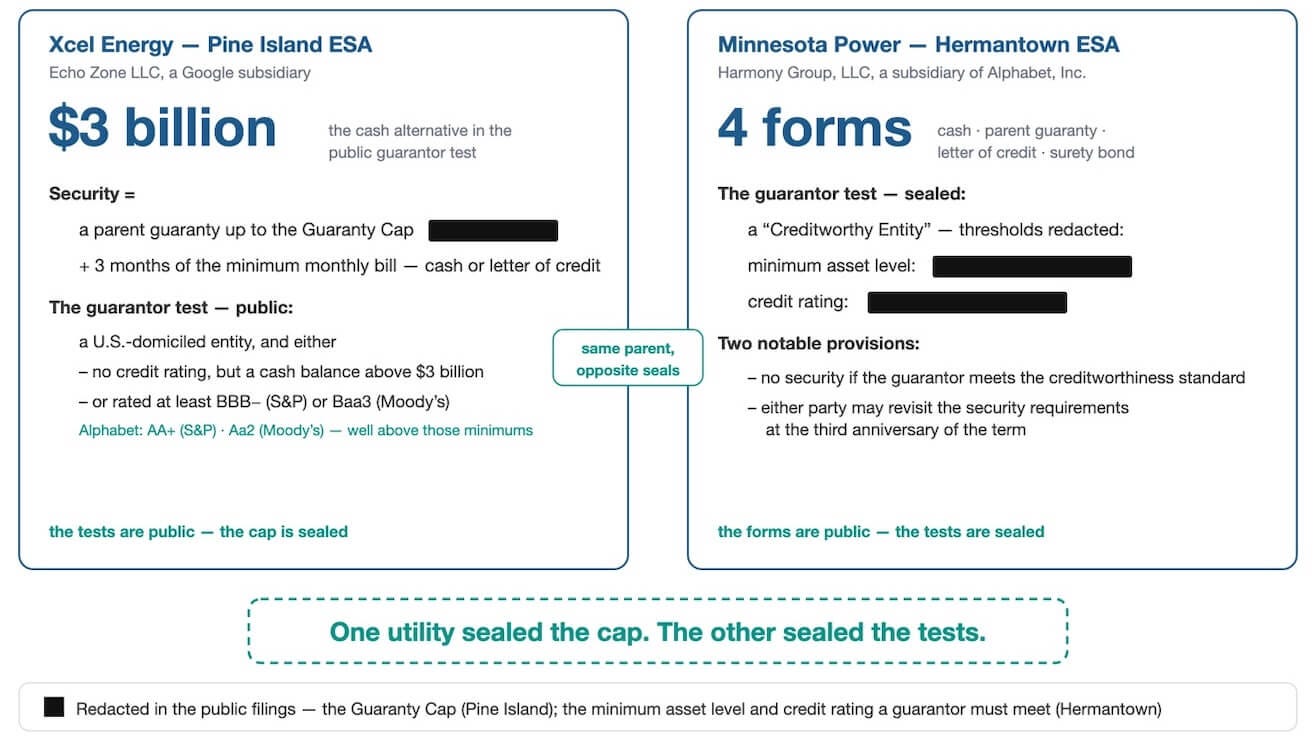
Google’s Pine Island obligations carry a parent guaranty up to a cap the filing redacts, plus cash or a letter of credit equal to three months of the minimum monthly bill. The guarantor test, by contrast, is fully public: a U.S.-domiciled entity with either no credit rating but a cash balance above $3 billion, or a rating of at least BBB- from S&P or Baa3 from Moody’s. Alphabet Inc., Google’s parent company, is rated AA+ by S&P and Aa2 by Moody’s, well above those minimums. On a defined downgrade, insolvency, or guarantor default, Xcel may demand cash, a letter of credit, or other security up to its remaining credit exposure, capped at the guaranty cap.
Hermantown follows the same pattern but allows more forms of security — cash, a parent guaranty, a letter of credit, or a surety bond. The disclosure is the reverse of Xcel’s: Xcel made its guarantor standards public, while Minnesota Power redacted them, including the minimum asset level and credit rating a parent must meet to qualify. Two other provisions are notable: Google does not have to post security if its guarantor meets the creditworthiness standard, and either party may revisit the security requirements on the third anniversary of the term.
Schedule DCT requires, at contract signing, a guaranty or collateral equal to 50% of the total minimum charges for the full term — a parent guaranty, standby letter of credit, or cash — declining by one year’s minimum charges for each year the customer is energized and pays on time. The waiver is the Indiana test verbatim, with the same Higgins provenance behind both.
The Commission’s single substantive modification opened the project-finance door: the requirement may be met by the customer’s financial sponsor, so long as the sponsor co-signs the contract. And the actuarial basis for leniency is stated with unusual candor: AEP Ohio is unaware of any customer of 25 MW or more that declared bankruptcy in the last 10 years.
One architecture, three sizing conventions — months of bills (Indiana, Xcel), a fraction of the total commitment (Ohio, Minnesota Power), a negotiated schedule (DTE) — converging, in Indiana and Ohio, on a single waiver test written by the industry’s own witness.
The collateral is not the last backstop, and Michigan’s order says who eats a shortfall. If the Oracle guaranty and letters of credit fall short of DTE’s remaining exposure, the loss stays with the utility and its shareholders: the Commission barred recovery from ratepayers, ordered quarterly reports on Oracle’s load, credit, and financial condition, and reserved the authority to reopen the case if serving the campus begins costing other customers.
Distinguish two things the 2025 and 2026 records changed. Public discussion of ESA economics — testimony, briefs, commission findings, dollar totals — is now routine. The contract text itself mostly is not — what stays sealed almost everywhere are the terms that made these agreements sensitive in the first place: energy pricing and discounts, guaranty caps, letter-of-credit schedules, and the ramp calendars that phase load in month by month.
But the direction of travel is unmistakable: the risk architecture is migrating out of bespoke confidential contracts and into public tariffs, and three of these four states are already there.
Ohio’s has been live since July 2025 and is under appeal at the state supreme court. Minnesota’s arrived on June 12, 2026, when the Commission created a Very Large Customer class at 100 MW and above and approved Xcel’s tariffs — followed a month later by a compliance filing carrying the final tariffs and a public form ESA, a template of the contract itself. Minnesota Power withdrew its own large-power proposal in May and refiled in July under the tighter architecture: a Very Large Power class, an 80% minimum bill, a 15-year minimum term, multi-year termination notice, and exit fees. Michigan ordered DTE to generalize the Oracle deal into a standard tariff, and the proposal is already on file.
That end state is no longer a forecast. Minimum demand, term, credit support, exit protection, and stranded-cost allocation are becoming observable and comparable across utilities through public tariffs — while the ESAs that remain confidential shrink to what the tariffs still cannot show: whose load, how big, arriving when, and where.
Measured AI provides institutional-grade analysis of the physical infrastructure powering AI data centers. For access to our full research library, regulatory intelligence, and weekly briefings, visit MeasuredAI.com.
No posts
Comments
Nothing yet. Say the first thing.
Sign in to join the conversation.