
On November 1, 2024, the Federal Energy Regulatory Commission (FERC) spent the day in a technical conference it had convened on one question: how large loads — AI data centers above all — should be allowed to plug directly into the power plants beside them. The same day, it rejected, 2–1, the amended interconnection agreement that would have let Amazon’s data center campus in Salem Township, Pennsylvania, draw up to 480 MW directly from the Susquehanna nuclear plant next door, and the dissenter was FERC’s own chairman, Willie Phillips, who called the order “a step backward for both electric reliability and national security.”
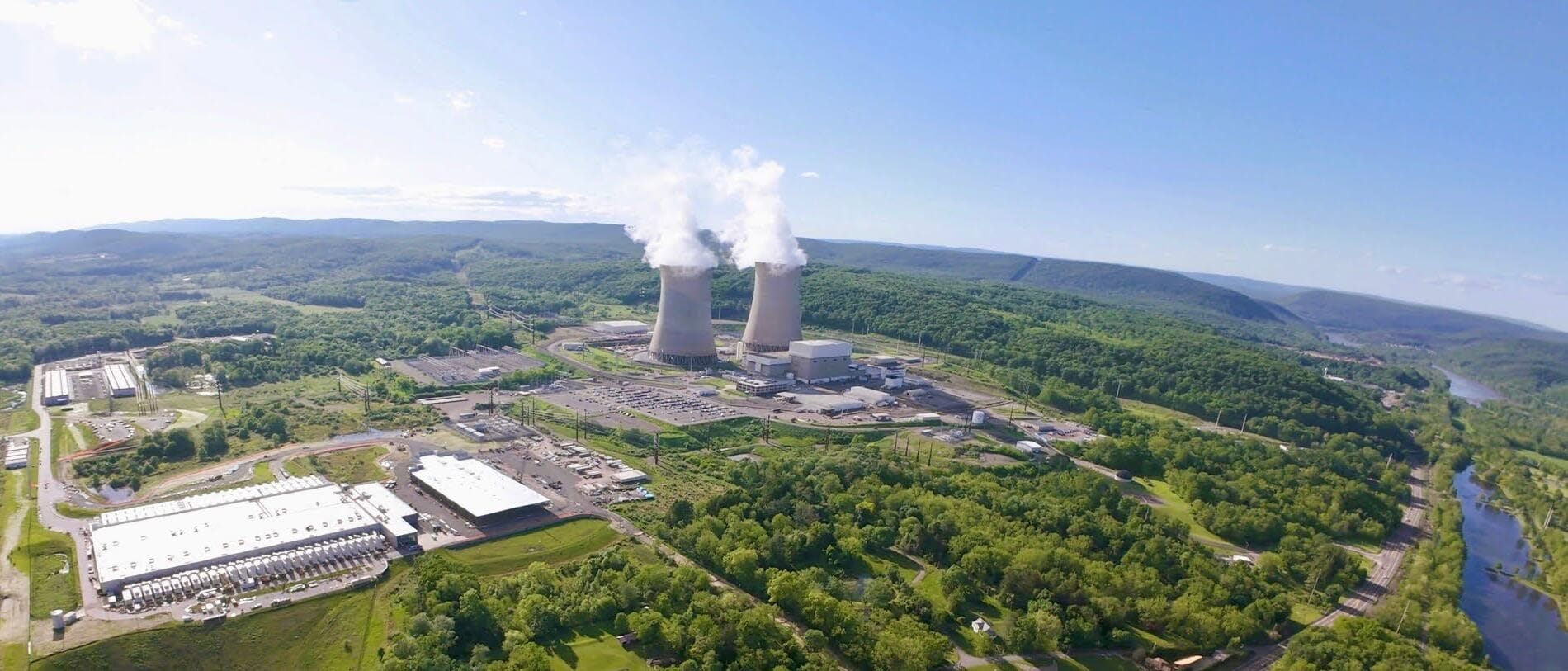
Source: Talen Energy.
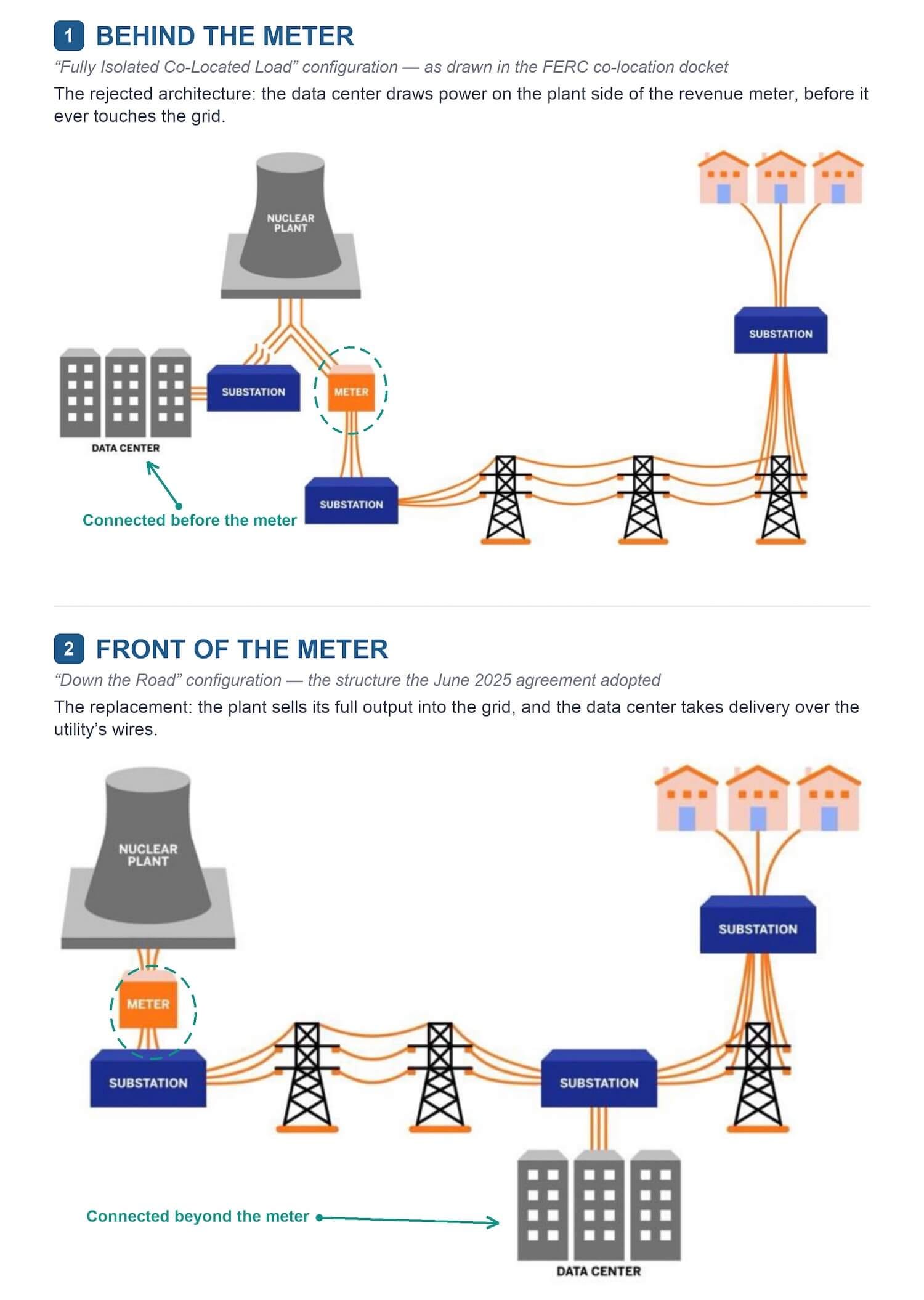
The rejection did not stop the campus. It re-architected it. Seven months later, on June 11, 2025, Talen Energy — the plant’s majority owner and the campus’s original developer — announced that the behind-the-meter arrangement was gone.
Instead, Susquehanna would sell its output into the PJM grid, while Talen would serve Amazon as a retail supplier over the wires of PPL, the local electric utility. The agreement would run at a full contracted capacity of 1.92 GW through 2042 — twice the 960 MW that the co-location design had ultimately aimed for — and Talen estimated it could be worth about $18 billion over the life of the contract.
All of it sits on one piece of ground: roughly 1,200 acres beside the Susquehanna River in Salem Township, Luzerne County, in northeastern Pennsylvania — PPL’s territory, inside the PJM grid.
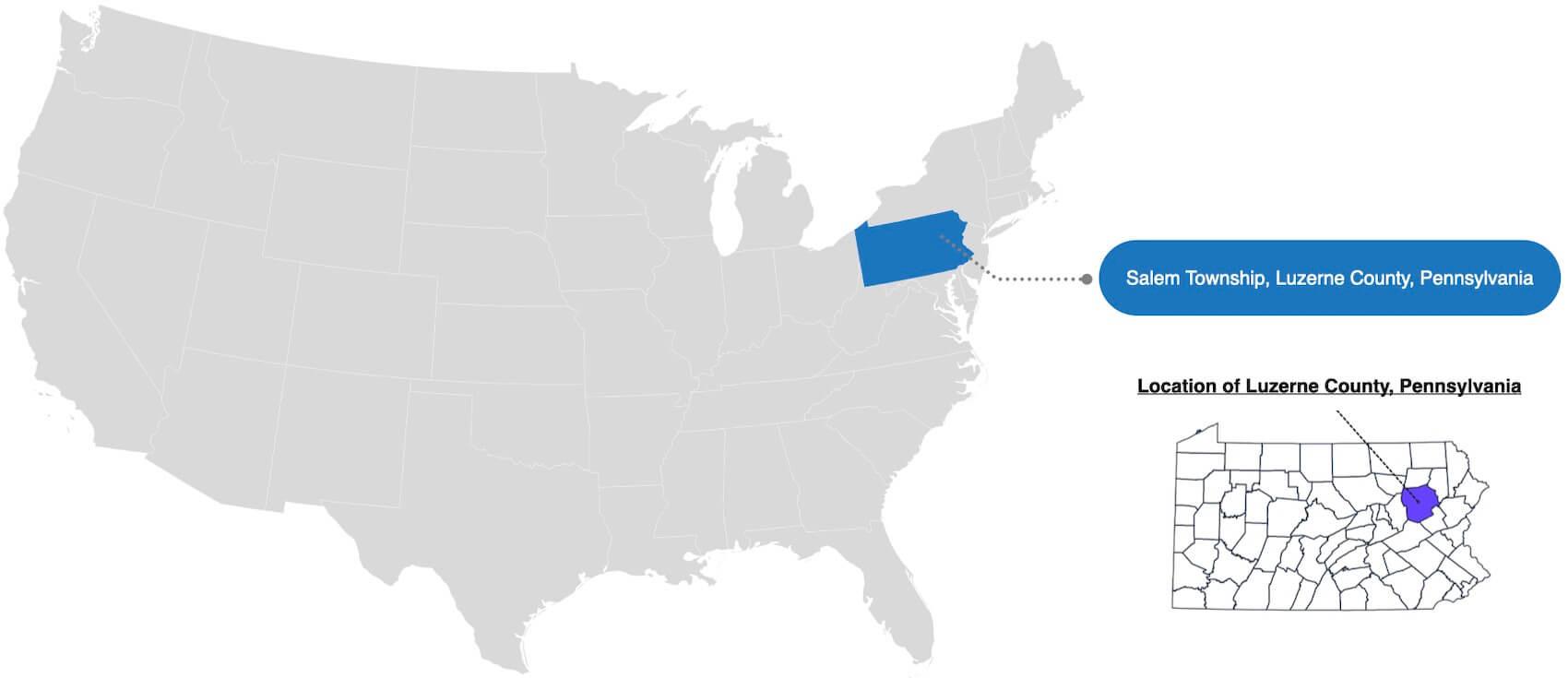
Susquehanna both defined the co-location era and became its clearest counterexample. This is the campus that made nuclear-adjacent AI data centers a national regulatory fight — the test case that FERC’s vocabulary, PJM’s large-load policy, and Pennsylvania’s tariff framework were all built in response to. Then it abandoned co-location and got bigger by doing it.
This primer traces the Susquehanna campus from Talen’s original nuclear co-location strategy and $650 million sale to Amazon through Amazon’s data center build-out, the FERC fight, the 1.92 GW power deal that followed, the resulting grid and tariff consequences, and the local land-use and environmental constraints shaping the campus and its surroundings.
Before Susquehanna was Amazon’s campus, it was a power company’s product. Talen did not attract a data center to its nuclear plant; it built one — assembled the land, erected the first shell, ran a crypto mine as the anchor tenant, and marketed the package to hyperscalers as the fastest route to nuclear-scale power. The AI demand wave was the exit, and Talen took it.
The assembly started early, and the decision earlier still. Talen launched the Cumulus venture in October 2019 and began work in the spring of 2020 — three and a half years of building, begun with no buyer under contract. Susquehanna Data, LLC — a Talen vehicle — had begun obtaining the necessary permits by mid-2021. In March 2022, Cumulus Data, LLC — the Talen subsidiary that would own the buildings — mortgaged 13 parcels to Orion Energy Partners, an infrastructure investment firm, to fund the build.
Two months later, Talen itself filed for bankruptcy in a cash crunch brought on by surging gas prices — and kept assembling the campus through Chapter 11, repaying its first-lien debt in full and converting its unsecured notes into equity before emerging in May 2023 owned by its former creditors.
The anchor tenant came first: Nautilus Cryptomine, a bitcoin-mining joint venture with TeraWulf rated at up to 200 MW gross, with 150 MW submetered from March 2023. The first data center shell went up beside it — 48 MW of what Talen called “processing load,” expandable to 65 MW with more cooling.
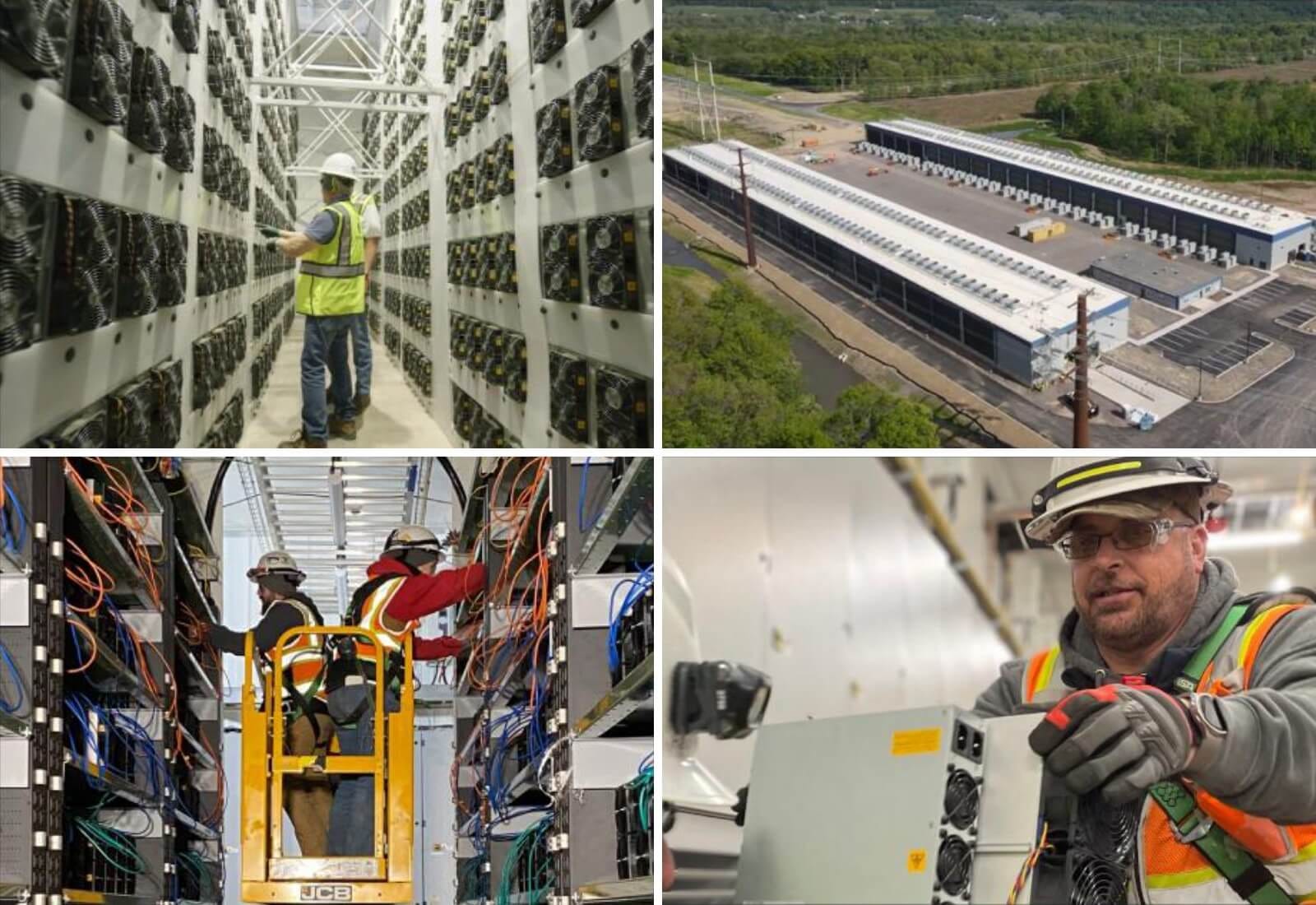
Source: TeraWulf.
In 2023, Talen positioned the site as a 1,200-acre campus directly connected to the Susquehanna nuclear plant, with four substations providing up to 956 MW of potential redundant capacity, a fiber network with entries from three directions, and the first data center ready for fit-out.
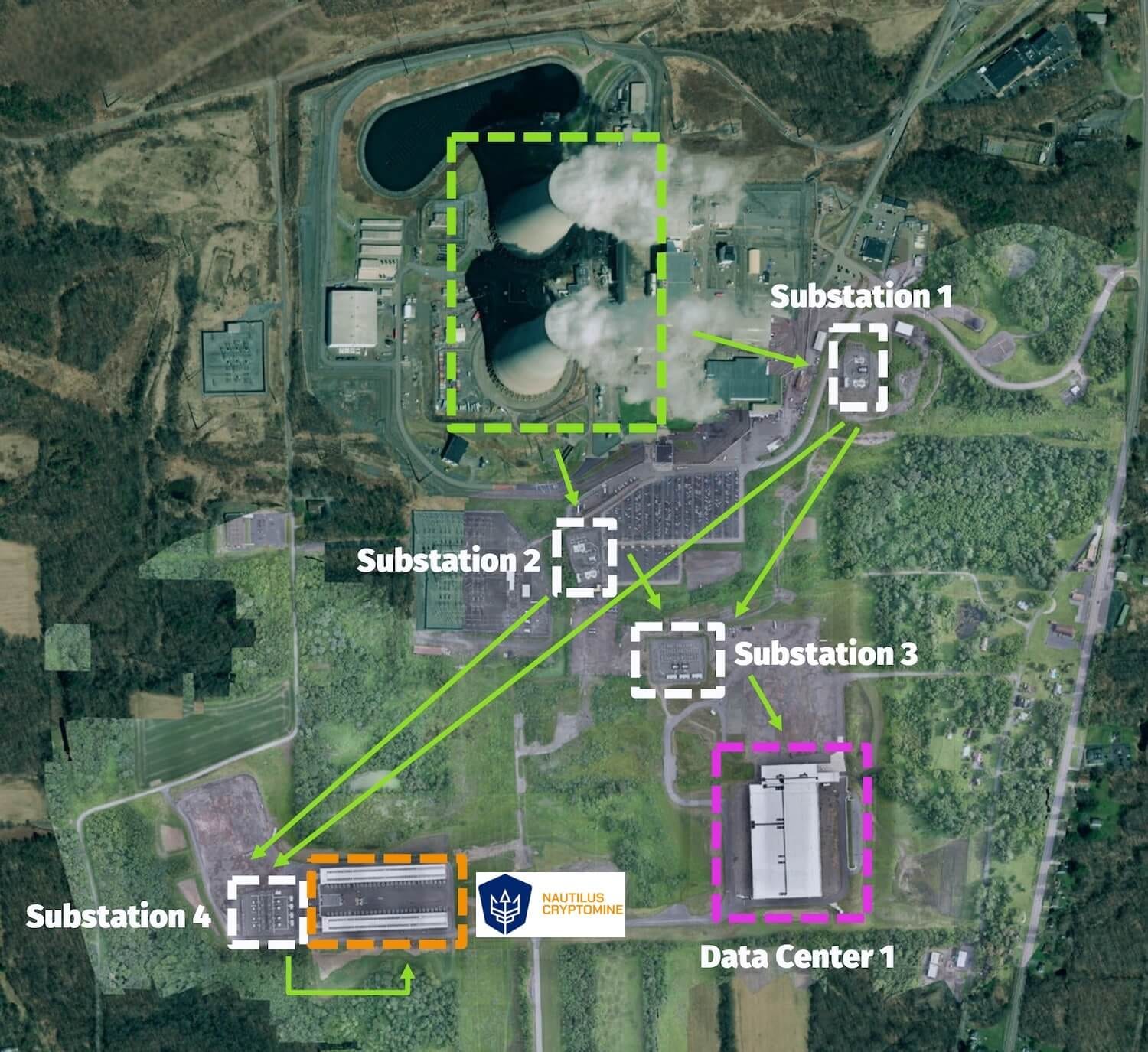
Source: Talen Energy.
Substations #1 and #2 draw from separate nuclear reactors — the redundancy the whole design rested on — while #3 and #4 serve the data centers and the former Nautilus Cryptomine.
Talen announced the sale on March 4, 2024: substantially all the assets of the Cumulus Data campus sold to Amazon Data Services, Inc. for $650 million — $350 million at closing, $300 million held in escrow against zoning milestones. Of the $650 million purchase price, the agreement allocated just $90 million to the real property — land, buildings, and easements — and the remaining $560 million to contracts, government permits, and equipment. The returns were significant for Talen: a $324 million gain on sale and a greater-than-2.5x multiple of invested capital by management’s account. That price came out of an auction among four of the world’s largest companies by market value, with Amazon the winner.
The sale had in fact closed on March 1, 2024, with the deeds recorded on March 13. Nautilus Cryptomine initially remained on the property under its existing ground lease. Mining ceased on September 30, 2024, and the following month Talen bought TeraWulf’s 25% interest in the venture for $85 million in cash. The transaction gave Talen full ownership of Nautilus, while TeraWulf received the mining fleet as the in-kind portion of the consideration. Talen stopped using the building in June 2025 under the revised power arrangement, and the ground lease was terminated that September, bringing the site’s crypto-mining era to an end.
One distinction matters throughout what follows: Amazon Data Services, Inc. owns and permits the campus, while Amazon Energy, LLC is the wholesale power buyer at FERC.
Both entities point back to the same asset — the ground beside the plant — and that ground had been readied for gigawatt-scale loads long before Amazon arrived.
What Amazon really bought was a site next to a nuclear plant. That location matters in two ways: the campus sits on land once intended for a nuclear expansion that was never built, and the purchase agreement leaves open the possibility of another reactor being built there in the future.
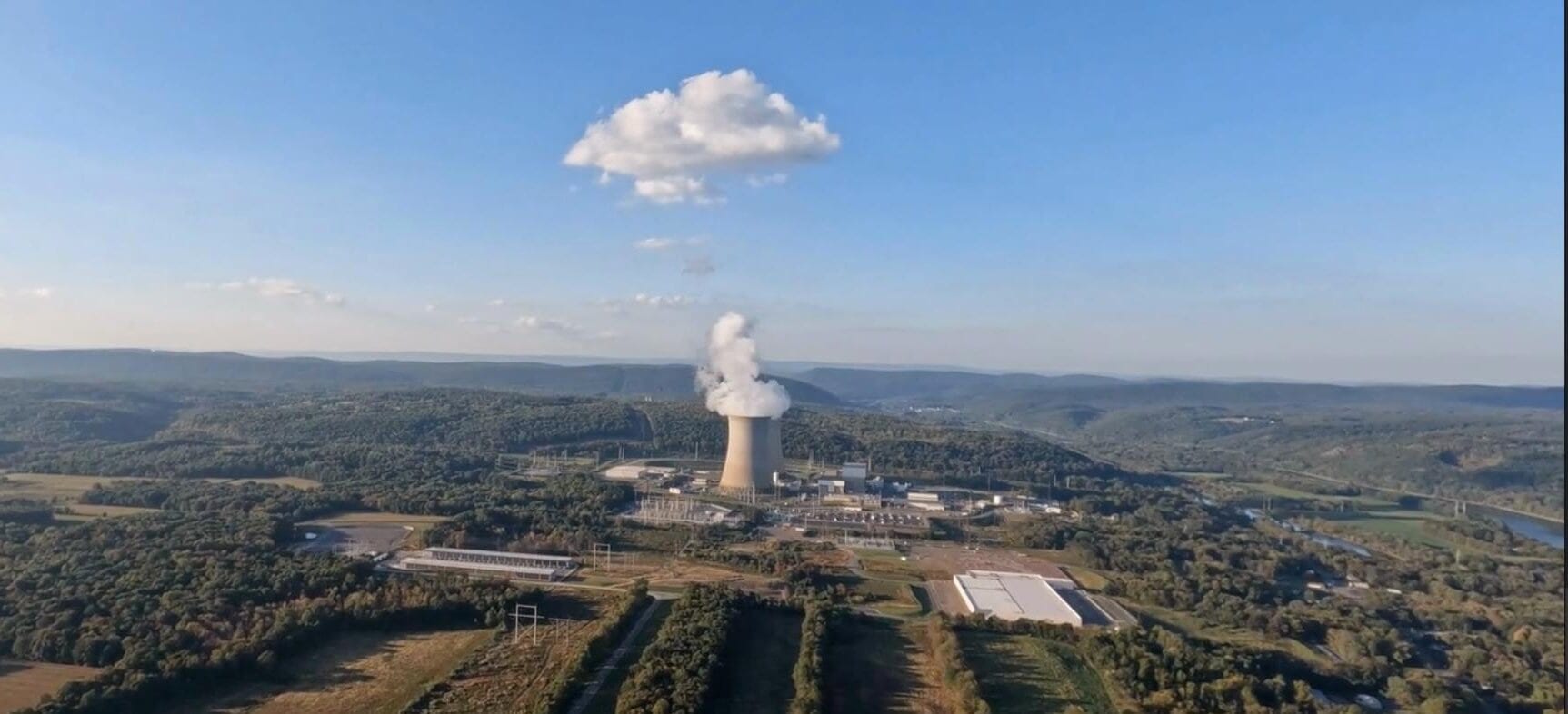
Source: Talen Energy.
Susquehanna Steam Electric Station is two separately operable nuclear units of roughly 1.25 GW each — 2.494 GW of summer-rated capacity between them, commissioned in 1982 and 1984 and licensed to 2042 and 2044. Talen holds 90%; Allegheny Electric Cooperative holds the other 10%. Two units, not one machine: that is the fact governing everything downstream, from the megawatt ladder at FERC to the contracted capacity Talen supplies today.
The site’s industrial zoning dates back to Bell Bend, a nuclear project that was never built. In 2011, Salem Township created the I-3 Special Industrial District for PPL’s proposed 1.6 GW nuclear plant on 2,055 adjoining acres. Nuclear Regulatory Commission staff recommended issuing the license, but the Army Corps withdrew Bell Bend’s wetlands permit application in February 2016 over problems with its alternatives analysis, and Talen withdrew the reactor application that August.
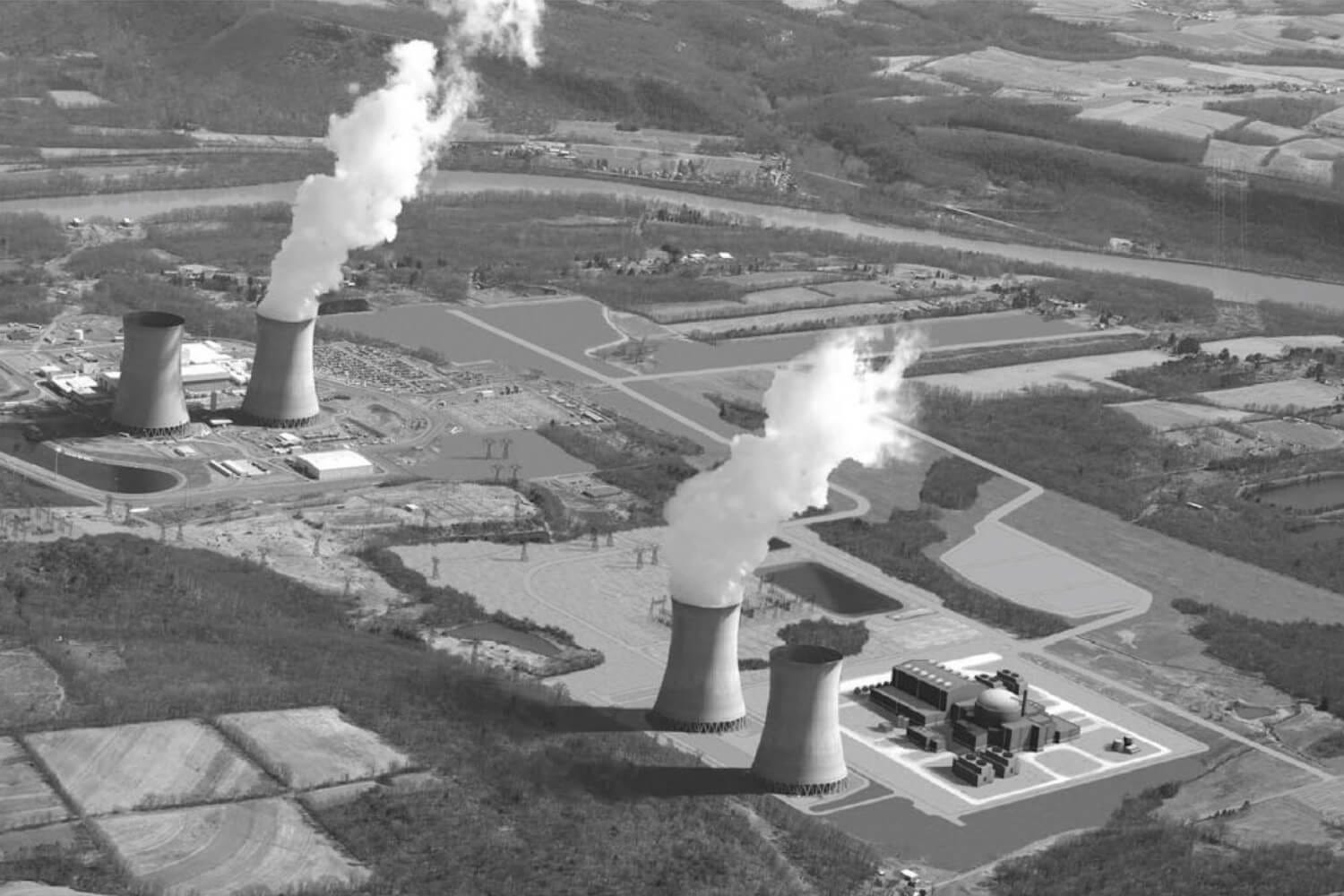
Rendering of the proposed Bell Bend nuclear plant beside Susquehanna’s two existing units; Bell Bend was never built. Source: U.S. Nuclear Regulatory Commission (NRC).
The reactor disappeared; the heavy-industrial zoning remained and was later inherited by the data center.
Amazon’s purchase agreement also preserves a path for another reactor. Under a 2021 agreement, Allegheny Electric Cooperative retained an option to participate in a nuclear reactor project pursued by the buyer on the property; Talen was required to buy out that right by March 1, 2025, or pay $500,000, and the seller’s liability cap would rise by $30 million if the cooperative invoked it. Amazon and Talen have since said they will explore small modular reactors (SMRs) at the site.
Amazon’s hyperscale data center campus, known as PHL 100, uses 1125 Electron Avenue, Berwick, Pennsylvania, as its primary address. The campus is located at the intersection of Cumulus Boulevard and Salem Boulevard in Salem Township, within the Berwick area of Luzerne County in northeastern Pennsylvania.
When fully built out, Amazon’s campus is expected to include 20 data center buildings across approximately 1,200 acres.
Source: Pennsylvania Public Utility Commission (PUC).
Amazon began construction in October 2025. As of August 2026, three data center buildings adjacent to substations #3 and #4 were occupied and operational. Immediately to their south, at least two additional buildings were in structural/shell construction, while sitework and civil works were underway for three more, including preparation of their building pads.
Talen previously envisioned the campus in phases: Phase 1 would comprise three data centers totaling 200–240 MW, while Phase 2 would add three more immediately to the south, bringing the campus to six data centers and 400–480 MW. A further expansion to the west would have brought the campus to about 12 data centers and up to 950 MW.
The campus is expected to support approximately 1,000 permanent jobs at full build-out. By the end of 2025, Amazon had already invested $2.7 billion in Salem Township, Luzerne County, through capital and operating expenditures, supporting an estimated 4,750 annual full-time-equivalent jobs across the local economy and contributing $849 million to county GDP.
Fiber was already part of the campus before Amazon arrived. FirstLight and Lumen were both publicly associated with the original Cumulus data center build: FirstLight said in 2021 that it was serving the Berwick campus with fiber, while Lumen described itself as a network partner in the project. By early 2023, Cumulus said multiple fiber routes were in service.
FirstLight continues to market lit and dark fiber routes directly from the Berwick site. Its network map below shows how that connection ties into its broader Pennsylvania backbone.
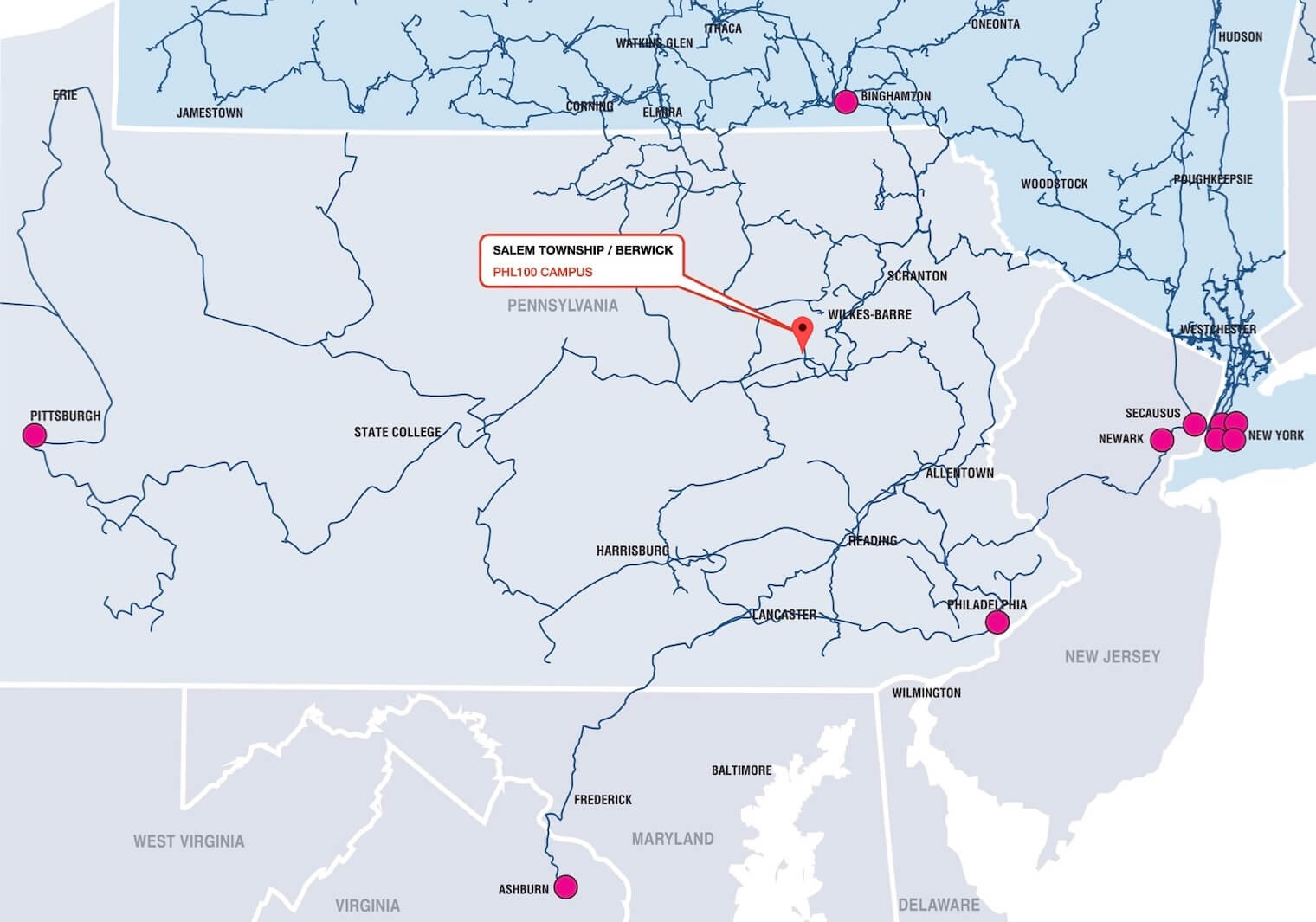
Source: FirstLight.
The newer build-out is regional. Lightpath announced a 130-mile Eastern Pennsylvania network in August 2025, with plans to expand beyond 400 miles, explicitly citing AI data center growth and the Susquehanna region’s power infrastructure. By July 2026, it had signed a second anchor customer to a 10-year deal for a multi-gigawatt campus. Separately, FirstLight completed a 280-mile Eastern Pennsylvania network for an unnamed major hyperscaler in 2025, using its existing statewide backbone.
Permitting has moved more slowly. Lightpath’s water-crossing applications covering Berwick, Salem Township, and other Luzerne County municipalities had not passed Pennsylvania Department of Environmental Protection completeness review by mid-August 2026. Lightpath markets the network as fully underground, but preliminary drawings show its Susquehanna River crossing attached to the SR-93 bridge, about five miles from the Amazon campus. The crossing had railroad approval but was still awaiting Pennsylvania Public Utility Commission (PUC) approval, past Lightpath’s original mid-2026 completion target.
The drawings also provide a physical measure of the build. At the SR-93 crossing, two six-inch conduits are designed to carry separate 1,728-strand and 432-strand cables — 2,160 individual fiber strands in aggregate — with additional internal duct space.
Whatever workload lands there, the design premise was always the plant next door — and scaling that premise is what set off the fight.
The fight that made Susquehanna famous was never over whether a data center could run behind the plant’s meter — that was already allowed. It was over the terms of scaling it up, and the ruling that ended it decided almost nothing while changing almost everything.
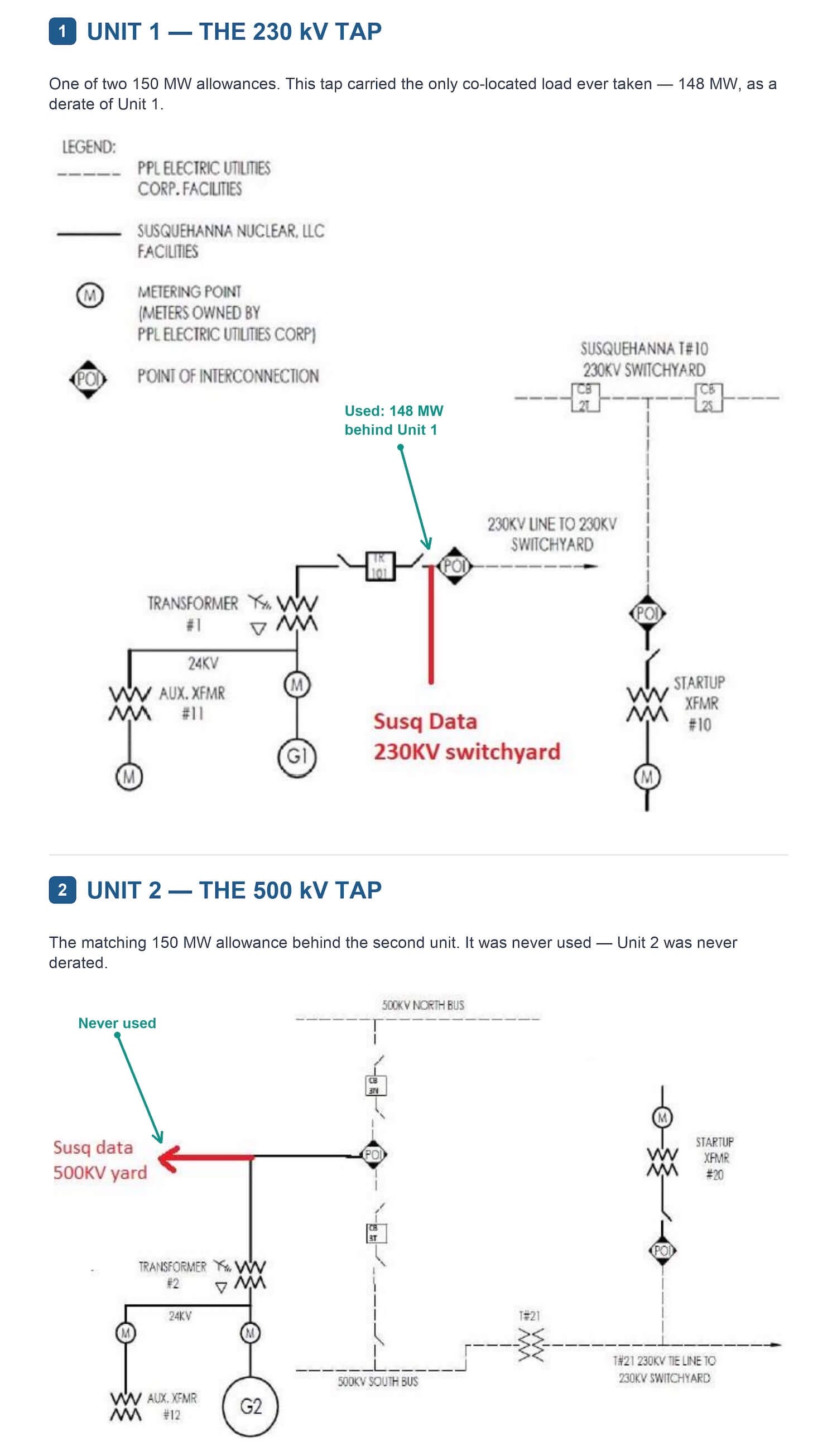
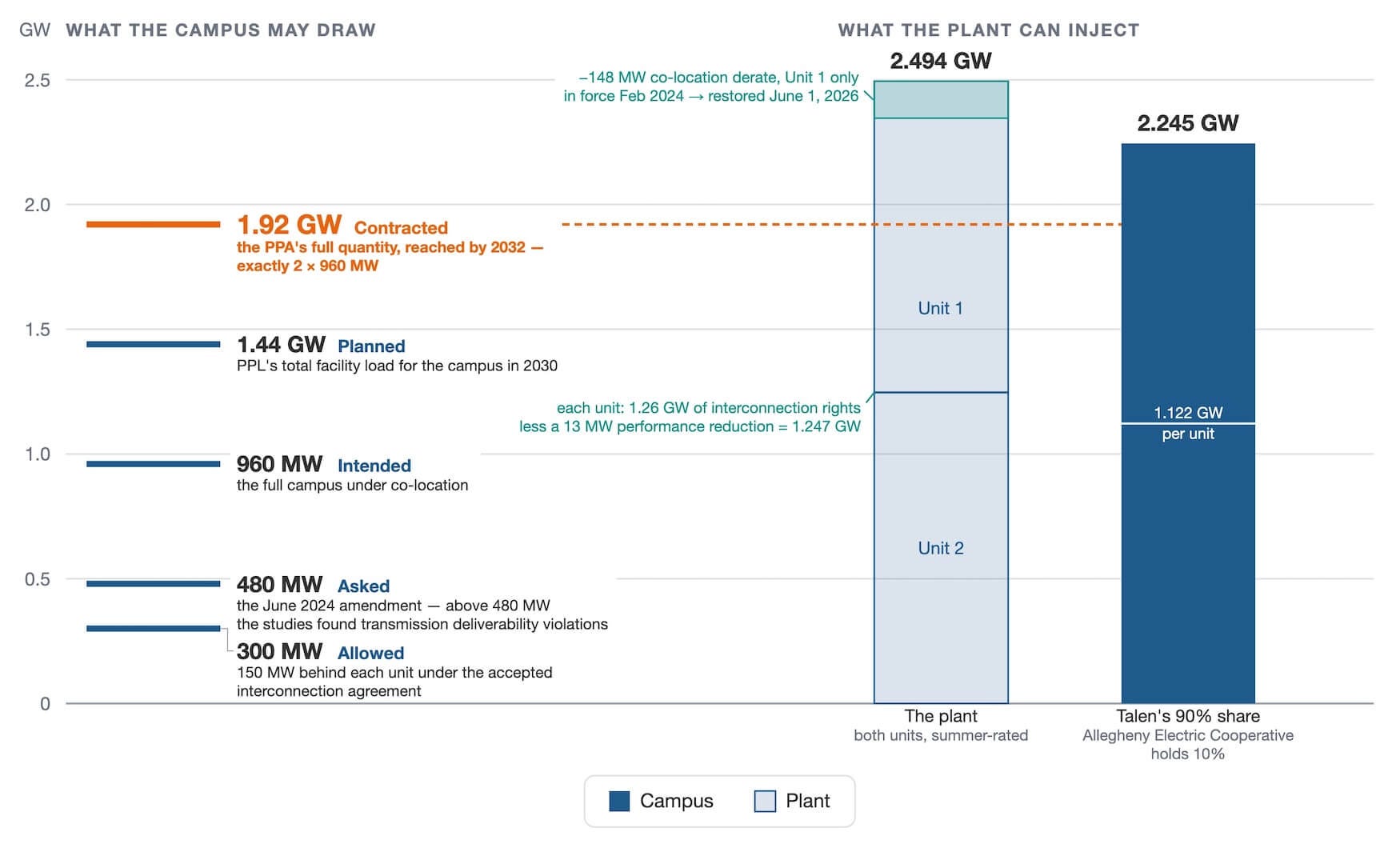
The arrangement had a three-step permission structure. A FERC-accepted interconnection agreement already authorized 300 MW of co-located load, specifically 150 MW behind each of the plant’s two nuclear units. And that standing allowance is what the campus actually ran on throughout the fight.
Source: Federal Energy Regulatory Commission (FERC).
The June 2024 amendment, filed by PJM itself, asked for 480 MW: a ceiling set by physics as much as commerce, because the system studies found that any co-located load addition in excess of 480 MW would result in generation deliverability violations on the transmission system.
Above that sat the stated ambition — 960 MW, the full campus. The commercial architecture underneath ran in 120 MW annual steps, with a one-time Amazon option either to cap at 480 MW or to step up to 960 MW, over an 18-year initial term with two 10-year extensions. Of the 300 MW allowed, only 148 MW was ever taken, all from Unit 1 as a derate, a corresponding reduction in the unit’s output available to the grid. Unit 2 was never derated.
Exelon and American Electric Power (AEP) protested, and their headline claim set the terms of the national debate: co-location at the 480 MW scale could shift “as much as $140 million per year” onto other customers — 98% of it transmission charges, priced off PPL’s retail tariff. Talen called it “a headline-grabbing allegation that is entirely fabricated,” arguing the figure represented at most the utility’s lost opportunity costs.
On November 1, 2024, with two of its five commissioners recused, FERC rejected six non-standard provisions in the proposed co-located data center arrangement because they did not meet the required “necessary” standard, while declining to resolve broader questions about transmission costs, load status, and ancillary services.
Phillips, the lone dissenter, argued that the first-of-its-kind arrangement should have been approved with reporting requirements, emphasizing its reliability implications and the importance of electricity access for U.S. AI leadership. The broader concern was precedent: FERC appeared to keep the ruling narrow precisely because its treatment could shape similar data center arrangements across the country.
Susquehanna Nuclear, a Talen Energy subsidiary, challenged FERC’s November 2024 decision, but ultimately failed: its rehearing request was denied, and it later voluntarily dismissed its appeal in federal appeals court in January 2026.
More consequentially, FERC shifted to a broader rulemaking process, finding in December 2025 that PJM’s tariff did not clearly or consistently address co-located large loads and ordering PJM to develop new rules. By June 2026, FERC had expanded the framework beyond co-location through a new category called Eligible Load, while PJM separately adopted a 50 MW threshold for new large-load procedures amid growing capacity concerns.
The result was that the Susquehanna case itself produced little direct precedent, but it helped trigger the broader regulatory framework now governing large data center loads and behind-the-meter generation.
Losing the amendment did not shrink Amazon’s power supply. It doubled it — because what capped the deal at 960 MW was never the plant’s output; it was the co-location architecture.
Source: Nuclear Energy Institute (NEI).
Talen’s June 11, 2025 announcement replaced the behind-the-meter co-location structure outright: Susquehanna sells its full output into the PJM grid; Talen Energy Marketing serves Amazon as its retail electric generation supplier; PPL delivers.
The power purchase agreement (PPA) provides for a full contracted capacity of 1.92 GW through 2042 — with the ramp reaching full contracted capacity no later than 2032, the old 480 MW cap option surrendered, and the power deliverable to other Amazon sites in Pennsylvania.
What Amazon holds under that structure is contracted capacity served as grid load rather than a direct draw on the plant. The nuclear attribution was contractual from the start: alongside the March 2024 sale, Susquehanna Nuclear signed a separate Amazon Environmental Attribute Purchase Agreement, under which Talen would receive additional revenue from Amazon for the carbon-free energy the plant sells to the grid.
The mechanical reason the deal could double is that co-location had held the second of the plant’s two roughly 1.25 GW units in reserve as redundancy for the first. Talen could still offer that unit into the energy and capacity markets; what it could not do was commit it to Amazon. Going front-of-the-meter converted a reserve into a saleable asset — “we also unlock our second nuclear unit previously held in reserve as redundancy,” as Talen put it at the announcement, “which now allows us to expand the PPA to nearly 2 gigawatts.”
The contract is worth about $18 billion over its roughly 17-year term. Because contracted capacity ramps over time, annual revenue rises with it; at the full 1.92 GW contracted capacity, the deal is worth roughly $1.4 billion a year — an implied price of about $80/MWh.
The figures below track two different measures: Talen’s PPA ramp, which can supply up to 1.92 GW across multiple Amazon Web Services (AWS) sites in Pennsylvania through 2042, and PPL’s projected load for the Susquehanna/Berwick campus itself. PPL expects that facility to reach 1.44 GW by 2030. The two series are not directly comparable: one is Amazon’s broader contracted capacity, the other the physical load planned for this campus.
The transition from behind-the-meter to front-of-the-meter service happened in spring 2026. In April, Talen changed the facility configuration and moved to the revised AWS power purchase agreement during Unit 1’s refueling outage. Separately, FERC had already approved the restoration of 148 MW of Unit 1 capacity interconnection rights, effective June 1, 2026.
That $18 billion is Talen’s valuation of nominal cash flows under the minimum contractual ramp. Faster delivery toward the full 1.92 GW would provide additional upside, but Talen has not disclosed the contract’s value under the maximum ramp scenario.
The agreement also does not require Amazon to buy the full amount of power. Minimum commitments rise through 2032, and if Amazon falls short, it must compensate Talen for the difference between the contract price and the market price. But that payment is capped: Talen discloses that if Amazon took no power at all, its maximum obligation would equal about 50% to 65% of the contract’s full financial impact. Talen therefore retains the residual market-price risk beyond that cap, and it posts letters of credit to Amazon under the PPA. It nonetheless expects the agreement to make its earnings more predictable.
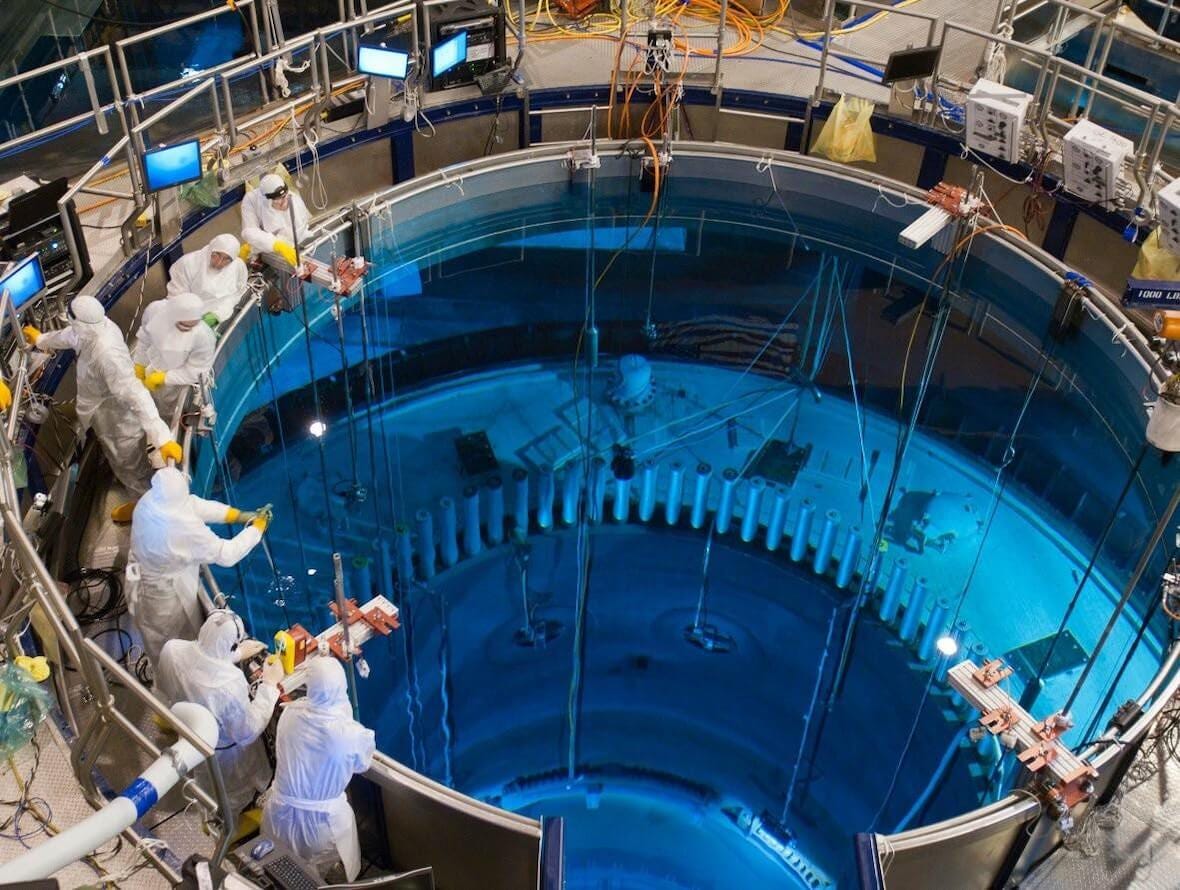
One unresolved issue is plant availability. Talen owns 2.245 GW of Susquehanna, and the AWS PPA reaches its full contracted capacity of 1.92 GW — but the units undergo refueling outages in alternating years, typically in the spring, and Talen calls the outage “our largest recurring maintenance project.” Unit 2 was down from March 25 to June 4, 2025; Unit 1 from March 23 to May 4, 2026.
Source: Talen Energy.
With one unit offline, Talen’s 90% share of the running unit is about 1.12 GW, roughly 800 MW short of the full contracted capacity — a shortfall Talen would have to cover from its other generation or from the market. The gap is not binding yet, because the ramp does not reach full capacity until 2032 — but it widens with every step of the ramp.
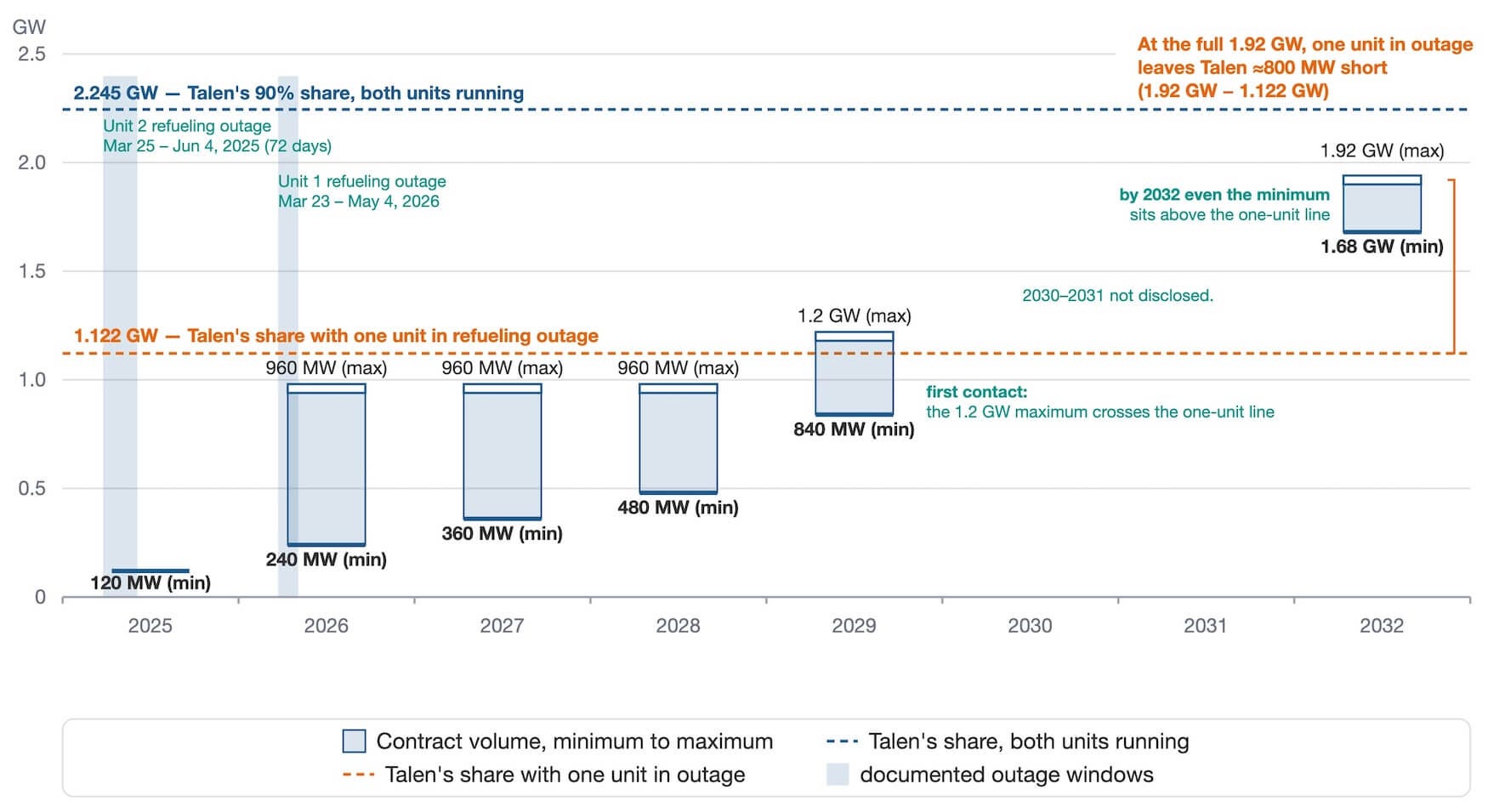
Talen’s disclosures do not explain how the 1.92 GW is reconciled with those outages or with the plant’s PJM Capacity Performance obligations.
The PPA runs through 2042, the same year Susquehanna Unit 1’s operating license expires; Unit 2’s license expires in 2044. That timing is deliberate. The original behind-the-meter agreement had an 18-year term with two 10-year extensions tied to future license renewals. Amazon aligned the new contract with Unit 1’s currently licensed life; anything beyond 2042 would depend on a renewal.
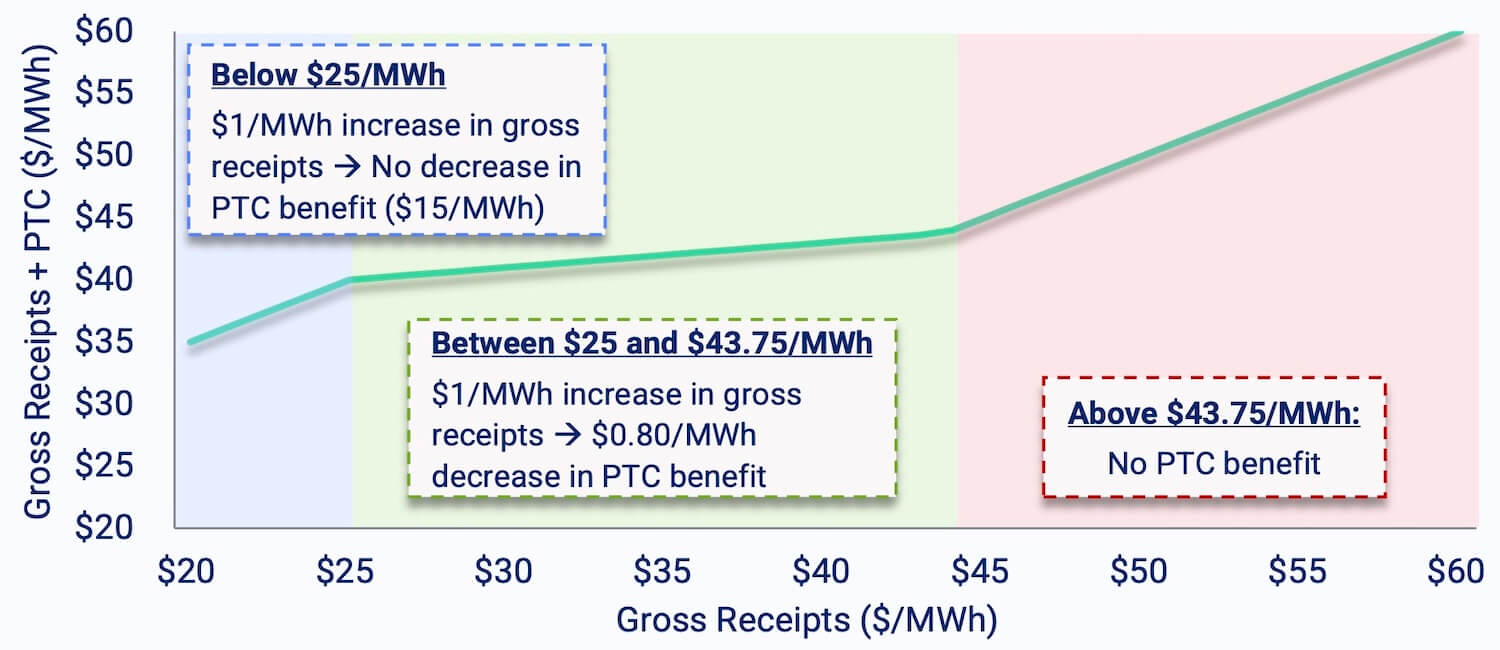
The federal nuclear production tax credit also expires in 2032, when the PPA is scheduled to reach full contracted capacity. The credit can provide up to $15/MWh when power revenues fall below an inflation-adjusted threshold, but Talen received none in 2025 because market prices stayed above it. Talen now presents the AWS contract as reducing its reliance on the credit, which provides no benefit when power prices are strong.
Source: Talen Energy.
The agreement also offers less expansion potential than the headline announcement suggests. Amazon and Talen have agreed to explore SMRs and possible uprates, but management has said further output increases from the existing plant are likely to be modest, and SMRs have been framed as a longer-term possibility rather than a current capital commitment. The PPA is capped at 1.92 GW, so any additional Amazon demand in Pennsylvania would fall outside the current contract.
Co-location’s pitch was that the campus would barely touch the shared system. Ending it moved the campus into everyone’s systems at once — PJM’s transmission plan, its load forecast, and a PPL rate class that did not exist until this docket forced one.
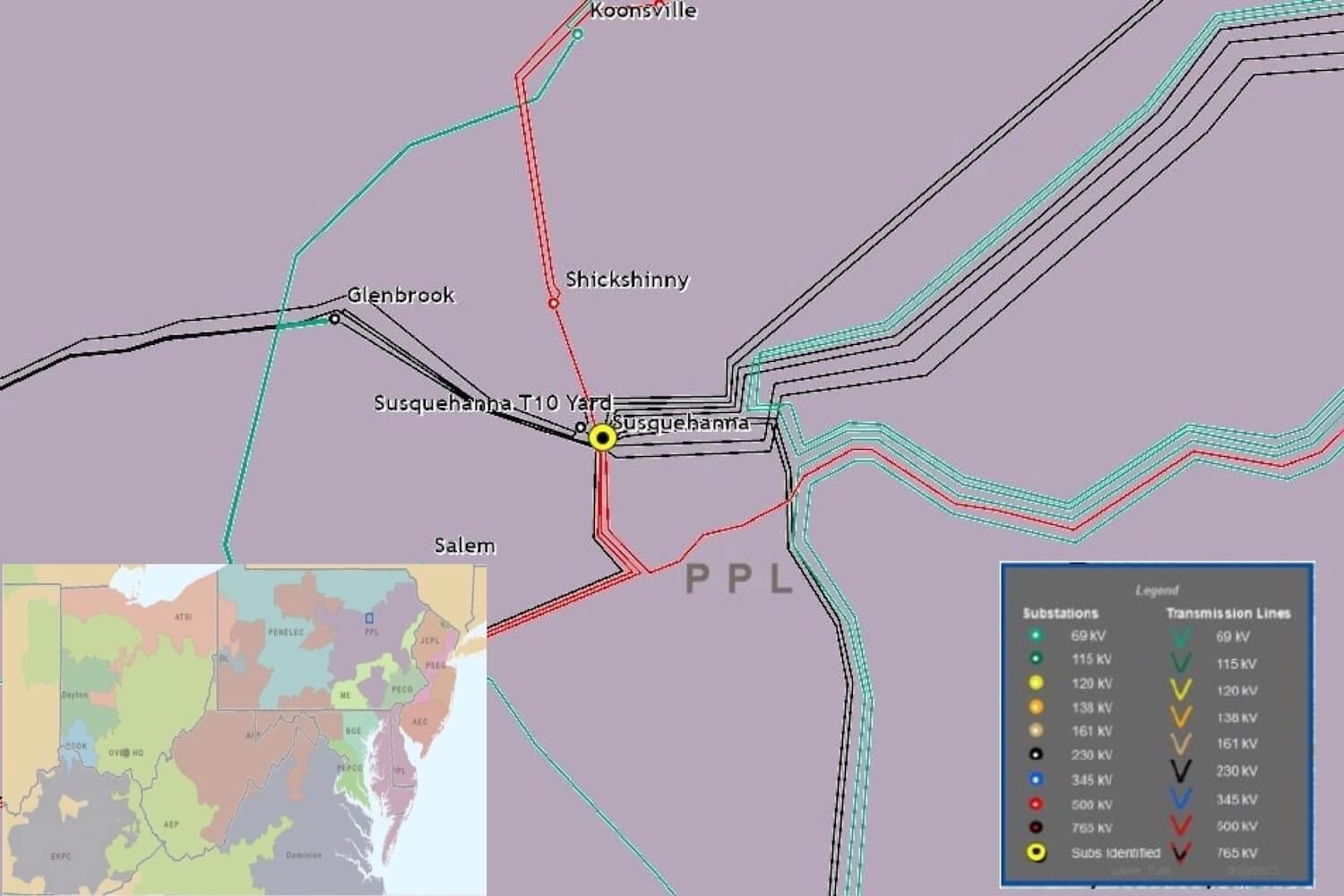
On April 1, 2025, PPL presented Amazon’s Susquehanna data center campus to PJM as a new large-load connection at Berwick, served by dedicated 500 kV and 230 kV transmission lines from PPL’s Susquehanna switchyards.
Source: PPL Electric Utilities.
Amazon requested service beginning in April 2026, but PPL projected completion for May 30, 2028, leaving a roughly 25-month gap. That mismatch did not mean the campus would lose power, however, because it had been drawing electricity through the plant’s own switchyards since early 2024.
The project also involves three separate layers of construction, each on a different track and each with its own cost responsibility:
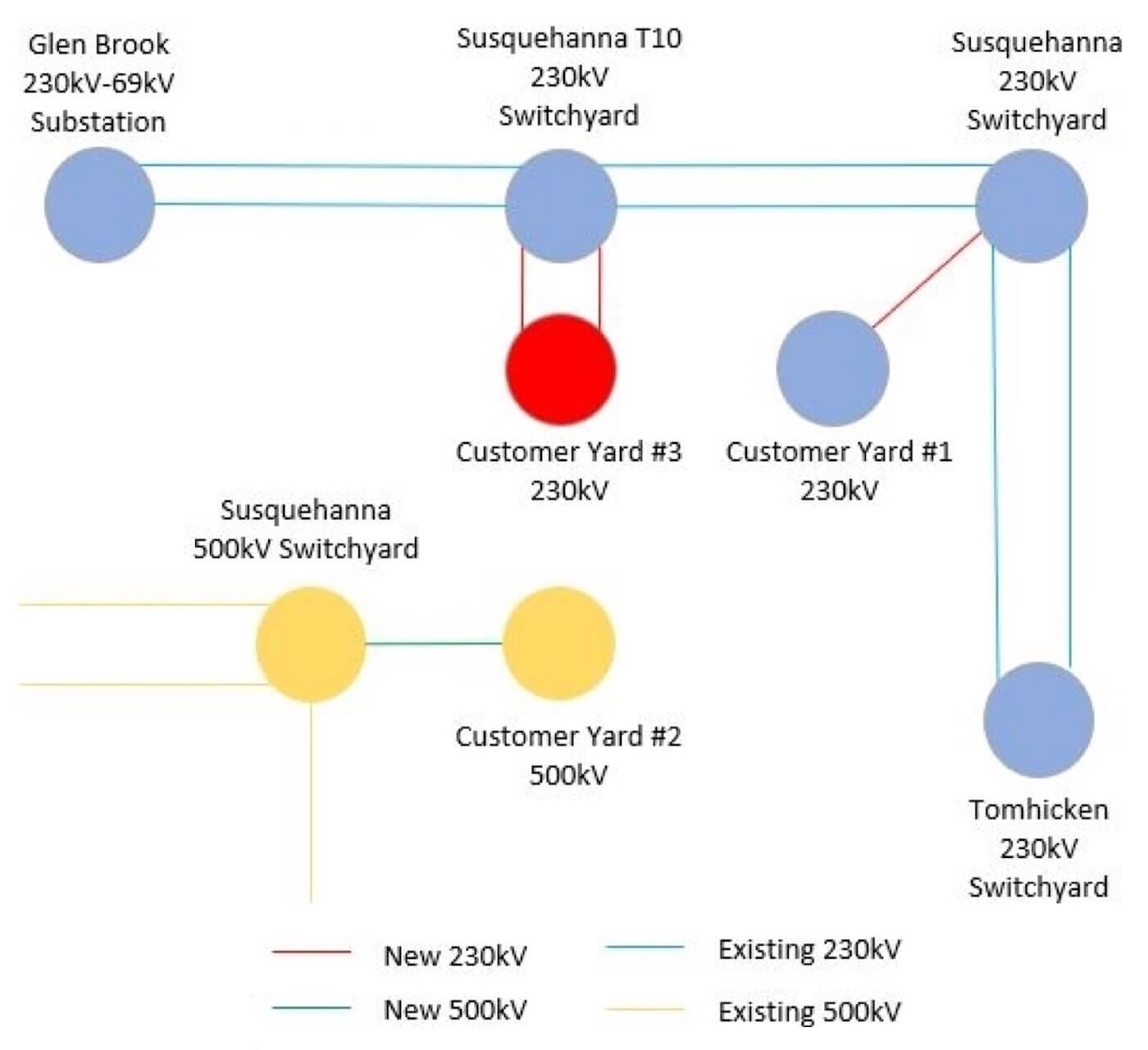
At $19.4 million, the campus interconnection is well below comparable large-load projects in PPL’s 2025 Local Plan, which range from $73.5 million to $242 million — largely because it connects at a substation built for the nuclear plant.
PPL’s connection diagram below shows what that money buys: three new “customer yards” — two at 230 kV, one at 500 kV — tapped off the plant’s existing switchyards.
Source: PPL Electric Utilities.
The broader regional upgrades are far more expensive: PJM plans $567.4 million of transmission work, including $213.6 million at the Susquehanna substation, with about 60% of the cost assigned to the PPL zone and 40% to other areas. Capacity at the site is also tightening: a year later, PPL said the Susquehanna T10 and Glen Brook 230 kV yards could not be expanded enough to serve data center developer QTS’s planned Salem Township campus, which is seeking about 1.5 GW by 2033.
PPL’s territory had essentially no data center load before 2024, with summer peak demand remaining roughly flat for more than a decade. For its 2026 forecast, PPL submitted more than 15 GW of proposed large-load growth, counting every project with a signed authorization at 100% probability; PJM cut that to about 6.3 GW, but the increase was still enough to make PPL one of the fastest-growing zones in the PJM system.
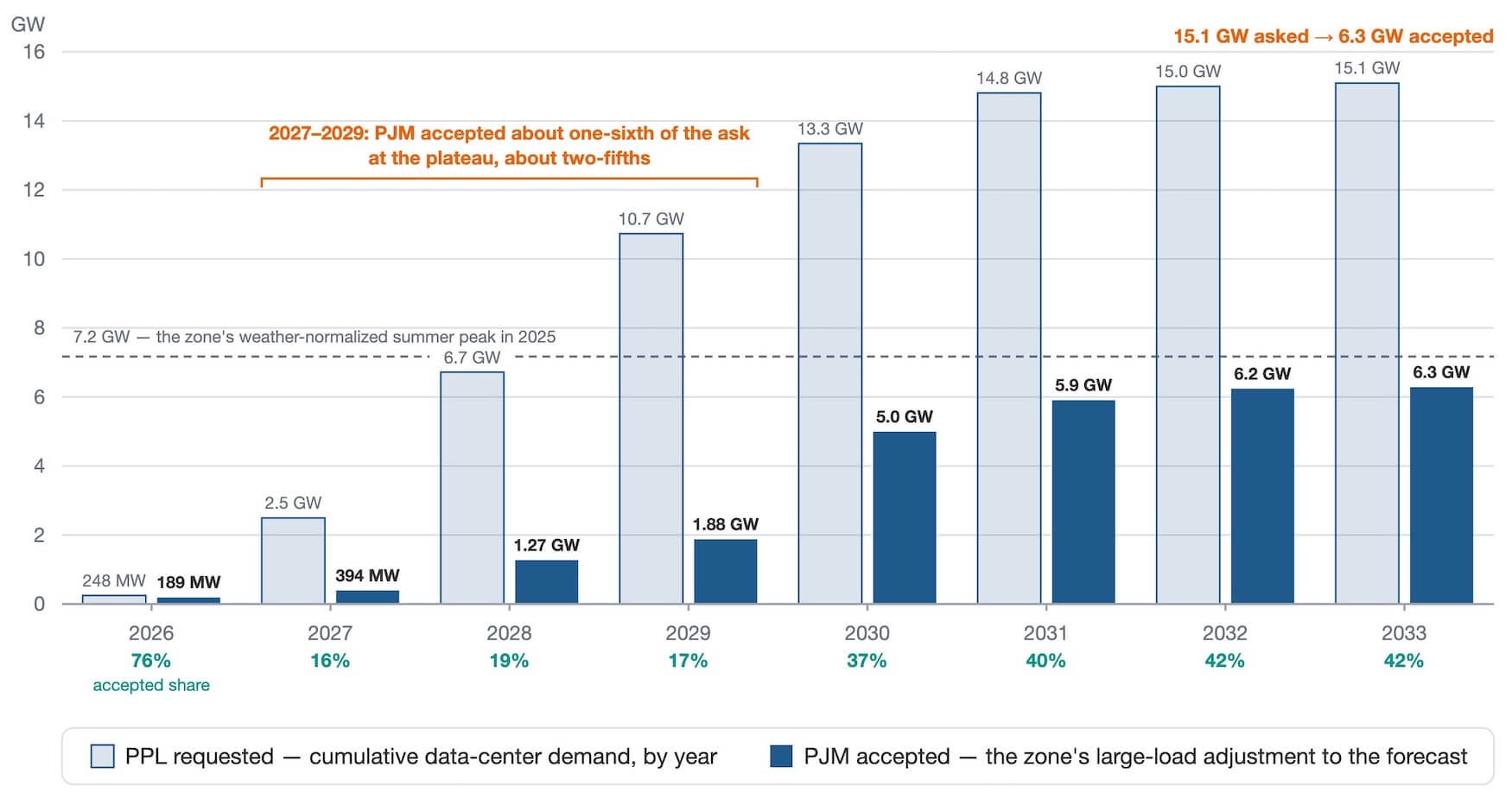
The Susquehanna campus is part of that shift: PJM records specifically reference its load, and PPL’s monthly adjustment begins in April 2026, the same month the campus requested grid service. Even after PJM’s reduction, PPL’s forecast peak rises to 14.4 GW by 2046.
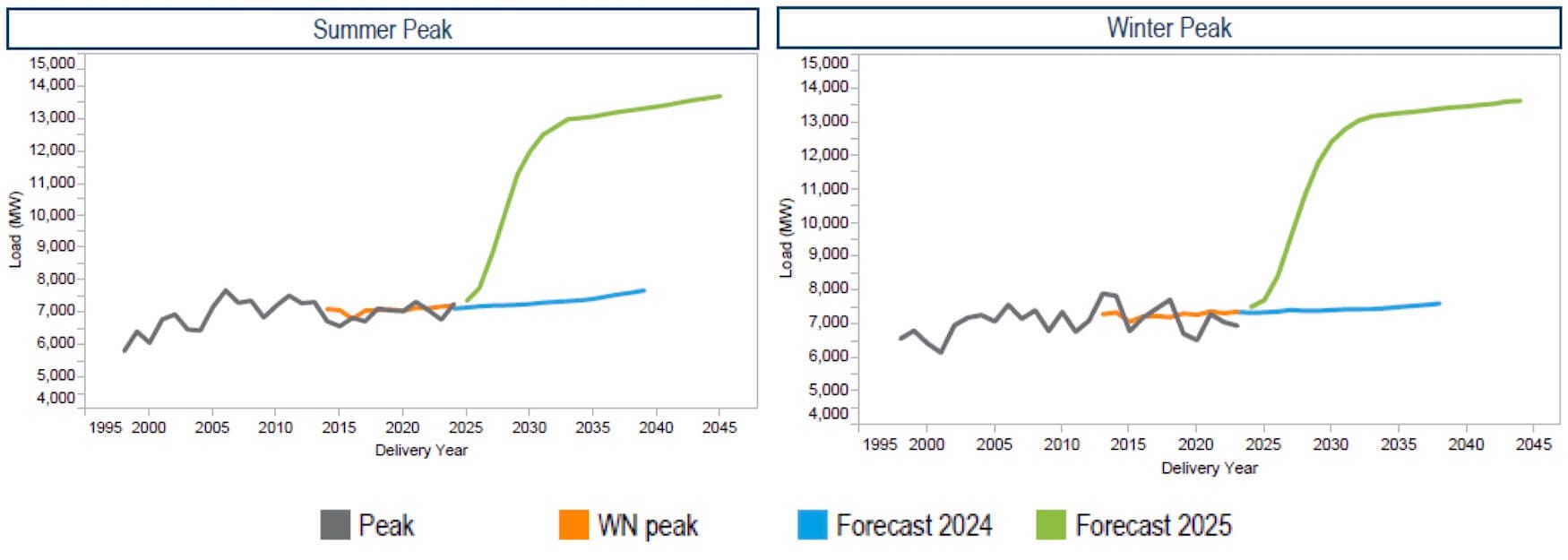
Source: PPL Electric Utilities.
PPL created a new rate class, LP-6, for large data centers after consumer and industrial groups pushed for stronger protections in its 2025–2026 rate case. Effective July 1, 2026, the tariff applies to large data center customers that began service on or after October 1, 2025. Its key requirements include:
Load Threshold: At least 50 MW of peak demand at a single facility, or 75 MW across facilities within 10 miles.
Contract Term: An electric service agreement with a minimum term of 10 years.
Minimum-Load Requirement: Customers initially pay for at least 80% of committed load, falling to 50% in Years 6–10.
Interruptible-Service Option: Customers choosing interruptible service face lower minimum-load requirements of 60% initially and 30% in Years 6–10.
Universal-Service Costs: Beginning January 1, 2027, the class will be allocated $11 million per year in universal-service costs.
LP-6 also requires customers to provide financial security for grid upgrades, pay upfront for directly assigned interconnection work, and pay an exit fee if they leave early. For the Susquehanna campus, that exit exposure could reach the high hundreds of millions of dollars: at its planned 1.44 GW load, five remaining years at LP-6’s 50% minimum-load requirement would come to roughly $806 million of transmission charges at PPL’s current $18.663/kW-month rate.
Pennsylvania’s PUC adopted a statewide model tariff for large electricity users on April 30, 2026 — a template for utilities to write into their own tariffs, not a rule that binds customers on its own. Its terms set the benchmark against which Pennsylvania’s utility-specific tariffs, LP-6 among them, are now read. Key terms include:
Large-Load Threshold: At least 50 MW of demand at a single site or 100 MW of combined demand across multiple sites.
Minimum Billing Level: Billing demand of at least 80% of contracted capacity — or 80% of the highest demand in the past 11 months, whichever is greater.
Notice Period: After the initial contract term, four years’ notice to reduce or terminate service.
Amazon pushed the other way on notice. Its energy-strategy principal, Michael Fradette, sought a shorter 18–24-month period; the PUC moved the opposite way, tightening its draft’s three years to four in the final order.
Behind-the-meter generation is excluded when determining whether a customer meets the large-load threshold. Amazon also indicated that shifting or curtailing workloads should not be treated as the customer’s responsibility, reinforcing the expectation that hyperscale data centers will operate as large, firm loads that utilities must plan around.
Those obligations are statewide and prospective. The constraint that actually governed this campus was local, and it had $300 million attached to it: Talen’s escrow turned Salem Township’s zoning decisions into a term of the Amazon sale.
Talen disclosed that the $300 million portion of Amazon’s purchase price held in escrow pending Salem Township zoning approvals was released in stages: $200 million after zoning was approved for at least 540 MW of the campus and the remaining $100 million after approval reached 960 MW. The township approved zoning for the full 960 MW on May 28, 2024, and the escrow milestones were completed that August.
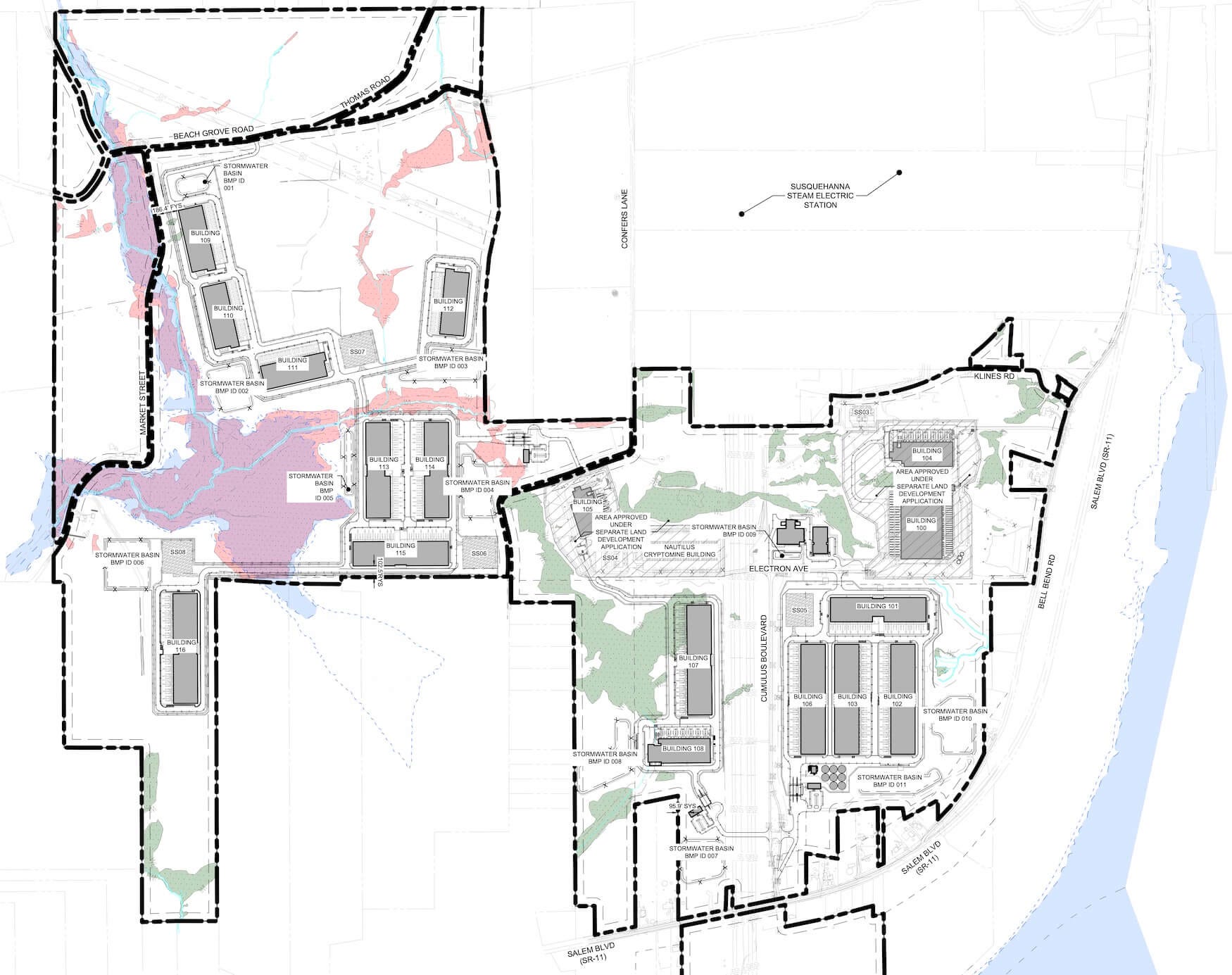
Salem Township later reaffirmed that rezoning through Ordinance No. 01 of 2025, adopted at a special meeting on September 29, 2025. The ordinance created the SDC-O Special Data Center Overlay District and provides that an approved data center master plan can lock in development rights for five years, protecting the project from later Salem Township zoning changes. That master plan, shown below, divides the assembled campus into Premises A through K.
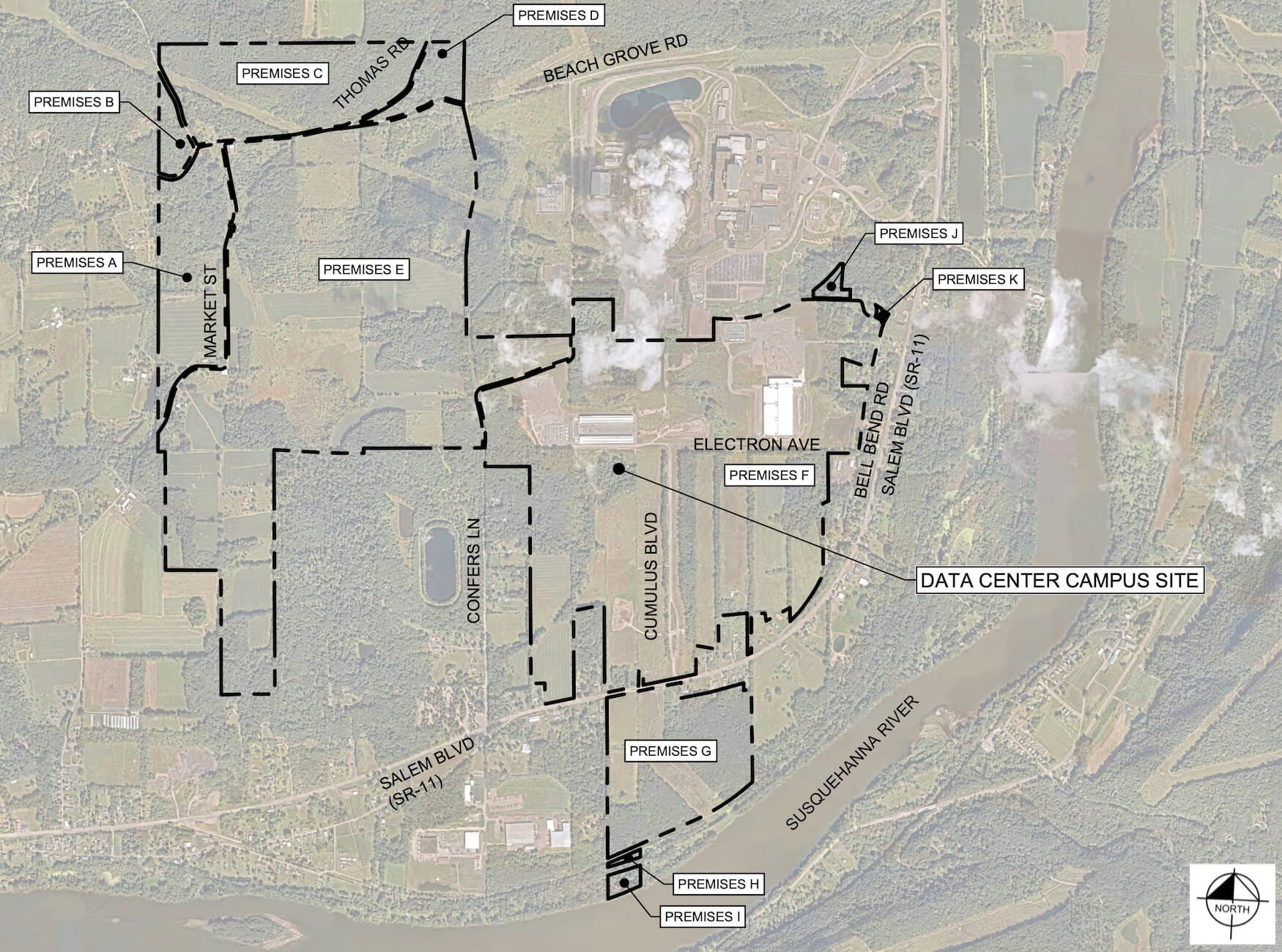
Source: Pennsylvania Public Utility Commission (PUC).
Buildings are permitted by right and can reach 100 feet in height, compared with the underlying industrial district’s 45-foot limit. The ordinance also caps noise at 70 dBA outside the overlay while exempting several power-related operations, including substations and generator testing.
Salem Township’s special data center overlay has expanded by 72.5%, from 2,308 acres to 3,981 acres, with another expansion — presented to the Planning Commission in July 2026 as 4,466 acres across 279 property owners — set for an August 26, 2026 hearing.
That is the campus’s legal ground. Its physical limits sit in other agencies’ files.
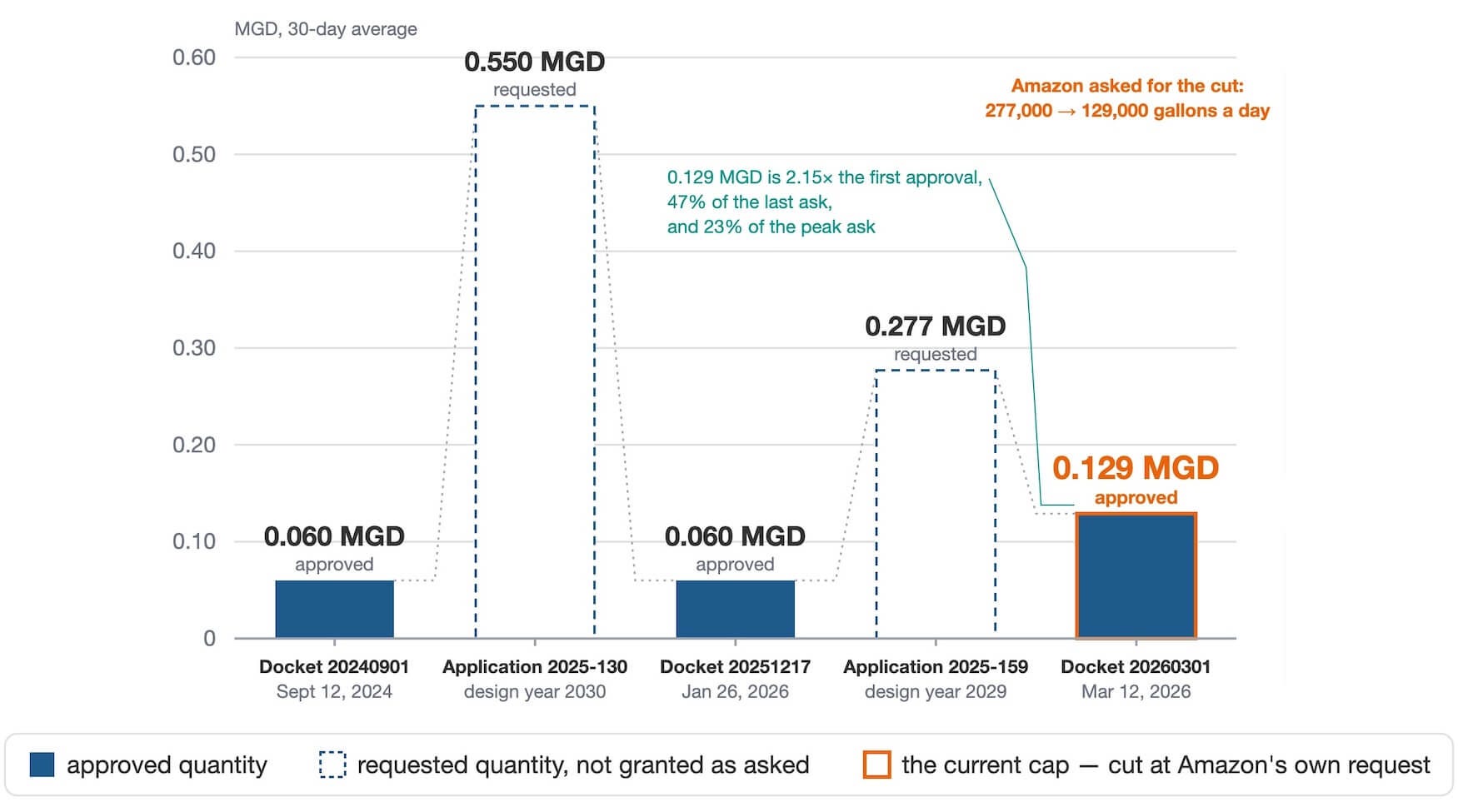
For a campus contracted in gigawatts, the numbers that physically govern it are strikingly small — 99 tons of NOx, 0.129 million gallons of water a day (MGD), 0.252 MGD of sewage — and each was set by negotiation rather than by demand: Amazon capped its own NOx to stay under federal major-source review, cut its own water request by more than half, and took sewer approval one phase at a time.
Pennsylvania has approved 109 diesel emergency generators at the campus — 283.5 MW of backup power — and an application for 86 more is pending.
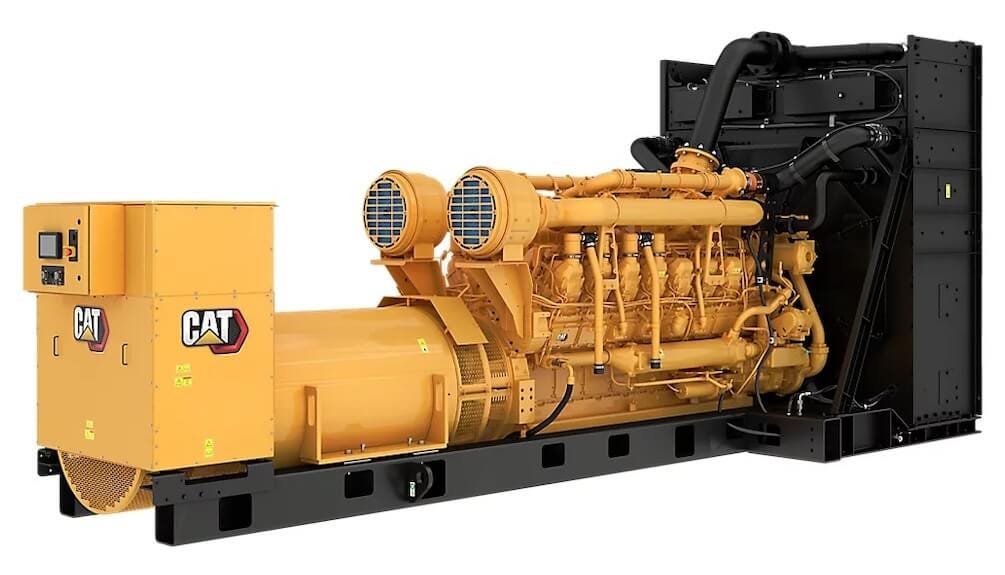
Source: Caterpillar.
At full approval, the 195-unit fleet would stand at roughly 515 MW, nearly all of it 2.75 MW CAT 3516E gensets alongside a handful of smaller house and auxiliary units.
A rolling 12-month NOx limit of 99 tons a year keeps the site below the federal major-source threshold — a cap Amazon proposed itself.
The generators are regulated under Pennsylvania’s Best Available Technology standard, with no federal Best Available Control Technology determination, and the state has not yet issued the State-Only Synthetic Minor operating permit. The campus is also permitted for 204 diesel tanks holding 1.3 million gallons, although less than 30% of that storage capacity has been installed to date.
The Susquehanna River Basin Commission authorized the campus to consume up to 0.129 MGD, measured as an average over any 30 consecutive days — a cap on the hottest month rather than the year. That figure was reduced at Amazon’s request from the 0.277 MGD recommended by Commission staff. It is also a long way from Amazon’s earlier plans: the campus was approved for 0.060 MGD in September 2024, and Amazon then sought 0.550 MGD for a fully built campus by 2030, primarily for evaporative cooling and construction. The current 0.129 MGD limit is less than a quarter of that projected full build-out requirement.
The approval allows five supply sources, but the primary one is Pennsylvania-American Water’s Berwick system, which draws from wells in neighboring Columbia County. The campus has no separate water-withdrawal approval, and its on-site well is operated below the 0.100 MGD threshold that would require one.
The cap counts only water evaporated and lost to the basin. Pennsylvania-American’s line-extension agreement provides for delivering up to 1,042 gallons per minute, about 1.5 MGD, under average-demand conditions. Water that is not evaporated is to be reused, sent to the Berwick Area Joint Sewer Authority, or — under a permit still pending — discharged to the Susquehanna River.
The Susquehanna River, which runs directly along the south and east perimeter of the campus, is not an approved campus water source for Amazon. The river withdrawal belongs to the nuclear plant: the approval, held by Susquehanna Nuclear, LLC, authorizes up to 76 million gallons of peak-day withdrawal and 53 million gallons of peak-day consumptive use to run the power station.
Amazon states that its data center campus will use water-based cooling less than 2% of the year. The Susquehanna River Basin Commission said in mid-2026 that this was the only data center water-use project it had approved anywhere in the basin.
The Berwick Area Joint Sewer Authority has approved the Amazon campus in stages, beginning in June 2024 with Phase 1 and a peak sewage flow of 0.252 MGD. The authority later approved a campus agreement and signed a reimbursement agreement, while state approvals moved forward for sewage planning, a sewer extension, and an on-site pump station.
Federal wetlands review has been more limited: a 2021 determination identified 19.8 acres of federally regulated waters and wetlands but did not authorize any construction or discharge. State permits have allowed more extensive work, including stormwater controls and a 2025 water-obstruction permit covering 10 impacts and two stormwater outfalls to a Susquehanna tributary. A June 2026 amendment, still pending, would expand the permit to 16 impacts and add a cooling-water outfall into the Susquehanna River — the first proposed permit that would allow the campus to discharge cooling water directly to the river. Amazon’s separate industrial-waste discharge permit remains unissued after five deficiency letters.
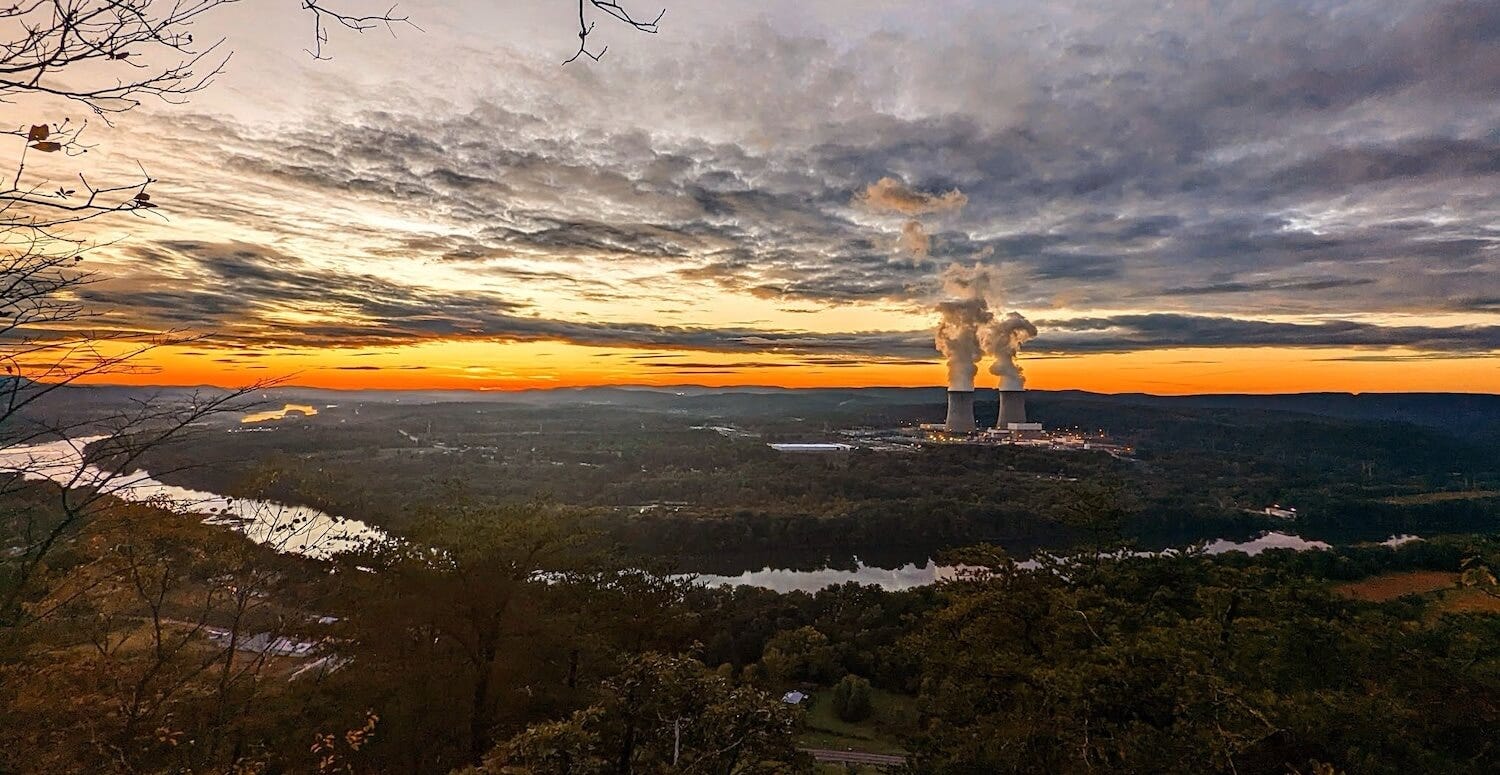
Amazon’s Susquehanna campus did not stay singular. The combination that drew Amazon here — industrial land beside high-voltage infrastructure — has pulled other developers onto the ground around it, and Amazon has since repeated the model across Pennsylvania.
Source: Talen Energy.
Amazon’s campus is no longer alone on this ground. Salem Township’s solicitor now counts four data center projects, not one. The largest belongs to QTS, which has assembled roughly 1,700 acres across 180 lots and holds a land-development plan the township has approved — a campus seeking about 1.5 GW by 2033, off the same switchyards PPL has already said are constrained.
The result is an emerging data center cluster around the Susquehanna site, with multiple developers now pursuing the same combination of industrial land and access to high-voltage infrastructure.
What Talen proved was buildable, others are now building.
Amazon’s Salem Township campus is just one component of the hyperscaler’s broader AI data center expansion across Pennsylvania. On June 9, 2025, Amazon and Governor Josh Shapiro’s administration announced plans to invest at least $20 billion in data centers statewide.
Salem Township in Luzerne County and Falls Township in Bucks County were the first locations identified, with Amazon later adding Kline Township in Schuylkill County and Banks Township in Carbon County as additional areas of interest. A potential development at Homer City would further extend Amazon’s data center footprint into western Pennsylvania.
Measured AI provides institutional-grade analysis of the physical infrastructure powering AI data centers. For access to our full research library, regulatory intelligence, and weekly briefings, visit MeasuredAI.com.
No posts
Comments
Nothing yet. Say the first thing.
Sign in to join the conversation.