
On June 9, 2026, Crusoe, a power-first neocloud, announced that its contracted AI infrastructure capacity was approaching 5 gigawatts — and on the same day added: “At the request of our customer, Crusoe has paused its development activities” on the 1.8 GW campus it had launched a year earlier outside Cheyenne, Wyoming. The Wyoming project was not in the contracted total. The next morning, the serving utility flatly contradicted the word “paused”: Black Hills Corp. said the project “has not been paused” at all — “While Crusoe is no longer the development partner for this project, the project continues to progress as planned and is tracking for service to begin in early 2028.”
A month later the shift in control became a matter of county record. On July 8, the Laramie County Board of County Commissioners told residents that “Crusoe Energy has withdrawn from the project,” that the campus formerly called Project Jade is now Project Tembo, and that the party across the table is Google. The stronger document had already been filed a week earlier: Google’s June 30 site plan narrative states that “Google, through its wholly owned subsidiary Jupiter Star Holdings LLC … will be the developer and owner of the project” — a resubmitted program of four data center buildings inside a campus totaling about 3.08 million square feet, smaller than the five-building plan Crusoe had permitted. Bloomberg also reported in June that Google “had raised concerns about the costs and timetable under Crusoe’s watch.”
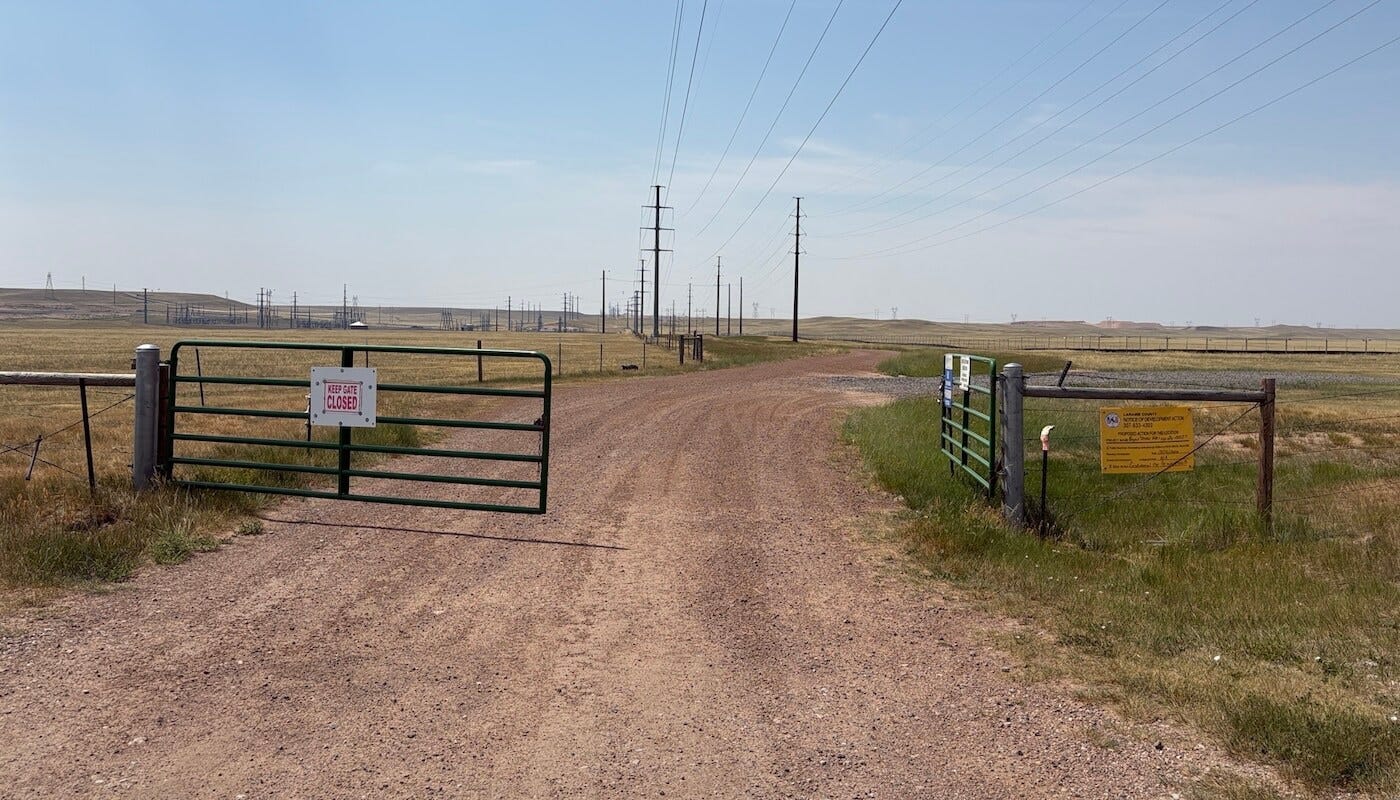
What Google took over is one of the largest planned AI data center campuses in the United States: a 715.9-acre data center site inside a 1,375-acre industrial park on former ranch land eight miles south of Cheyenne, in Laramie County, Wyoming.
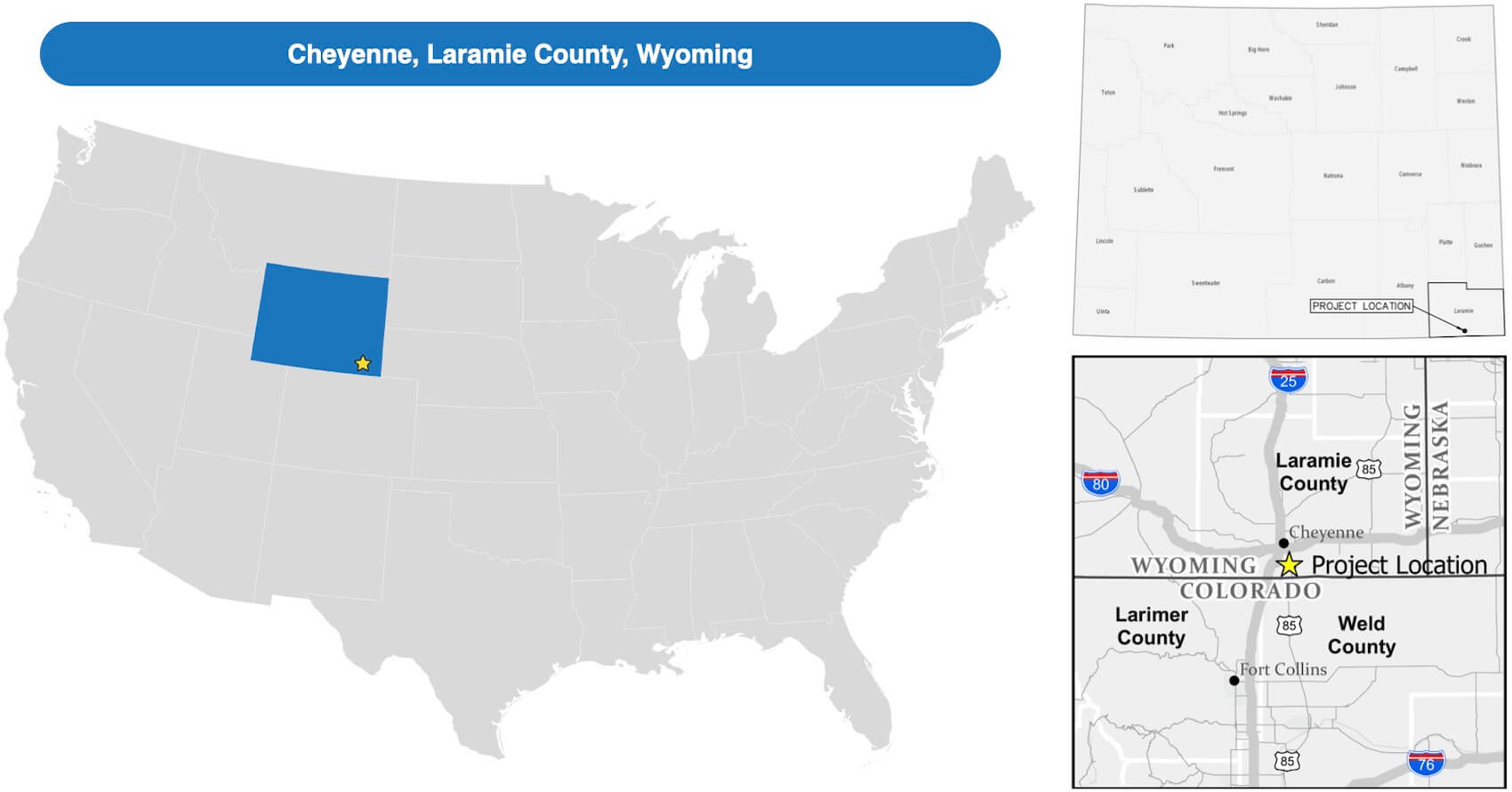
The project was announced at 1.8 GW with a stated design ceiling of 10 GW. That 1.8 GW load is roughly 4.1 times the all-time peak of the utility that will serve it. Next door, on land the campus’s own power developer now owns, Blackstone-backed Tallgrass is building the Cheyenne Power Hub — a first phase of two Mitsubishi M501JAC turbines totaling roughly 1.15 GW, inside a permitted generation fleet the applicant sizes at up to 2.2 GW, behind a power investment Tallgrass puts above $7 billion.
The structure is what makes Cheyenne an instructive case study. Google’s Project Tembo is a unique model — Google takes only the data center, and everything upstream belongs to someone else — and it is not the model everyone, including the applicant, has described it as.
This primer walks the project layer by layer: the ownership structure and why Google needs it, the handover from Crusoe, the land, the data centers, the power hub and its capacity numbers, the utility deal and who pays for it, the water, and the markers that will test all of it over the next 18 months.
Every layer of this campus belongs to a different named company, and the relationships between them reveal what’s really going on.
Google is the data center’s developer and owner — and holds nothing upstream. Tallgrass owns the gas turbines. An American Electric Power (AEP) subsidiary owns the fuel cells. Tallgrass’s Rockies Express Pipeline (REX) moves the gas. Tallgrass also owns the switchyard where every megawatt is sold. Black Hills’ Wyoming utility owns the Robinson Substation that ties the campus to the grid — and Google is paying for it. And — the fact that reorganizes everything else — none of that generation sits behind Google’s meter.
At the county hearing that approved the site plans in January 2026, Crusoe’s Chief Real Estate Officer, Matt Field, described the power strategy in the phrase the whole industry now uses: “We also have a unique take on power … We’re colloquially viewing it as BYOP, bring your own power.” The air-permit application states the same thing, describing the plant as “a behind-the-meter power generation facility that will deliver electricity to a data center.”
The FERC filing says otherwise, and it is the better authority. Cheyenne Power Hub’s July 2026 waiver application walks through three phases of the project, and in every one of them the generators — the gas fleet and the fuel cells alike — “sell the entirety of the output to BHE,” and Black Hills Energy serves the data center “through a retail sale.” The interconnection is engineered to cap flow from the generation onto the utility’s transmission system at “only 600 MW“ — dedicated supply, not a merchant plant. Black Hills takes title on site and delivers to the data center over dedicated lines that never enter its transmission network, so the 600 MW is the ceiling on what can reach the wider grid, not a limit on what the utility buys. The waiver’s own exhibit draws the arrangement — every owner color-coded, every generator sized, and the cap labeled at the interconnection.
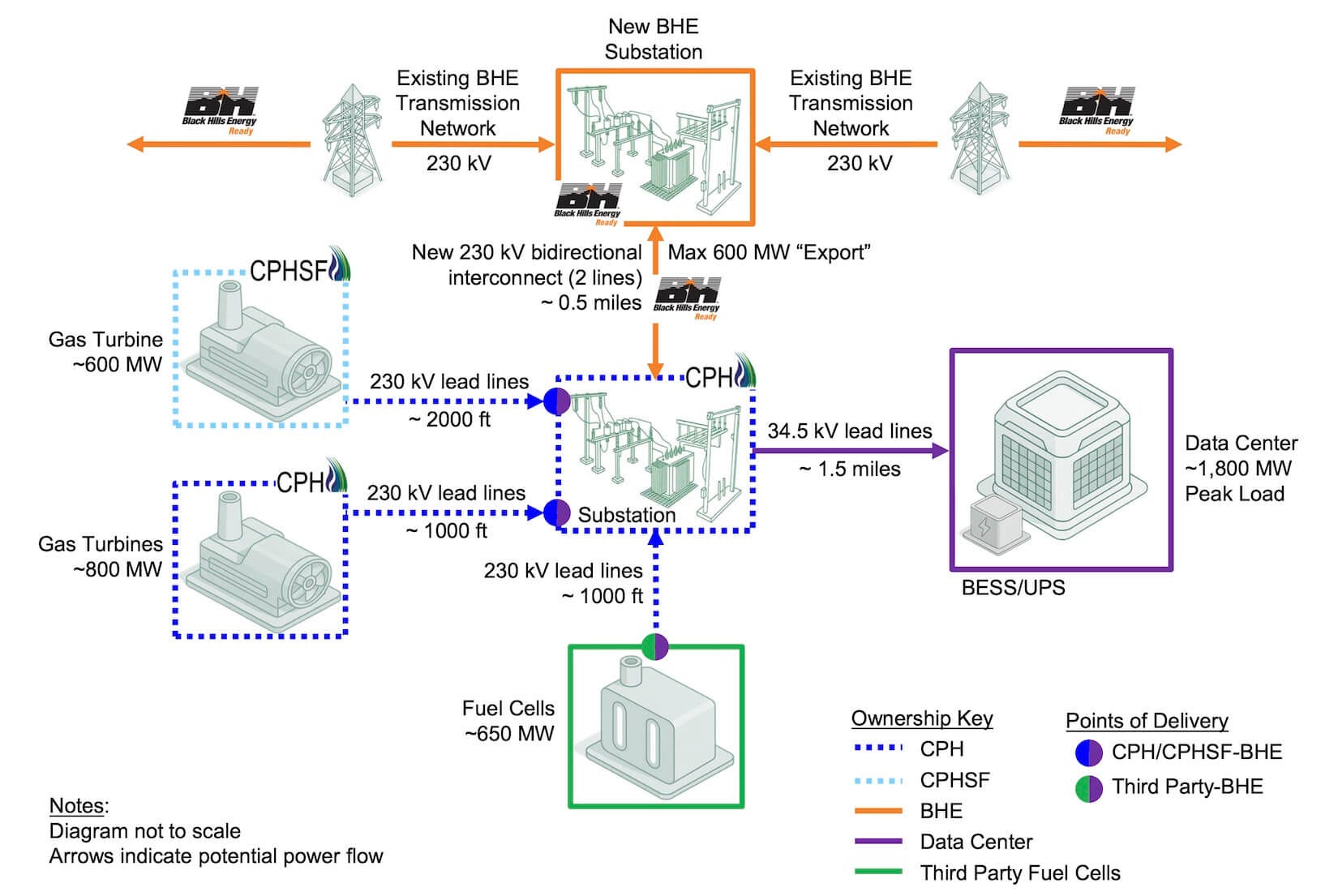
Source: Federal Energy Regulatory Commission (FERC).
The same corporate family told two agencies two different things: “behind-the-meter” to the air regulator as a physical description, and utility-resale to FERC as the commercial architecture. The commercial architecture governs.
That distinction is not pedantry; it is the model. Bring-your-own-generation means a load develops or contracts for on-site power that it takes directly — behind its own meter, netted against its own consumption, with the utility bypassed as the seller. That is what lets it begin operating without waiting for grid service, and it is why the load, not the utility, controls the supply.
Cheyenne keeps every part and moves the meter: the generation is new and dedicated, but the load never owns or nets against it — it is front-of-the-meter, dedicated generation, sold at regulated retail. Wyoming’s answer to the interconnection queue is not to leave the utility; it is to keep the utility as the seller, build the generation anyway, and ring-fence who pays for it. Sections V and VI trace each half of that framework.
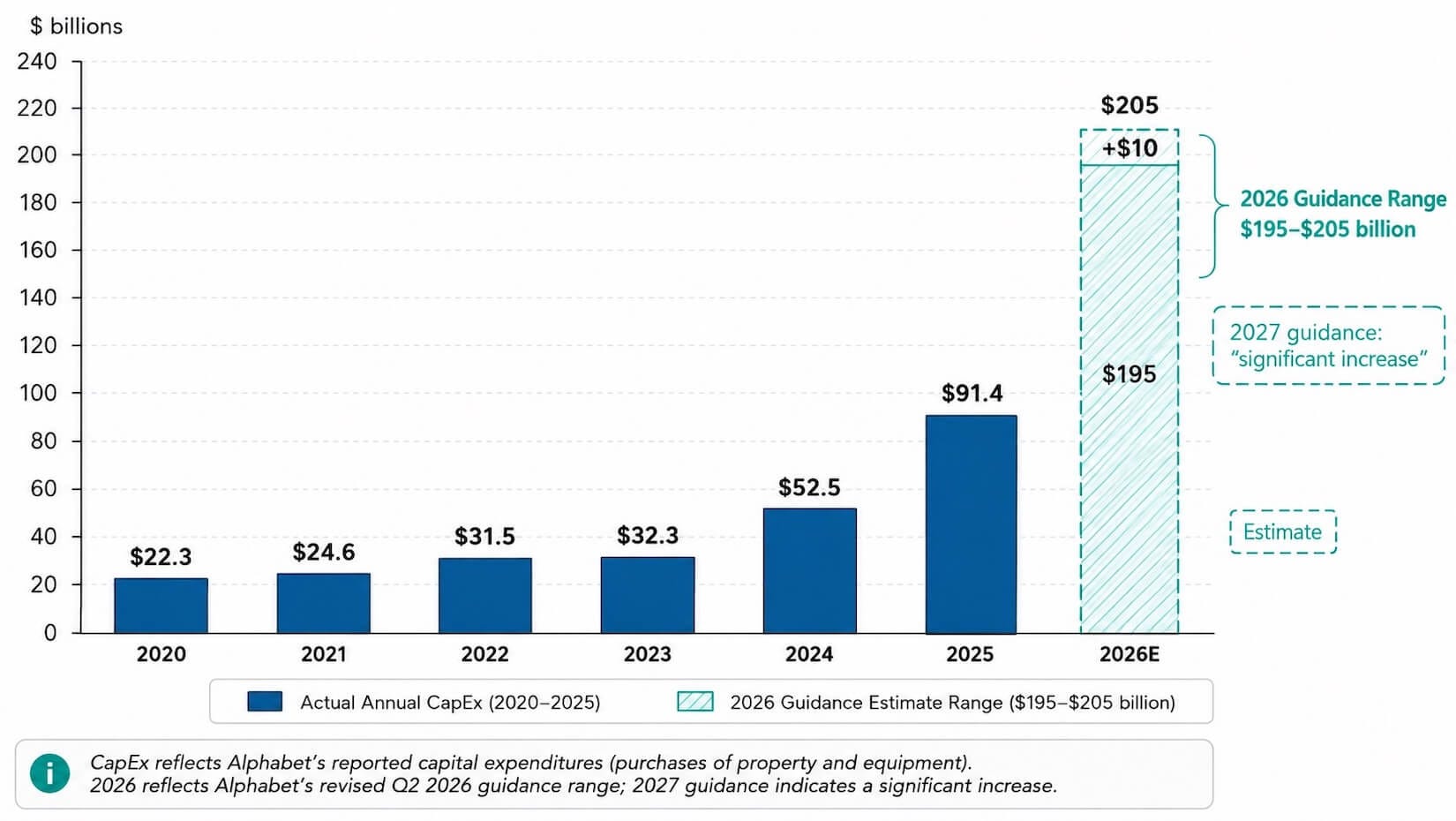
The demand side of the project is Google’s, but the frame is Alphabet’s. At fleet level rather than site level, Google’s parent company provides the corporate context this Wyoming project sits inside. Alphabet’s ability to scale its physical infrastructure is increasingly constrained by the availability of power, water, and land. The spending curve behind that statement: capital expenditures of $52.5 billion in 2024, $91.4 billion in 2025, and FY2026 guidance raised twice since the beginning of the year to $195–205 billion — with 2027 guided only as “a significant increase.”
Google’s own energy team describes the approach behind the spending. In November 2025, Google’s global head of data center energy, Amanda Peterson Corio, said the company has “been moving Google from a power customer to an infrastructure partner,” running an “energy first” screen before siting decisions — and, notably, stated a preference for grid-connected load, exploring co-located generation only “in markets where it is regulatorily allowed” and “while still building a path to ultimately interconnect these co-located power and data center assets to the grid.”
The named example was a partner: Intersect Power, a developer that co-locates data centers with dedicated renewable and gas-fired generation. Within months Google bought the company, closing March 10, 2026 at a $5.9 billion valuation.
Cheyenne fits Google’s approach precisely — dedicated generation, sold through a utility, grid relationship intact from day one — but not the ownership: here every megawatt belongs to Tallgrass or AEP. And Google’s cost pledge to “intentionally structure our energy deals to cover 100% of the costs of the power we use” is about to get its most literal test in a Wyoming tariff docket (Section VI).
On August 5, 2026, Google itself stated in the Wyoming regulatory record, via a petition to intervene, its arrangement with its utility counterparty, Black Hills: “Google is considering development of data center facilities in Cheyenne, Wyoming, within the Company’s service territory. Under this proposed development, Google will purchase electricity from the Company and become a large-load customer.”
The structure explains what Google bought. The handover explains how it came to be the buyer.
Project Tembo’s defining event is a mid-build change of control and one of the clearest cases of a hyperscaler customer displacing a neocloud developer from a flagship AI data center campus while keeping the developer’s power platform intact.
The public sequence ran three days. Crusoe, June 9: a customer-requested “pause.” Black Hills, June 10: no pause — Crusoe “is no longer the development partner,” and the utility “is working directly with the potential large-load customer.” Bloomberg, June 11: Crusoe “pushed aside” after Google raised cost and schedule concerns, with Google “working to finalize a deal with the remaining partners to buy computing from the site.”
The government record fixes the outcome. The data center’s own stormwater permit — held by builder DPR Construction — was terminated on June 8, the day before Crusoe’s statement, in a single sentence with no successor permit. The county’s July 8 memorandum states simply that “Crusoe Energy has withdrawn from the project.”
The record also shows how early the transition began. On May 14 — about a month before the first press report of Crusoe’s exit — the Laramie County planning director told a hearing, “we met with Google last week.” A county letter the following week disclosed that “Laramie County was under a confidentiality agreement with Crusoe only” — the incoming owner, Google, had no NDA with the county at all. And on Black Hills’ August 6 earnings call, CEO Linn Evans dismissed the drama entirely: “the exit of Crusoe has not had any impact on the negotiations. In fact, it’s been important to us from essentially day 1 to ensure that we’re negotiating with the hyperscale end user … we want to do it right, not just fast.”
What Google did next is on the record: a smaller campus, resubmitted in its own name, on ground it does not own.
Six decades of grazing land became an approved 1,375-acre industrial park in under six months.
The campus sits in the Switchgrass Industrial Park, about eight miles south of Cheyenne along US 85, on ground that spent six decades as the Lazy D Grazing Association’s ranch land, held since a 1965 deed.
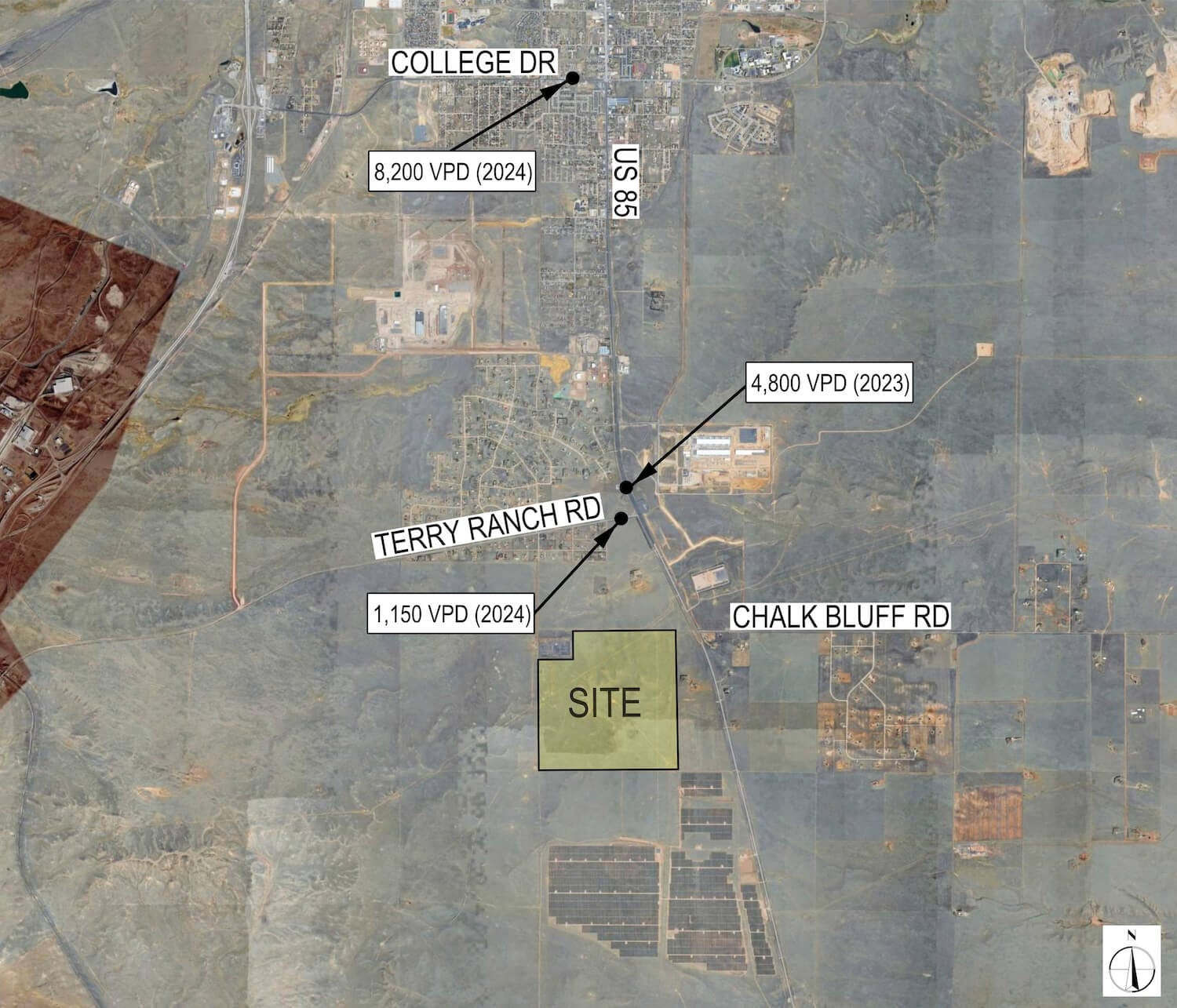
Source: Laramie County Planning & Development.
On December 4, 2025, the ranch changed hands outright: Lazy D transferred the park and several sections around it — including the lots the data center and the power project sit on — to Tallgrass-owned Cheyenne Power Hub, LLC by warranty deed. And the buying has not stopped: on July 24, 2026, Lazy D sold Tallgrass a further full section southeast of the industrial park, roughly 640 acres, plus part of another.
Switchgrass Industrial Park is a 1,375-acre planned unit development across five lots: the data center project area is 715.9 acres (Lots 1–3), and the generation site, known as Cheyenne Power Hub, is another 659 acres (Lots 4–5).
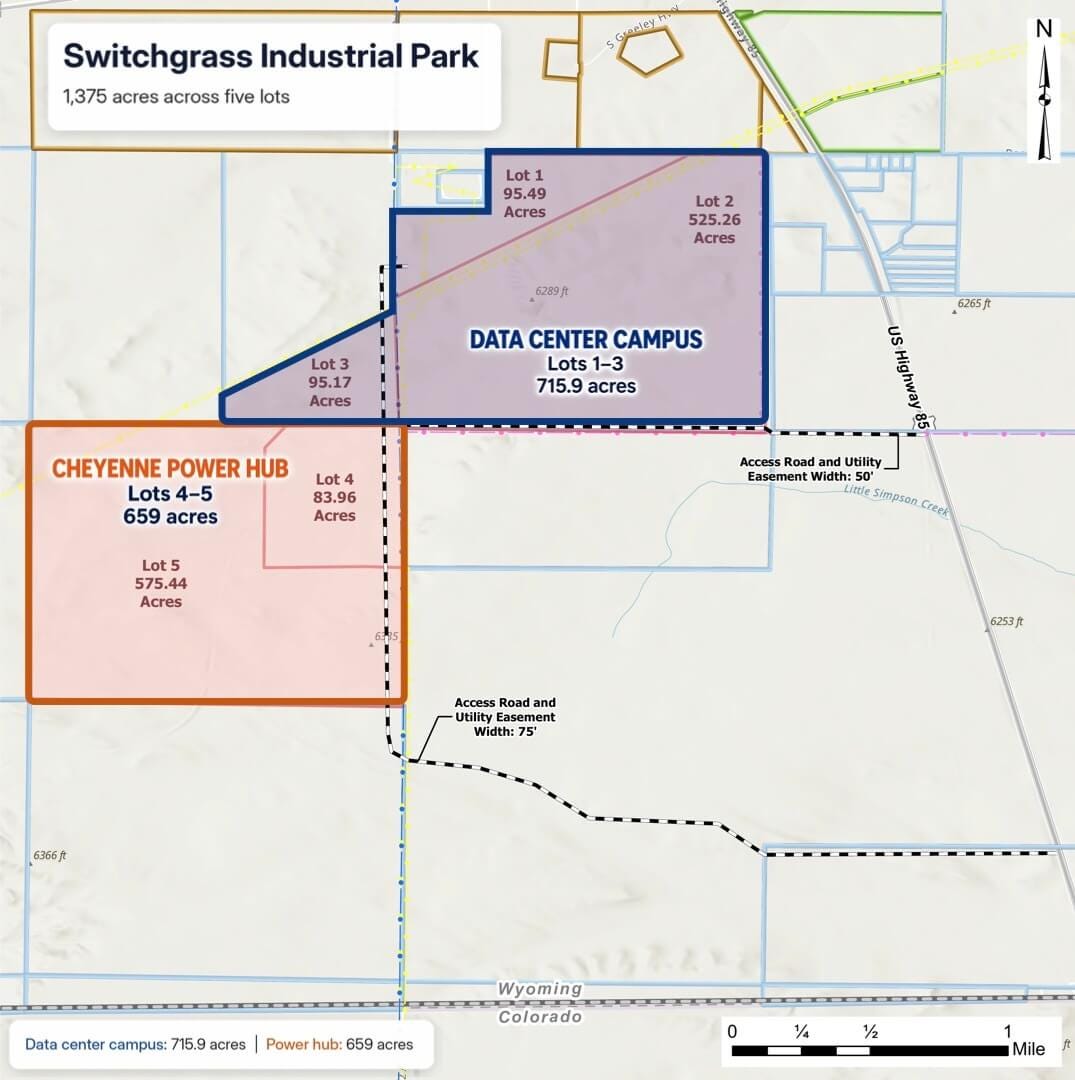
Source: Laramie County Planning & Development. Measured AI annotations.
The entitlement moved fast: a zone change was filed in July 2025 and approved in October 2025 with no conditions. Both site plans — data center and power plant — cleared the Laramie County Board of County Commissioners unanimously on January 6, 2026.
The land was the fast part. What sits on Lots 1 through 3 is what Google inherited from Crusoe — and then cut.
The resubmitted campus is smaller than the one Crusoe permitted. The county memorandum records the program dropping from five data center buildings to four, from 4.0 million square feet of built area to 3.08 million square feet. Of this total, the four data center buildings (DC-1A, DC-2A, DC-3A, and DC-4A) will make up 2.84 million square feet, with the remaining 240,000 square feet made up of office, logistics, and network buildings.
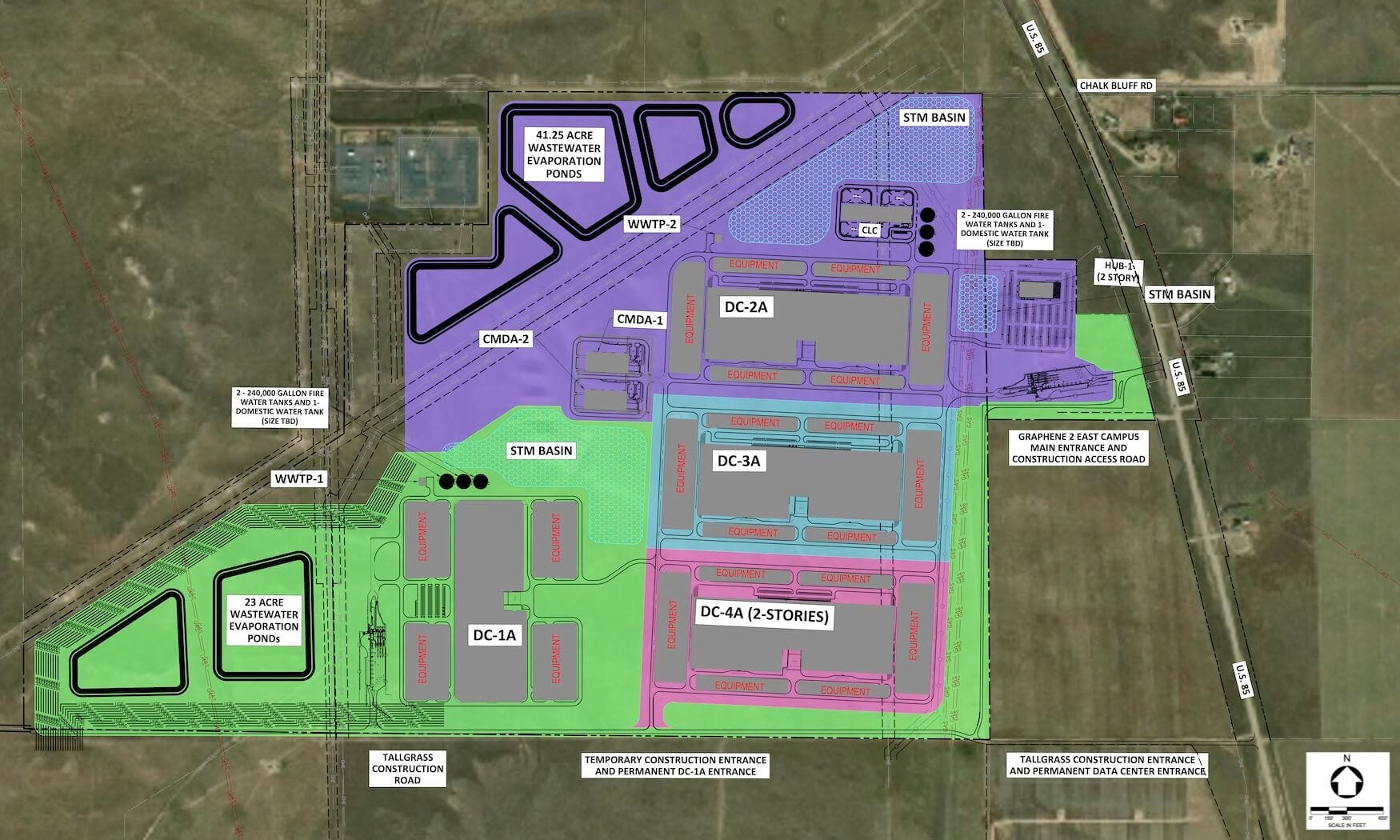
Source: Laramie County Planning & Development.
The memo also records a smaller construction force: peak workforce “reduced from 5,000 to 2,500,” both figures belonging to the data center program. Tallgrass’s Cheyenne Power Hub (discussed next) is counted separately, with its most recent studies putting its peak workforce at 2,740 workers in early 2028. Laramie County’s planning director has described the program as a build-out running to 2031.
The buildings are not the whole build. The campus also carries battery energy storage systems (BESS) — an on-site battery bank that sits behind Google’s meter, unlike every asset that actually makes power.
The site plans name Google as “developer and owner of the project.” What is not in question is the limit of what Google will own: four data center buildings, on ground held by Tallgrass, drawing a load Google will not generate a watt of.
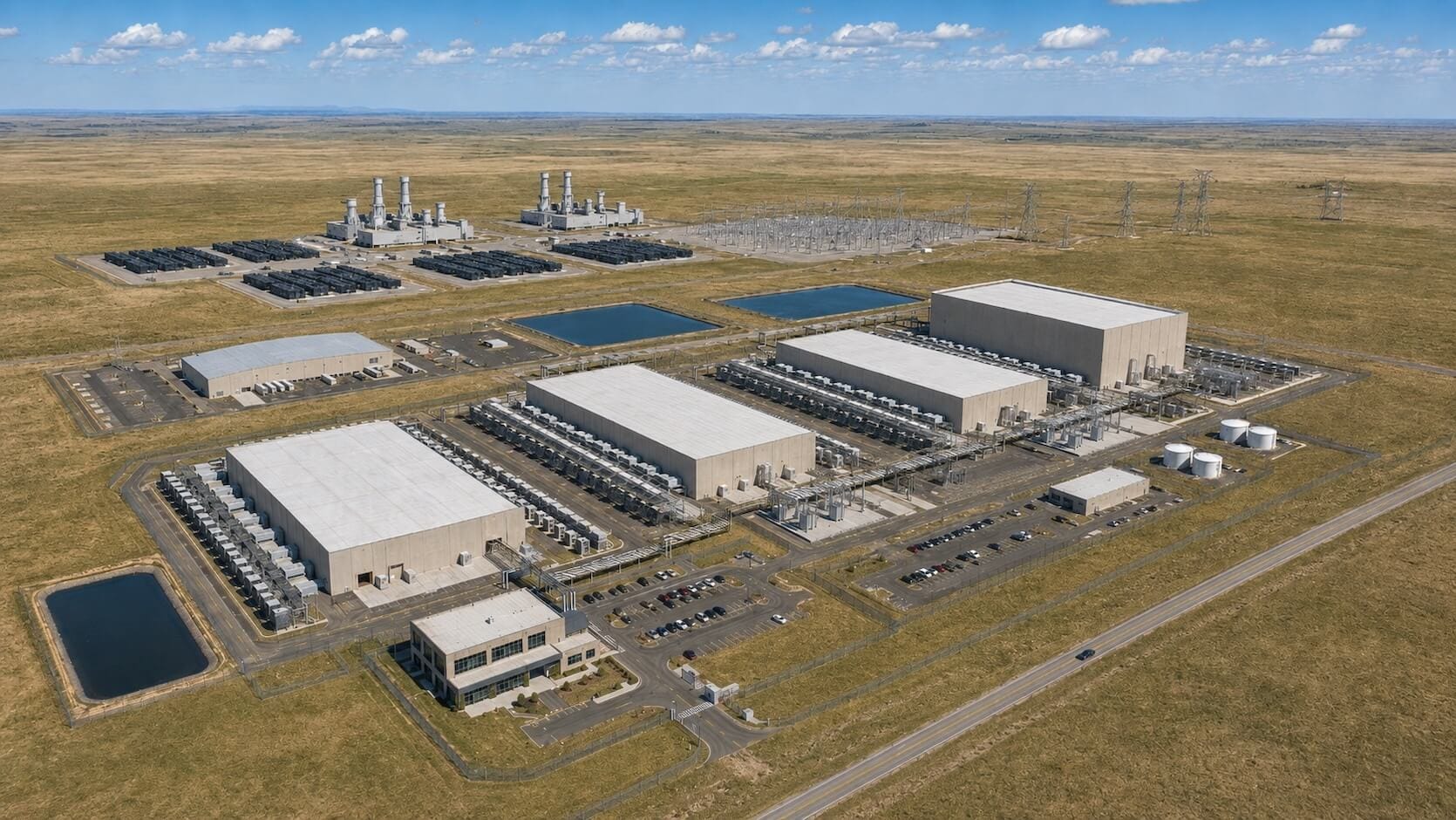
Everything hard about this project sits upstream of that meter.
The Cheyenne Power Hub is what Google did not buy. Owned and built by Tallgrass, it occupies 659 acres immediately southwest of the data center tracts and holds two natural gas power generation facilities, two aeroderivative substation yards, three fuel cell yards leased to an American Electric Power subsidiary, a gas meter station at the southeast corner fed by Tallgrass’s own pipeline, and one 230 kV substation yard where every megawatt on the property converges.
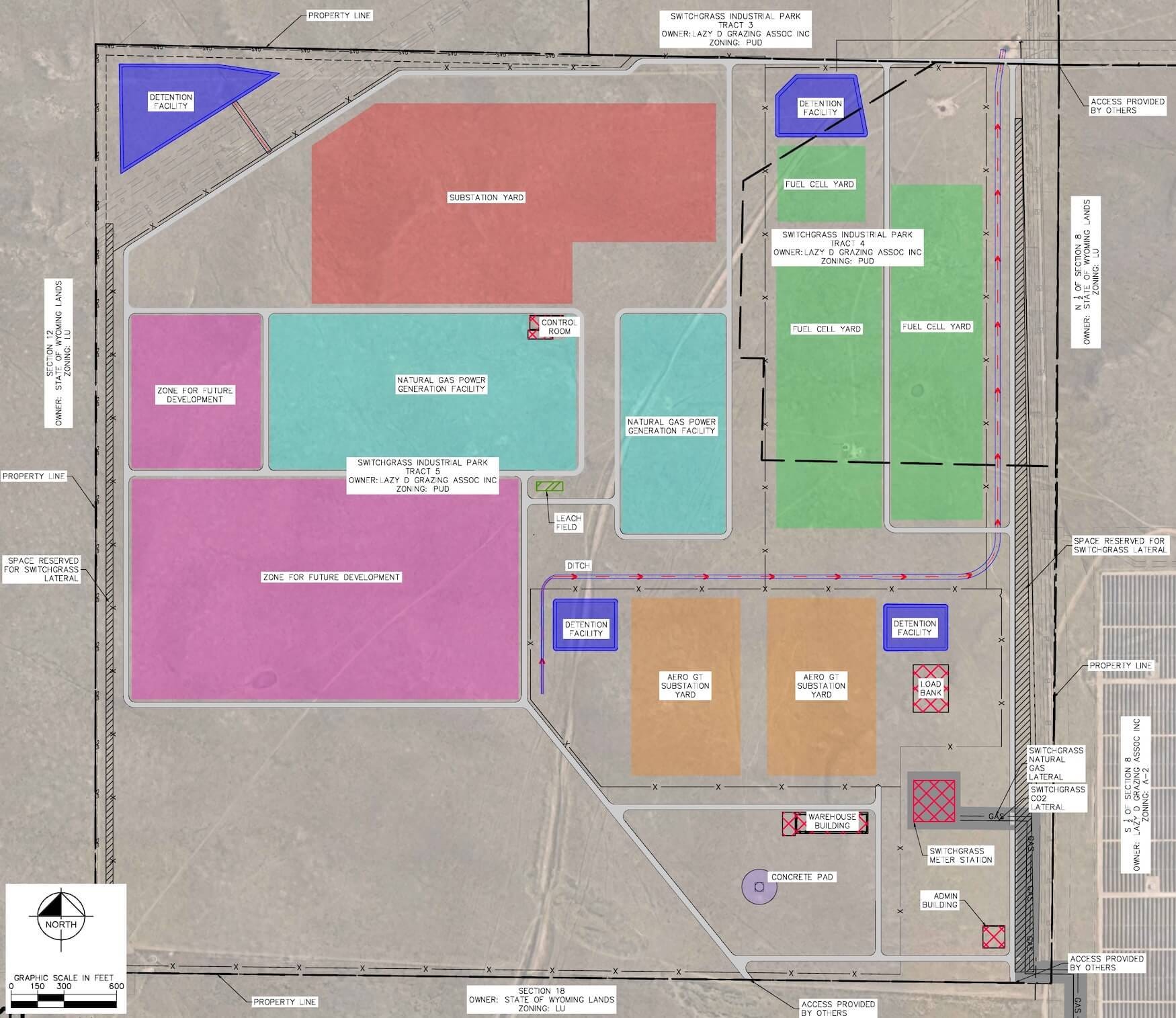
Source: Laramie County Planning & Development.
The two natural gas-fired power generation facilities are the permanent plant that will run the campus long term, owned by Tallgrass. They hold the turbines: two Mitsubishi M501JAC combined-cycle units — announced from Tokyo on May 15, 2026. These combined-cycle turbines will provide approximately 1.15 GW of site-ready power as Phase 1 of the Cheyenne Power Hub, with major components scheduled to begin arriving in July 2026 and total investment that “will exceed $7 billion.”
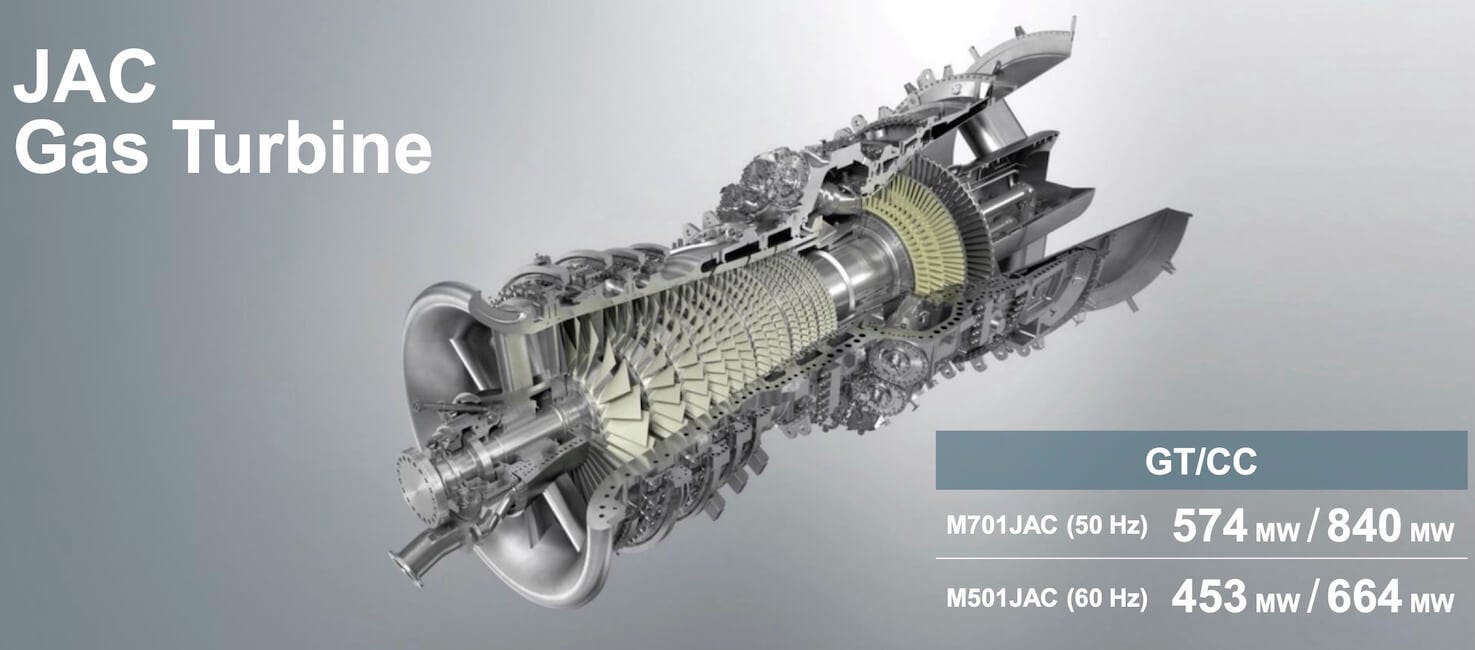
Source: Mitsubishi Heavy Industries.
More precisely, from the permit’s perspective, the two M501JAC combined-cycle units can produce 1.16 GW at this site — the pair’s 1.33 GW ISO nameplate derated 12.7% by Cheyenne’s ~6,200-foot elevation and ambient conditions to 580 MW each in combined-cycle mode.
The two aeroderivative substation yards are the bridge-and-backup fleet. These are the aeroderivatives — jet-engine-derived machines, small, modular, fast-starting, several of them literally trailer-mounted (e.g., the GE TM2500 — see below).
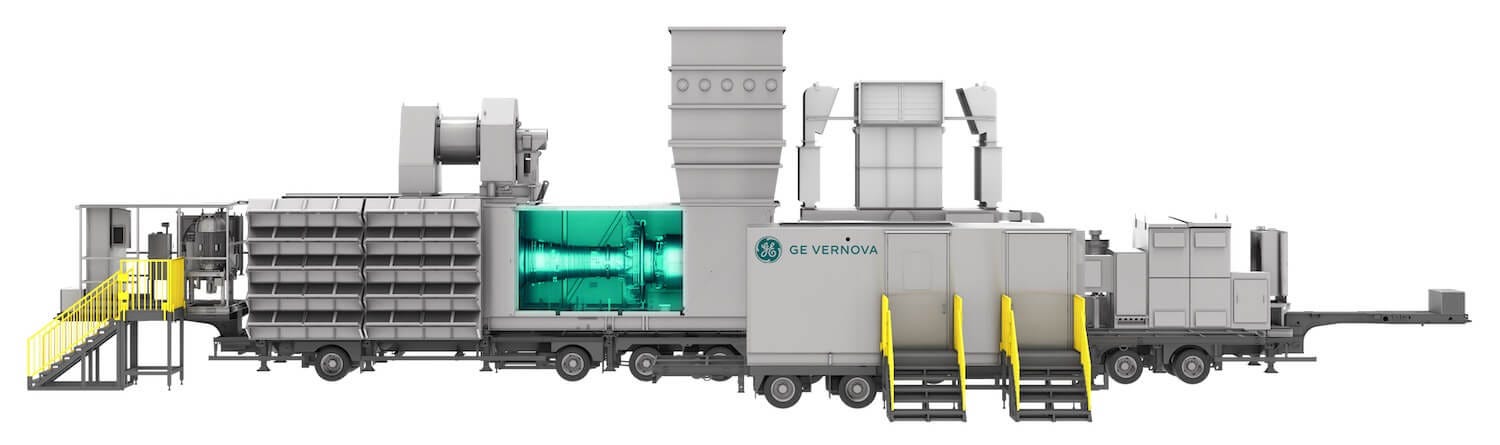
Source: GE Vernova.
The temporary units provide early generation for initial data center loads, plus startup and backup power for the combined-cycle plant, while the permanent units provide base-load generation that supplements and backs up those same units. Together they carry the load before the combined-cycle plant is commissioned, and back it up after.
The air permit issued July 2, 2026, authorizes 42 turbines: the two M501JACs, 16 permanent simple-cycle units, and 24 “temporary” simple-cycle units — a fleet totaling 2.20 GW at site rating and 2.76 GW at ISO rating.
An amendment now pending would swap the fleet again: 56 turbines — the M501JACs plus 30 Baker Hughes NovaLT16s and 24 Mitsubishi FT8s — totaling less capacity: 1.83 GW at site rating and 2.58 GW at ISO rating.
More machines, fewer megawatts, and not yet issued. The timing explains it better than the machines do: the amendment was filed July 21, just weeks after Google took over and cut the campus from five buildings to four. The generation shrank with the buildings — though the load did not, since the utility record still describes a 1.8 GW data center through August. It also re-cuts the supply chain: the issued permit’s simple-cycle fleet is GE-based, while the amendment splits the 56 machines between Baker Hughes (30) and Mitsubishi (26) and leaves GE Vernova out entirely.
The environmental math is major-source scale in every direction. All nine regulated pollutants trigger federal Prevention of Significant Deterioration review; greenhouse-gas potential to emit is 10.4 million tons of CO₂e per year; modeled PM₂.₅ sits at 96% of the annual air-quality standard and cumulative one-hour NO₂ at 99.7% — about as close to the line as a permit can be written. The permit requires an ambient monitoring network within 180 days of startup, run at least three years.
The fuel cells are dedicated generation running on the same natural gas as the turbines, converting it to electricity electrochemically instead of burning it — no flame, no rotating machinery, no water in normal operation.
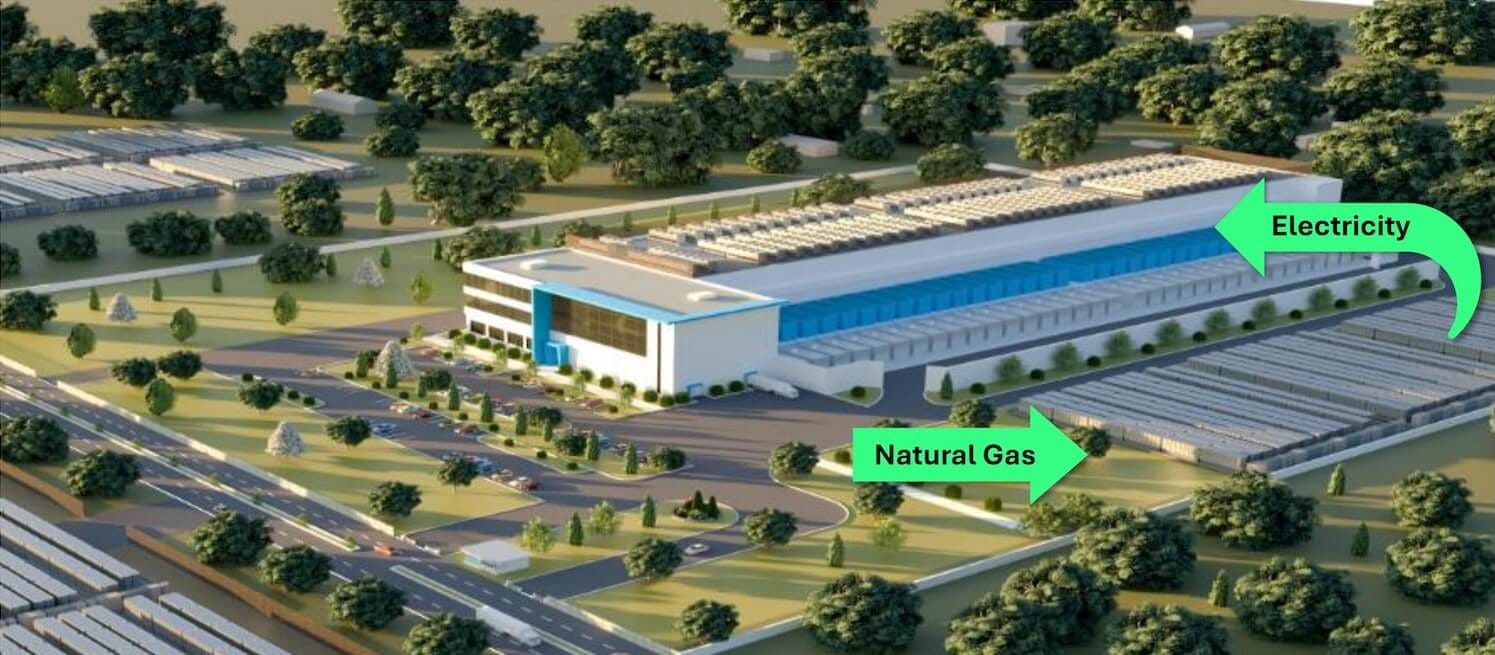
Source: Bloom Energy.
The three fuel cell yards sit on 86.8 acres owned by Tallgrass, through its Cheyenne Power Hub subsidiary, and leased to AEP in January 2026. The fuel cell supply chain has two parties:
1. Bloom Energy manufactures and sells the solid-oxide units — an initial 100 MW order under a framework for up to 1 GW, backed at signing by a $100 million letter of credit. The two Bloom models being purchased are the Energy Server 5 (ES-5) and Energy Server 6.5 (ES-6.5) — with the ES-6.5 making up the bulk (up to 900 MW) and the ES-5 a 72 MW tranche.
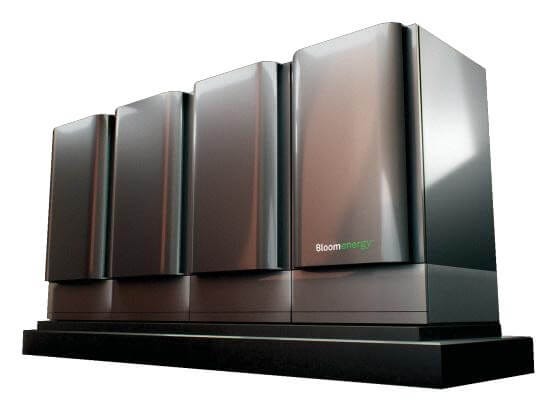
Source: Bloom Energy.
2. American Electric Power (AEP), through its unregulated subsidiary, Cheyenne Fuel Cell, LLC, is the buyer, developer, owner, and offtake counterparty of the fuel cells. In January 2026, AEP purchased the fuel cells for approximately $2.65 billion. As of June 30, 2026, AEP carries the whole facility at $4 billion of incremental capex, with an in-service date by 2028. The fuel cell array actually being interconnected comprises approximately 650 MW of capacity — the air permit authorizes a 900 MW not-to-exceed ceiling. AEP has established a 20-year offtake agreement selling 100% of the output of the fuel cell generation facility to Google — a commercial layer sitting over the physical sale, since the FERC filing has the fuel cells’ entire output going to Black Hills for resale at retail.
The offtake’s conditions deadline was extended by mutual agreement in June 2026 — the month Crusoe exited — with a decision milestone in December 2026 intact. AEP’s CFO has said the company can “put the fuel cells back to the hyperscaler at a cost plus” roughly 10% if the deal fails, and that Google may elect to deploy the fuel cells at an alternate location — “could be anywhere in the U.S.” — if the Cheyenne site does not advance.
The commercial clock is set by the federal tax code: the cells must be “installed and ready to go by the end of 2028 to qualify for the investment tax credit.”
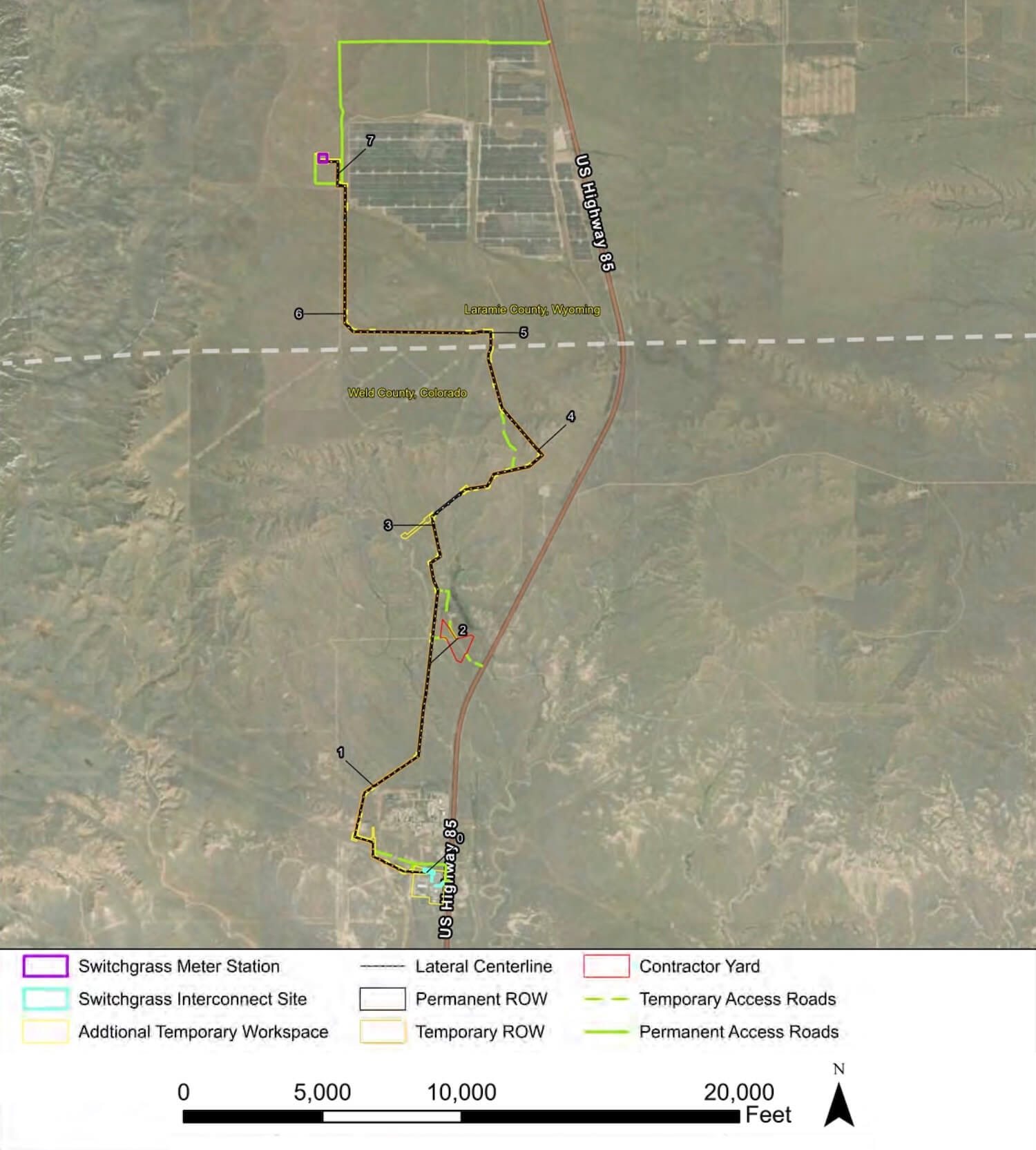
The fuel artery is Tallgrass’s own. Rockies Express Pipeline (REX) is a 1,700-mile interstate pipeline that originates in Rio Blanco County, Colorado, to the southwest and runs across Wyoming’s southeast corner, where Google’s Project Tembo sits. Here, Tallgrass is building the Switchgrass Interconnect: 7.2 miles of 36-inch lateral rated at 419,000 dekatherms a day, a $57.3 million project.
Source: Federal Energy Regulatory Commission (FERC).
Construction of the Switchgrass Interconnect began March 2, 2026; as of July 2026, pipe was being strung and bored, with concrete work finishing at the meter station.
The Substation Yard, known as the CPH Substation, is the largest block on the Cheyenne Power Hub’s site and generates nothing. It sits along the northern edge of the site — half a mile from the utility’s Robinson Substation — and it is the reason the whole arrangement is legal.
Tallgrass’s FERC filing describes what runs in and out: 230 kV lead lines roughly 1,000 feet long from the combined-cycle plant, 2,000 feet from the second gas facility, and 1,000 feet from the fuel cells, all terminating in the CPH Substation, with “approximately twenty 1.5-mile, 34.5 kV lead lines” running out the far side to the data center. Bechtel is a contractor of record on the yard.
Two half-mile 230 kV lines — these owned by Black Hills — connect the yard to Robinson Substation, Black Hills’ new switching station to the north, which terminates transmission at 230 kV and steps nothing down.
Every transformation the campus needs happens at the CPH Substation, on Tallgrass ground, and so does every sale. The waiver Tallgrass is asking FERC for turns on this one asset and the lead lines feeding it.
Everything in Section V ends at the same commercial destination: Black Hills’ Cheyenne utility buys the output and sells it to Google at retail. That makes the tariff architecture the load-bearing structure of this project, and it is an architecture with a history: Google is stepping into a rate framework a different hyperscaler built.
Cheyenne Light, Fuel and Power — Black Hills’ Wyoming electric utility, called Wyoming Electric in Black Hills’ investor disclosure, then serving about 41,000 customers — “was contacted in 2011 and asked to provide a proposal to serve a large data center,” and the framework that emerged is the Large Power Contract Service (LPCS) tariff, filed in October 2015 and litigated with Microsoft as an intervenor telling the Commission that “Approval of the Tariff is essential to Microsoft’s plans for its data center in Cheyenne.” The Commission approved it in July 2016, writing that “the potential new load is large enough to nearly double the load of CLFP existing system” and calling the tariff “the beginning of a controlled experiment to be conducted under our continuing supervision.”
Three design choices from that docket now define Google’s deal a decade later:
LPCS customers form their own ring-fenced class — costs “assigned to them individually based upon cost causation principles,” with no allocation of the utility’s existing generation fleet.
Capacity is the customer’s problem: the current tariff book requires each LPCS customer to maintain Eligible Capacity Resources of at least 115% of its actual peak monthly load, from a set of options that includes “Company-owned generators built specifically for one customer served under this Rate Schedule” — the exact category a dedicated gas fleet sold to the utility slots into — and a 2024 amendment approved by the Commission made customer-owned on-site backup generation an LPCS obligation.
The consequence: the utility’s 2026 resource plan states outright that it “does not address Large Power Contract Service (LPCS) tariff capacity needs, which are handled separately under customer-specific agreements.” The plan forecasts 650 MW of contracted LPCS peak by 2031–2033 — counting only customers with agreements already in place — and provides no capacity resources for any of it.
A campus announced at 1.8 GW is absent from its serving utility’s capacity plan by design.
The money moving today runs through an instrument that barely has a name in the tariff. On April 22, 2026, “Wyoming Electric entered into a generation reservation agreement with a prospective new customer seeking to construct a 1.8 GW data center in Wyoming subject to the LPCS Tariff” — Google — under which the customer advances refundable cash so the utility can make milestone payments to suppliers for long-lead generation equipment the utility itself may own.
The balance has climbed fast: $201 million disclosed in early May, $285 million on the June 30 balance sheet — booked as a current liability, “Refundable advances for construction,” a line that did not exist at year-end — and a July amendment raising the ceiling to $377 million with a maturity of August 31, 2026.
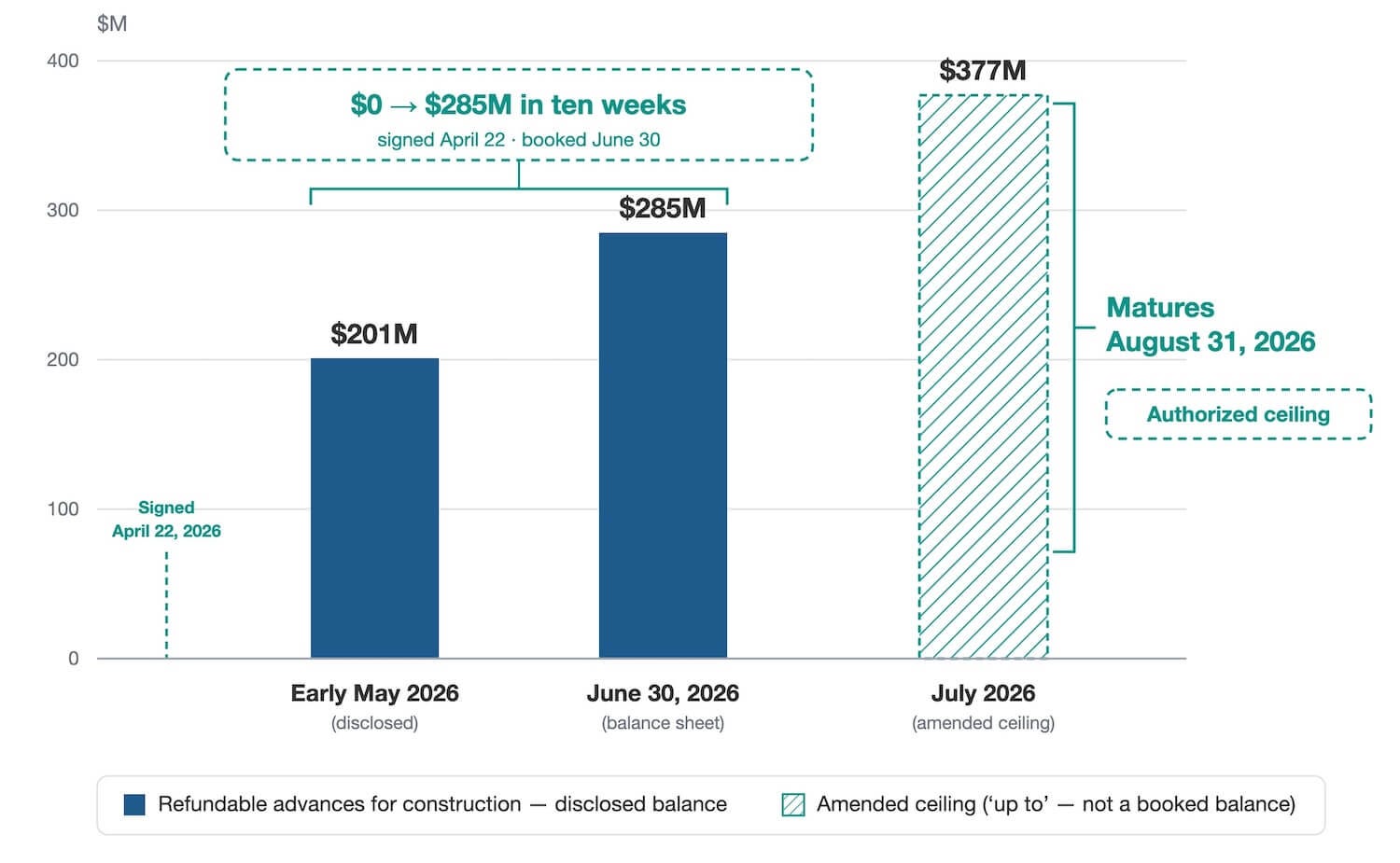
Black Hills calls it “a bridge agreement” while definitive agreements are negotiated; if it matures without renewal, the utility has said it would look to its revolver, short-term loans, and equity program to repay the advances. And the advances sit outside the tariff architecture entirely: none of the large-load tariff instruments mentions contributions in aid of construction, so how customer money for generation equipment is booked, refunded or converted is not established anywhere in the public tariff record. Asked whether the reserved equipment covers the full 1.8 GW, CEO Linn Evans was direct: “No, it is not. And we’re not yet ready to announce what kind of megawatts we would serve.”
The hard commitments to date are narrower and physical: the reservation advances, and the Robinson Substation — a 230 kV interconnection substation with ten line terminals, six reserved for future use — approved in May 2026 at about $20.5 million. It is customer-funded and has been under construction since June 10, 2026.
The mechanism that decides whether any of this touches ordinary bills is a new tariff. On June 19, 2026, Cheyenne Light asked the Commission to approve a Large Customer Transmission Cost Adjustment Mechanism — LCTCAM — by September 1, effective January 1, 2027. Its design principle, in the utility’s words, is that “cost allocation follows cost causation”: large-load customers — those on the LPCS tariff, or with dedicated transmission facilities of 25 MW or more — “will pay 100 percent of LCTCAM costs” — new transmission plant built for them — plus their load-ratio share of the shared system. Those obligations rest on 10-year demand forecasts that are binding and ratchet only upward, backed by an exit-fee provision and collateral requirements, with the utility earning a return on construction work in progress as it builds.
Black Hills frames the whole architecture to investors as service that “is fully self-supporting and does not shift costs to other customer classes,” and to Wyoming as alignment with Governor Mark Gordon’s executive order titled “Data Centers the Wyoming Way.”
The same cost-shifting protection exists at the federal level: since 2025, the utility’s FERC transmission formula excludes any plant “direct assigned to a large load Cheyenne Light retail customer” from wholesale rates — an exclusion that went from zero to $78.8 million of plant in its first year of operation, with a workpaper that names six plant accounts and no customer.
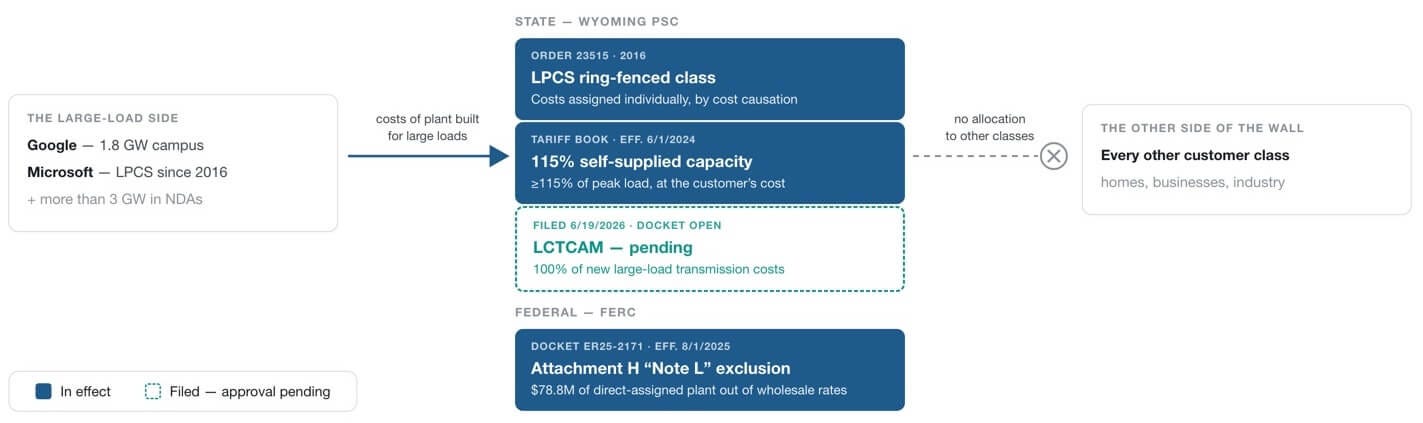
The docket is where the campus’s economics will be tested, and the parties tell you who has skin in it. Microsoft intervened in the present tense — it “owns and operates data center facilities in Cheyenne … and is a customer” whose transmission-cost responsibility is directly at stake. Google intervened with the hedged petition quoted in Section I. Industrial customers Dyno Nobel and Cheyenne Renewable Diesel — veterans of the 2016 fight — brought consultants; the state’s consumer advocate is reviewing. None has yet stated a position on the merits.
The scale mismatch explains why every one of these mechanisms exists. Wyoming Electric’s all-time peak load is 439 MW, set in July 2026 — up 40.7% in three years, driven by data center growth that does not yet include this project. The Google campus’s 1.8 GW ultimate load is roughly four times that entire system.
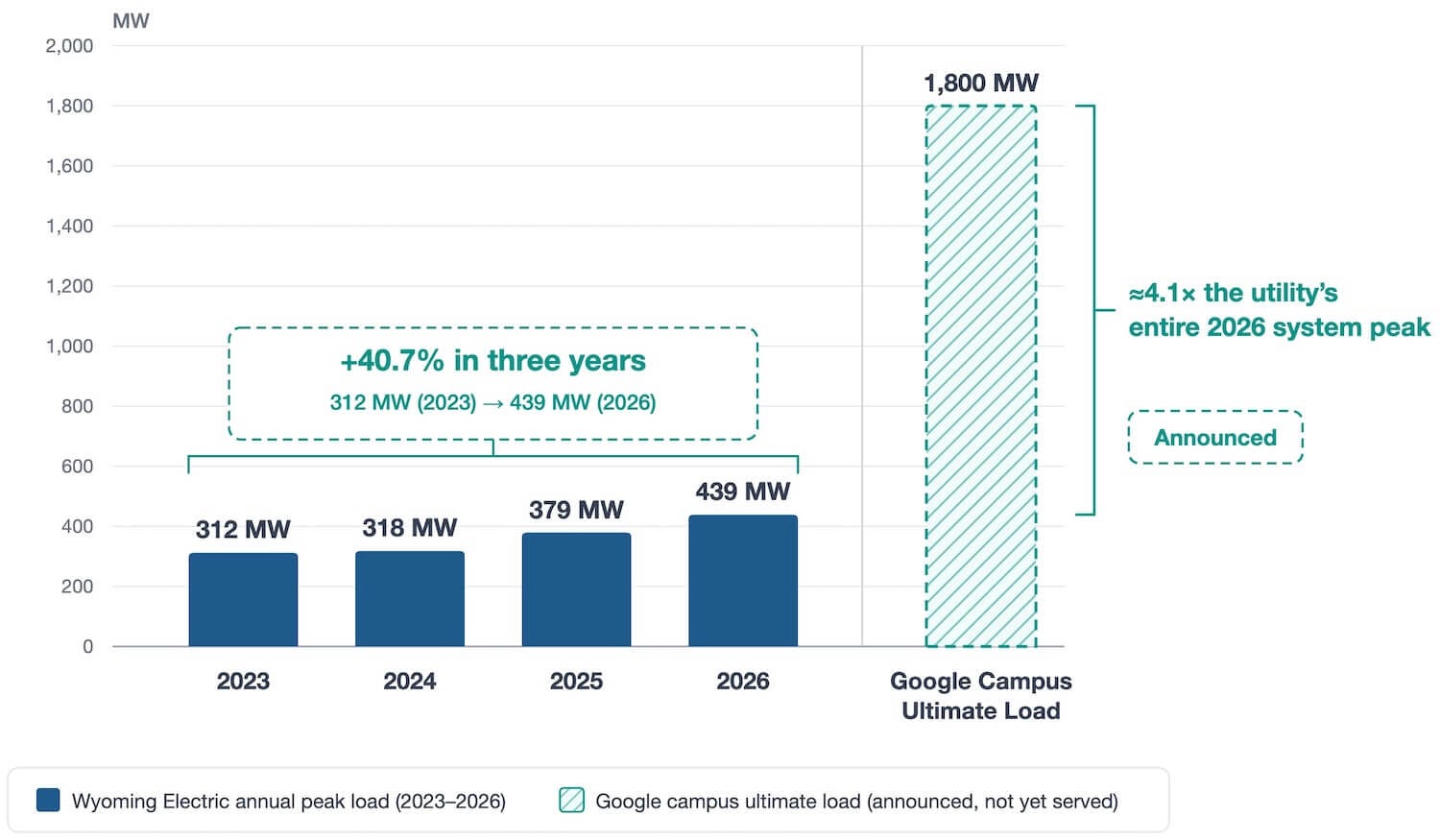
The utility’s disclosed pipeline has tripled to more than 3 GW of signed NDAs, but its five-year, $4.7 billion capital plan carries only the approximately 600 MW of Microsoft and Meta load already under agreement — this project enters the plan only when definitive agreements sign, and would be financed on top of it.
The structural shift is in the service model: Black Hills describes three ways it serves large loads — market energy with a management fee (Microsoft and Meta today), contracted resources, and utility-owned rate-base generation “recovered through rates specific to customer.”
Project Tembo is positioned to be the first customer served under the third model. The reservation agreement’s long-lead equipment — the piece the utility itself may own — is what points there; the generation in Section V is Tallgrass’s, bought under contract — the second model. Which one the campus lands in is what the definitive agreements will settle.
Electricity is the layer where Google’s money is most visible. Water, the campus’s other critical input, runs even further from its owner.
What the record establishes is what the campus may draw, not what it will use — and its most consequential filing is the one still pending.
The campus’s water is groundwater, permitted through the State Engineer’s Office in seven filings whose combined ceiling comes to roughly 620 to 645 million gallons a year (1,895 to 1,974 acre-feet, the spread depending on whether pumping rates or annual volumes are totaled). Nearly all of it sits in two production wells, and only one of those is permanent — the other is a construction well whose right expires December 31, 2030.
Only one permit states cooling as a use: the campus’s permanent industrial well, applied for January 2, 2026 and permitted at 315 million gallons a year (967 acre-feet), restricted to a single completion in either the deep Lance or the Fox Hills formation, with multiple-formation completion expressly prohibited. The campus takes no municipal water.
The applicants’ consistent public position is that the ceiling overstates the draw: the county minutes record that the company “will drill its own well and will utilize closed-loop water resources”; the pre-application file puts the requirement at “approx. 2 million gallons“ reused in a closed system. The Tembo narrative commits to “no ongoing water demand for cooling operations” beyond an initial fill, and at the January 2026 hearing the applicant told the Board each data center fills once with the equivalent of about 20 households’ annual water use and consumes “less than three households” ongoing.
Source: Laramie County Planning & Development.
Nearly everything unresolved about Project Tembo carries a date, and most of the dates land within a year.
August 31, 2026 — the $377 million maturity. The generation reservation agreement’s amended term ends, with definitive agreements between Black Hills and Google targeted “by the end of the quarter.” Signature converts the project’s entire commercial base from a refundable bridge into contracts; a further extension keeps the utility fronting supplier payments on customer cash.
September 1, 2026 — the FERC waiver. Cheyenne Power Hub asked for its waiver order by this date to support a September financing launch, and promised a market-based rate application “shortly.” The generation configuration is “not yet final and may change”; the financing and the fleet harden together.
December 2026 — the fuel-cell decision. AEP’s amended offtake milestone comes due, with Google holding the option to move the fuel cells elsewhere if Cheyenne “does not advance,” and AEP holding a cost-plus put-back.
February 15, 2027 — the first metered water. The production wells’ first annual water-use reports are due, replacing the households-versus-ceilings argument with numbers.
Early 2028 — first service. This is the current target, already moved once from the “Q1 of 2027” that management described in February 2026. Robinson Substation and the Switchgrass lateral are under construction; the M501JAC components were scheduled from mid-2026.
Measured AI provides institutional-grade analysis of the physical infrastructure powering AI data centers. For access to our full research library, regulatory intelligence, and weekly briefings, visit MeasuredAI.com.
No posts
Comments
Nothing yet. Say the first thing.
Sign in to join the conversation.