
On December 4, 2023, three governmental bodies in El Paso — a city at the western tip of Texas, bordering New Mexico and Mexico — committed to the same project in a single day. The El Paso County Commissioners Court approved a tax abatement and an economic development agreement for the project, City Council approved its own incentive agreement at a special meeting, and El Paso Water’s board unanimously reserved 2.5 million gallons per day for the same customer. The name on every instrument was Wurldwide LLC, a Delaware company — a prospect El Paso County had negotiated with in closed session for over a year and a half under the code name “Project Seafox.”
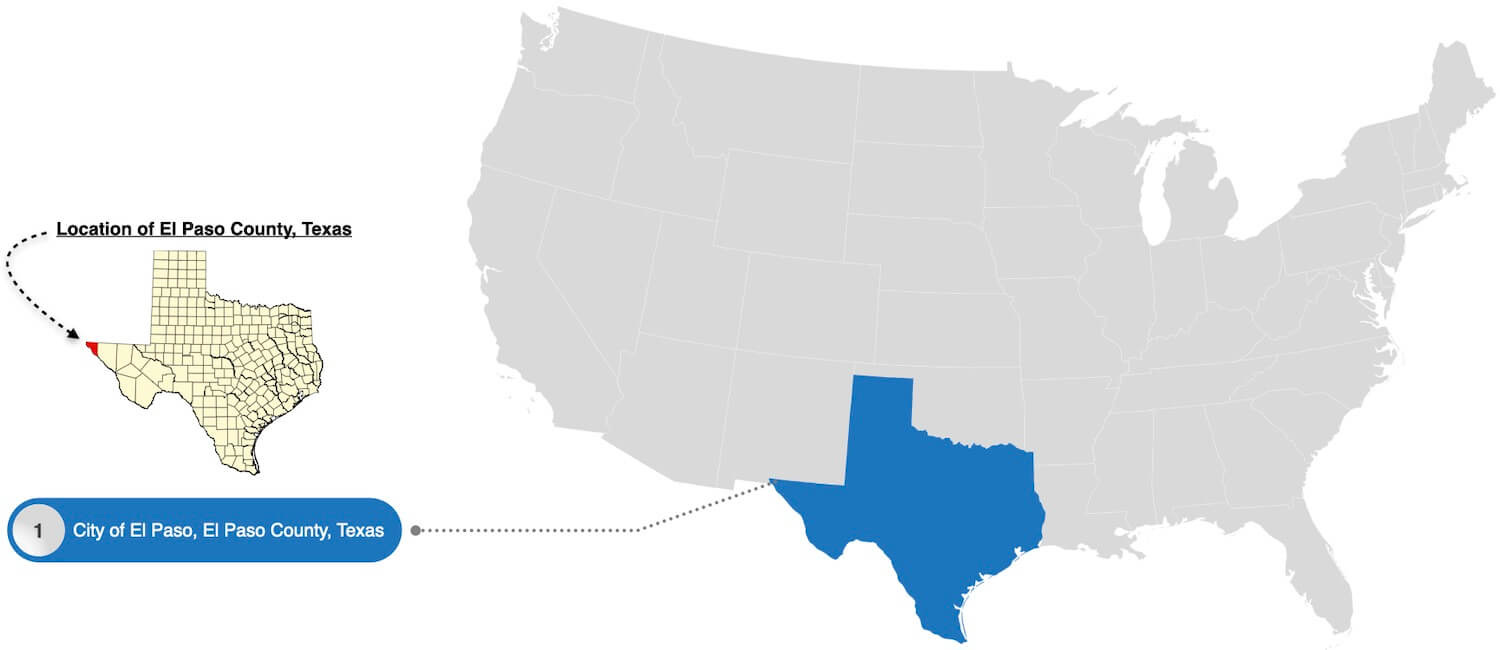
Over two-and-a-half years later, another entity surfaced in New York. On July 27, 2026, a Delaware shell company named after a fried pastry — Sopaipilla Investor LLC — priced roughly $12.5 billion of senior secured notes. The next morning, Meta and BlackRock announced what the money was for: an 80/20 joint venture to build a $14.3 billion, 960 MW, 4-million-square-foot AI data center campus on 1,039 acres in El Paso, Texas.
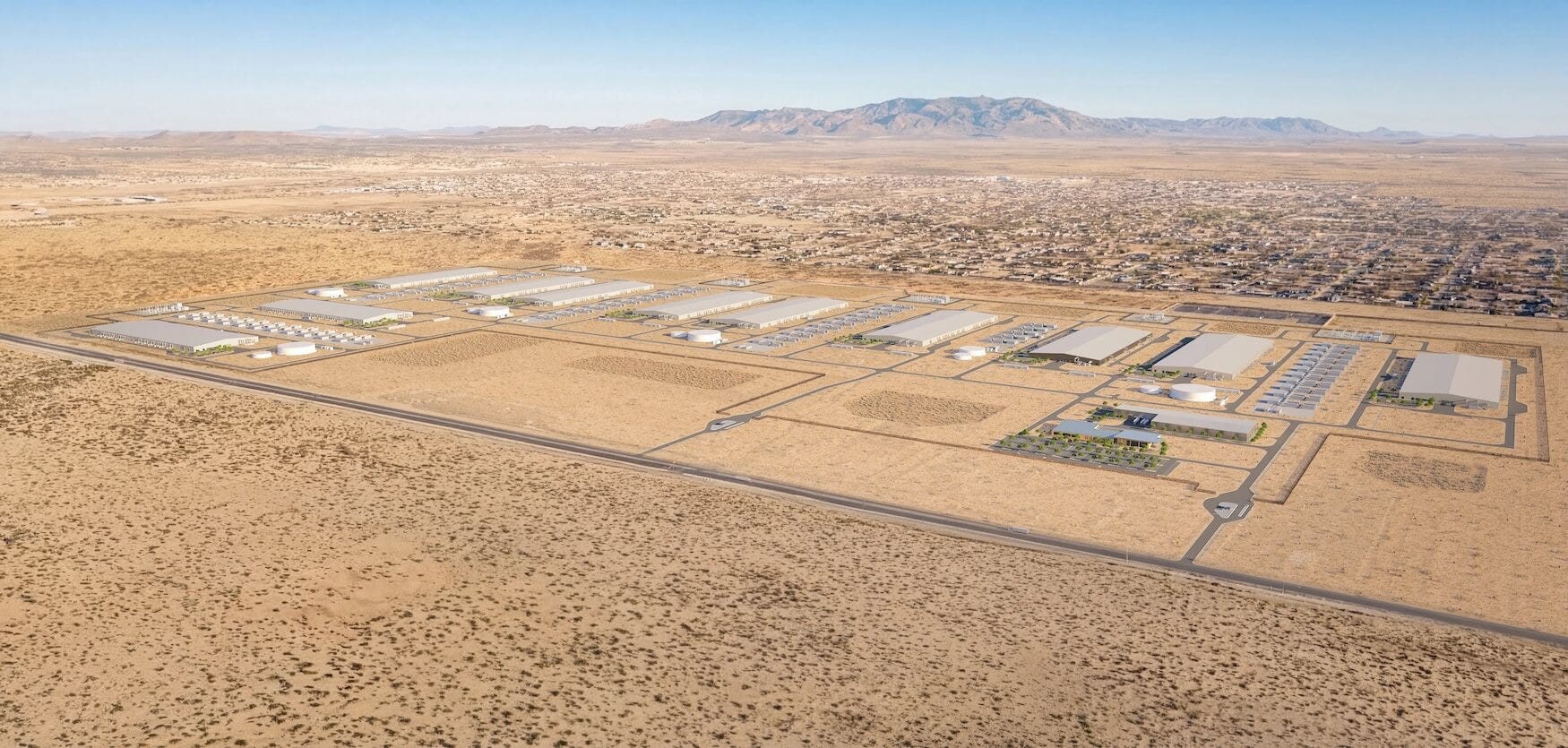
Source: Meta Platforms.
What makes El Paso, Texas, a case study worth exploring in detail is that, for once, both ledgers are public. Meta engineered one of its largest disclosed campuses so that it would not own it — Meta is the 20% member and the tenant of a venture BlackRock’s funds control — and the rated bond that moved the debt off Meta’s balance sheet also forced the deal’s full economics into view: the lease terms, the guarantees, the rent mechanics, even the sponsors’ return thresholds. That is disclosure the hyperscalers’ self-built campuses rarely produce.
Read against the local record — the covenants El Paso actually signed, the tariff invented for the load, the bridge power plant its utility is buying, the water contract that survives any drought — the two ledgers show, line by line, how the risk of a frontier AI campus gets distributed: bondholders and the electric utility got Meta’s guarantees, and El Paso’s governments got the project SPV, Wurldwide LLC.
This AI data center primer walks through Meta’s El Paso campus ledger by ledger: the bet and the balance-sheet strategy behind it, the deal Wall Street was sold, the campus itself, the gigawatt of power arranged outside ERCOT, the water, and the instruments El Paso signed.
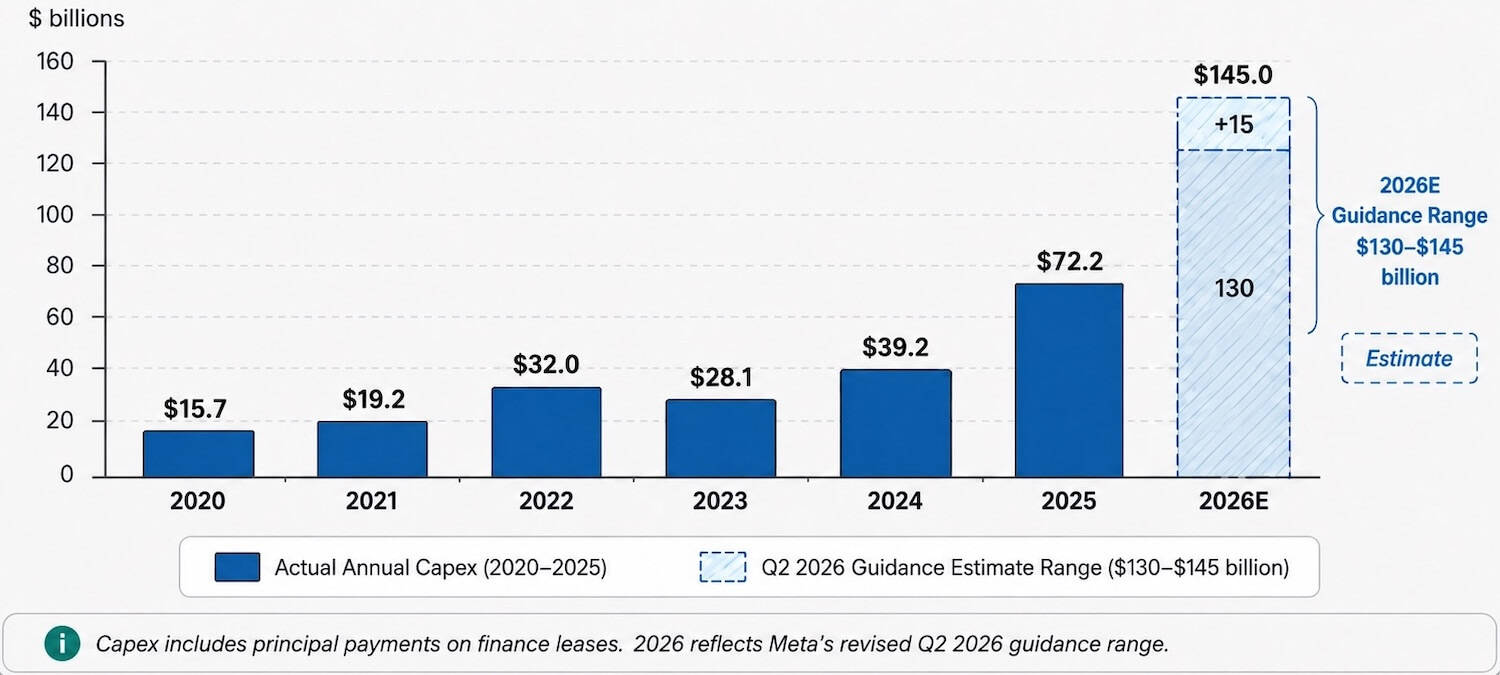
Meta’s problem is not demand for compute; it is where to put the cost of the buildings. The company spent $72 billion of capex in 2025 and guided 2026 to $130–145 billion to support its AI efforts and core business.
Meta’s non-cancelable contractual commitments ran from $131 billion at year-end 2025 to $349 billion by June 30, 2026; leases signed but not yet commenced reached $279 billion, plus roughly $68 billion more signed in July 2026 alone.
Long-term debt went from $59 billion to $84 billion in six months, and free cash flow in Q2 2026 was $784 million — against $8.5 billion in the same quarter a year earlier.
A gigawatt-scale AI data center campus like El Paso is what that squeeze produces: a campus Meta needs, pays for, operates, and guarantees, but deliberately does not own.
The strategic frame is AI. On Meta’s Q2 2026 earnings call, the company described AI usage across its products as still ramping, with a significant share of its compute headed to training models, growing the core business, and delivering personal agents and new products — the demand a campus like El Paso exists to serve.
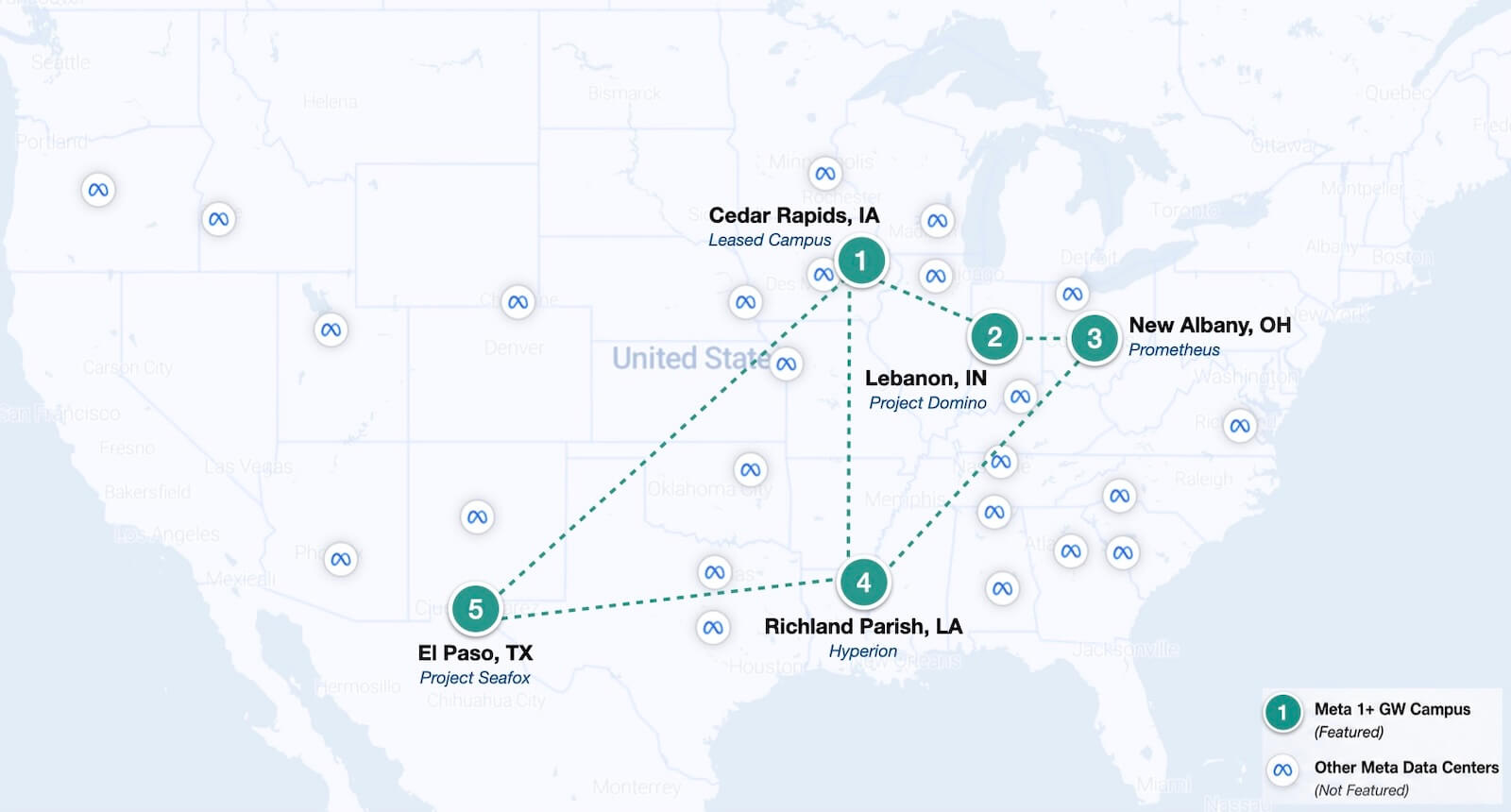
The El Paso campus belongs to Meta Compute, the internal division building AI infrastructure and pairing “Meta’s infrastructure expertise with capital partnerships that deliver the speed and flexibility its long-term AI ambitions require.” El Paso sits within Meta’s fleet as one of five gigawatt-scale U.S. AI data center campuses — alongside Prometheus in Ohio, Hyperion in Louisiana, Project Domino in Indiana, and the leased QTS Cedar Rapids campus in Iowa — tied together by a backbone network designed to link campuses nearly 1,500 miles apart — not a standalone training cluster but a node in a networked machine.
Every gigawatt-scale AI data center campus Measured AI has covered is, underneath, a story about ownership. Amazon owns everything at New Carlisle, Indiana, and points it at one customer. xAI built its own power plant rather than wait for a grid. Microsoft rents an entire gigawatt from a neocloud at Monarch in West Virginia.
El Paso is a different corner of the map: the landlord is an asset manager. Meta holds a 20% interest through Bluebonnet Crossing LLC — which doubles as the campus’s property and asset manager — leases the whole campus back through Roadrunner Leap LLC, and wraps the structure in parent guarantees. BlackRock’s funds, through Global Infrastructure Partners (GIP) and HPS Investment Partners, own the other 80%. Meta supplies the demand, the construction management, and the credit; BlackRock supplies the balance sheet.
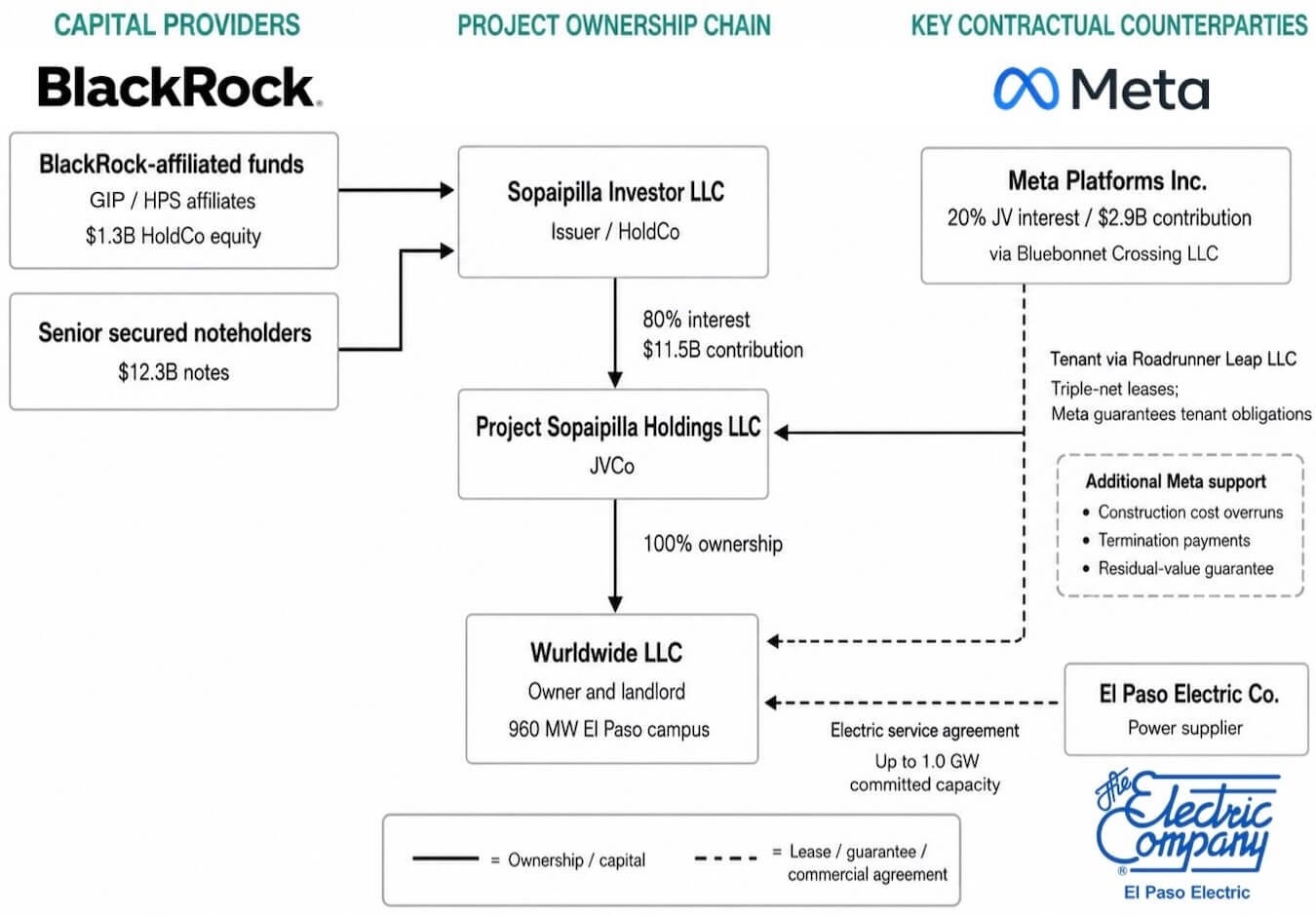
Senior secured noteholders and BlackRock-affiliated funds capitalize the note issuer (Sopaipilla Investor LLC), which holds 80% of the joint venture company alongside Meta’s 20%, and the venture itself owns Wurldwide LLC — the landlord on every El Paso instrument. Meta is everywhere except in control: tenant of the whole campus, guarantor of the leases, backstop for overruns and residual value.
Meta’s CFO Susan Li stated the rationale plainly: Meta has “been evolving our capital structure in recent years to include a greater mix of debt as we work to bring down our cost of capital,” and has “broadened our aperture there to include partnerships, like the one we announced with BlackRock.” Pressed by an analyst on how to think about “these off-balance sheet obligations,” she gave the structure’s two selling points — the leases let Meta re-evaluate its compute needs every four years, and “the value of the backstop also goes down over time.”
El Paso is the second run of a structure Meta debuted in October 2025, when it formed a venture with Blue Owl for the $27 billion Hyperion data center campus in Louisiana, financed through Beignet Investor LLC — the deal in which Meta first made use of the residual value guarantee (RVG) in data center construction. The Louisiana disclosures are the template for what El Paso will become in Meta’s filings: a 20% interest, accounted for under the equity method and not consolidated, yet carrying a stated maximum exposure to loss of $46 billion as of June 30, 2026. Meta manages the construction, administers the property, occupies every building, and guarantees the debt service chain; the venture is still not Meta’s, because Blue Owl controls what happens to the campus if Meta ever leaves.
The structure answers a problem every hyperscaler now shares: how to fund the buildings without carrying them. Borrowing through a project entity raises the construction money while keeping the debt, and the data centers themselves, off the parent’s books. El Paso is that answer made concrete, and because its financing was sold as rated public debt, it is the version where every term can be inspected.
The financing stack is engineered to do two contradictory-sounding things at once: keep the campus off Meta’s balance sheet, and make sure bondholders face nothing but Meta.
The structure raised $16.8 billion — about $17.5 million for every megawatt of the campus’s 960 MW of IT capacity — and nearly three-quarters of it is borrowed: $12.3 billion of senior secured notes against $4.2 billion of combined equity checks from BlackRock’s funds and Meta. All the leverage sits on BlackRock’s side. Its funds’ $11.5 billion goes into the venture through the note issuer, which borrows $12.3 billion against $1.3 billion of fund equity; Meta funds its 20% with its $2.9 billion contribution alone, unlevered. That is why the minority member writes the bigger equity check. Almost all of it goes into the ground, funding construction of the data centers.
At closing, Meta contributes roughly $2.3 billion of land and construction-in-progress, BlackRock contributes about $4.9 billion in cash, and Meta takes back a one-time distribution of approximately $1 billion to align ownership stakes — a net day-one contribution of about $1.3 billion, with the rest of Meta’s $2.9 billion commitment funded over the course of construction. Meta pays no rent until December 2028 while the notes accrue from 2026, so more than two years of coupon — $1.9 billion — is capitalized into the raise.
The venture’s own economics are disclosed too. Distributions run pro rata to BlackRock’s issuer and to Meta until the issuer clears an 8.25% IRR and a 2.4× multiple on invested capital — after which Meta’s reimbursements for cost overruns, power costs, and repair costs jump the queue ahead of it.
The leases convert a four-year commitment into two-decade-long paper. Meta’s subsidiary, Roadrunner Leap, signs eight leases — six triple-net, one for each pair of the 10 data center buildings, and one for the network building, plus two gross leases for the administration and infrastructure business operations support (IBOS) buildings.
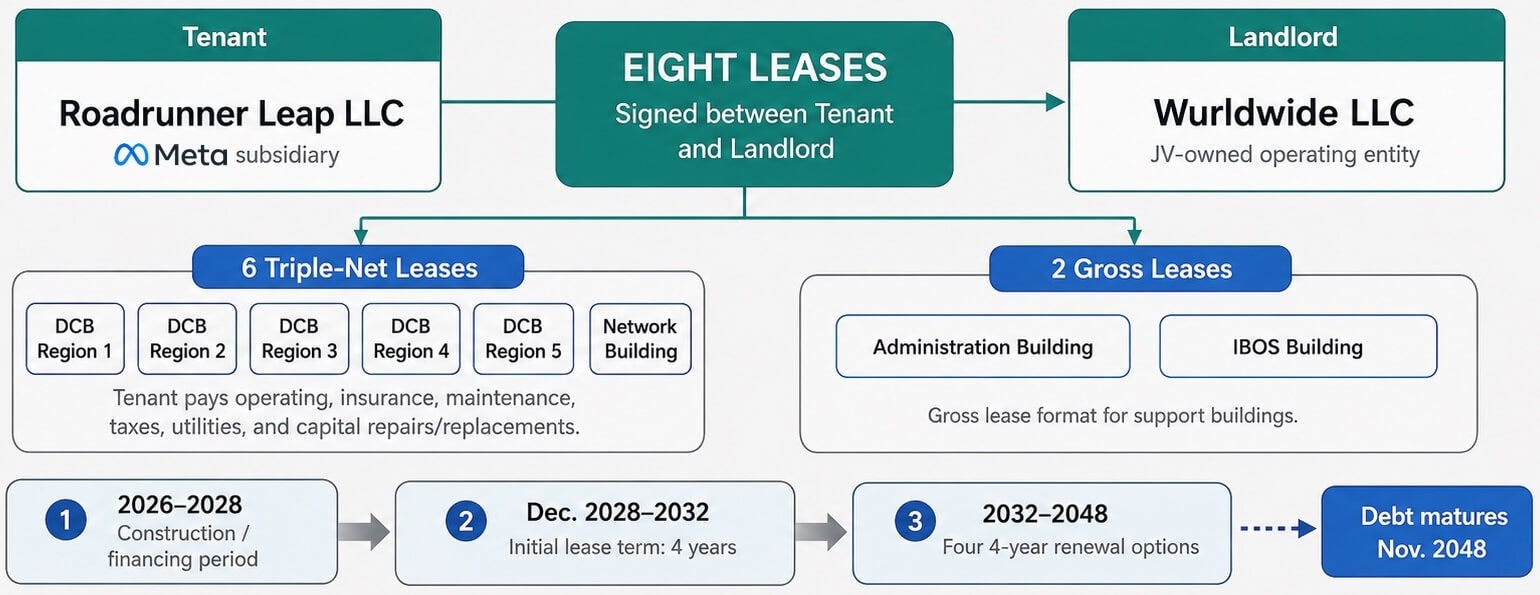
Rent commences December 1, 2028, date-certain, irrespective of construction status — a fixed base rent for the first 13 months, set to a 50% utilization assumption, then reset annually on actual utilization with a floor, escalating 2% a year from 2031. The initial term is four years with four four-year renewals (i.e., Meta’s options extend 16 years total); the notes mature in November 2048.
Construction risk sits with Meta: cost overruns beyond 105% of budget are Meta’s, and it has no termination right even for prolonged construction delay.
Source: Meta Platforms.
Above the leases sits the guarantee stack, all of it running to Meta Platforms, Inc. itself: a payment guarantee of the tenant’s lease obligations, a parent guarantee of the landlord’s power contract with El Paso Electric, a guarantee of the termination fee (the discounted value of remaining rent), and the residual value guarantee — an aggregate threshold of approximately $13 billion, declining over time. Per megawatt, that is $13.5 million guaranteed against $14.9 million built: Meta backstops roughly 91% of an asset it deliberately does not own.
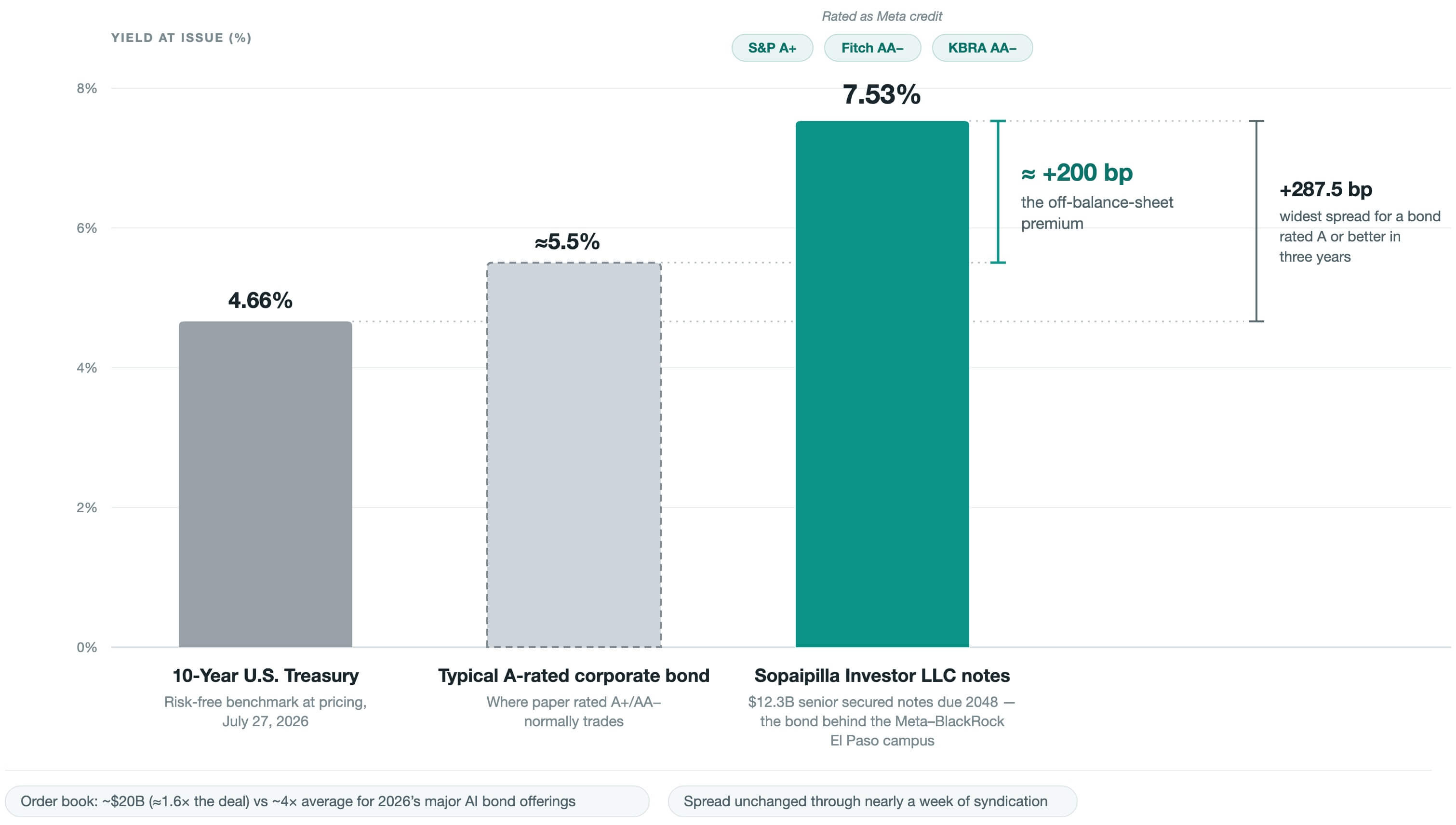
The notes were rated as Meta credit in a project-finance wrapper. S&P assigned A+, one notch below Meta’s AA- corporate rating, explicitly because the noteholders have no lien on the buildings, the land, or the project contracts — only a pledge of equity interests and accounts. Fitch and KBRA, by contrast, rated the paper AA-, level with Meta’s corporate rating. The contractual rent floor produces a flat debt service coverage ratio of just 1.12× — thin by design, because the real coverage is Meta’s guarantee stack, not the project’s cash flow.
The market took the paper, at a price. The order book peaked around $20 billion — about 1.6× the deal, the weakest subscription of any major AI investment-grade offering of 2026 by Bloomberg’s ranking, against a roughly 4× average — and syndication ran nearly a week without the spread tightening, both rarities in high-grade bonds. The notes priced July 27 at 7.53%, 2.875% over 10-year Treasuries, the widest spread for a bond rated A or better in three years. The launch-day upsize of about $273 million took the deal from the $12.3 billion the agencies rated to the ~$12.55 billion that sold.
That gap is the trade. Meta moves $12.3 billion of construction debt off its own balance sheet, and pays for it in the coupon — a bond the agencies rate as Meta credit, sold about two percentage points wider than comparable A-rated corporate paper.
That is the ledger on paper. What it bought is already rising in the desert.
The rating file specifies that campus building by building.
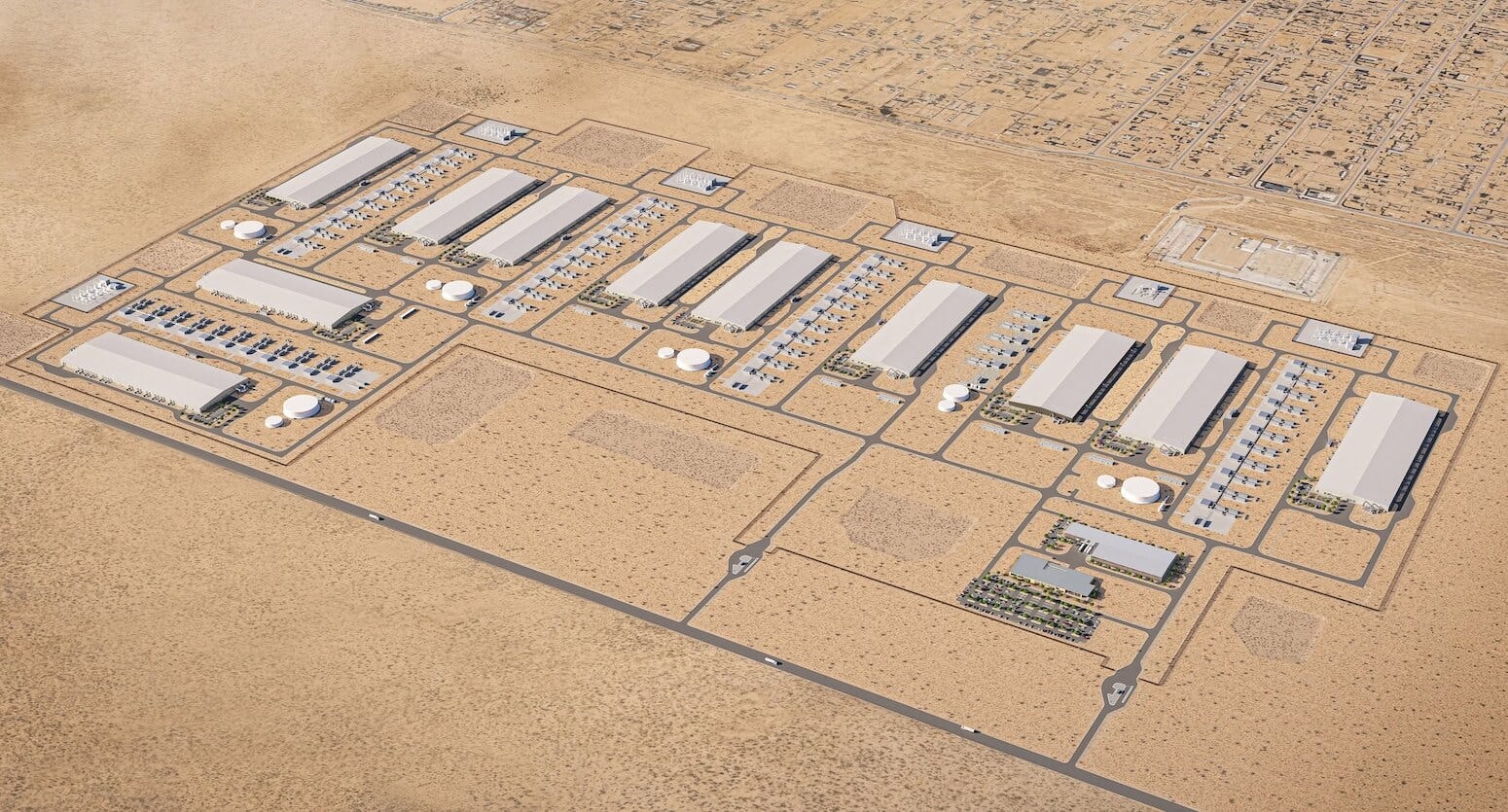
Meta’s 960 MW of total IT capacity comprises 10 data center buildings at 90 MW plus one 60 MW network building, across approximately 4 million square feet of built area.
Source: Meta Platforms.
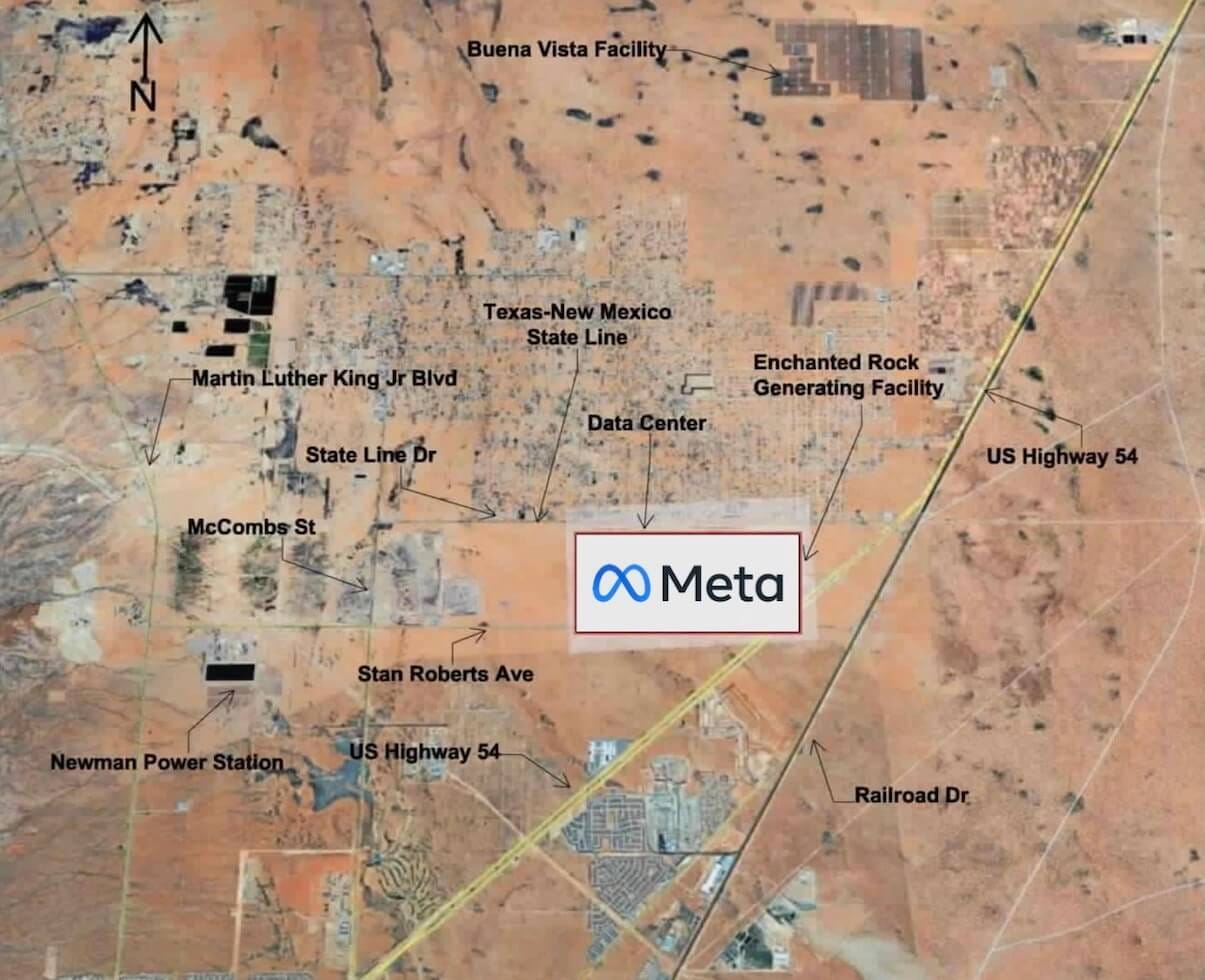
Around the buildings sit three switching stations, six substations, and stormwater retention basins, on 1,039 acres on the north side of Stan Roberts Sr. Avenue, west of U.S. 54, in the desert of Northeast El Paso.
Source: El Paso Electric Company.
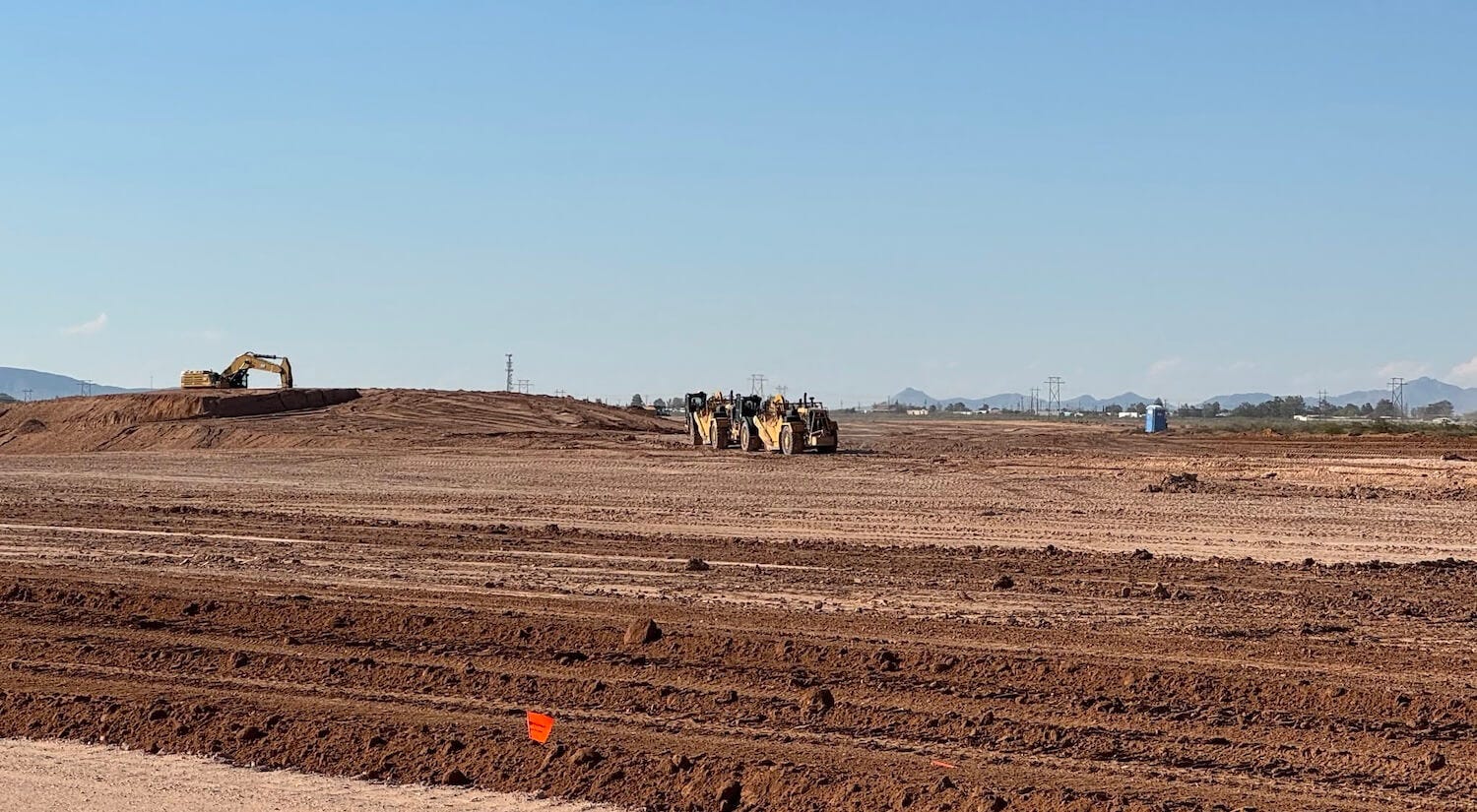
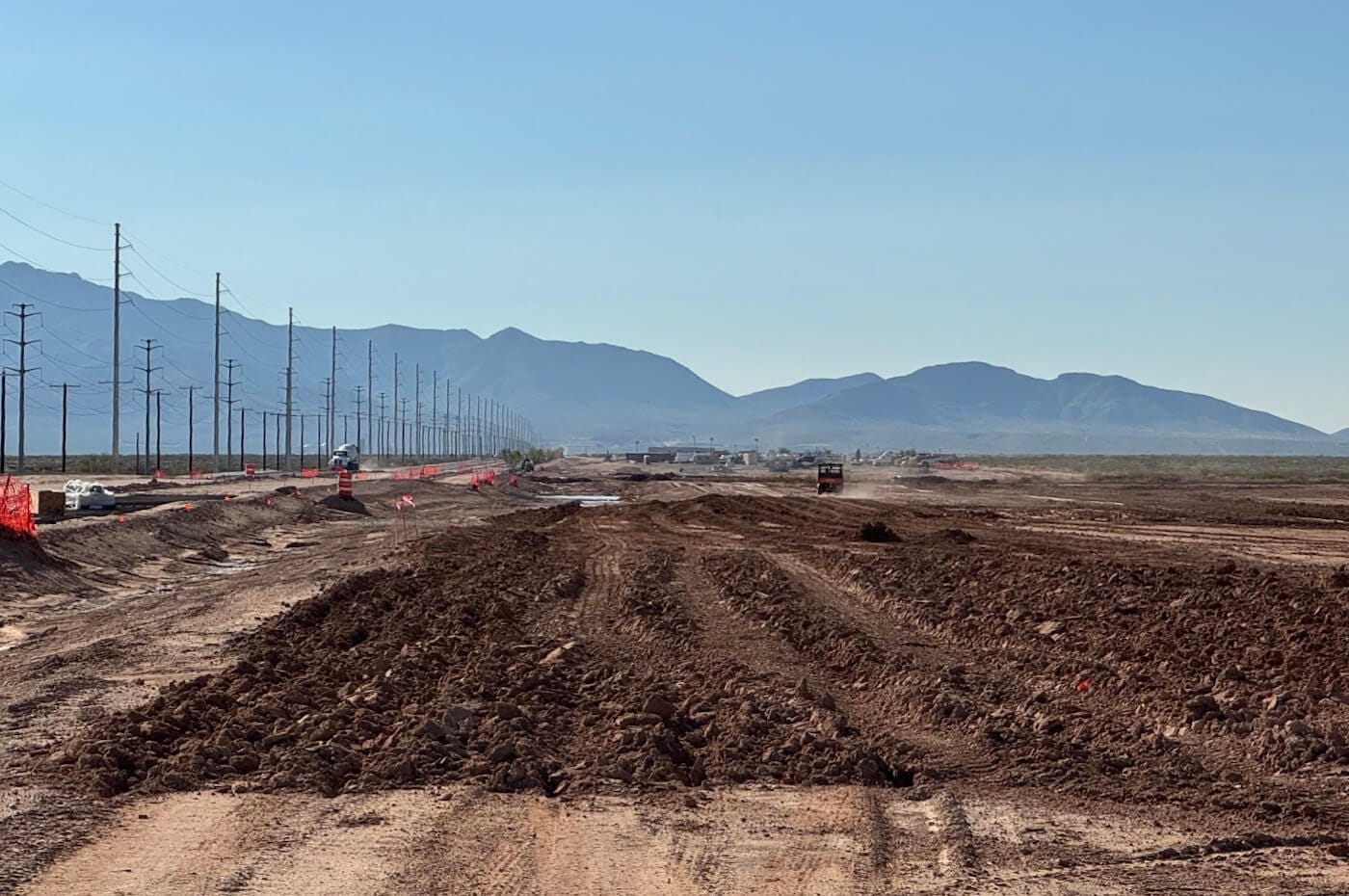
Construction is well underway and predates the joint venture by nearly a year. Meta broke ground on October 15, 2025, and by the July 2026 announcement, over 2,300 workers were on site, on the way to a claimed peak above 4,000 workers.
Source: Meta Platforms.
The named builders are Hensel Phelps and JE Dunn — the general contractors — joined by Faith Technologies, the electrical and modular-power specialist, with Stantec as the design firm. Meta expects to begin bringing capacity online in 2028.
All of it depends on the one input the venture cannot build for itself: power.
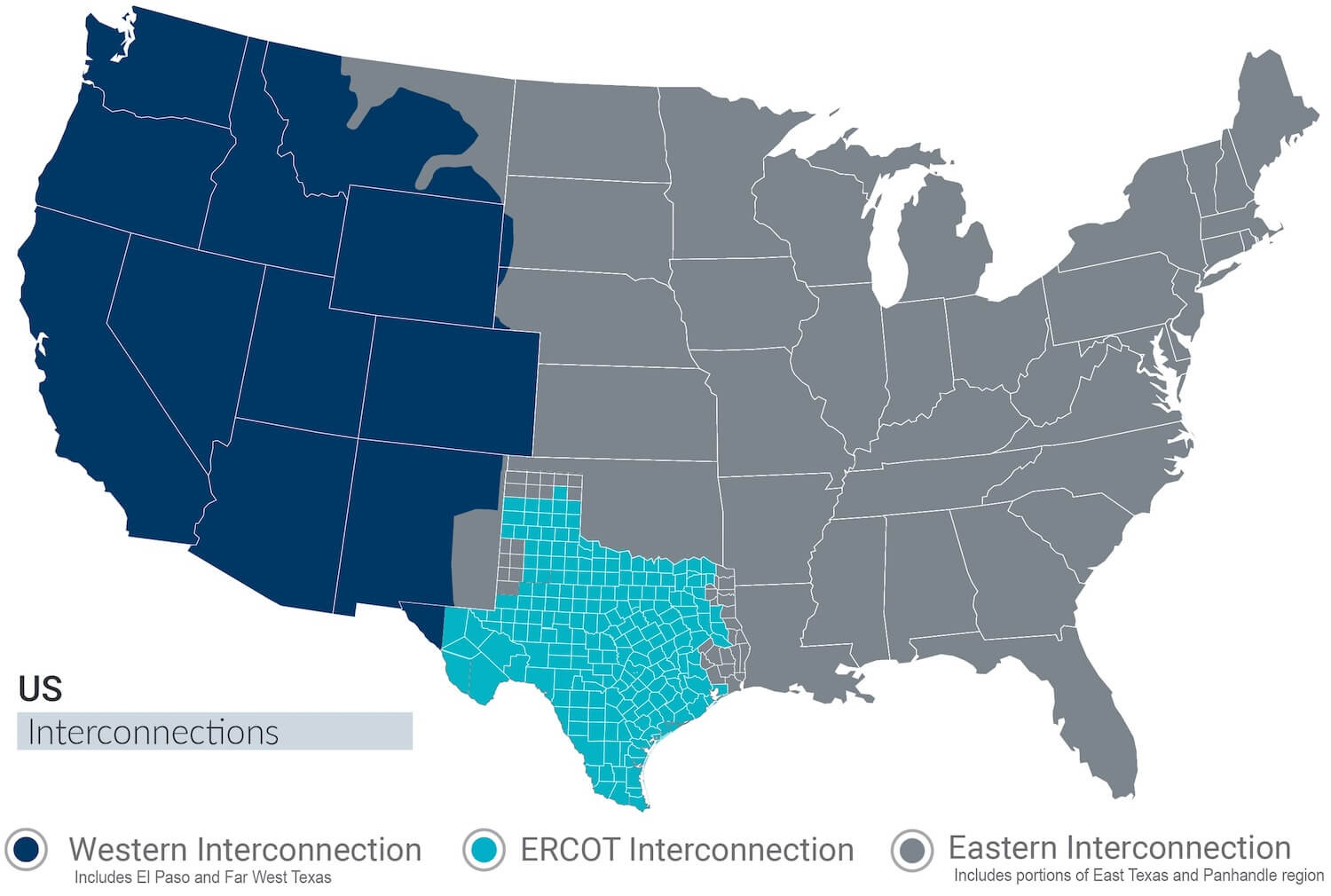
The most consequential fact about El Paso’s power is the grid it is not on. El Paso Electric operates in the Western Interconnection (WECC), not ERCOT — so none of the machinery Texas has built around data center load applies here: no ERCOT interconnection queue, no ERCOT large-load rules, no ERCOT price formation.
Source: ERCOT.
The scale mismatch is the story. El Paso Electric’s 2025 system peak was 2.3 GW; its entire industrial class is 55 customers consuming about 1.07 TWh a year. The campus’s contract commits El Paso Electric to deliver up to 1.0 GW — more than 40% of that system peak — with a right to request 1.4 GW.
Five capacity figures circulate around this Meta data center project, and each measures something different:
The result is that a gigawatt-scale retail load arrived through three instruments: a bilateral contract, a bespoke tariff, and a bridge power plant.
The electric service agreement — executed March 18, 2026 — runs to 2048, the same year the bonds mature. Its key terms: committed capacity up to 1.0 GW; the 1.4 GW option conditioned on three substations, added transmission and interconnection, and 225 MW of on-site generation capacity; minimum demand of 85% of monthly contract demand; and a Meta parent guarantee. The contracting party is Wurldwide (the landlord) — but El Paso Electric’s counterparty risk is Meta’s credit, exactly as the bondholders’ is.
The retail rate came first, and it came through a side door. El Paso Electric’s Economic Development Rate rider — a mechanism for negotiating rates outside a rate case — names data centers as the only eligible sector exempt from its jobs requirement (two employees per 100 kW for everyone else). What substitutes is a condition that welds the tariff to the local ledger: a data center customer must hold, and annually re-certify, Chapter 380 or 381 incentives from local government.
In August 2024, El Paso Electric applied to create Schedules 33A and 33B for Wurldwide under that rider, describing a customer with “between 100 and 200 MW” of peak load; its modeled scenarios topped out at 179 MW and 1.41 billion kWh a year — by itself more than El Paso Electric’s entire existing industrial class consumes. The Commission approved the settlement in July 2025 for a five-year term, El Paso Electric insisting the rates are “cost based” rather than discounted — and PUCT Commissioner Courtney Hjaltman added a condition from the bench: any revenue shortfall gets booked as a regulatory asset and reckoned with in the next base-rate case. The schedules were always designed to expire into a dedicated data center rate class once the load shows up in a test year.
That rate class now has a docket. On April 7, 2026, El Paso Electric filed Schedule 27 — High Load Factor Large Power Service, a permanent tariff for any customer with peak demand of 75 MW or more and an annual load factor of at least 85%, and named its prototype: Wurldwide, “expected to initiate service in July 2026,” ramping to 1 GW at a load factor above 90%. The filing carries Schedule 33A’s rates forward, terminates 33A on approval — and attaches the electric service agreement. The Commission sent the tariff to a contested hearing, questioning whether a 20-year minimum initial term is appropriate, whether the service agreement should really escape review, and what conditions keep residential and small-commercial customers whole under a tariff that bills its customer “regardless of whether the customer has energized its facilities.”
What the tariff record never priced is how fast the load would grow. El Paso Electric’s rate-case load forecast of April 2024 contained no data center line at all — 372 MW of total growth over 10 years. Six months later, its planning studies carried 168 MW of new large load; the September 2025 New Mexico resource plan carried 533 MW at a 97.6% load factor; by January 2026 an internal study showed 1.16 GW of large-load demand by 2029; and by June 2026 El Paso Electric’s own rebuttal exhibit walks Wurldwide alone from 16.4 MW in 2026 to 1 GW in 2029 — then holds it there for the next fourteen years.
El Paso Electric told federal regulators, in a June 2026 forecast, that its summer peak will rise 77.7% and its energy load 132.5% by 2035, with a single 711 MW step between 2027 and 2028. Behind it all sits a pipeline El Paso Electric described to New Mexico stakeholders in April 2025 as 8 GW of data center inquiries, 5.4 GW of them active — against a utility whose peak is 2.3 GW.
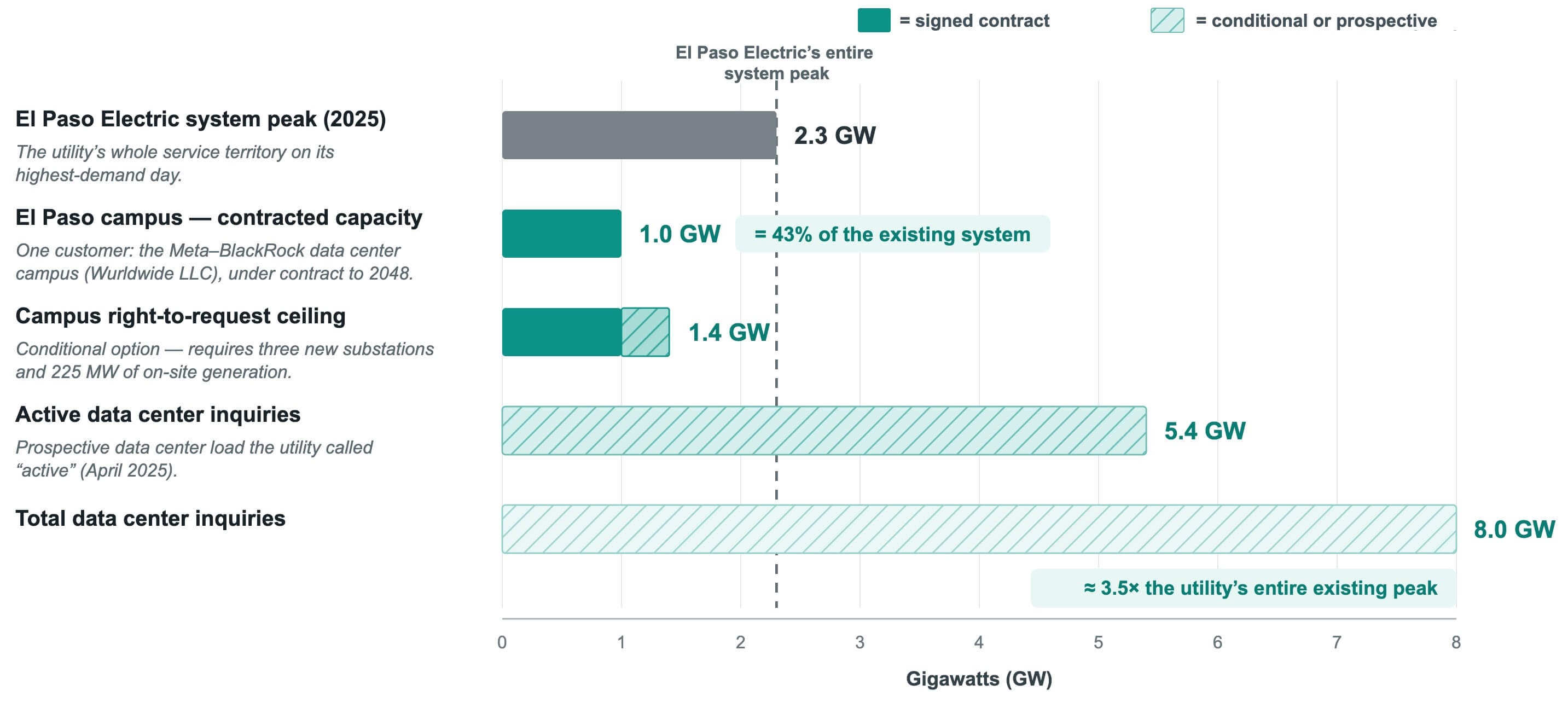
The procurement response is already open. El Paso Electric’s 2025 all-source request for proposals seeks 650 MW to 850 MW of accredited capacity for its own load growth through May 2031 — and, separately, up to 1.65 GW more for potential large-load customers, a bucket the utility ties to the surge in service inquiries. None of it is dedicated Meta generation; it is the portfolio a 2.3 GW utility now has to assemble around a gigawatt customer.
The physical answer to the 2027 gap — load arriving before the new substations and 345 kV lines can serve it — is McCloud Generation, a natural gas plant built by Enchanted Rock — a Houston company that makes modular natural gas generators and sells them as backup power, as dispatchable capacity, and, as here, as “bridge” power for customers who cannot wait for a grid connection. The plant’s ownership structure is the unusual part: McCloud is not Meta’s plant and not Enchanted Rock’s — El Paso Electric will own the plant and the land, with Enchanted Rock engineering, building, and operating it under contract.
It is 366 MW nameplate, built from 813 Enchanted Rock 450 kW rich-burn natural gas engines in clusters of four or five, arrayed in roughly 168 rows across ~31 acres adjacent to the campus — air-cooled, with a peak water demand of about 4,000 gallons a day for safety showers and potable use, none of it for cooling.
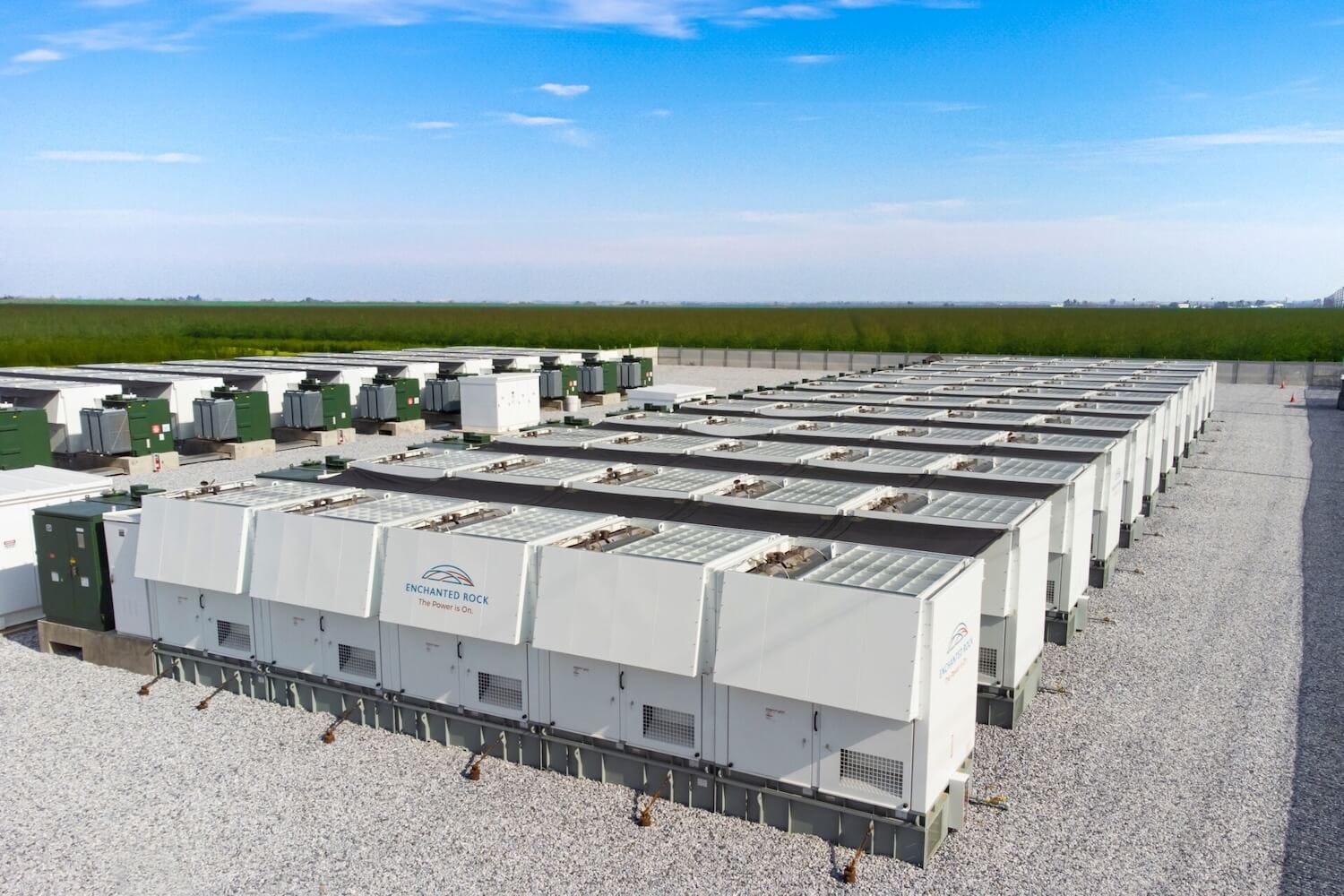
Illustrates the dense, modular natural gas generator configuration expected at McCloud. Source: Enchanted Rock.
The reciprocating internal combustion engines (RICE) are fired exclusively on pipeline-quality natural gas, with no on-site fuel storage: the plant burns what the pipeline delivers, as it delivers it. Enchanted Rock’s dimensioned layout drawing (below) shows what El Paso Electric is buying: an engine farm and a reserved maintenance yard.
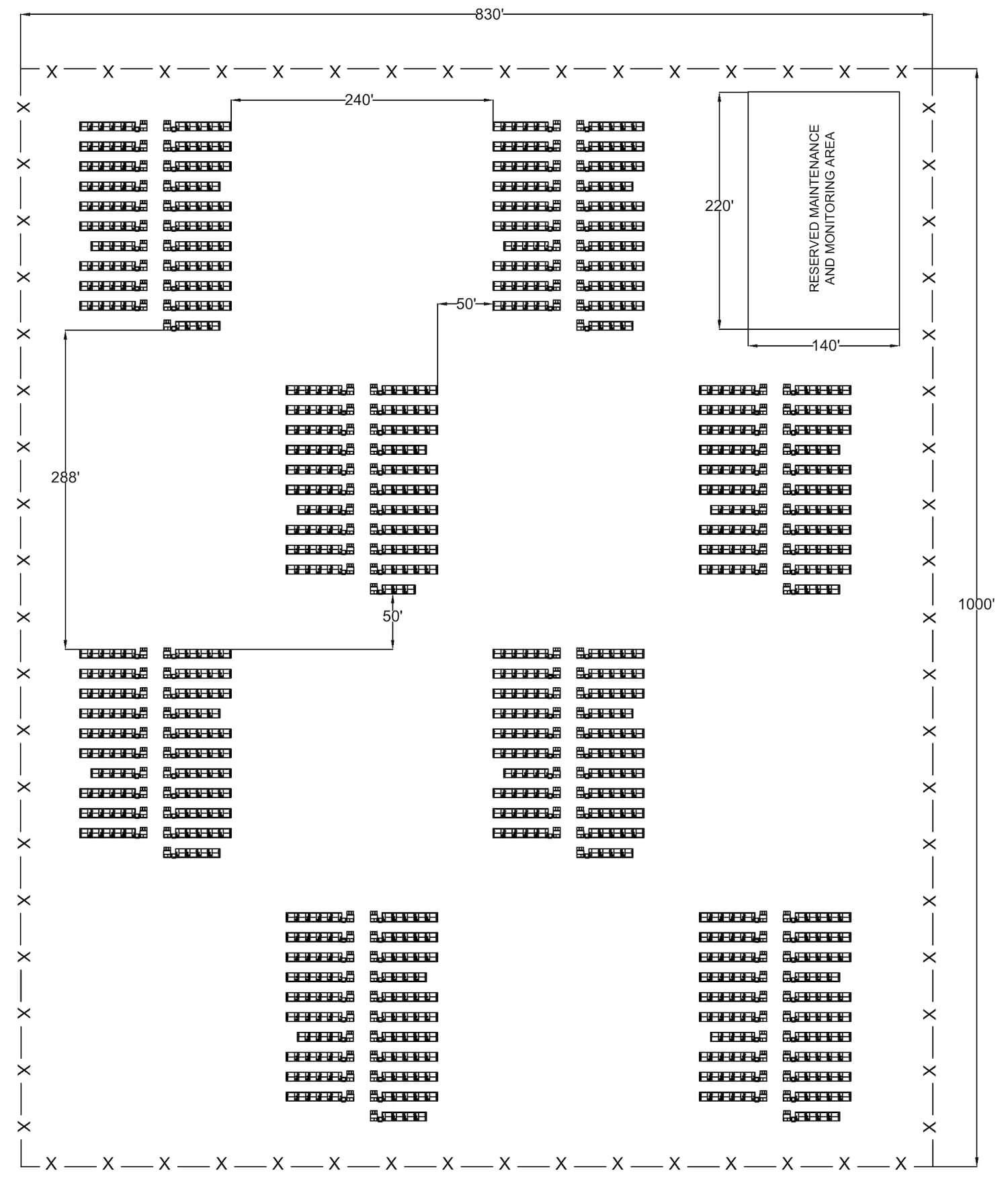
Source: Enchanted Rock.
During a bridge period of up to five years, it runs islanded — electrically connected to the customer’s load and to nothing else — delivering 225 MW of continuous power (modeled at a 95% annual load factor) by mid-2027, its capital and operating costs recovered from Wurldwide through a dedicated rate. Grid-connected by roughly 2032, it is rated 343 MW firm. The 225 MW matches the on-site capacity condition in the 1.4 GW option.
The ability to deliver by 2027 was key for El Paso Electric — a schedule only a modular vendor could meet.
Commitment preceded certification: El Paso Electric signed a limited notice to proceed in September 2025 with a first payment of $29.95 million, and Enchanted Rock obtained the air permit in October 2025 — a TCEQ standard permit. It authorized 225 MW by capping natural gas consumption, thereby avoiding Title V and PSD review. Both steps came months before El Paso Electric filed the Certificate of Convenience and Necessity (CCN) application in December 2025. The permit registration names Meta.
The cost figures for the McCloud bridge plant are as follows:
$/kW is computed at 343 MW firm capacity.
On the intervenors’ all-in figure, the plant costs $1,609/kW against $1,264/kW for a generic combustion turbine in El Paso Electric’s own resource plan; its modeled heat rate is a flat 12,000 Btu/kWh against roughly 9,300–9,500 for El Paso Electric’s recent units, worth $28–36 million a year in extra natural gas for the same energy, and its non-fuel operations and maintenance (O&M) runs 3.5× that of El Paso Electric’s recent gas fleet.
El Paso Electric concedes every differential and relocates the burden: all of it is Wurldwide’s to pay during the bridge. The catch is the exit. The application says El Paso Electric “will” fold the plant into its system portfolio afterward; its brief retreats to “may be beneficial… no decision has been made” — and a model El Paso Electric produced in discovery shows what folding McCloud’s costs through the standard recovery rider would do: a residential bill increase of 8.43%. El Paso Electric has not proposed that rate; the intervenors are litigating to make sure it never can.
That is why the CCN is contested. Of seven parties, the City of El Paso — whose expert proposes six conditions of its own, a $565.6 million cost cap among them — the state’s residential ratepayer advocate (OPUC), Freeport-McMoRan, and an individual intervenor urge denial; TIEC (representing large industrial customers) would grant only with conditions; Commission Staff makes no affirmative recommendation and two adverse findings; El Paso Electric alone asks for a clean grant. The Sembrando Esperanza Coalition filed 1,210 signed protest forms into the docket. The hearing ran July 8–9, 2026; initial briefs are in; the statutory deadline for a decision is December 9, 2026.
Interconnection is the structural finding of the whole record. In El Paso Electric’s federal tariff, a new generator larger than 20 MW faces cluster windows, application fees, study deposits, site control requirements, and withdrawal penalties. A new load of any size faces Section 31.2, whose entire governing standard is that the customer provide “as much advance notice as reasonably practicable.” No megawatt threshold, no queue, no fee, no deposit, no public posting. A gigawatt of demand entered the system through a provision written for an era that never imagined it, which means the terms were set bilaterally, in contracts, rather than by any published procedure.
The contracts came early, and the money is already flowing. In June 2024 — before any public announcement, and two months before the tariff application — El Paso Electric signed an agreement with “a potential large load customer” to build and expand transmission for “a planned data center,” amended in October 2025 to add the expansion of one existing substation and construction of two new ones. The customer paid El Paso Electric $144.5 million of non-refundable construction advances during 2025 alone. El Paso Electric’s financial filings never name that customer; the electric service agreement with Wurldwide followed the interconnection deal by more than 18 months.
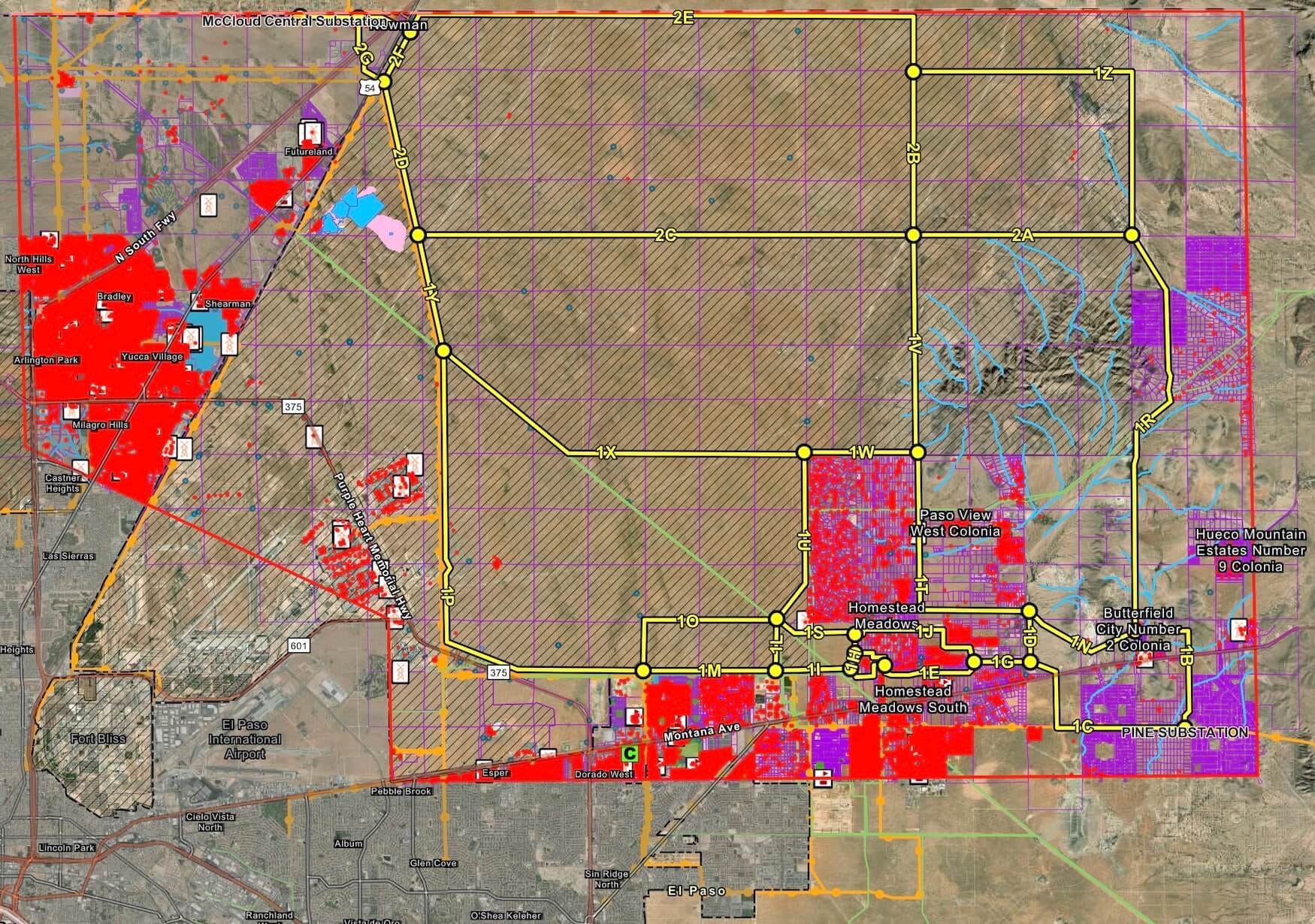
On El Paso Electric’s own Northeast-area expansion map (below — black lines are existing, red lines are new/upgrades), the buildout is unmistakable: McCloud East substation in service January 2026 to serve the Large Load, McCloud Central and McCloud West 345 kV substations in January 2028, a ±200 MVAR STATCOM — six times larger than any other reactive device in El Paso Electric’s 10-year plan — in May 2028, and new 345 kV lines to Pine (May 2029) and Vado (May 2030).
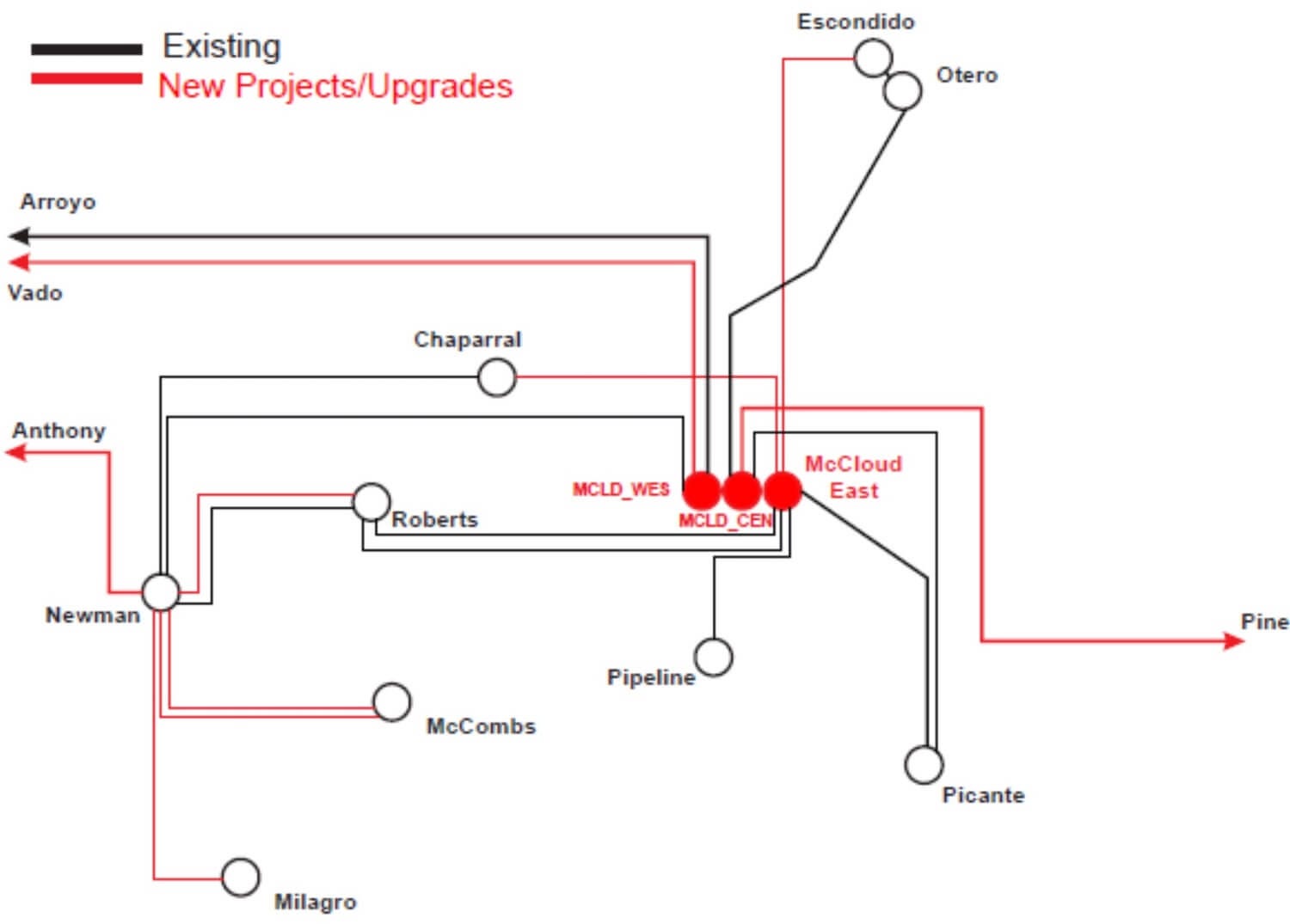
Source: El Paso Electric Company.
The Pine–McCloud Central 345 kV line moves to routing now: a CCN filing in September 2026, targeted approval March 2027, construction from April 2028.
Source: El Paso Electric Company.
Gas is the one input still dark. El Paso Electric designated its gas-supply answer as the docket’s only Highly Sensitive filing; Enchanted Rock told FERC the McCloud gas upgrades “fall outside of FERC’s jurisdiction as intrastate facilities”; and the single named counterparty is Kinder Morgan, whose delivery fees of roughly $8.5 million a year sit among the costs El Paso Electric excludes from its O&M estimate.
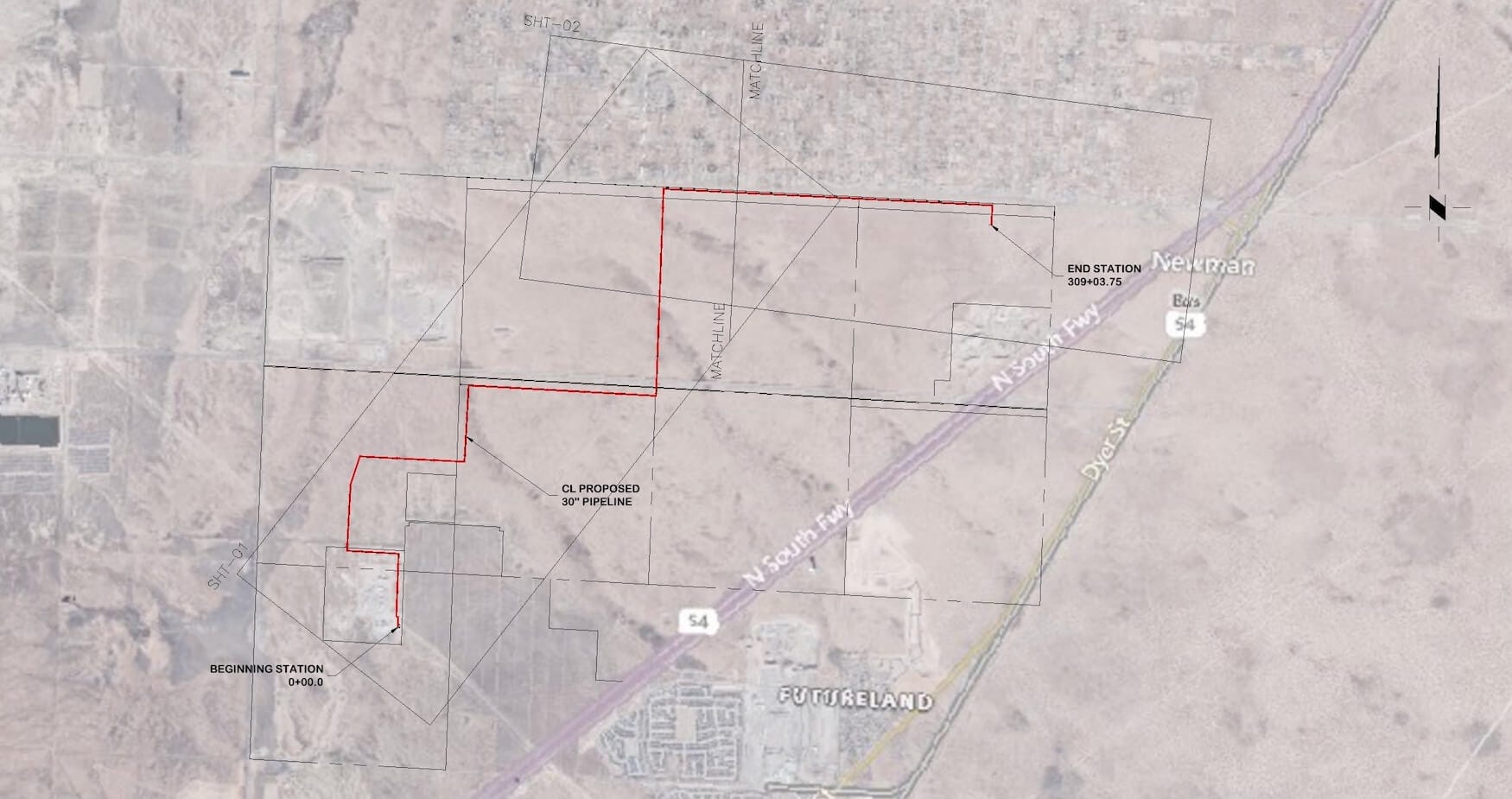
What El Paso Electric sealed, Kinder Morgan’s own tariff bulletin board largely answers: in March 2026, its El Paso Natural Gas (EPNG) pipeline ran a binding open season for a “McCloud Lateral” — nearly six miles of 16-inch pipe from its mainline to a new delivery meter station at the plant, offering 167,000 dekatherms a day of firm capacity from January 1, 2027 — and subscribing the whole pipe at the notice’s recommended rate comes to almost exactly the $8.5 million a year in the CCN record.
Source: El Paso Natural Gas.
The floor under all of it is math: run flat out, 225 MW at McCloud’s modeled 12,000 Btu/kWh heat rate burns roughly 65,000 dekatherms — about 60 million cubic feet — of natural gas a day, delivered as it is burned, to a plant with no storage, while the balance of the campus’s gigawatt arrives over El Paso Electric’s wires.
Power the venture had to arrange in public, docket by docket. Water it had settled two and a half years before the bonds priced, on the same December day El Paso’s governments signed everything else.
The agreement El Paso Water’s board approved on December 4, 2023, for $100 of consideration, reserves 2.5 million gallons per day (MGD) of water capacity across three tiers and up to 1.25 MGD of wastewater for Wurldwide, and designates the campus a “high priority economic development project” whose meters will be approved “regardless of any drought or Water emergency.” The utility cannot reduce the reservation without the customer’s consent, “which consent may be granted or withheld in Customer’s sole discretion.” El Paso Water commits that it “will not discriminate against the data center industry” and will adopt no data-center-specific rates. The customer may terminate at any time, for any reason.
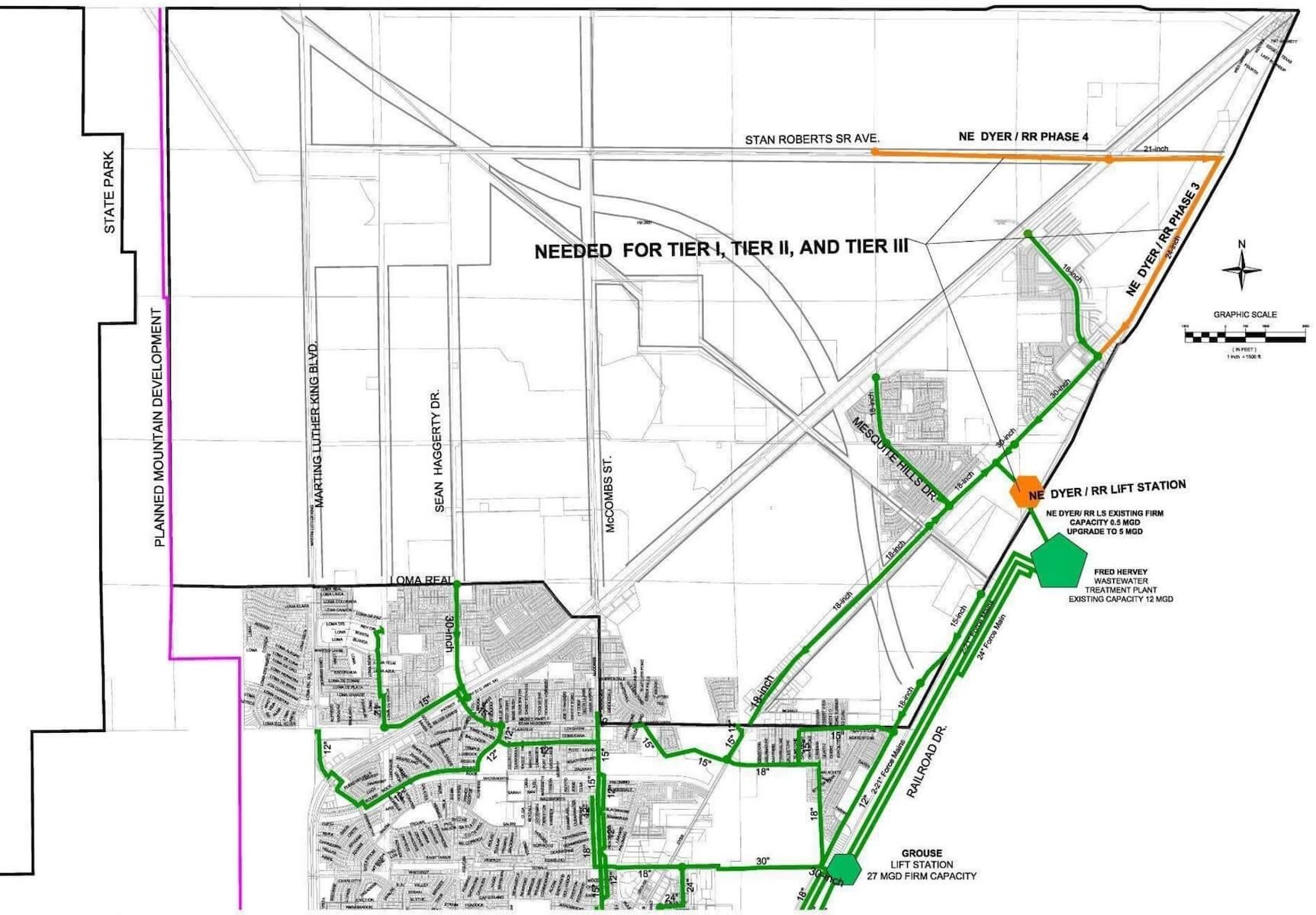
The water utility had been building toward the site for years. In October 2023, two months before the agreement existed, El Paso Water awarded a $4.96 million contract for a 16-inch water main and 30-inch sewer interceptor terminating at Stan Roberts and Dyer — the campus’s corner. The agreement’s own exhibit maps the rest of the program (below): phased interceptors up the Dyer/Railroad corridor and along Stan Roberts itself, an order-of-magnitude upgrade of the NE Dyer/Railroad lift station (0.5 to 5 MGD), and the campus’s wastewater delivered to the Fred Hervey plant — works the agreement obligates El Paso Water to “design, construct and fund.”
Source: El Paso Water.
The utility’s own account holds that the prior data center design abandoned once-through water cooling for an air-cooled system that sprays water only on the hottest days. The rest of the record suggests the campus will rarely need the 2.5 MGD it reserved: Meta’s published description of a closed-loop, liquid-cooled design (liquid at the racks, air at the heat rejection) using “zero water for a majority of the year,” with annual use “similar to a typical golf course in west Texas”; the 0.48 MGD figure El Paso Water modeled for Council in July 2026; and Meta’s standing pledge — the company’s standard policy in high-water-stress watersheds — to restore 200% of consumed water.
That agreement was one of several instruments El Paso signed in the same stretch of weeks. The rest are on the other ledger.
The instruments El Paso executed in 38 days in late 2023 bind its governments for 35 years — and against the bond file, they read like documents for a different project. Wall Street’s ledger is denominated in billions and secured by Meta Platforms, Inc.; El Paso’s is denominated in 50 jobs and $800 million per phase, and signed by the project SPV, Wurldwide LLC.
Start with the land. On December 29, 2023, the City of El Paso sold the campus site to Wurldwide for about $8.5 million, equivalent to $8,156 per acre. The deed carries two protections the City’s negotiators did win: a “Springing Repurchase Right” — develop within five years or the City may repurchase at the original price, or take $5 million in liquidated damages — and a full reservation of the groundwater estate to the City.
Then come the four incentive agreements, two per government, approved on December 4 and 5 — weeks before the deed:
Each instrument runs at 80%, across up to five phases that “may run concurrently or sequentially,” under 35-year terms. The abatements rest on City of El Paso Reinvestment Zone No. 1, created November 21, 2023, with a five-year, renewable life. The zone expires November 21, 2028, a lapse that cannot undo the signed agreements (Tax Code § 312.203) — it ends only the deal’s ability to take in new land.
What did El Paso get in covenant form? An investment commitment of $800 million per phase — a contractual floor that, across all five phases (i.e., 10 data center buildings), comes to $4.0 billion against a $14.3 billion announced build. And an employment commitment of exactly 50 full-time jobs — cumulative across all phases, due within four years of a completion deadline that is itself seven years from the start of vertical construction. “Full-Time Job” is defined to admit sub-40-hour schedules and remote employees who qualify as “Regional Residents”; local hiring is a non-binding “goal” of 25 of the 50, drawn from within a 50-mile radius; the wage floor is the area median. City staff’s presentation told Council to “expect 200+ FTEs at full ramp-up” — but the economic model it presented ran on the covenanted 50.
The City of El Paso has put numbers to what it signed: roughly $110 million of combined City–County incentives for Phase 1, up to $550 million across all five phases, projected net collections of $83.4 million per phase, and up to $5 million in funding for intersection and roadway improvements at Stan Roberts and US-54.
The ledger runs to Austin too, and the state’s line is the only one that reaches the power bill. On September 17, 2025 — four weeks before groundbreaking — the Texas Comptroller registered “Wurldwide LLC DBA Statue LLC” as a Qualifying Large Data Center Project: a 20-year exemption from state and local sales and use tax on qualifying purchases — servers, cooling and electrical systems, generators, and the electricity itself, through 2045. The statute’s thresholds are 250,000 square feet, $500 million of investment within five years, and 40 jobs in the county — the covenanted 50 clears the state’s bar by ten. Wurldwide is registered as the project’s owner, occupant, and operator.
For now, the property-tax side is still theoretical: the appraisal district carries the two parcels at $5.4 million for 2026, and the 80% abatements have nothing to abate until the buildings land on the books. The sales-tax exemption, by contrast, has been live since September 2025, while the campus is still being built.
On July 20, 2026, City Council adopted El Paso’s first Data Center Policy Framework — the product of a six-month process Council ordered in February 2026: six community meetings and more than 2,300 public comments. The City’s own summary of that input records “repeated requests for the City Council to cancel the 80% tax abatement.”
Council did not cancel anything. What it adopted is aimed at the next project: future hyperscale data centers should face a Special Permit — public notice, Plan Commission review, a public hearing, final Council action. The framework also calls for enhanced standards for water, energy demand, wastewater, noise, lighting, and ecological impact; community benefit agreements; parent-company commitments; protections against infrastructure costs migrating to existing ratepayers; and no local economic incentives at all. Every element is scoped to future projects. The framework is a roadmap, not yet law — each piece returns to Council as ordinance amendments — but its premise is already plain: the Meta deal is one El Paso does not intend to offer twice.
Source: Meta Platforms.
Most of what happens next is already on a docket, a filing calendar, or a lease schedule. The markers, in rough order:
The McCloud decision — by December 9, 2026. A proposal for decision is expected around early October 2026; the statutory deadline is December 9.
The closing paper trail — Q3 2026. Meta’s 10-Q said closing was expected in the third quarter; the first post-closing disclosure will be Meta’s Q3 filing, due at the end of October 2026.
The wires — September 2026 through 2030. El Paso Electric files for the Pine–McCloud Central 345 kV line around September 2026, targeting approval in March 2027 and construction through March 2029; McCloud Central and West substations are scheduled for January 2028 and the 200 MVAR STATCOM for May 2028. These are the physical preconditions of the 1.4 GW option — three substations and 225 MW of on-site capacity.
December 1, 2028 — the machine turns on. Rent commences date-certain whether or not construction is done; the venture expects first capacity online in 2028.
Measured AI provides institutional-grade analysis of the physical infrastructure powering AI data centers. For access to our full research library, regulatory intelligence, and weekly briefings, visit MeasuredAI.com.
No posts
Comments
Nothing yet. Say the first thing.
Sign in to join the conversation.