
NEWS#60 - GLOBAL EDITION

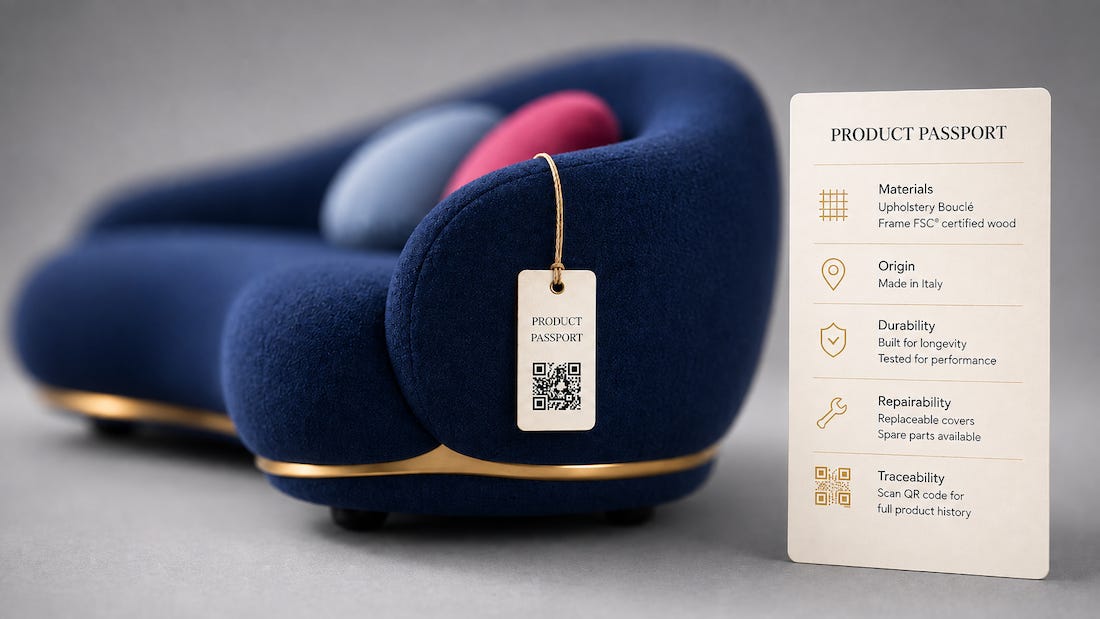
Passport, please. Europe has just opened the digital counter that will register the passports of products placed on its market. On 20 July, the Digital Product Passport registry became operational, part of a regulatory shift intended to make products and supply chains more transparent.
This is not a QR code carrying a polished story about sustainability. Depending on the rules established for each category, the passport may include information on materials, durability, repairability and other aspects of a product’s life cycle. Furniture is among the priority product groups. The European Union plans to adopt specific rules for the category in 2028, followed by a transition period of at least 18 months. In other words: for anyone designing, producing or selling furniture, this conversation already has an address.
Does that sound distant? Not to an industry.
For Brazil, the timing is particularly interesting. In the same year that the Mercosur-European Union trade agreement began to be provisionally applied, expanding the possibilities of access to the European market, Europe made operational an infrastructure that will increase the traceability of the products entering it. Future requirements will apply to imports as well.
There is a paradox here: as trade borders become more permeable, objects themselves will have to become more legible. For design, this changes an old conversation. For years, we learned to ask who designed a chair, who manufactures it, what award it has won. The next question may be less glamorous - and far more important: what exactly is it made of, where did its materials come from, can it be repaired, and what happens when a component breaks?
Brazilian design likes to speak about material, origin, territory and craftsmanship. The passport may turn part of that discourse into evidence. And at that point, narrative alone is no longer enough.
A passport does not make a product better. But it makes it harder to conceal its weaknesses behind a beautiful photograph. Perhaps that is the most interesting development of all: design is acquiring documentation. And documents have the inconvenient habit of asking for proof.


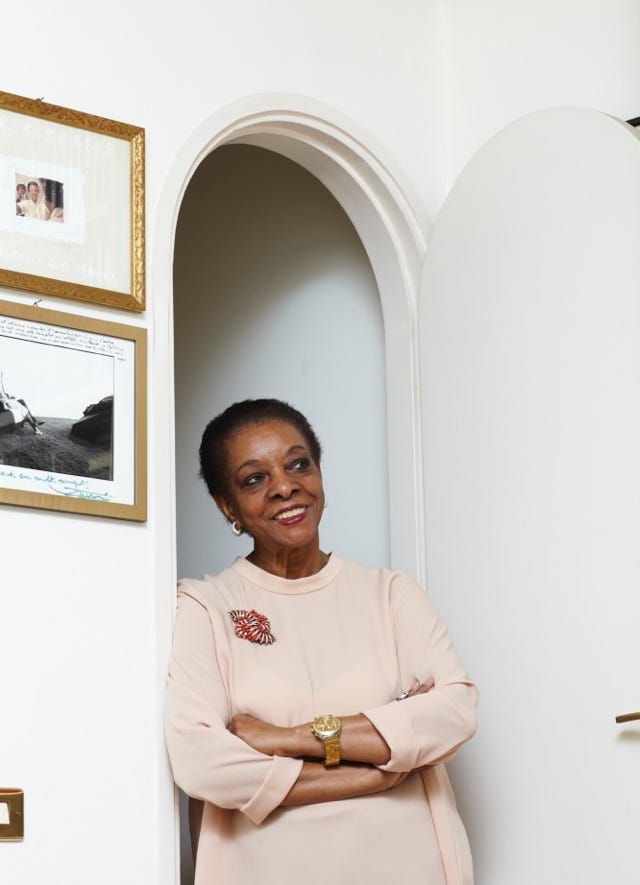
I have known Marva Griffin for just over a decade, and I remain impressed by her memory. In Milan, or at design gatherings elsewhere in the world, she recognises journalists by name, remembers conversations and treats us with impeccable professional rigour. And I believe the smile with which she greets me is sincere too — and affectionate. That attentiveness says a great deal about Marva. She does not seem particularly interested in predicting where design is heading. She is more concerned with preserving the conditions that allow a designer to get somewhere. Her authority was built in precisely this way: by connecting talent, industry, the press and institutions. Born in El Callao, Venezuela, and Milanese by choice, she arrived in Italy in the early 1970s. A polyglot - she speaks Spanish, English, French, Italian and Portuguese - she began at C&B Italia, now B&B Italia, working alongside Piero Ambrogio Busnelli and Cesare Cassina as an assistant, interpreter and communications manager. It was there that she came to understand the Italian design industry from within, while working closely with some of the figures who were defining design at the time. Journalism followed. She became the Italian correspondent for Condé Nast publications in France and the United States, including Maison & Jardin, Vogue Décoration, House & Garden and Vogue. For two decades, she also headed international press relations for the Salone del Mobile.Milano. In 1998, she founded SaloneSatellite, bringing young designers, design schools and industry into closer contact and turning the initiative into one of the leading international platforms for emerging talent. Today, she is Founder and Curator of SaloneSatellite and Ambassador for International Relations at the Salone del Mobile.Milano. Since 2001, she has also served on the Philip Johnson Architecture and Design Committee at MoMA in New York. The honours help convey the scale of that trajectory. SaloneSatellite received the Compasso d’Oro alla Carriera in 2014; Marva was awarded Milan’s Ambrogino d’Oro in 2017, an honorary degree from Politecnico di Milano in 2021 and, in 2024, an honorary Doctor of Fine Arts degree from the Rhode Island School of Design. This conversation reveals something I have always found striking about her: Marva does not speak on behalf of designers. She prefers to bring them closer to the people who can turn an idea into a path. For her, talent matters. But so do time, learning, industry and persistence.
1.When SaloneSatellite was created, one of the main challenges for a young designer was gaining access to industry. Today, visibility is easier to achieve, but building a lasting career may not be. What has become more difficult?
I cannot respond for young designers. However, as far as I know, every year at SaloneSatellite, when I go to say goodbye to the participating young designers on the last day, they are very happy with the contacts they have made during the week of the Salone. Over the years, many young designers have started collaborations that, in some cases, worked and, in others, didn’t. But, as I say to them, they must be patient. Discussing with producers, learning and gaining experience takes time. In my beginnings at C&B (now B&B Italia), I saw top designers presenting their products, and only after three years of study and research was the prototype finally brought to market, building, as time passed, a lasting career.
2.After observing several generations of designers from different parts of the world, what does the international design system still fail to recognize in talent coming from outside its traditional centres?
Designers must respond to you, not me.
3.Young designers are often told what they need to learn from industry. What does industry need to learn from them today?
It’s a give and take. When presenting a project to an industry, the majority of producers work together with designers to develop a product to be launched on the market, and this is very important for young people. But the producer is also happy to get fresh ideas about what is happening around the world and what young designers can bring into their industry.
4.Does today’s education prepare designers to propose new ideas, or to respond to the demands of a market that already knows what it wants?
At SaloneSatellite, over these 27 years, we have hosted more than 330 international design schools and universities from more than 40 countries, bringing their graduates-to-be to visit the Salone del Mobile.Milano and industries, and to observe what the market is producing. We have experienced the educational systems of many of these institutions, which prepare designers to a very high level. Around the world, from what I have learned, many of the top designers who started their careers at SaloneSatellite have graduated from very important schools and universities.



I learned early that you do not sit in someone else’s place. At work, especially in a superior’s chair, I was taught to see it as an act of impertinence, an overstepping of intimacy, almost a small invasion of territory. I had not thought much about that code again until I came across a story about Yinka Ilori.
In the London home where he grew up, each member of the family had their own chair. There was no need to write anyone’s name on it: everyone knew which place belonged to whom. Ilori recalls that he would even feel guilty sitting in his sister’s chair, as though he had crossed a small personal boundary.
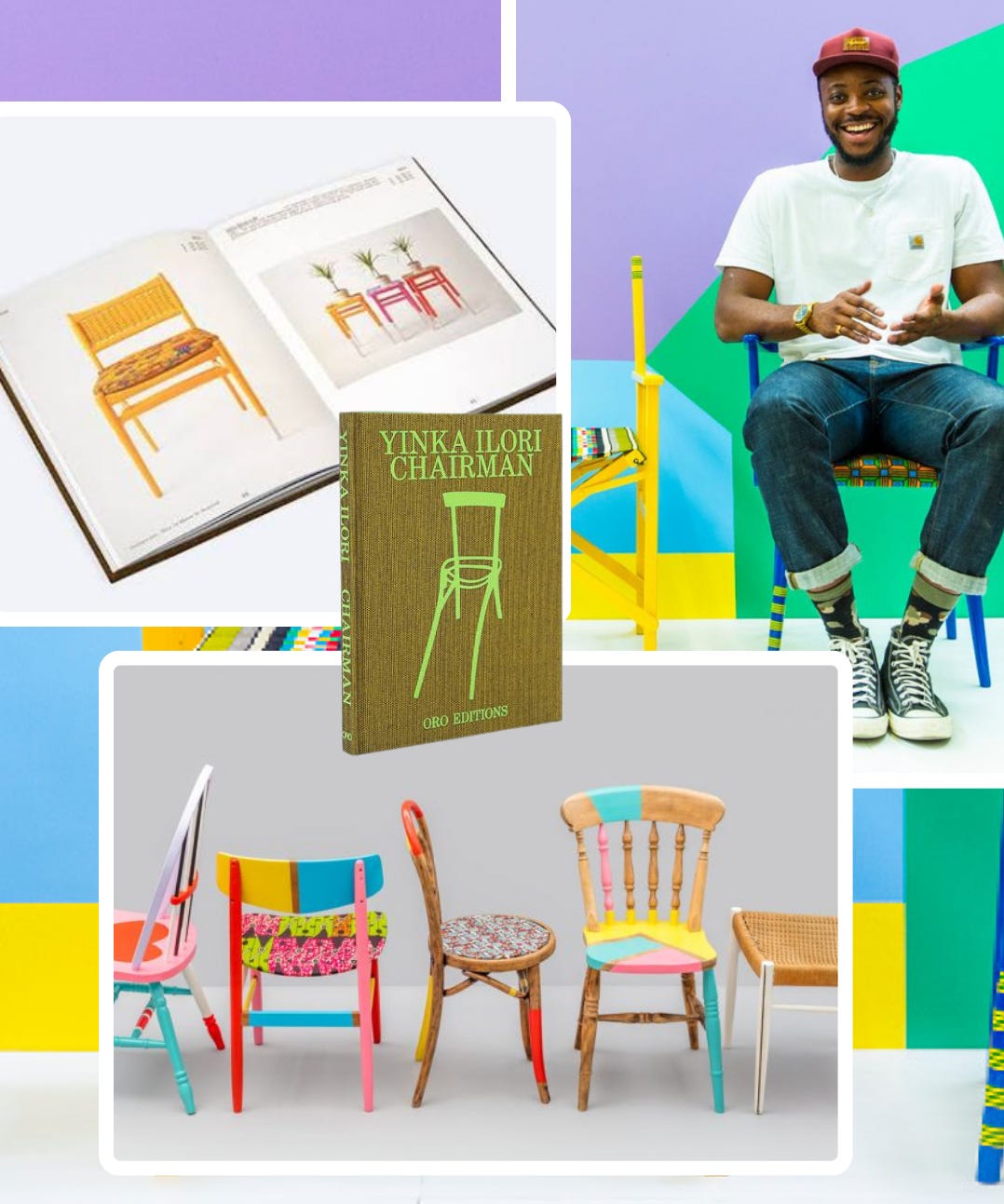
That memory helps explain why such an everyday object occupies a central place in the work of the British-Nigerian artist and designer - and now in Chairman, a book bringing together more than a decade of his work devoted to chairs.
Few objects have been revisited by design with such persistence. Mies van der Rohe once said that designing a chair was extremely difficult; a skyscraper was almost easier. It makes sense. Within a remarkably small object, body, balance, structure, material, manufacturing and language all have to coexist.
The chair also records its time. Thonet turned bentwood into an industrial system in the nineteenth century. Modernism experimented with tubular steel, plywood and plastic. Later, Martino Gamper - who contributes to Chairman - would dismantle discarded furniture to create the one hundred pieces of 100 Chairs in 100 Days.
Ilori starts from this territory, but shifts the question. Many of his early chairs were also made from found and abandoned furniture. He dismantles, paints, alters and reconstructs them. But what he seeks to preserve or add is not simply material: it is stories. Childhood memories, Nigerian parables, migration, identity and belonging become part of the structure.
The practice began while he was still at university, when Jane Atfield asked him to combine old chairs without discarding any of their components; Two Become One, from 2006, emerged from that exercise.
In Chairman, the chair appears almost as a cultural archive. And perhaps that is why we keep returning to an object that seems to have been resolved centuries ago. A chair never supports only a body. It also reveals who we are, how we relate to one another - and the place we believe we occupy.

Click and share with a friend.

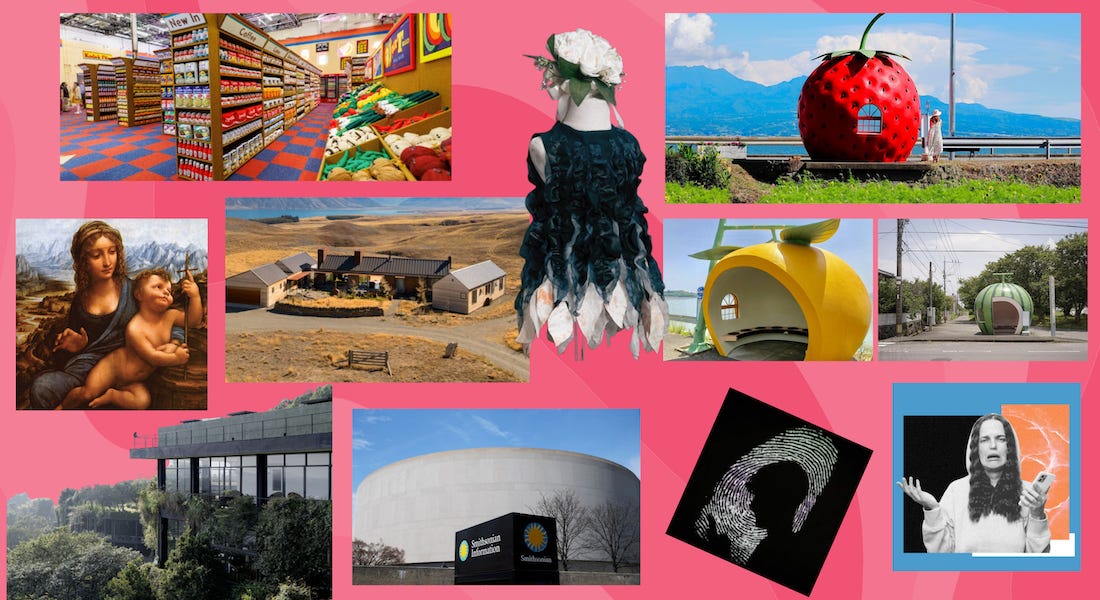
- For anyone in New York, a Leonardo da Vinci is quietly there. Since the spring, the Metropolitan Museum of Art has been showing Madonna of the Yarnwinder, dated around 1501, without much announcement or ceremony. Attributed to “Leonardo da Vinci and workshop,” the painting belongs to Kenneth Griffin’s collection and is on long-term loan to the museum. An even greater rarity considering that fewer than 20 paintings by Leonardo survive today. If you are passing through the Met: Gallery 609, second floor - and, for now, without the crowds.
- Now imagine an entire 1980s Walmart made of felt. In Bentonville, Lucy Sparrow recreated more than 20,000 products by hand, transforming one of the great symbols of American consumer culture into an installation. It is pop, playful and slightly unsettling: sometimes, turning everyday life into a toy is the best way to see what it says about us.
- Perhaps that is why I am so drawn to cities that allow themselves to play. In Konagai, Japan, 16 bus stops are shaped like strawberries, watermelons, melons, oranges and tomatoes. Created in 1990, they still line a coastal road, turning the wait for a bus into something unexpected. Small gestures can make a city more human - and a little more fun.
- In September, the Vitra Design Museum opens the first major Geoffrey Bawa retrospective in two decades. Born in Sri Lanka and trained in London, Bawa was one of the key figures of tropical modernism, combining modern architecture with climate, landscape, materials and local knowledge. Architecture for the Senses brings together more than 250 works, with new photography by Iwan Baan and exhibition design by Lina Ghotmeh.
- And there are projects in which the place itself determines everything. Near Lake Tekapo, in New Zealand, a house was built off-site and transported in large modules to a remote location 850 metres above sea level, travelling along steep roads and even crossing a stream. A good reminder that innovation in architecture often begins less with form than with finding a way to build where construction once seemed impractical.
- It is also worth watching what is happening with materials. Chinese researchers have developed a living textile from the mycelium of the Cordyceps militaris fungus, capable of regenerating, taking on new functions and eventually biodegrading. More than an experimental dress, the project points to a shift: materials that, instead of simply being extracted and manufactured, can be grown, repaired and returned to nature.
- Meanwhile, climate is already imposing a different kind of urgency. Seven Smithsonian sites in Washington suspended visits after a cooling-system failure during a period of extreme temperatures. The episode exposes an increasingly common problem: buildings, cities and even the preservation of collections will have to adapt to a climate for which much of our infrastructure was simply never designed.
Another change is happening far less visibly. Age verification is advancing in different countries and may require identification documents or facial recognition to access online content. The debate goes beyond protecting minors: we are building a new infrastructure for digital identity. And one detail deserves particular attention - these controls take place inside the home, on the screen we use every day.
- And I end with a question from Wired: why are ordinary people still not using AI agents? Perhaps because nobody wants to learn a new technology; they simply want to get things done with less effort. The future of AI may depend less on what it is capable of doing and more on an old design principle - working so well that it almost disappears.


No posts
Comments
Nothing yet. Say the first thing.
Sign in to join the conversation.