
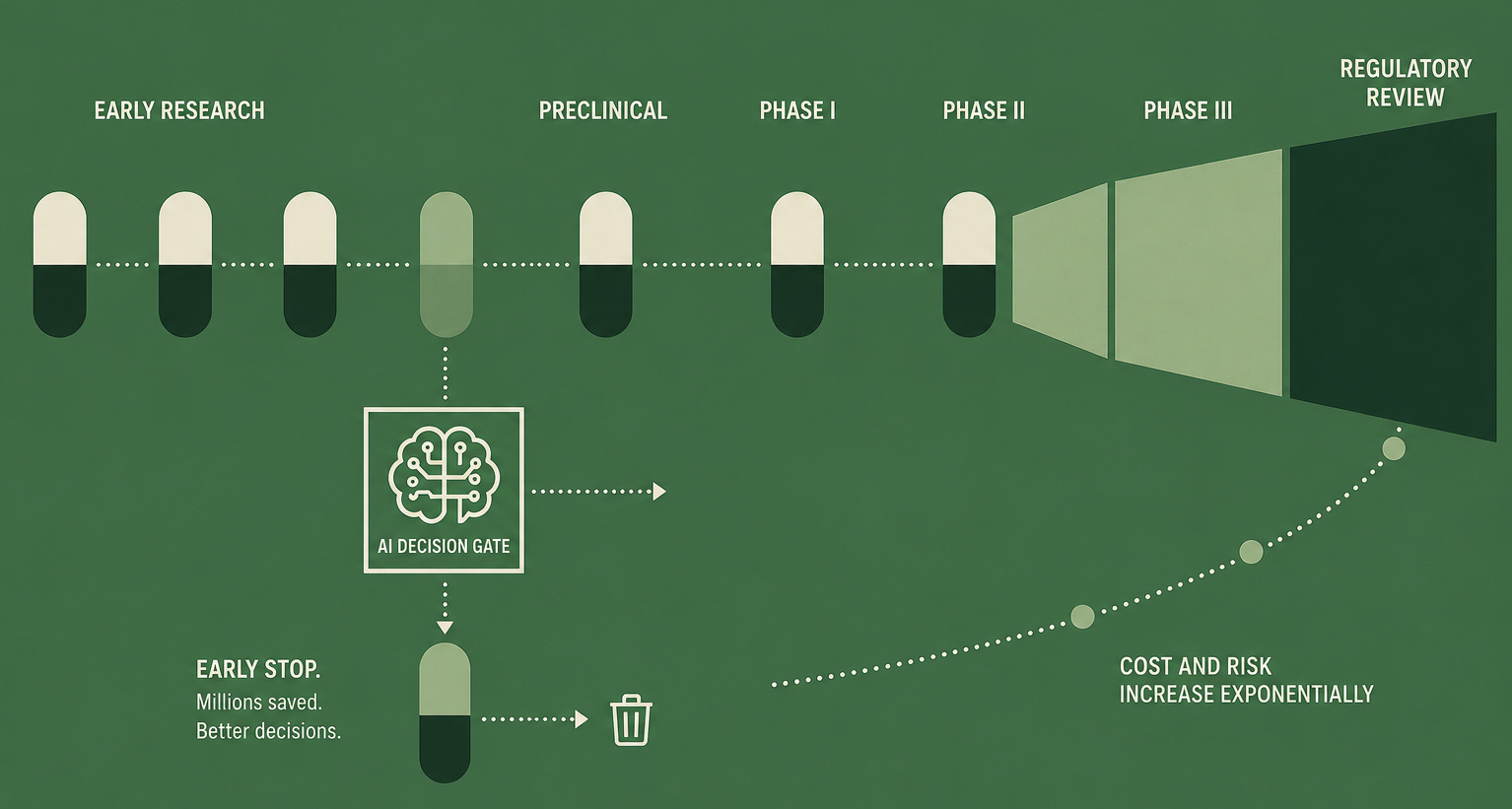
Stop! Yes, stop - This might be the most valuable prediction an AI system can make in drug discovery.
Yea, I know. The entire pharma industry story was written around creation and the AI narrative excites shareholders and hungry BD people looking for a golden goose laying new targets and designing molecules and drug candidates at previously unimaginable speed.
The imagery is invariably generative: more molecules, more targets, more shots on goal. Yet the economics of drug discovery suggest that one of AI’s most consequential applications could lie in precisely the opposite direction. The industry may need artificial intelligence less to tell it what to start than to tell it, earlier and with greater confidence, what to stop.
Drug development is an unusually expensive exercise in discovering that you were wrong. A molecule can look attractive computationally, survive preclinical testing, pass initial safety studies and the scientist’s wishful thinking and still fail when someone finally asks the expensive question that matters: does it meaningfully help patients?
Failure is so common that attrition turned from unfortunate exception to basic economic architecture. Billions of dollars are routinely invested in programs that never become approved medicines. This ocean of mass belief in success of random lottery tickets still attracts investors who are simply bad at math and still prefer to invest in gold over picks and shovels.
What’s curious is that the timing of failure is economically important. A drug that fails in a computer simulation is an inconvenience. One that fails after years of toxicology work, manufacturing investment and clinical development is a financial event. One that reaches a large Phase III program before revealing an efficacy problem can consume substantial capital, management attention and, less visibly, the time and participation of patients. The industry’s objective should therefore not simply be to reduce the number of failures. Biology makes that aspiration heroic. It should also be to move unavoidable failures as far to the left of the development timeline as possible.
This is where AI’s less glamorous opportunity begins. Imagine a system that combines preclinical results, pharmacokinetic data, biomarkers, human genetics, imaging, previous trials, disease biology and accumulating clinical observations to continuously revise the probability that an asset will ultimately demonstrate an acceptable benefit-risk profile. The output need not be a theatrical green or red light. It could instead make uncertainty more explicit: given everything currently known, this program has deteriorated from a 25% probability of technical success to 8%; obtaining another particular dataset could materially resolve the uncertainty; absent that evidence, committing hundreds of millions of dollars to the next phase has poor expected value. That is not automated drug discovery. It is automated skepticism, a commodity of which large organizations rarely suffer an excess.
The math is attractive because avoiding a bad investment can be valuable even without producing a single new medicine. Consider a deliberately simplified example. Suppose a company is contemplating a $300M late-stage program. If better prediction identifies ten genuinely doomed programs before that commitment, the gross avoided expenditure is $3B. The calculation becomes much less flattering if the model incorrectly kills one medicine that would have generated billions in value, which is precisely why claims that AI can simply become pharma’s automated executioner deserve suspicion. The relevant metric is not accuracy alone. It is the economic cost of false positives and false negatives, calibrated to the decision being made.
This distinction is particularly important in drug development because the data is dangerously unstable. Historical pharma datasets encode previous scientific assumptions, portfolio decisions, trial designs and commercial priorities. A discontinued asset did not necessarily fail because the molecule was bad. Companies terminate programs because competitors arrive, strategies change, patents weaken, financing disappears or another asset looks better. Conversely, a program that advanced was not necessarily scientifically superior. Training an algorithm on historical go/no-go decisions without carefully distinguishing these causes risks teaching a machine to imitate yesterday’s corporate judgment rather than improve tomorrow’s scientific judgment.
At the same time, the algorithm shouldn’t be expected to replace the experiment that actually resolves uncertainty. Clinical trials exist because predictions about human biology have an ugly habit of encountering humans. The more credible role for AI is therefore decision support: finding weak signals across datasets that humans cannot easily integrate, identifying inconsistencies between mechanistic hypotheses and emerging evidence, predicting toxicity or lack of efficacy, improving patient stratification, and showing decision-makers where their confidence is least justified. Regulators are already treating AI in drug development in similarly contextual terms. The FDA’s framework emphasizes a clearly defined context of use and risk-based assessment of model credibility rather than some universal certification that an algorithm is “good at drug development.”
There is also an organizational/management problem that may prove harder than the technical one. Pharmaceutical companies don’t generally lack committees capable of saying no. They lack committees that can say no at the right moment. Once an asset has accumulated a team, a budget, executive sponsorship and years of work, stopping it becomes more than a scientific decision. Careers, forecasts and narratives become attached to molecules. The phenomenon has familiar cousins in every capital-intensive industry: yesterday’s investment becomes today’s justification for tomorrow’s investment (we call it escalation of commitment in psychology). A sufficiently credible predictive system could therefore have value not merely because it sees biology differently, but because it changes the institutional politics of evidence.
This suggests that the most useful pharmaceutical AI systems may look less like molecule factories and more like unusually unforgiving investment committees. They would continuously ask whether the evidence supporting a program has strengthened enough to justify the next dollar. They would compare an asset with historical analogues, expose assumptions embedded in forecasts, quantify what new evidence would change the decision and force teams to explain why a deteriorating probability of success should still command scarce R&D capital. None of this requires surrendering judgment to an algorithm. It requires making judgment more disciplined.
The opportunity extends beyond outright termination. An AI system might conclude that a molecule is unlikely to work in the population originally selected but has a stronger mechanistic case in a biomarker-defined subgroup. It might recommend redesigning a trial, changing an endpoint or demanding another experiment before escalating expenditure. In this sense, “killing drugs earlier” is useful shorthand for a broader capability: allocating experimental capital according to evidence rather than momentum. Sometimes the correct decision will be death. Sometimes it will be a cheaper experiment. Occasionally it may rescue a program by revealing that the original development strategy, rather than the molecule, was the problem.
There is already evidence that AI is moving deeper into clinical development. The FDA says it has seen a substantial increase in drug submissions containing AI components, spanning nonclinical, clinical, post-marketing and manufacturing uses, and its current guidance architecture explicitly contemplates AI-generated information being used in regulatory decision-making. Recent work has also examined AI’s ability to improve the operational efficiency of clinical trials. None of this, however, proves the stronger proposition that algorithms can yet predict clinical failure with enough reliability to transform portfolio economics. That evidence will require prospective validation: models making predictions before outcomes are known, compared against expert decision-making, with both avoided expenditure and the opportunity cost of mistakenly terminated program measured over time.
Such evidence would also provide a better benchmark for the industry’s AI race. Counting AI-designed molecules entering pipelines is easy and photographable. Counting money not spent on trials that never happened is considerably less glamorous. Yet pharmaceutical productivity ultimately depends not on how many molecules an organization can generate, but on how intelligently it allocates scarce capital among them. An AI system that generates 100 additional plausible compounds could even make the industry’s economics worse if it merely supplies more candidates for expensive failure.
The deepest promise of AI in pharma may therefore be selection rather than abundance. Modern computational systems can produce hypotheses at astonishing speed, but experiments remain expensive, patients remain scarce and human biology remains stubborn. As the cost of generating possibilities falls, the value of deciding which possibilities deserve further investment should rise. The bottleneck moves from invention toward judgment.
Silicon Valley has trained us to associate artificial intelligence with making more things. Pharmaceutical companies may discover that its greater contribution is knowing which things never to make at all.
No posts
Comments
Nothing yet. Say the first thing.
Sign in to join the conversation.