
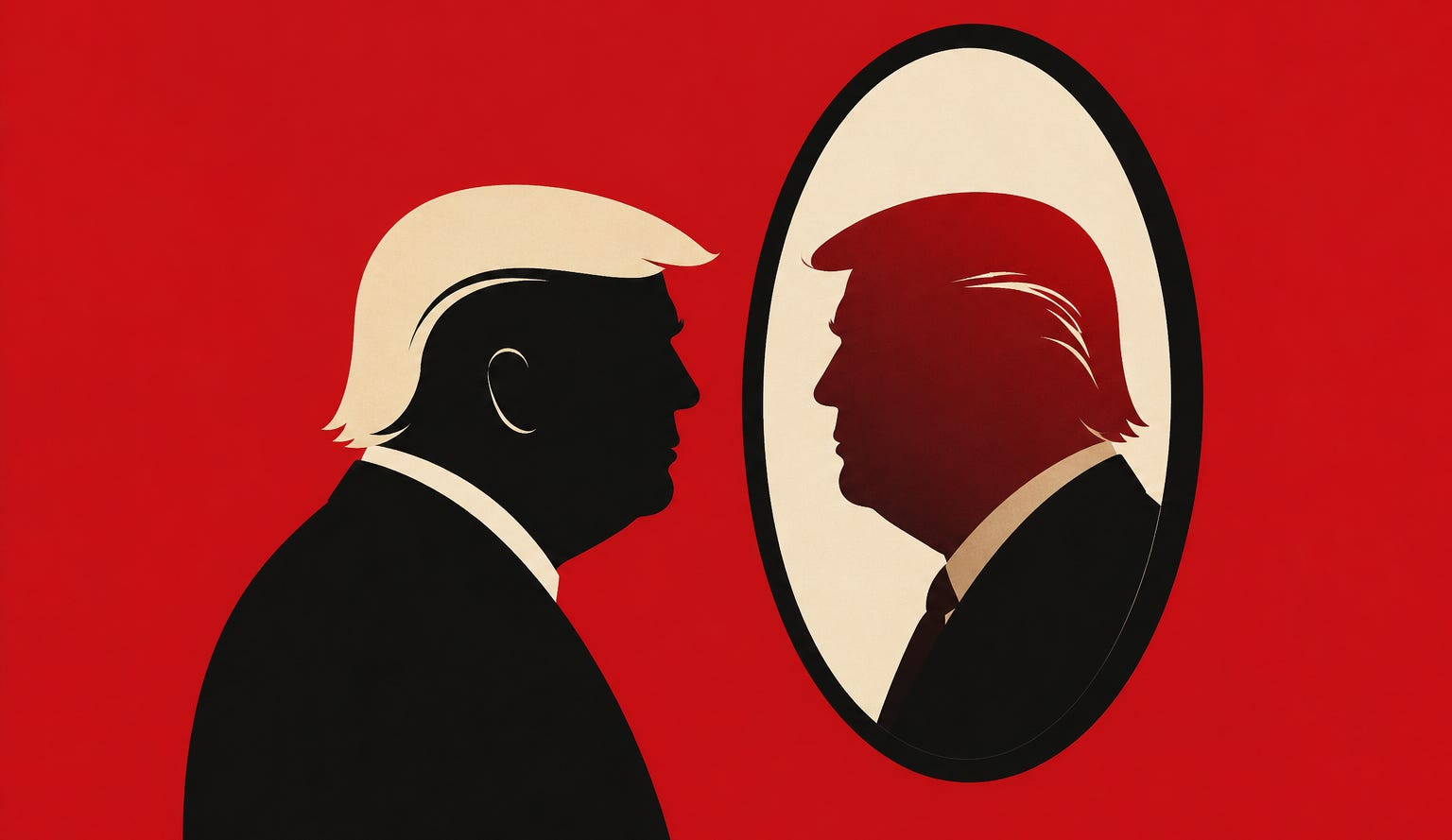
Donald Trump may be less psychologically interesting than the people who think they are nothing like him.
Love him or hate him. Whether you consider him erratic, genius, or both, he represents an interesting lesson in science. No, I am not wondering how chromosomes could have created something the entire world is scratching its head about, and I am not wondering about his policy or cutting NIH funding in the name of pseudoscience. I am wondering whether the rest of the population really looks that much different from him.
Trump’s statements about bombing Oman and Haitians eating dogs in Ohio may sound absurd, but they are not based on clinical insanity. To put it simply, they might just be a representation of a regular human brain and its propensity to simplify, apply bias, and act - a survival mechanism reinforced by years of evolution and an occasional dopamine rush. Whether this specific specimen with his collection of randomness is a good fit for presidency can be a separate topic for discussion, but the fact that millions of peopled voted for him demonstrates a bigger pattern - all humans simplify, apply bias, and act, and the difference between people may lie in the book of biases they managed to collect throughout their lives.
This is where we get to science. Of course everyone going through the PhD program learns about bias and eliminating it in research. But that’s where this bias elimination exercise often ends and people publish research that can’t be reproduced or takes us into the wrong rabbit hole. My recent discussion of a paper with a colleague is a case in point - a well-written paper with lots of data and claims of scientific breakthroughs, except it followed traditional human logic consisting of flaws, biases, and wishful thinking, with publishing being a higher incentive than revealing nature’s secrets. And it’s not flaws that I found curious, but my colleague’s reaction to my findings - yes, this type of logic is a state of scientific writing - it’s basically the norm. In other words, don’t expect papers to publish the truth. Focus on the signal instead - methods, observations, and interpretations. Simplify, apply bias, act. Get a Nobel prize and let someone else deal with reproducibility. Humans know they are biased and flawed, so they invented peer review, controls, statistics, and replication, which remarkably push our flaws towards progress.
This exercise reminded me of a biotech CEO who pitched us a few years ago. After she presented a deck with claims of taking over the world in a year, I asked her for data to demonstrate her claims, to which I got a Trump-like answer: “I have a PhD from Stanford. I know what I am doing.” Evidently, somewhere in the evolution cycle humans created a new type of bias: Stanford PhD = God level knowledge.
While we can wonder about true capabilities of this startup CEO or humans who wrote illogical papers, we should also ask ourselves a less comfortable question: Are we truly different?
Despite what we like to think, the simplification-survival mechanism of the brain likes to turn off critical thinking even in basic evaluation of facts. Thus, we take things for granted and spend very little energy evaluating statements and the environment around us, and even less time evaluating ourselves. This explains of course why we see Trump in others but not in our own bodies.
But then there is something beautiful about these flaws as well. We created common beliefs in god, money, music, and democracy. All are human inventions one can question and criticize, but somehow they created structure, although imperfect, that allows us to not kill each other (for the most part). Pure logic would have never created these things, as it would get stuck contemplating imperfections. Yet, our ability to simplify, apply bias, and act allowed us to walk the progress lane with a smile, so we agreed to live with a set of shared abstractions.
Humans built civilization by simplifying an impossibly complicated world enough to act within it. The same cognitive shortcut that makes action possible also makes error inevitable. Science is our most sophisticated attempt to correct for this defect, yet it is practiced by the same defective machinery. We are excellent at detecting the resulting biases in Trump, CEOs, colleagues and scientific papers. The experiment becomes much more uncomfortable when the subject is ourselves.
Maybe some day evolution will change us. But until then, simplify, apply bias, and act.
No posts
Comments
Nothing yet. Say the first thing.
Sign in to join the conversation.