
We are screwed, ladies and gentlemen. We are totally screwed. There is a new human-made disease going around, spreading faster than rabbits. No, not the disease you protect yourself from by wearing a mask on your chin, and not the one you ignore under the leadership of Robert F. Kennedy Jr. or by joining the French in proudly ignoring it because accepting it will violate your privacy. It’s a disease that affects everyone and it has no cure.
And technically it’s more than a disease. It’s an allergy.
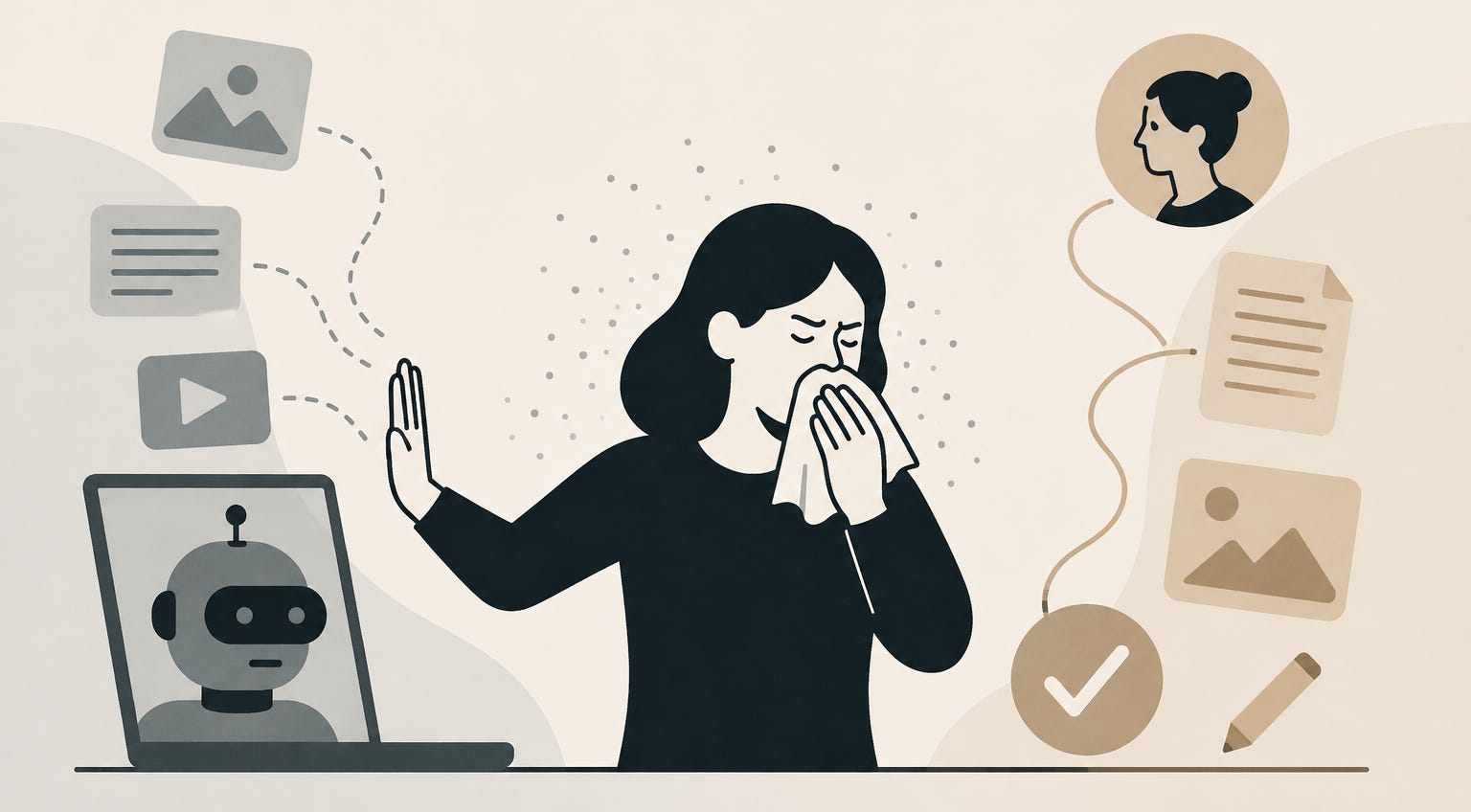
An allergy to artificial intelligence.
You’ve seen it. A suspiciously polished email. A photo with immaculate lighting and a perfect body that spells out wishful thinking. Words in LinkedIn posts that provoke an almost dermatological reaction. Text messages from your co-workers using em-dashes. Say “delve” to your friends and you will be accused of being a large language model.
Yes, a lot of it is probably true. Humans quickly adopt productivity tools and AI is a great example. But that’s not where the problem is. The problem is that this allergy to AI is changing human culture. All of a sudden we refuse to be ourselves. We choose our words differently, both written and verbal. We wonder if movie posters are AI generated and treat all written content with 10x the level of suspicion we had for Facebook posts advertising cancer healing with magnetized water or politicians claiming that higher billionaire taxes will solve every problem on earth.
There is nothing wrong with knowledge being transmitted if it’s written by AI. It’s still knowledge. We still learn. And it might arguably be better than human teachers, as AI has less bias than humans and it has no feelings if you throw a fit. Images and videos are equally entertaining and philosophical, whether they are designed by AI or humans. And a lonely old woman dying of cancer in the hospital shouldn’t push back against a cure if it was designed by AI.
Yet we push back. We make our lives harder. We ignore educational materials written by AI and choose human-bias-generated materials instead. A thoughtful scientific LinkedIn post with a call for action will be dominated by comments discussing a far more important subject, criticizing that the article was written by AI. School kids are asked to spend hours on manual research on .gov and .org websites instead of using ChatGPT, because of course the official White House statement that Tylenol causes autism is more authentic than an indexed library of scientific facts.
Yes, we are becoming allergic to AI, and some of my recent Substack posts provide a rather amusing case study. I spent more than two hours writing my last one, only to have Substack inform me, with impressive confidence, that it was 100% AI-generated. This presents writers with a peculiar problem: should I deliberately make my writing worse to establish my humanity? Introduce a few clumsy sentences, perhaps, or misspell something reassuringly difficult? Or should I simply stop sounding like myself because AI has learned to sound vaguely like me? Perhaps I am vaccinated against this disease, but I have decided on the less accommodating option: I am not changing anything. If the machine can’t tell the difference, maybe the machine is the thing that needs improving.
Perhaps that’s the strangest symptom of our new allergy. We are so determined not to be mistaken for machines that we are beginning to edit ourselves around them. We avoid certain words, distrust beautiful images, question polished writing and sprinkle imperfections into our work as little certificates of humanity. AI spent years learning how to sound like us. Now we are learning how not to sound like AI.
And that may be the punchline to this entire technological revolution. We were worried that artificial intelligence would become indistinguishable from humans. We spent considerably less time worrying about what humans would do once it did. Today we are ignoring the fact that AI learns every day, and our quickly-changing communication style will once again be matched by AI within a year, forcing us into this vicious circle of reinventing ourselves for the sake of sounding human.
So use “delve” if you want to. Write a suspiciously good sentence. Send an email with an em-dash. Make something beautiful enough to be accused of using a machine.
Being mistaken for AI may soon be one of the more peculiar compliments a human can receive. And perhaps that is the final irony (em-dash) we built machines to imitate humans, only to discover that humans would start imitating themselves less.
No posts
Comments
Nothing yet. Say the first thing.
Sign in to join the conversation.