
One of the most honest photographs I made took under 10 seconds to make, and I nearly did not make it at all.
I was walking back from a shoot that had failed, my head already home with dinner and rest. On the walk back, surrounded by dark landscape, I kept my head up. A ridgeline rose behind me, a single figure moving along it, the last of the light lying low across the grass. I lifted the camera, made one frame, maybe two, and kept walking. I had forgotten it before I reached the road.
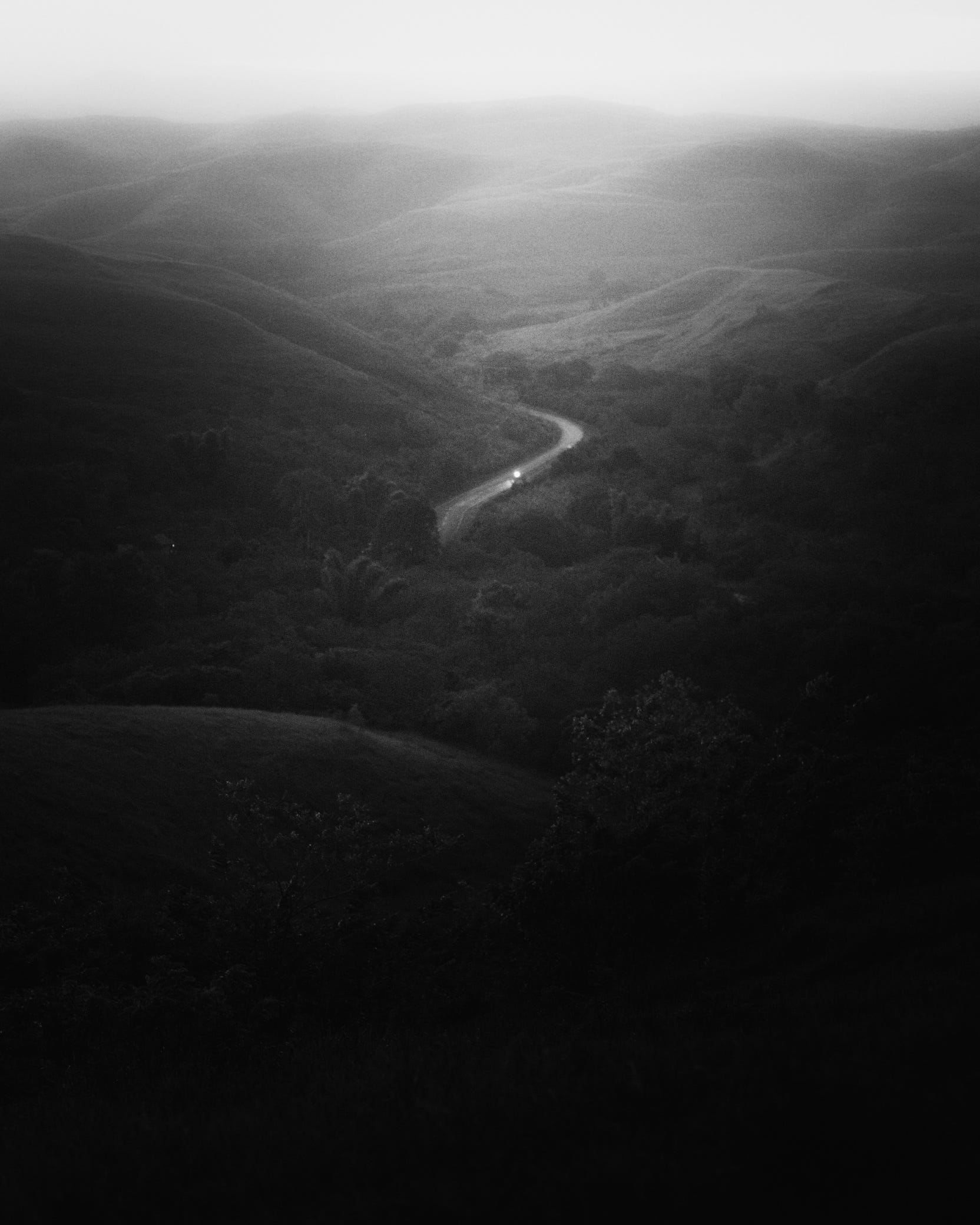
Everything I shot that day on purpose has sunk into the archive without a ripple, while the accident has outlived all of it. Stranger still is the gap it left behind, because I remember the moment completely and the making of it barely at all, as though something arrived in that turning which I have never quite been able to take credit for. The photograph where I was all attention and no author, where I got out of my own way, is the one that sounds most like me. But this seems to undo nearly everything we are told about finding a voice.
We are taught to hold a voice the way a person holds a deed: as property, something to build and defend and stamp onto every frame in case it might be stolen. From our first serious day with a camera, the industry hands us a job description that reads have a point of view, develop a signature, be recognisable within 3 frames. So we grip. We chase a look until every frame is watermarked with us, and somewhere inside the gripping a quiet dishonesty creeps in, because the photograph slowly stops being about the thing in front of the lens and starts being about our taste, our talent, our claim to be worth watching. There are whole seasons in my archive straining to be ‘Matt Jacob’ photographs, and you can still feel the strain in them. They are competent, consistent, on brand, but mute.
Cristina Mittermeier gave me the word for what goes wrong in pictures like that. Before she became one of the most seen photographers alive, she was a young marine biologist in Mexico City, translating the captions of a colleague’s conservation book. At the launch she watched the room walk straight past her careful science and gather at the photographs, asking human, almost childlike questions: “Were you scared? Was it cold?” Her words had been a wall people feared to climb, while the pictures were a door they walked through without noticing, and she carried a biologist’s lesson out of that room. The photographer, she told me, is not a messenger shouting in the square but a membrane, a semi-permeable skin like the wall of a living cell, whose whole purpose is to let a conversation pass between the thing in front of the lens and the stranger who will one day stand before the print. You are not the message. You are the place where the subject and that stranger finally meet, and your work, mostly, is to keep the glass clean enough that they can.
What clogs the glass is ego. Not conviction, but the small hungry kind that wants the viewer to admire how clever we are. When a photograph is about its author, the author is as far as anyone travels, and the conversation dies politely at our feet. If your voice feels fragmented, shifting shape depending on who is looking, it may not be because there is too little of you in the work. It may be because there is too much of the wrong kind.
There is a contradiction folded in here, and it deserves daylight, because the same Cristina who asks a photographer to dissolve also insists that we become champions and ambassadors, people who insert themselves and drag their cause in front of anyone with the power to act. Vanish, or show up? The answer, I have come to think, is a division of labour rather than a contradiction. Inside the frame, you disappear, subtracting the vanity so the subject can speak in its own voice. Outside the frame, where the work must travel and find the eyes that matter, you arrive as loudly as the work demands, sequencing it, fighting for it, refusing to let it die quietly in a drive or a sleeve. The self you subtract and the self you add are not the same creature. One wants to be admired, and the other has simply decided that something matters enough to fight for.
This is also why the membrane is no soft idea, no license to have nothing to say. A membrane is selective - it lets some things pass and turns others away, and that selection, what you cannot help caring about, what you refuse, what you keep letting through, is your voice. It is your point of view, and it is harder won than a style, because a style can be copied by anyone with your preset pack, while your permeability belongs to you the way your walk belongs to you, impossible to counterfeit. Excavating it is slow, private labour, the labour most photographers never sit down to do, which is why so many technically flawless portfolios stay strangely silent. That excavation is most of what I now do with photographers inside MOOD Insiders, because a voice cannot be installed like a preset. I believe it has to be drawn up slowly, like water from a deep and half-forgotten well.
So maybe, return, at last, to your own archive, because somewhere in it I would bet there is a frame you cannot fully explain. The moment is probably vivid, the making a blur, a gap in the memory right where your decisions should be. That gap is not a flaw in your attention, but is the clearest recording you own of what passes through you when the grip lets go. We grip, in the end, out of fear, the 2am suspicion that if we stopped forcing the work into existence there would be nothing underneath. But nothing about that frame was forced, and it may be the most honest thing you have ever made.
So, go and make one photograph where your only job is to get out of the way. Choose a subject you genuinely care about, because the membrane still needs something worth letting through, and then try, honestly try, to vanish: no style, no signature, no imagined audience grading you from the back of your mind. Afterwards, sit with the frame and ask it a single question. Not whether it is good, but what passed through. You may find, as I keep finding, that the frame with the least of you in it carries the most of you, and that the voice you have been gripping for was never a possession at all, only the shape of what you let through.
Show up. Then get out of the way.
Happy shooting,
x
Rather watch or listen? The full Moments of Mood episode is below.
Comments
Nothing yet. Say the first thing.
Sign in to join the conversation.