
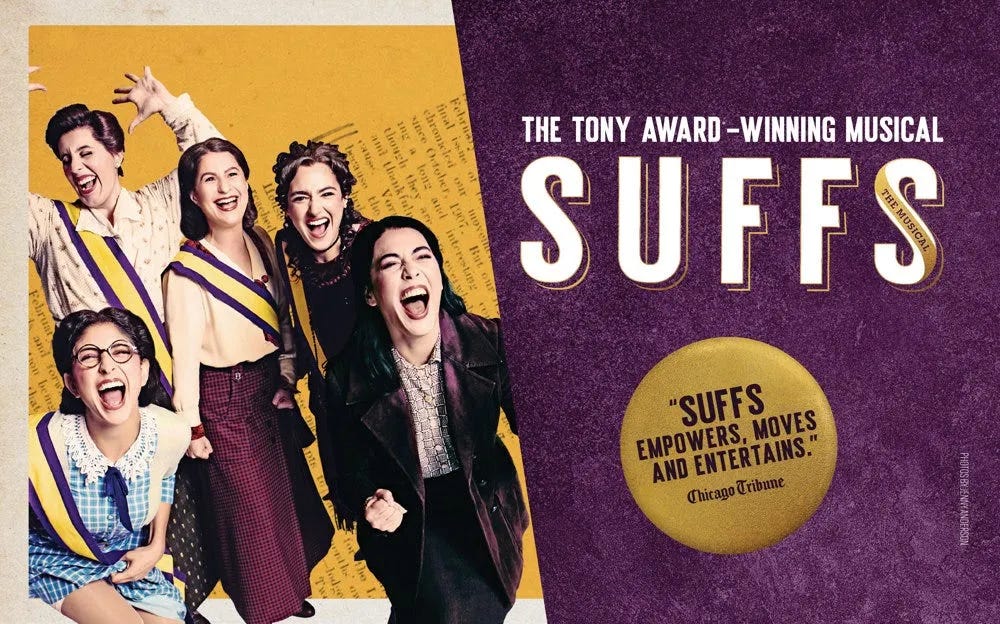
Last week, I had the opportunity to see Suffs during its closing week. I had heard the music, understood the basic story, and knew I was walking into a musical about the women’s suffrage movement, but I was not prepared for how much it would stick with me after I left the theater. Suffs follows the women who spent years fighting for the passage of the 19th Amendment, focusing largely on Alice Paul and the generation of suffragists who pushed the movement into a more confrontational era. It would be very easy for a musical about women’s suffrage to become a two-and-a-half-hour history lesson where we already know the ending. Instead, Suffs is messy. People disagree, movements fracture, activists make mistakes, and people fighting for equality sometimes fail to offer that same equality to others. Most importantly, the victory at the end doesn’t really feel like an ending.
Maybe seeing it during closing week made that hit harder. I was watching a company tell this story one of its final times, knowing that in a few days this particular production would be gone. Yet the message of the show is almost the exact opposite: the work doesn’t disappear when one chapter ends. People leave movements, leaders die, laws get passed, and eventually history books condense decades of fighting into a few paragraphs. Then another generation inherits whatever was left unfinished. Walking out of Suffs, that was what I couldn’t stop thinking about. We spend so much time celebrating the people who changed history that we sometimes forget they were never able to finish the job.
The fight for women’s suffrage in the United States lasted generations. The 1848 Seneca Falls Convention is commonly recognized as a major beginning of the organized women’s rights movement, but the constitutional amendment guaranteeing that voting rights could not be denied on the basis of sex would not be ratified until August 18, 1920. The amendment itself had first been introduced in Congress in 1878. That means 42 years passed between its introduction and ratification, while more than seven decades separated Seneca Falls and the eventual constitutional victory. During those years, suffragists organized, petitioned, marched, lobbied lawmakers, challenged voting restrictions, picketed and practiced civil disobedience. Some of the women who helped begin the movement never lived to see the victory they had spent their lives fighting for.
Suffs focuses on the later years of this movement, when Alice Paul and other younger suffragists became frustrated with the strategy of established leaders such as Carrie Chapman Catt. That conflict is one of my favorite parts of the show because it destroys the clean version of history we are usually taught. These women agreed that women deserved the vote, but they did not always agree on how to get there. Some activists pursued state-by-state victories while others demanded a federal constitutional amendment. Others embraced tactics such as picketing and public demonstrations. The movement wasn’t one perfectly united group of women heroically walking toward an inevitable victory. It was people arguing over how quickly change needed to happen and how much they were willing to risk to achieve it.
And the movement itself was deeply imperfect. Ida B. Wells, the Black journalist, anti-lynching activist, and suffragist portrayed in Suffs, experienced that firsthand. At the massive Woman Suffrage Procession in Washington on March 3, 1913, organizers faced pressure from white Southern suffragists who opposed marching alongside Black women. Black participants were encouraged to march at the back. Wells refused. She waited along the route until the Illinois delegation approached and stepped into the procession with them. The movement demanding equality for women was simultaneously struggling with racism inside its own ranks. That contradiction is uncomfortable, but it matters. Progress does not become worthless because the people creating it were imperfect. It means the next generation has a responsibility to take what they accomplished and push further.
On August 18, 1920, Tennessee became the 36th state to ratify the 19th Amendment, providing the three-fourths of states required to add it to the Constitution. The amendment was certified eight days later, on August 26. That was an extraordinary victory, but even that did not finish the fight. The National Archives itself notes that ratification did not result in full enfranchisement. Black women and other minority women continued facing discriminatory state laws and practices that prevented them from exercising the right supposedly guaranteed to them. It would take another 45 years before the Voting Rights Act of 1965 created major federal protections against racial discrimination in voting.
That may be the most important lesson Suffs has for us today. We love endings. We like being able to point at a law, an election or a Supreme Court decision and declare that an issue has finally been solved. History almost never works like that. A victory is not the same thing as permanent victory. A right written into law still has to be protected, expanded and made accessible to the people it supposedly serves. The suffragists of 1920 moved the country forward tremendously, but people in 1965 still had to keep marching. And now, more than a century after the 19th Amendment, we still do.
As of May 1, 2026, the Brennan Center for Justice reported that lawmakers in at least 41 states had considered at least 302 bills containing restrictive voting provisions this year. At least nine states had already enacted 12 restrictive voting laws, nine of which are scheduled to be in effect for the 2026 midterm elections. Between January 2025 and April 2026, states enacted 44 restrictive voting laws, already surpassing the previous two-year federal election-cycle high of 43 set in 2021 and 2022. At the same time, other states continue passing laws that expand voting access. The fight is moving in both directions, because history does not automatically move toward progress. People move it.
Voting rights are far from the only place where this lesson applies. LGBTQ+ rights, racial equality, reproductive freedom, access to education and countless other issues have been shaped by generations of people who fought before us. It can be tempting to look at their victories and assume the hardest work has already been done. It can also be tempting, especially right now, to look at the sheer number of fights happening at once and decide that nothing we do will make much of a difference. I understand that exhaustion. There are days when another headline, another bill or another political argument feels less like a call to action and more like background noise. But the suffragists spent decades losing before they won.
That is what I took away from Suffs. Alice Paul didn’t invent the fight for women’s equality, and the ratification of the 19th Amendment didn’t complete it. One generation pushed the country forward far enough for another generation to push it further. Sometimes they disagreed. Sometimes they failed spectacularly. Sometimes the movements themselves excluded the very people they claimed to fight for. But enough people kept going that something once considered radical became part of the United States Constitution.
I don’t know what parts of today’s fights will end up in history books a hundred years from now. I don’t know which protest, court case, election, school board meeting or seemingly insignificant conversation will turn out to have mattered. The suffragists didn’t know either. They simply knew that the world they lived in wasn’t good enough, and somebody had to be stubborn enough to change it.
So be stubborn. Vote. Speak at the meeting. Call your representative. Support the organization doing the work. Defend someone who is being pushed aside, even when they aren’t exactly like you. Celebrate victories when they come, because people fought incredibly hard to achieve them. Then recognize that almost every victory leaves something unfinished.
When the curtain came down on Suffs, I expected to leave thinking about how much the women on that stage had accomplished. Instead, I left thinking about how much they didn’t get the chance to accomplish.
William Sampson is a Junior at Timber Creek High School. He is active in his theater department, acting in numerous productions such as White Christmas, Kodachrome, The Laramie Project, and the Beaux’s Strategem. He is also an active member in Scouting America, and co-owns a non-profit theater company called Scratch Theater Co, working towards enriching theater education for youth in the DFW area.
No posts
Comments
Nothing yet. Say the first thing.
Sign in to join the conversation.