
Welcome back to Queering the Map! The series where I tell you LGBTQ+ friendly cities and the places within to celebrate your identity. Today we’re talking about Cincinnati, Ohio. It’s a U.S. city you may not immediately think of as LGBTQ+ friendly, but it truly is, especially given that it’s located in a red state. We just want to make people more familiar with places where they can feel accepted and included. Cincinnati is easily one of the Midwest’s best-kept secrets when it comes to vibrant, deeply rooted queer culture. While Ohio’s state politics can skew conservative, the Queen City itself functions as a progressive haven with strong municipal protections, dedicated funding for transgender youth resources, and a long legacy of queer activism dating all the way back to its very first march in 1973.
What makes Cincinnati’s story so powerful is that its transformation into an LGBTQ+ haven didn’t happen by accident; it had to actively fight to dismantle some of the most anti-gay laws in the nation to get where it is today. Back in 1993, Cincinnati voters passed Article XII, a city charter amendment that explicitly prohibited the city from passing any non-discrimination laws to protect gay, lesbian, or bisexual individuals. That effectively made Cincinnati the only city in the United States where it was constitutionally illegal to protect queer people from being fired or evicted based on their identity. But over the next decade, local activists, grassroots organizations like the Equality Foundation of Greater Cincinnati, and progressive leaders fought back. In 2004, voters successfully repealed Article XII, launching a multi-decade legislative push that turned Cincinnati into a benchmark for municipal LGBTQ+ protections.
Today, Cincinnati scores a perfect 100 out of 100 on the Human Rights Campaign’s Municipal Equality Index. Because Ohio lacks a comprehensive statewide non-discrimination law protecting sexual orientation and gender identity in housing or public accommodations, local municipal laws are absolutely crucial. Under Chapter 914 of the Municipal Code, Cincinnati’s municipal law strictly bans discrimination in employment, housing, and public accommodations based on sexual orientation and gender or transgender status. And these aren’t just symbolic laws without teeth. Cincinnati maintains an active process through its City Manager and Office of Human Relations to investigate and penalize local businesses or landlords violating non-discrimination policies.
Cincinnati has consistently been ahead of the curve. In 2015, the city made history by becoming the first city in the entire United States to enact a municipal ban on conversion therapy for minors. The ordinance imposes civil fines on any licensed mental health professional attempting to subject youth to the harmful practice, setting a precedent that dozens of other American cities eventually followed. The city also uses its power as an employer to model inclusive corporate policy, providing comprehensive health insurance coverage to city employees that explicitly includes gender-affirmation treatments, surgeries, and therapy. They even established equal healthcare and domestic partner benefits for municipal workers long before same-sex marriage was legally recognized nationwide.
Even as the Ohio General Assembly passed restrictive state-level legislation targeting transgender healthcare, Cincinnati’s local leadership has taken explicit policy steps to shield its residents. Local leadership and the City Council have moved through administrative orders to prevent city resources or law enforcement from being used to monitor, enforce, or penalize individuals seeking or providing gender-affirming healthcare within city limits. On top of that, the city allocated municipal funding explicitly earmarked for LGBTQ+ youth services, including mental health care, suicide prevention, and housing support for unhoused queer youth.
Cincinnati is actually embedded in the legal history of marriage equality in the United States. Jim Obergefell, the lead plaintiff in the landmark 2015 U.S. Supreme Court case Obergefell v. Hodges that legalized same-sex marriage nationwide, was a Cincinnati resident. His historic suit began in the U.S. District Court in Downtown Cincinnati right on 5th Street in the heart of the city, when he sued the state of Ohio to be legally recognized as the surviving spouse on his late husband John Arthur’s death certificate. That commitment to inclusion shows up in the city’s infrastructure today, where Cincinnati mandates single-occupancy, non-gendered facilities in city buildings and encourages gender-inclusive signage in commercial builds. The Cincinnati Police Department even maintains a designated LGBTQ+ Community Liaison officer to handle hate crime reporting, community outreach, and safety coordination during major events like Pride and the Cincy Fringe Festival.
When you visit, you’ll find the city’s queer scene thriving across distinct, welcoming neighborhoods — primarily Northside, which serves as the historical epicenter of Cincinnati’s counterculture and queer life, and Over-the-Rhine, or OTR, a historic urban neighborhood full of nightlife and boutique shops.
If you’re heading out for the night, Good Judy’s in Northside is a staple dive bar that celebrates queer culture with an unpretentious, inclusive atmosphere. They offer a wide selection of craft cocktails, mocktails, and beer options, and host regular themed dance parties, drag performances, and community mixers in a cozy indoor setting with a welcoming, local-focused community vibe. Just down the road in Northside is Tillie’s Lounge, a plush, turn-of-the-century themed cocktail lounge named after the 19th-century circus performer Tillie Boggs. It features ornate decor, velvet seating, and a spacious outdoor patio, serving up handcrafted cocktails and a curated wine list while regularly featuring drag shows, cabaret performances, and lively patio events.
Over in the heart of Over-the-Rhine, Bloom OTR brings a high-energy, inclusive venue with a high-volume nightclub atmosphere featuring a dance floor and state-of-the-art lighting. They host weekly drag performances with regional and national drag talent, alongside popular weekend drag brunches and theme nights. If karaoke is more your vibe, Tokyo Kitty is a futuristic, Japanese-style karaoke lounge in Downtown Cincinnati that is a favorite gathering spot for the local queer community. You can grab a private, neon-lit karaoke room or hang out in the vibrant main bar area, and they even have robotic drink delivery via ceiling-mounted robot arms in their private suites. They also frequently partner with local LGBTQ+ organizers for special events and watch parties.
For daytime eats and coffee, Northside is home to Morsel & Nosh, a neighborhood deli and specialty grocery shop offering artisanal cheeses, cured meats, deli sandwiches, and prepared foods. They feature extensive vegetarian and vegan-friendly options and are known for sourcing local products and supporting queer-owned regional vendors. Over in OTR, Findlay Market is Ohio’s oldest continuously operated public market and serves as a major community hub. It is home to dozens of LGBTQ+-owned food stalls, bakeries, and artisan vendors, hosting seasonal “Prideful Plates” culinary events and acting as a central gathering point for local foodies, stree performers, and neighbors.
If you want to do some shopping, Casablanca Vintage has been a staple in Northside for decades, offering an extensive selection of vintage fashion featuring clothing, shoes, and accessories spanning from the 1920s to the 1990s. Its gender-inclusive layout and styling attract local drag performers and fashion enthusiasts, and it is staffed by knowledgeable locals deeply connected to the Northside arts scene. For enjoying the outdoors, Washington Park is a civic park located directly in Over-the-Rhine that serves as the central gathering space for urban neighborhood events. Located right across from the historic Cincinnati Music Hall, creating a scenic backdrop, it features a massive lawn, interactive water fountains, a dog park, and a covered porch bar. The park hosts outdoor film screenings, artisan markets, and Pride Month community events.
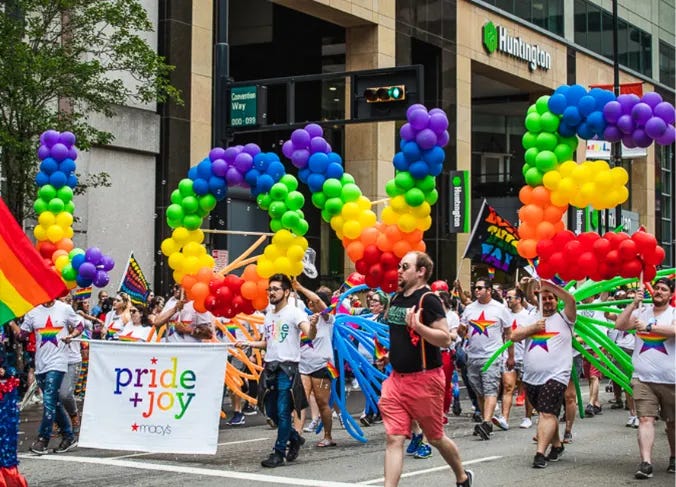
And Cincinnati definitely knows how to throw an event. The annual Cincinnati Pride Parade & Festival in late June draws nearly 300,000 attendees, stepping off in downtown Cincinnati and marching down Vine Street toward Sawyer Point along the riverfront for an all-day festival. Cincinnati Black Pride organizes events year-round, including an annual LGBTQ+ film festival, the Vizazi Torch Awards, and a community health fair, highlighting the intersections of Black and queer identity in the region. And every May and June, the Cincy Fringe Festival hosts two-week performing arts festival that highlights experimental theatre, drag, and LGBTQ+ artists across multiple venues in Over-the-Rhine.
If you’re plotting your next trip or looking for a welcoming Midwest city to explore, definitely don’t sleep on Cincinnati.
Daniel Simpson, born and raised in New Jersey, studies Business and Theatre at the University of Michigan (Go Blue!). He is the Media Coordinator for the Be A Friend Project, an international nonprofit focused on Bullying Prevention and Kindness Activism. When not working or studying, you can find Daniel performing, cooking, staying active, or going on an adventure with family or friends.
No posts
Comments
Nothing yet. Say the first thing.
Sign in to join the conversation.