
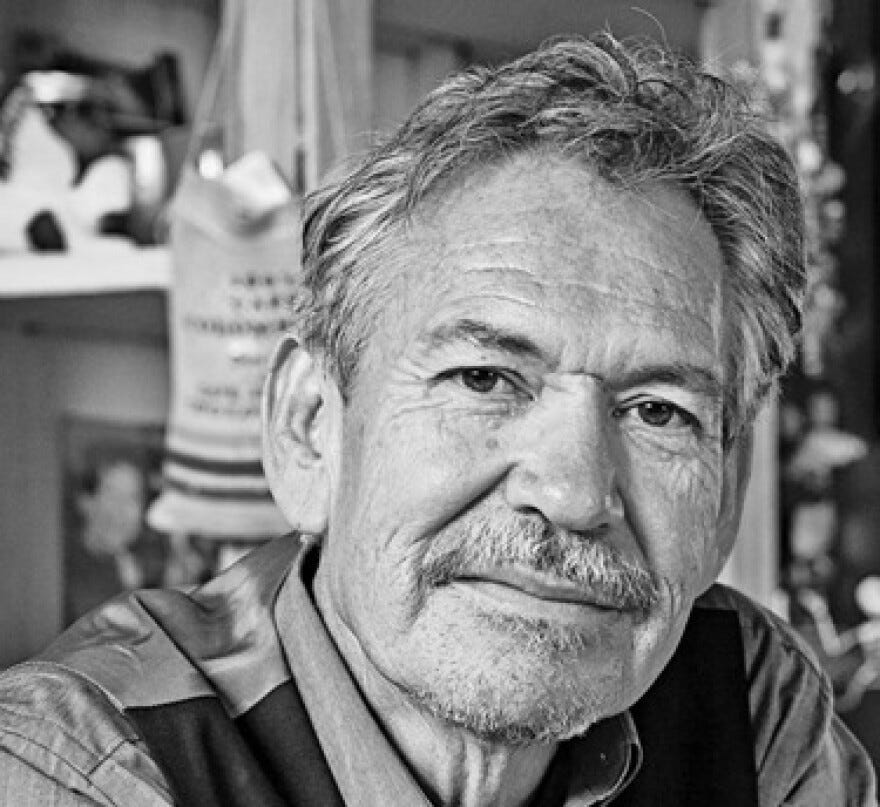
I didn’t know that Benjamin Alire Sáenz had died until several days after the fact. The circumstances of this finding-out were perfectly unexceptional, and that in itself distressed me — the unpleasant reminder that grief and loss might worm their way into any moment, any ordinary crack of life. You’re going along, scrolling through Tumblr (of all the wretchedly mundane things), and then — bam! — the post that breaks the news, assailing your retinas without warning. There’s a split, now: a world with Benjamin Alire Sáenz, and a world without him. And the latter seems just a little bit darker than before.
Part of the dissonance, I think, was my persistent yet entirely mistaken assumption that Sáenz had been a much younger man. Because when I first discovered his work, I happened to be a very young queer person myself, and I also happened to live in a place without many other queer people at all. And when you’re a very young queer person that lives in a place without many other queer people at all, it’s difficult to conceptualize a world outside of that existence. Life was a narrowing tunnel that would eventually collapse and rain rubble down upon me, and I simply couldn’t imagine anything beyond that bitter, claustrophobic end.
So it never occurred to me, when I first discovered his work, that Benjamin Alire Sáenz was a gay man already well into his 50s. Even more inconceivable was the fact that Sáenz hadn’t come out as gay until just then, despite years of seminary school and priesthood and even a marriage. Half of his life was already lost to him; irretrievable. Someone else — some other part of his own psyche, maybe — might’ve argued what good it would do to gamble with the rest of it, uncertain of what he might win, all-too-aware of what he could lose.
After he came out, Sáenz published what would become his most famous work: Aristotle and Dante Discover the Secrets of the Universe. It was also the first book of his that I ever read. I struggle to recall, now, how it fell into my hands — whether it was a loan from my sister or simply an auspicious purchase of my own. But what I do remember is reading it: sitting on the floor with my knees pulled up, my back against the bed, my room strewn with the deep blue shadows of a summer evening. I remember that I had been seeking refuge from the rest of the house, the pervasive atmosphere of perpetual conflict so intense that it almost felt tangible, the nature of which was always some nebulous combination of closeted queerness, mismanaged mental illness, and emotional absence. I remember that I was young, either 10 or 11, and that I had never before read a book with gay characters in it. I remember that I cried at the end.
I’d cried over books before, but this was different — these horrible, shuddering sobs like my heart was breaking. It wasn’t a sad ending. By all accounts, in fact, the conclusion of Aristotle and Dante Discover the Secrets of the Universe is actually quite joyful. But I don’t think I was crying because of what had been written on the page. I was crying because my heart was breaking — for a life that I would never live, a happiness that would never belong to me, a love that I thought I would never feel. There was so much love in that book, such clumsy, messy love that hurt because of its presence, not its absence. I ached for it and hated it and felt sick with it all at once.
Since its publication, Sáenz always maintained that the writing of Aristotle and Dante helped him come to terms with his sexuality. I cannot say for myself whether my reading it wasthe sole inciting factor in what would become a decades-long struggle throughout my own life, but I do look back on that first encounter now as a pivotal moment in the creation of my current self. In other words, I would not be who I am today without Sáenz’s work. I wish desperately that I had been able to meet him, and I think I will always mourn the fact that — in this world, at least — I never will.
Two days after his death, Shannon Maughan of Publishers Weekly wrote an incredibly moving and acutely heartwrenching obituary in honor of Benjamin Alire Sáenz. I recommend reading it — with tissues on hand — as it lovingly crafts a far more comprehensive mosaic of his life, accomplishments, and impact not just in the queer community, but for Latinx artists and authors as well, especially those living on the Mexico-U.S. border. One quote in particular stood out to me because it mentioned how, over the years, adolescents and adults alike would message Sáenz and tell him how much Aristotle and Dante had impacted their lives — and in some cases, saved them. So if I had met Benjamin Alire Sáenz, this is what I would say:
Mr. Sáenz, I am one of the many who has felt saved by your work. When I read Aristotle and Dante Discover the Secrets of the Universe for the first time, all I wanted was for someone to love me the way that Aristotle loved Dante. But the funny thing is, if I had been honest with myself, I really was more like Ari. My body was a foreign terrain that I didn’t know how to navigate, and I always struggled with this sense of heaviness, like I was trapped inside my own head more than most people. I didn’t know how to love myself, but I had a lot of love to give. So I thought it would be easier to just love other people instead.
A lot of the things I learned from Aristotle and Dante, I think I only really learned in retrospect. But I also don’t think that stops those lessons from being valuable. The impact of your work on me has compounded with every year that passes by, as I continue to discover new things about myself, my body, my identity, and who I choose to love. Because so much of it stems from a book that I read over a decade ago, alone in my room, sick with longing for a person I thought I could never be and a life I thought I could never live. I’m happy to say I’ve proven that version of myself wrong a hundred times over.
Benjamin Alire Sáenz, the world will miss you so very, very much.
Elliott Robinson is a queer author, journalist, poet, and teacher located in central Indiana. He received a B.A. in English from Butler University, which is where he first encountered Matthew’s Place, and his work has been published in the Butler Collegian as well as in several editions of Manuscripts Literary Magazine. Elliott is extremely passionate about LGBTQ+ advocacy and volunteer work, and he strives to use his talents as a writer and educator for the betterment of his community.
No posts
Comments
Nothing yet. Say the first thing.
Sign in to join the conversation.